
 Home
Home- Investment Guide: Strategies for Stocks, Forex, and Metals
- The 2% Rule: Risk Management and Position Sizing
The 2% Rule: Risk Management and Position Sizing for Beginners
In practice, what separates successful traders isn't entry technique — it's risk-control discipline. Many beginners lose not because their strategies are bad, but because a single loss is so large that capital can't recover.
Against that backdrop, the "2% rule" has become a core principle for many traders. By capping the maximum loss on any single trade, it extends the capital's survival horizon in the market and builds a steady trading rhythm.
1. What Is the 2% Rule? Core Concept
The 2% Rule states that the maximum loss on any single trade should not exceed 2% of total account capital. It is a fundamental principle used to control single-trade risk.
For example, with a $10,000 account, each trade should risk no more than $200. When the loss reaches that threshold, the stop is executed to prevent further damage.
A common question is: why not 5% or 10%? The reason lies in the mathematics of "risk of ruin." At 10% per trade, five losing trades in a row cut your capital in half, and going from $5,000 back to $10,000 requires a 100% return. With strict 2% adherence, five losses only draw the account down about 10% — the effort and psychological burden to recover are far smaller.
2. How to Apply the 2% Rule: Step-by-Step
When translating the rule into trades, don't start from "how much to make" — work backwards from risk to position size in four steps.
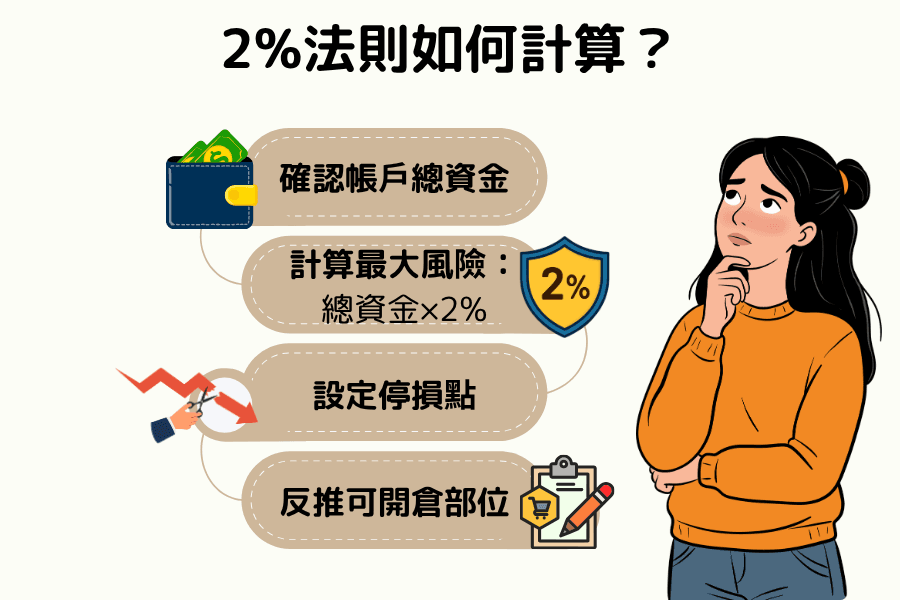
Step 1: Confirm Total Account Equity
First determine your account equity, the total foundation available for trading. For example: $10,000.
Step 2: Calculate Maximum Acceptable Loss
Multiply total equity by 2% to define the "lifeline" for a single trade.
Formula: $10,000 × 2% = $200 (the maximum you can lose on this trade).
Step 3: Set the Stop Loss
Before entering, decide your stop level based on technical analysis (such as support). Then calculate the pip distance between entry and stop.
- Example: Buy EUR/USD, entry 1.1000, stop at 1.0950.
- Pip distance: 1.1000 − 1.0950 = 0.0050 = 50 pips.
Step 4: Reverse-Engineer the Position Size
This is the crucial step. Divide the "max loss" by "stop distance" to find the allowable value per pip.
- Logic: Value per pip = Max loss ÷ Stop distance
- Example: $200 ÷ 50 pips = $4/pip.
Once you know "each pip can cost $4," align that with the instrument's contract specs. In forex, one standard lot typically equals about $10/pip, so $4/pip translates to a 0.4 lot position.
Practical: Full Worked Example
Assume a $10,000 account. By the 2% Rule, max single-trade risk is $200. Gold (XAU/USD) is near $2,000 and you set a stop at $1,990 (a $10 difference, or 100 pips):
- ①. Max loss: $200.
- ②. Stop distance: 100 pips.
- ③. Value per pip: 200 ÷ 100 = $2/pip.
- ④. Final position: In gold, 0.1 lots is roughly $1/pip, so the trade should be 0.2 lots.
With this reverse calculation, even if the stop is hit, the loss is precisely $200 — never more.
3. Why the 2% Rule Matters: Three Advantages
The value of the 2% rule is to stabilize trading and reduce the impact of any single mistake.
Advantage 1: Prevent a Single Trade From Crippling the Account
It's a seatbelt — making sure that a single wrong read doesn't knock you out of the market. Even during extreme moves, the account still has ample firepower.
Advantage 2: Survive Losing Streaks
In trading, consecutive losses are a statistical inevitability. With the 2% rule, even after a streak the account retains around 80% of capital. That resilience is the foundation of a long-term upward equity curve.
Advantage 3: Build Stable Trading Discipline
When risk is quantified and capped, emotional swings fall significantly. One or two losses no longer trigger panic or revenge trading, and the trader can calmly execute the pre-set strategy.
4. Applying the 2% Rule in Forex and CFD Trading
In forex and CFDs, leverage amplifies risk, which is exactly why disciplined risk control matters more.
In forex, higher-volatility pairs such as GBP/JPY, or commodity CFDs like oil, can swing widely. Without sizing properly, single-trade risk can easily exceed 2%. Accurate stop distance and lot calculation are needed to keep risk within the safe band.
Especially during high-volatility events (data releases, geopolitical events), spreads can widen. The right response is to place a slightly wider stop and cut lot size at the same time, so the total loss stays within 2% — rather than keeping the same lot size and taking on larger risk.
5. Common Mistakes and Misconceptions
Even traders who understand the rule run into common problems in execution.
Mistake 1: Canceling the Stop in Hopes of a Bounce
Believing price will always come back and canceling the stop is the most dangerous behavior. The 2% rule relies on stops being strictly executed.
Mistake 2: Chasing Big Wins by Suddenly Increasing Size
Seeing a "can't-lose" setup and lifting risk to 10% or more. There are no absolutes in markets; over-exposure is usually the beginning of blowup.
Mistake 3: Adding After a Losing Streak
Attempting a quick comeback via strategies like martingale increases risk geometrically and directly violates the purpose of risk control.
Before entering a trade, you can use the Margin Calculator to estimate the required margin and position size and keep your risk within plan.
6. Summary
The core of the 2% rule is keeping risk in a controllable range so capital can participate in the market over the long term. By limiting the loss ratio of a single trade, investors can effectively absorb volatility and avoid letting a single mistake deal a fatal blow to the account.
In practice, what matters isn't how much is earned on a single trade, but whether stability holds across a series of trades. Only when risk is quantified and strictly executed does a trading strategy have room to keep working.
In forex and CFD markets, through platforms like Titan FX, investors can combine stop-loss settings with position calculations to apply the 2% rule to every trade. Once risk control becomes a habit, trading performance is more likely to stay on a steady growth track.
Further Reading
- Why Forex Beginners Fail: 10 Mistakes & 7 Risk Strategies
- How to Set a Stop Loss? 5 Common Methods Compared
- Stop Loss
- Risk-Reward Ratio
The financial markets research team at Titan FX. We produce educational content for investors across a wide range of instruments, including forex, commodities (oil, precious metals, agriculture), stock indices, US equities, and crypto assets.
Primary Sources (by Category)
- International Institutions: Bank for International Settlements (BIS), International Monetary Fund (IMF)
- Market Data: FRED (St. Louis Fed Economic Data), CME Group