
 Home
Home- Investment Guide: Strategies for Stocks, Forex, and Metals
- How to Set a Stop Loss? 5 Common Methods Compared
How to Set a Stop Loss? 5 Common Methods Compared
In investing, many people focus on stock picking and entry timing but overlook a more critical question: how to limit losses when the judgment turns out wrong. In practice, most losses do not come from a single mistaken call, but from the amplification that follows when there is no real risk-control framework.
Stop loss is one of the core risk management tools in investing. By setting clear exit rules, investors can cap losses when the market moves against them while preserving capital and the chance to come back. Below we walk from the basic concept to the five most common stop-loss methods, and how to choose the right approach for your own style.
1. What Is a Stop Loss, and Why Does It Matter?
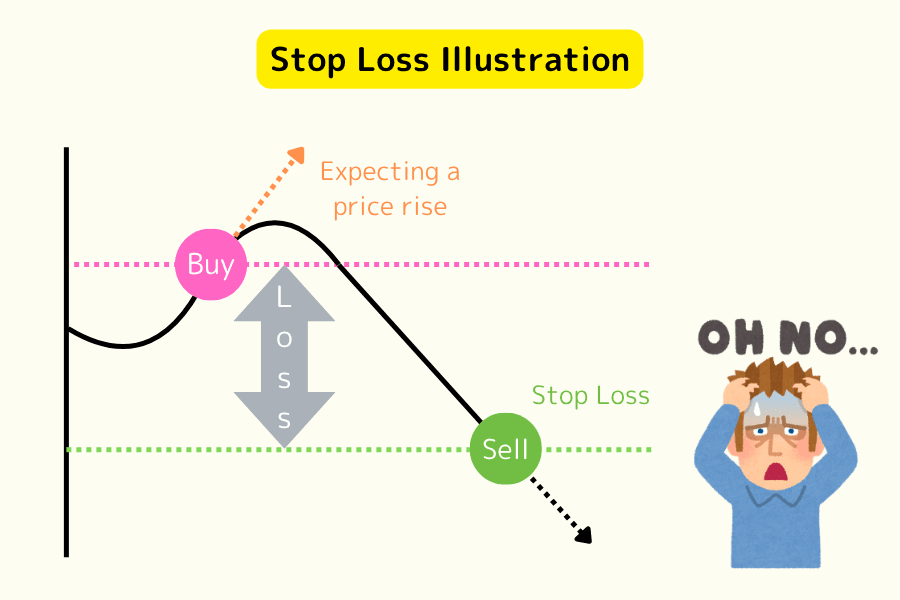
A stop loss is a maximum loss level defined before entering a trade; when price reaches that level, the trader exits automatically or manually. It is a risk-control mechanism planned in advance, not an ad hoc decision.
In volatile markets, no strategy wins every time — so controlling the size of losses is the key to long-term survival. With clear stop-loss settings, traders keep the risk of each trade within a predictable range. That prevents short-term price swings from driving emotional decisions and ensures that trading is based on logic, not a gambler's mindset. Only by learning to lose correctly can you keep winning over the long run.
2. Five Common Stop-Loss Methods Explained
The right stop-loss approach depends on your trading style and the market environment. For investors, the point is not to find the "best" method, but to build clear, executable rules that suit your own habits. Below are five widely used core strategies.
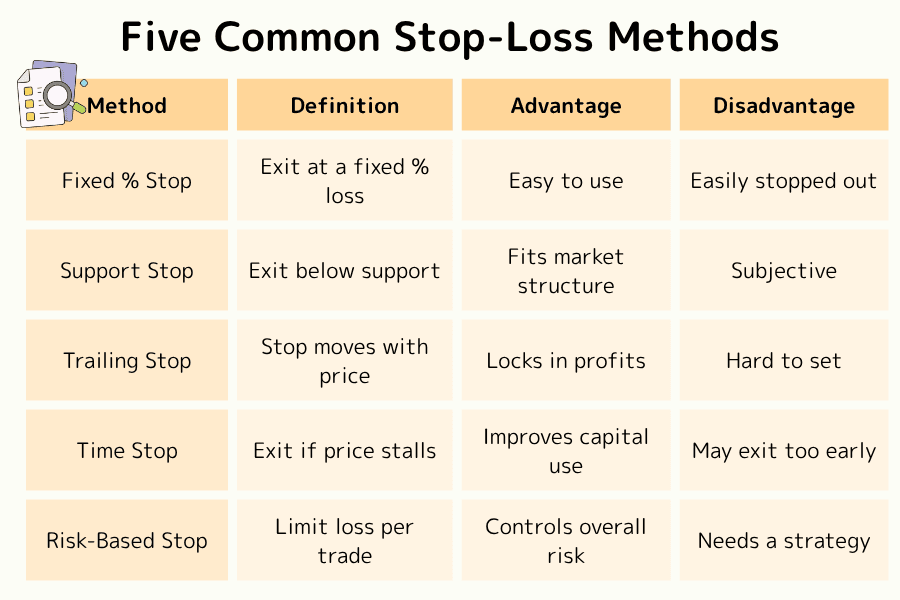
Method 1: Fixed Percentage Stop
The fixed-percentage stop is the most intuitive approach. Before entering a trade, the investor sets the maximum acceptable drawdown (for example, 5% or 10%); once price hits that threshold, the exit is triggered.
The strength is its simplicity. It does not require reading the market and is especially suitable for beginners or those who have not yet built a full trading system. A fixed ratio helps quickly install risk awareness and discipline.
In practice, stable large caps can use a tighter ratio, while volatile growth stocks may require a wider ratio so the trader is not shaken out by normal noise.
One caveat: this method does not account for stock structure or market trend, so mechanical use can trigger frequent stops in choppy conditions.
Method 2: Support-Level Stop
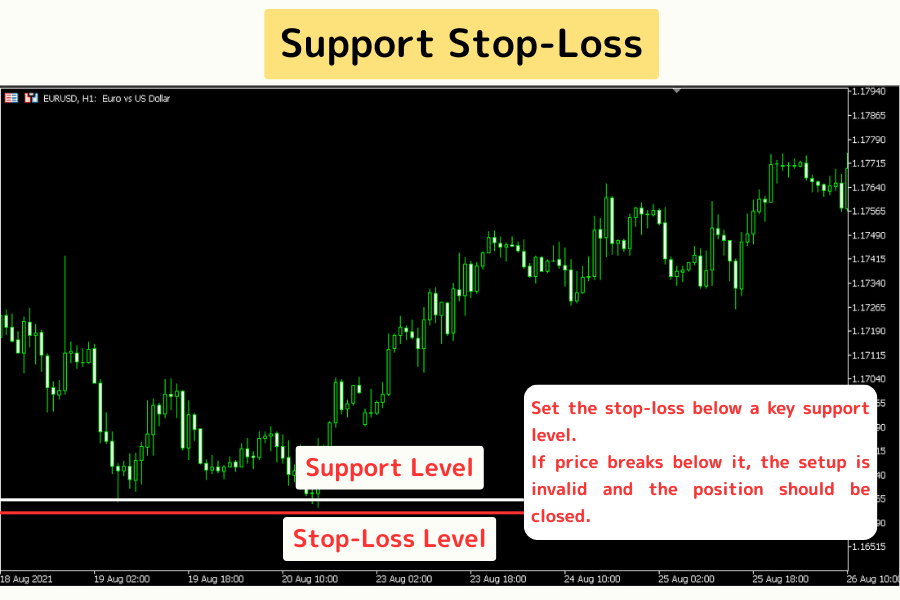
A support-level stop is based on price structure, placing the exit near a key support area — such as a prior swing low, the bottom of a range, or a major moving average. If price decisively breaks through, the original thesis has failed and you exit.
The advantage is that this aligns with market logic: the stop has technical meaning rather than being a random number. For investors with basic technical skills, it improves the rationality of entries and exits.
Common placements include prior swing lows, the bottom of a consolidation range, or a major moving average. If price cannot quickly reclaim a broken support, the trend may be weakening.
Remember that support is a zone rather than a single exact price, so leaving a small buffer on the stop helps avoid false triggers from brief spikes.
The area just below a prior low is also where stops cluster most and get swept most often; see What Is Stop Hunting? for why it happens and how to defend against it.
Method 3: Trailing Stop
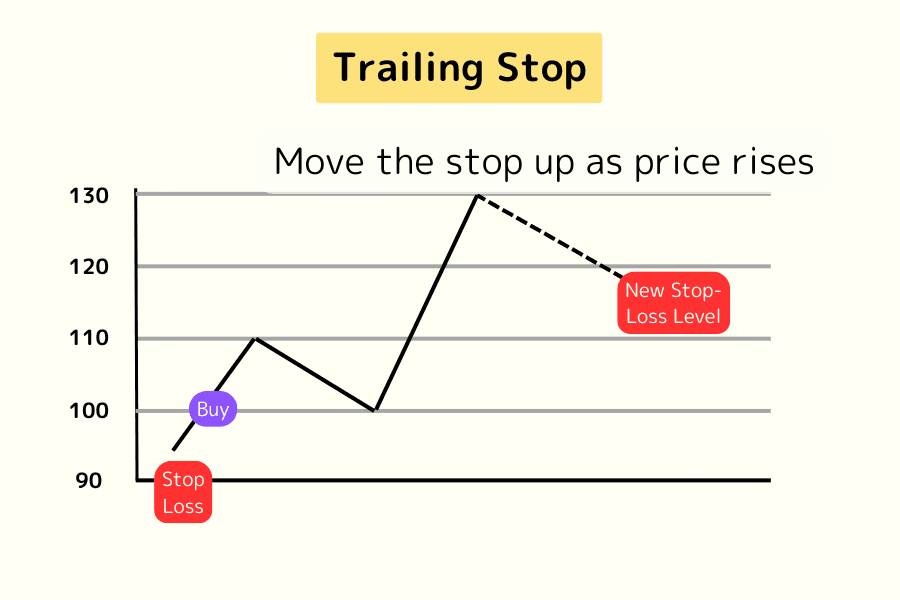
A trailing stop moves the stop level up as price rises, protecting realized gains while keeping the position engaged with the trend.
For example, a stock bought at $100 moves up to $130; the stop can be raised from the original $90 to $117 (a 10% pullback), locking in at least $17 per share.
This method is especially suited to clearly trending conditions — bull runs or strong-trend stocks. The trader doesn't need to call the top; the price action itself creates the exit.
In practice, trailing stops can be combined with a fixed percentage, a moving average, or a volatility measure to add flexibility.
Watch the distance — too tight and you're stopped out too early; too wide and you give back too much profit. Adjust based on the instrument's volatility profile.
Method 4: Time-Based Stop
The core idea of a time-based stop is capital efficiency. If a position doesn't perform as expected within a set window, the trader exits even without a big drop.
For example, if you expected a stock to rally within 1–2 months but it has stayed sideways, that tells you the market's capital isn't flowing into the name — continuing to hold carries rising opportunity cost.
This approach suits short- and medium-term traders and helps avoid getting stuck in idle positions, improving overall capital efficiency.
In practice, time stops can be combined with fundamental or technical signals — for example, after an earnings release that didn't deliver the expected move, or after a failed breakout leads to extended sideways action.
Long-term investors rarely use this method on its own, but it can still serve as a supporting tool.
Method 5: Capital Percentage Stop
A capital percentage stop is set at the portfolio level, limiting the impact of any single trade on the total capital. For example: "Any single trade can lose no more than 2% of my total capital."
If total capital is $1,000,000 and the max single-trade loss is $20,000, you can back out the position size and stop distance from there. That keeps the risk of each decision at a consistent level.
This is common in professional trading because it emphasizes long-term stability over single-trade outcomes.
The main strength is that it effectively avoids large losses — even a losing streak keeps capital within a manageable range.
However, it needs to be paired with clear entry and exit strategies. Pure money management alone does not constitute a complete system.
The Takeaway: Build Consistent Stop-Loss Rules
Whichever method you choose, what matters most is consistency and executability. Constantly changing strategies or moving stops arbitrarily weakens risk control.
Beginners can start with a fixed-percentage stop and gradually add support-level or money-management concepts to build a complete trading framework.
3. How to Choose the Right Method for You (Comparison Table)
A common question after reviewing the methods is: which one fits me? The right choice depends on trading frequency, risk tolerance, and market familiarity. The table below helps you find your position quickly.
| Investor Type | Trading Characteristics | Core Needs | Recommended Stop Combination |
|---|---|---|---|
| Beginner | Disciplined, simple execution | Avoid large concentrated losses | Fixed percentage + capital percentage |
| Technical Trader | Entries/exits based on price structure | Logical exits | Support-level stop |
| Swing Trader | Catch big trends and lock in profit | Expand profit room | Trailing stop + technical levels |
| Short-Term / Day Trader | High capital turnover | Filter out ineffective names | Time stop + fixed percentage |
| Portfolio-Oriented | Multi-asset allocation, risk-first | Long-term account stability | Capital percentage stop |
Decision Logic 1: Choose Based on Time Available to Watch Markets
If you have a day job and can't watch the market in real time, combine fixed percentage with your broker's automatic trailing stop feature. That ensures the system acts first during sudden extreme moves, avoiding emotional delays.
Decision Logic 2: Choose Based on Instrument Characteristics
For growth stocks with large average daily range (ATR), a pure fixed-percentage stop can cause early exits. In that case, prioritize technical-level stops or ATR-based stops to allow reasonable room for natural volatility and avoid missing the main advance.
Decision Logic 3: Choose Based on Personality
If you find yourself "unable to pull the trigger" even with a stop set, the capital percentage stop is a lifeline. By pre-limiting any single-trade loss to 1–2% of total capital, the psychological pressure drops dramatically, and executing the stop starts to feel as natural as paying an insurance premium.
No single method fits every situation. The key is a set of consistent, executable rules. Beginners should practice one method first and, after it becomes second nature, combine two strategies to reinforce the defense.
4. Common Psychological Pitfalls When Executing a Stop Loss
The stop-loss strategy itself isn't hard — the real challenge often lies in the psychology of execution.
Pitfall 1: Unwilling to Take the Loss
When price hits the stop level, some investors delay the exit in the hope that the market bounces back. That mindset is how a manageable loss keeps expanding.
Pitfall 2: Averaging Down to Cover a Bad Trade
Adding to a losing position to lower the average cost looks attractive but actually increases the overall risk. If the trend keeps moving against the position, losses accumulate rapidly.
Pitfall 3: Randomly Moving the Stop Level
Constantly moving the pre-set stop in response to market noise or emotion hollows out the risk-control framework. Without discipline, a stop loss might as well not exist.
In practice, what drives results is often not the strategy itself, but whether the pre-set rules are actually followed. Consistency is the core foundation of long-term stability.
Before entering a trade, you can use the Margin Calculator to estimate the required margin and position size and keep your risk within plan.
5. Summary
Stop losses are an indispensable part of investing; they provide basic risk control in uncertain markets. By setting exit conditions in advance, investors avoid letting emotion drive decisions and keep trades more disciplined.
Each of the five common methods has its own best-fit situation. From fixed percentage to capital management, the key is to find the one that matches your style and keep executing it. Only once risk is under effective control can investment decisions rest on a more stable foundation.
Further Reading
- Stop Loss
- The 2% Rule: Risk Management and Position Sizing for Beginners
- Impact of Loss Cut and Strategies for Forex & CFD Traders
- What Are Pending Orders in Forex Trading? A Guide to MT5/MT4 Order Types and Usage Tips
The financial markets research team at Titan FX. We produce educational content for investors across a wide range of instruments, including forex, commodities (oil, precious metals, agriculture), stock indices, US equities, and crypto assets.
Primary Sources (by Category)
- International Institutions: Bank for International Settlements (BIS), International Monetary Fund (IMF)
- Market Data: FRED (St. Louis Fed Economic Data), CME Group