

What Is a Mnemonic Phrase? 12 vs 24 Words and How to Protect Your Seed
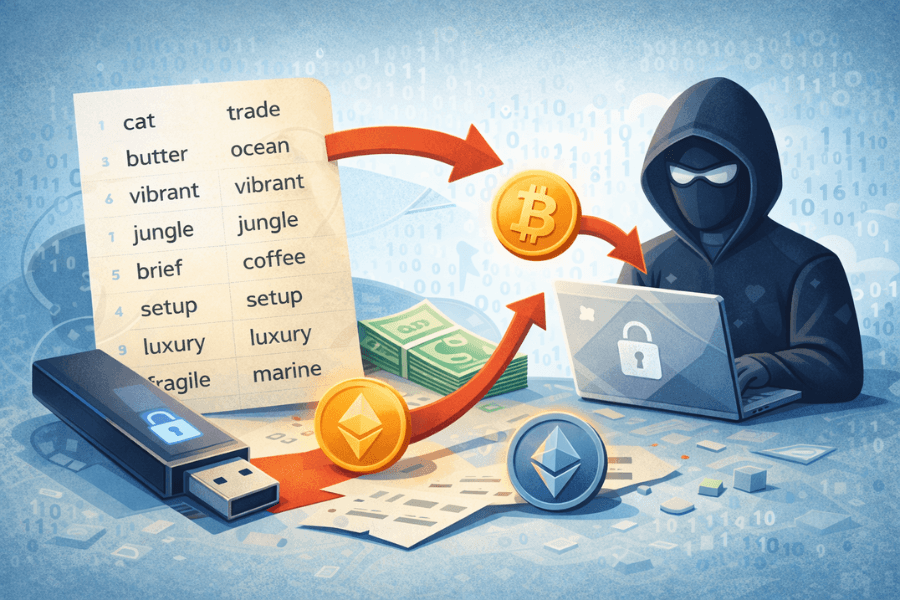
A few days ago, when South Korea's National Tax Service (NTS) released a press notice urging citizens to pay overdue taxes, an attached image accidentally leaked the mnemonic phrase of a crypto cold wallet.
The result: about 4 million units of a certain cryptocurrency (worth roughly USD 4.92 million) were stolen instantly. The Korean National Police Agency confirmed on the 28th that a report had been filed and the case was under investigation.
Although the coin's trading volume is low and cashing out may be difficult, the loss may be smaller than feared, but the incident serves as another stark reminder: once a mnemonic phrase leaks, the assets are practically gone in an instant.
This is not the first incident at a Korean public agency. The Gwangju District Prosecutors' Office once had 320.88 BTC (worth roughly USD 28.57 million) stolen after a staff member clicked a phishing site. In the crypto world, a mnemonic phrase functions as both your bank password and your ID — anyone who obtains it can take all of your assets.
This article explains, in the simplest possible terms, what a mnemonic phrase is, how it is generated, how to store it correctly, and the most common ways it leaks — so beginners can build the right mindset from day one.
- A mnemonic phrase (also called a seed phrase) is a sequence of 12, 18, or 24 English words drawn from the BIP-39 standard 2048-word list — the ultimate key to your wallet.
- The core difference between 12 and 24 words is security strength: 12 words is enough for everyday use; 24 words suits long-term holding or large balances, with crack difficulty rising exponentially.
- Correct storage: write multiple paper copies and store them in separate locations; consider engraved metal plates for fire/flood protection. Never photograph, cloud-sync, store in apps or websites, or share with anyone.
- Most common leak vectors: phishing sites and fake support scams; malware and keyloggers; physical accidental exposure (e.g., images attached to official documents); AI-generated fake support voices and videos (a 2026 risk).
- The crypto industry's iron rule: Not your keys, not your coins — if you don't control the private key or seed phrase, you don't truly own your digital coins.
1. What is a Mnemonic Phrase? The Ultimate Wallet Key
A mnemonic phrase, also called a seed phrase, is a list of 12, 18, or 24 English words used to back up and restore a crypto wallet. When you install a software or hardware wallet, the system generates this word list. The words are not random English vocabulary — they are drawn from the 2048-word list defined by the BIP-39 standard, and the sequence is derived from a string of random numbers via an algorithm.
The role of the mnemonic phrase is to derive every private key and address in the wallet. Enter the same word list into any BIP-39-compatible wallet, and your assets — including Bitcoin, Ethereum, USDT, and every other supported coin — will be fully restored. This word list is the wallet's root: holding it is equivalent to holding all your crypto assets.
2. How Mnemonic Phrases Are Generated and the Difference Between 12 and 24 Words
The generation process is straightforward. The wallet software first generates a random number, converts it into a list of words, and finally appends a checksum to ensure correctness.
A 12-word phrase already provides enough security for everyday use. A 24-word phrase offers higher security, with crack difficulty rising exponentially, and is preferred for storing larger balances. MetaMask and Trust Wallet typically default to 12 words, while Ledger and Trezor hardware wallets support 24-word phrases.
The main difference between them is security strength. A 12-word phrase is theoretically brute-forceable but would require an enormous amount of compute. A 24-word phrase is practically uncrackable at the current state of the art. If you are holding crypto long-term or in large amounts, choosing a 24-word wallet is the safer option.
| Comparison | 12-word | 24-word |
|---|---|---|
| Security strength | ~128-bit entropy, sufficient for daily use | ~256-bit entropy, astronomical crack difficulty |
| Representative wallets | MetaMask, Trust Wallet | Ledger, Trezor, Trust advanced mode |
| Typical use case | Small amounts / everyday hot wallet | Large amounts / long-term cold storage |
| Recording effort | Lower | Higher (twice as many words) |
3. How to Store a Mnemonic Phrase Correctly
Once the mnemonic phrase is generated, immediately copy it onto paper at least twice. While copying, double-check the spelling of every word — a single wrong letter can prevent wallet recovery. Store the copies in safe places: a safe deposit box, separate locations within your home, or even engraved on metal plates to survive fire and flood.
Never photograph the phrase on your phone, save it to a notes app on your computer, upload it to the cloud, type it into any website or app, or share it with anyone. The mnemonic phrase is equivalent to your bank account plus password — anyone who obtains it can drain your assets.
When recovering a wallet, only enter the phrase on a trusted device. Make sure the wallet software or hardware comes from an official source, and avoid using apps or sites of unknown origin.
4. Most Common Leak Vectors and How to Defend Against Them
The most common cause of mnemonic phrase leaks is phishing and social engineering. Fake support agents pretend to help solve problems and ask for the phrase. Phishing sites mimic the MetaMask or Trust Wallet interfaces to trick you into typing the words. Malware and keyloggers can also capture what you write or type.
Physical leaks are equally dangerous. A family member, friend, or thief who sees a paper copy can immediately move your assets. The Korean NTS incident is a textbook example: a public agency accidentally exposed a mnemonic phrase in a press attachment, and the assets were drained almost instantly.
Defense is simple: never share your mnemonic phrase with anyone, ever. With a hardware wallet, the phrase is generated once and never transmitted online. Periodically check your wallet addresses for anomalies, and if you suspect a leak, immediately move your assets to a fresh wallet.
Trade Crypto CFDs with Titan FX
Titan FX offers 20+ crypto CFDs including BTC and ETH with up to 100:1 leverage — go long or short with no wallet or private-key management.
5. FAQ
Q1: If I lose my mnemonic phrase, are my assets really gone forever?
Yes. Without the mnemonic phrase or the private key, the wallet cannot be recovered. Crypto has no bank customer service to reset a password, and your assets remain permanently locked on the blockchain.
Q2: Can I split the phrase across multiple locations?
You can, but with caution. Many people split a 12-word phrase into two halves stored separately. If you lose either half, the wallet can no longer be recovered. The safer practice is to write multiple complete copies and store them in different secure locations.
Q3: How does a hardware wallet's mnemonic phrase differ from a software wallet's?
A hardware wallet's mnemonic phrase is generated once and never transmitted online, which makes it more secure. With a software wallet, malware on your phone can steal the phrase. Hardware wallets are better suited for large holdings.
Q4: Is it a scam when someone shares their mnemonic phrase publicly?
Always. Nobody legitimately shares their mnemonic phrase, because doing so is the same as giving away the wallet. Any message asking for your phrase is a scam.
Q5: Are there new risks to watch out for in 2026?
Phishing sites and fake apps are becoming increasingly sophisticated, and AI-generated fake support voices and videos are starting to appear. Using a hardware wallet, verifying official URLs, and never clicking unknown links remain the most effective defenses.
6. Conclusion
The core appeal of crypto is that "you are your own bank," but this also means investors must shoulder near-bank-grade responsibility for asset security. The Korean NTS case taught everyone an expensive lesson: in the digital age, no matter how complex the cryptography, a well-stored physical backup can still beat it.
Mastering the mnemonic phrase is your ticket into decentralized finance and the last line of defense for your crypto assets. Always remember the most famous saying in crypto: Not your keys, not your coins — if you don't hold the keys, you don't truly own the coins.
Whether you hold crypto for the long term or trade market volatility through CFDs, understanding asset security and risk management remains an indispensable topic for every investor.
Further Reading
- What is Cryptocurrency?
- Bitcoin (BTC) Complete Guide
- Ethereum (ETH) Complete Guide
- USDT Complete Guide
- Blockchain Technology Complete Guide
The Titan FX financial market research team. Covering FX, commodities (oil, precious metals, agricultural products), stock indices, US equities, and crypto assets, the team produces educational content for investors across a wide range of financial instruments.
Primary Sources (by category)
- Technical standards: BIP-39 (Bitcoin Improvement Proposal — Mnemonic code for generating deterministic keys); BIP-32 / BIP-44 hierarchical deterministic wallet standards; Ledger and Trezor official security documentation
- Security research: Cambridge Centre for Risk Studies crypto-asset security reports; Chainalysis Crypto Crime Report series; mnemonic-phrase attack-vector analyses by Trail of Bits, CertiK, and other smart-contract auditors
- News and case references: Korean NTS mnemonic-phrase exposure incident (2025 reporting); Gwangju District Prosecutors' Office 320.88 BTC phishing case; CoinDesk Korea, Yonhap News, CNBC Crypto coverage
- Industry and third-party references: Investopedia (Seed Phrase entries); MetaMask and Trust Wallet official security guides; Titan FX internal crypto-asset security and risk-management documentation