

Solana (SOL): Features, Market Trends, and Trading Guide
Solana (SOL) is a high-speed, low-fee, highly scalable blockchain using a Proof-of-History plus Proof-of-Stake design; SOL is its native token for fees, staking, and ecosystem apps, often compared with Ethereum.
This article introduces Solana (SOL), its features, factors affecting its volatility, and trading methods.
- Positioning: a high-speed, low-fee, scalable blockchain
- Consensus: Proof of History (PoH) + Proof of Stake (PoS)
- SOL uses: fees, staking, DApp/NFT ecosystem apps
- Vs BTC/ETH: faster than BTC; like ETH a smart-contract chain but more efficient
- How to take part: trade both directions via CFDs without holding the coin
1. What Is Solana?
Solana (SOL) is a high-performance blockchain platform designed to provide fast and secure decentralized applications (DApps) and cryptocurrency transactions. It aims to solve scalability issues faced by other blockchain platforms, handling a large volume of transactions efficiently.
Here are the key features of Solana:
High Transaction Speed
Solana can process thousands of transactions per second (TPS) using its unique Proof of History (PoH) mechanism. PoH generates timestamps for transactions, ensuring all nodes agree on the order of transactions.
Low Transaction Costs
Thanks to its efficient architecture, Solana offers extremely low transaction fees, making it ideal for handling large volumes of small transactions.
Scalability
Solana's architecture allows it to scale with network growth without compromising performance. It achieves this through both vertical and horizontal scaling.
Support for Smart Contracts
Solana supports smart contracts and decentralized applications, enabling developers to build innovative solutions on its platform.
Robust Ecosystem
Solana boasts a vibrant and fast-growing developer community, attracting high-quality projects and applications, including decentralized finance (DeFi) and non-fungible tokens (NFTs).
Solana’s high performance and low costs position it as a significant player in the blockchain space, driving innovation and application development.
2. How Solana Differs from Other Cryptocurrencies
Compared to other cryptocurrencies, Solana has several distinct differences in its technical architecture, performance, and scalability.
Transaction Speed and Throughput
Solana
Using its unique Proof of History (PoH) mechanism, Solana achieves thousands of transactions per second (TPS), with a theoretical maximum of 65,000 TPS, far surpassing most blockchain platforms.
Bitcoin
Bitcoin processes about seven transactions per second due to the limitations of its Proof of Work (PoW) mechanism.
Ethereum
Ethereum 1.0 processes about 15–30 transactions per second. Ethereum 2.0 aims to significantly improve this with sharding technology.
Transaction Costs
Solana
Solana’s efficient design ensures transaction fees remain very low, often less than a cent, making it advantageous for high-frequency trading and microtransactions.
Bitcoin and Ethereum
These platforms typically have higher transaction fees, which can spike during network congestion.
Consensus Mechanism
Solana
Solana combines Proof of History (PoH) with Proof of Stake (PoS). PoH provides a verifiable timestamp method, ensuring the transparency and trustworthiness of transaction order.
Bitcoin
Bitcoin uses Proof of Work (PoW), requiring miners to perform extensive computational work to validate transactions, leading to high energy consumption and slower speeds.
Ethereum
Currently using PoW, Ethereum is transitioning to Proof of Stake (PoS) to improve efficiency and reduce energy consumption.
Scalability
Solana
Its architecture is designed for vertical and horizontal scaling without compromising performance, accommodating more nodes and higher transaction volumes.
Bitcoin and Ethereum
Limited scalability due to the constraints of PoW mechanisms. As usage increases, issues like slower transaction speeds and higher costs become more prominent.
Ecosystem and Application Support
Solana
Solana has a rapidly growing ecosystem, supporting a variety of DApps, especially in DeFi and NFTs.
Bitcoin
Primarily used as digital gold and a store of value, Bitcoin’s ecosystem and applications are relatively limited.
Ethereum
Ethereum boasts robust support for smart contracts and is a major platform for DApps. However, its performance and transaction cost issues remain challenges to overcome.
These distinctions give Solana significant advantages in performance and cost, particularly for use cases requiring high-frequency transactions and low-cost operations.
3. Factors Influencing Solana's Price Volatility
Solana’s price volatility is influenced by various internal and external factors:
Internal Factors
Technological Advancements
Upgrades and improvements in Solana’s technology can affect its price. Announcements of performance enhancements, new features, or increased security can boost market confidence and drive prices upward.
Ecosystem Growth
Deployments of new DApps, DeFi protocols, or NFT platforms on Solana can increase demand for its token (SOL), positively impacting prices.
Trading Volume and Liquidity
Higher trading volume usually indicates growing demand for SOL, while increased liquidity makes buying and selling SOL easier, both affecting price fluctuations.
External Factors
Market Sentiment and Investor Behavior
The cryptocurrency market is heavily influenced by investor sentiment. Positive news, celebrity endorsements, and market expectations can drive prices up, while negative news and market panic can cause declines.
Overall Cryptocurrency Market Trends
Solana’s price is affected by trends in the broader cryptocurrency market. For instance, fluctuations in major cryptocurrencies like Bitcoin and Ethereum often impact the entire market.
Macro-Economic Factors
Global economic conditions, monetary policies, inflation rates, and other macroeconomic factors influence the cryptocurrency market. During economic instability, investors might turn to cryptocurrencies as a hedge, pushing prices upward.
Regulatory Environment
Government policies and legal changes related to cryptocurrencies can also impact prices. Strict regulations may lead to price drops, while supportive policies could drive prices up.
Market Competition
The development and competition from other blockchain platforms can affect Solana’s price. If other platforms outperform Solana in technology or applications, demand for Solana may decrease, impacting its price.
These factors collectively contribute to Solana's price volatility. Investors should consider these factors comprehensively to make informed decisions.
4. Solana's Recent Price Trends
Solana’s price has shown significant fluctuations in recent years.
2022
In 2022, Solana experienced notable volatility. While prices were high at the beginning of the year, the market’s overall correction led to substantial declines. Technical issues and network outages, such as multiple shutdowns, negatively impacted its price.
2023
In 2023, Solana showed signs of recovery, especially in the second quarter, fueled by growing demand in DeFi and NFT markets. Despite market fluctuations, Solana’s price remained relatively stable, with some upward movement driven by key technological updates and ecosystem expansion.
2024
As of 2024, Solana’s price has shown strong performance, reaching $146.43. Compared to its 2023 price of $18.61, this represents a remarkable growth of approximately 686.7%. This growth is attributed to market recognition of its high performance, low transaction costs, and the continued expansion of its ecosystem.
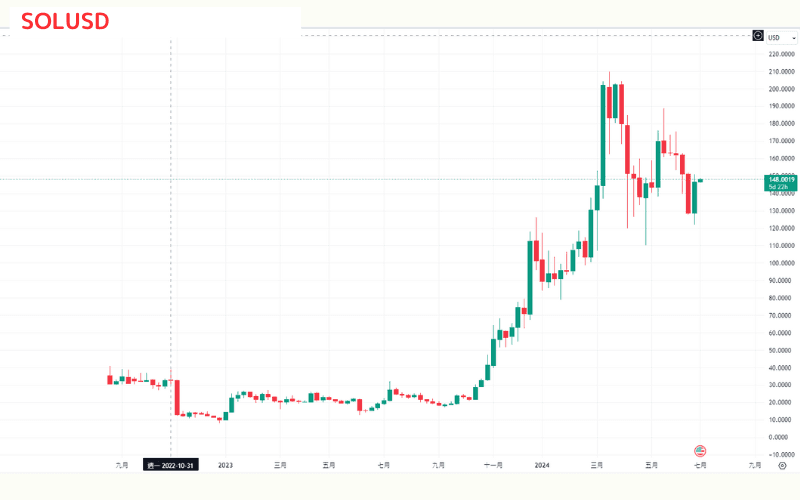
Overall, Solana’s price volatility is driven by factors such as technological advancements, market demand, investor sentiment, and macroeconomic conditions. Investors should consider these factors carefully to make informed investment decisions.
5. How to Start Trading Solana (SOL) CFDs
1. Choose a Trading Platform
Titan FX offers cryptocurrency CFD trading with leverage up to 100x. It supports trading on MT4 and MT5 platforms, providing investors with flexible and efficient market participation.
Solana (SOL) Trading Pairs on Titan FX
On Titan FX, you can trade two Solana pairs: SOLUSD (Solana/US Dollar) and SOLJPY (Solana/Japanese Yen).
Titan FX Cryptocurrency Trading Hours:
| Trading Day | Time |
|---|---|
| Monday | 00:01 - 23:59 |
| Tuesday | 00:01 - 23:59 |
| Wednesday | 00:01 - 23:59 |
| Thursday | 00:01 - 23:59 |
| Friday | 00:01 - 23:55 |
| Saturday | 00:01 - 23:55 |
| Sunday | 00:01 - 11:00, 13:00 - 23:55 |
Note that trading hours may change due to maintenance or upgrades. Pay attention to margin balances, stop-loss (S/L) and take-profit (T/P) levels.
What is Titan FX? Features, Leverage, Instruments, and Platforms2. Open a Trading Account:
Titan FX offers a fast and simple account opening process with no requirement for ID or address verification.
Titan FX provides Standard and Blade account types. Traders can choose their preferred type during registration.
Titan FX Account Opening Guide3. Deposit Funds:
After registration, deposit funds into your account. Titan FX supports multiple deposit methods, with credit card deposits being the fastest and most convenient, usually processed instantly.
Titan FX Credit Card Deposit Guide4. Download and Install Trading Platforms (MT4/MT5):
Titan FX offers MT4 and MT5 platforms for Windows, Mac, iOS (iPhone/iPad), and Android.
Titan FX MT5 Installation and Login
Titan FX MT4 Installation and Login
5. Place Trades:
Log into the MT4 or MT5 platform, select your trading instrument, and start buying or selling.
MT5 Interface and Order Methods
MT4 Interface and Order Methods
Titan FX Provides Free Trading Tools (Custom Indicators and EAs)
Titan FX is dedicated to providing traders with advanced trading support, including free trading tools such as custom indicators and EAs (Expert Advisors). These tools are designed to enhance traders' efficiency and strategy precision.
Custom indicators help traders analyze market trends more accurately and identify potential trading opportunities.
Meanwhile, EAs can automatically execute pre-set trading strategies, avoiding emotional interference and ensuring that each trade is executed accurately.
With these free tools, Titan FX helps you gain an edge in the competitive financial market and improve your trading performance.
All Custom Indicators EA Trading Program RankingsTrade Solana (SOL) CFDs with Titan FX
Titan FX offers Solana (SOL) CFDs with up to 100:1 leverage — go long or short with no wallet or private-key management.
6. Solana FAQs
Q1. How is Solana different from Ethereum?
Solana uses PoH + PoS to prioritize speed and low cost, while Ethereum is the smart-contract pioneer with a deeper developer base.
Q2. What is SOL used for?
Paying transaction fees, staking, and a range of ecosystem uses such as DApps and NFTs.
Q3. What drives Solana's price?
Network adoption, developer activity, overall crypto sentiment, and risk factors such as past network outages.
Q4. Can Solana be mined?
No. SOL is proof-of-stake based, so rewards come from staking rather than mining.
Q5. How can I trade SOL?
Besides spot, you can use CFDs to trade its price movements in both directions without holding the coin.
7. Conclusion
1. Solana’s Features
Solana is a high-performance blockchain platform capable of processing thousands of transactions per second (TPS) with very low transaction fees, making it ideal for microtransactions.
2. Factors Affecting Solana’s Price
Solana’s price is influenced by internal factors like technological advancements and ecosystem growth, as well as external factors like overall market trends and macroeconomic conditions.
3. Advantages of Opening an Account with Titan FX:
Up to 100x leverage, supports MT4 and MT5 platforms, simple and quick account opening process, multiple convenient deposit methods, and dozens of custom indicators and EAs.
Titan FX Account Opening GuideFurther Reading
Titan FX Trading Strategy Lab. We produce investor-education content covering forex, commodities (crude oil, precious metals, agricultural goods), stock indices, U.S. equities, and digital assets.
Primary Sources (by Category)
- Crypto basics: Solana official information and general technical explanations of major crypto assets
- Titan FX official: What is Bitcoin?, What is a CFD?