

What Is USDT (Tether)? Mechanics, Uses, and Risks for Beginners
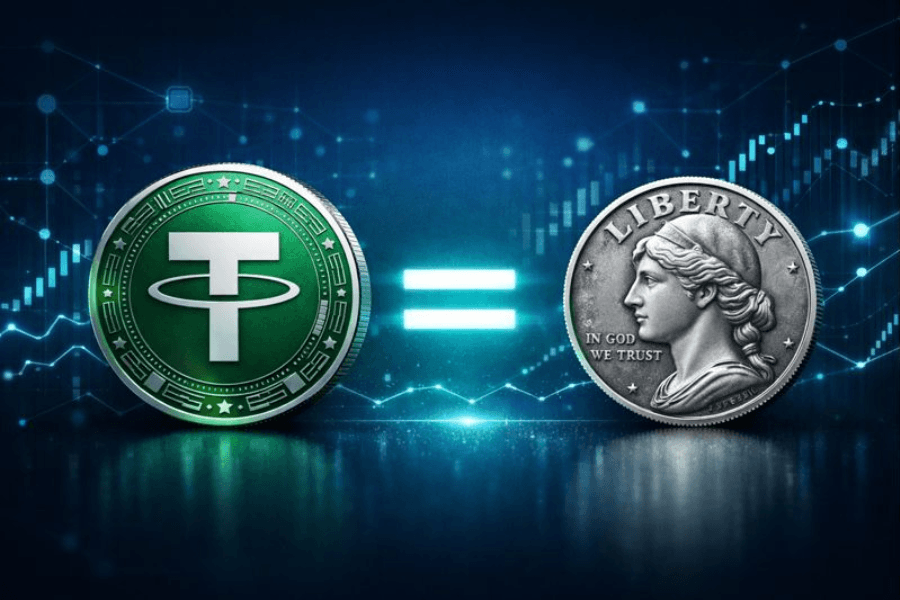
In the crypto market, USDT is almost everywhere. Whether you are buying and selling Bitcoin, reallocating your assets, or moving funds between platforms, USDT is often the first tool people reach for. Its high liquidity and price stability make many users rely on it almost without noticing — sometimes treating it as a digital US dollar.
But the design context, usage logic, and risk structure of USDT differ meaningfully from a traditional dollar asset. If you only see the surface fact that "the price is close to 1 US dollar," it is easy to misread the use cases and the risks. This article aims to give beginners a clear, practical mental model of USDT, so it can play the right role in the crypto world without being over-trusted or misused.
- USDT is the longest-running and most widely used dollar stablecoin, issued by Tether since 2014, with a target price of 1 US dollar.
- It stays near peg through three pillars: 1:1 dollar reserves, issuer mint/burn, and trader arbitrage.
- Common uses: parking value during volatility, the universal pricing unit (BTC/USDT, ETH/USDT), and moving funds between platforms.
- Vs USDC: same crypto-asset class, but USDC leads on transparency. Vs bank dollars: no deposit insurance.
- Main risks: issuer credit, reserve transparency, regulation, depeg under stress, and lost funds from sending on the wrong network (TRC-20 vs ERC-20).
- 1. What Is USDT? The Role of Stablecoins in the Crypto Market
- 2. How USDT Works: The Three Pillars Holding the 1-Dollar Peg
- 3. Why Traders Love USDT: Real-World Uses in Crypto Markets
- 4. USDT vs USDC vs Bank Dollar Deposits
- 5. How Beginners Acquire USDT: Safe Channels and Basic Principles
- 6. FAQ: Risks, Scams, and Network Selection
- 7. Conclusion: Using USDT Correctly in the Crypto Market
1. What Is USDT? The Role of Stablecoins in the Crypto Market
USDT (ticker symbol USDT, also called Tether) is a crypto asset whose value is benchmarked to the US dollar — a form of stablecoin. USDT is issued by Tether Limited and was first launched in 2014, making it the longest-running and most widely used stablecoin in the market today.
Stablecoins emerged from the problem that crypto prices swing too much. Bitcoin and most crypto assets are too volatile for everyday transactions or short-term parking. The market needed an asset that was both relatively price-stable and freely transferable on a blockchain, and USDT was designed to meet exactly that need.
USDT's target price is set close to 1 US dollar, letting users move funds from volatile crypto assets into a relatively stable form without leaving the crypto market. In practice, it serves as a pricing unit, a parking asset, and a transfer medium between exchanges.
It is important to note that USDT is not the US dollar itself, nor is it a fiat currency issued by a government or central bank. It is a crypto asset issued by a private company and operated on a blockchain; its stability comes from issuance design and market trust, not from legal tender status or deposit insurance. That is the fundamental difference between USDT and a US-dollar bank deposit.
2. How USDT Works: The Three Pillars Holding the 1-Dollar Peg
USDT is neither a government-issued fiat currency nor a number conjured by a computer algorithm. The reason it can hold its price near 1 US dollar over the long run is not a verbal promise but a system that combines "asset backing, centralised issuance, and market arbitrage" — somewhat like a digital pawnshop.
Pillar 1: A 1:1 "Collateral" System (Full Reserves)
USDT is essentially a "digital receipt" for the US dollar. Tether's promise is simple: for every USDT in circulation, there is 1 US dollar of assets (cash, US Treasuries, etc.) sitting in reserve as backing.
In other words, as long as the market believes that "this receipt (USDT) really can be redeemed for dollars," its value will not collapse.
Pillar 2: Centralised Mint and Burn
USDT's supply is not fixed; it adjusts dynamically with market demand under Tether's centralised management.
- Mint: When exchanges or large institutions hand US-dollar funds over to Tether, Tether mints an equivalent amount of USDT on-chain and releases the tokens into circulation.
- Burn: When institutions want to redeem dollars and return USDT to Tether, the tokens are taken back and "burned" on-chain, removing them from circulation.
This "mint only against assets, burn on redemption" design preserves a dynamic balance between supply and reserves.
Pillar 3: The Market's Self-Correction (Arbitrage)
Beyond the institutional design, traders themselves are an important force keeping the price stable.
- Auto-recovery: When markets move violently and the exchange price of USDT slips to 0.99 US dollars, alert traders see an opportunity — buy USDT cheap, then redeem it back to 1 US dollar with the issuer.
- Result: That buying pressure naturally pushes USDT back to 1 US dollar. This kind of spontaneous arbitrage is USDT's strongest defense against market shocks.
USDT's stability does not come from legal compulsion — it is sustained jointly by physical asset collateral, issuance controls, and global arbitrage.
3. Why Traders Love USDT: Real-World Uses in Crypto Markets
In the crypto market, USDT acts more like a "utility tool" than an investment target. Most users hold USDT not because they expect the price to rise, but to preserve operational flexibility and capital efficiency in a volatile market.
Use Case 1: A Temporary Shelter from Price Swings
When markets sell off rapidly or uncertainty rises, traders frequently swap Bitcoin or other crypto assets into USDT to lock in book value.
This is functionally equivalent to dampening the impact of price swings without leaving the crypto market — and re-entering once conditions clarify.
Use Case 2: The Universal Quote Currency for Crypto Trading
In day-to-day trading, both major and minor crypto assets are usually quoted against USDT — pairs like BTC/USDT and ETH/USDT. That makes USDT the most widely used "quote currency" in the market, sparing users from constantly converting between fiat currencies to trade different coins.
Use Case 3: Moving Funds Between Exchanges and Platforms
USDT is also widely used to move funds between exchanges and platforms. Compared with traditional cross-border bank transfers, which can be slow and procedure-heavy, a blockchain transfer of USDT settles in minutes — a major advantage for traders who need to reposition quickly.
Overall, USDT's value in the crypto market is not about generating return; it lies in offering a stable, highly liquid intermediary that does not require an immediate trip back to the traditional financial system.
4. USDT vs USDC vs Bank Dollar Deposits
Beyond USDT, USDC (USD Coin) is another name beginners encounter often. USDC is a US-dollar stablecoin issued by Circle, also designed around 1:1 dollar reserves, and emphasises compliance and transparency — it is often viewed as a stablecoin leaning toward the US regulatory framework.
For beginners, the most common confusion is treating USDT or USDC as the same thing as "dollars in the bank." All three reference the US dollar as a value benchmark, but they differ clearly in legal status, risk structure, and use cases.
| Comparison | USDT | USDC | Bank Dollar Deposit |
|---|---|---|---|
| Issuer | Private company Tether | Private company Circle | Commercial bank |
| Asset class | Crypto asset | Crypto asset | Fiat currency deposit |
| Value backing | Dollar and equivalent reserve assets | Dollar and short-term Treasuries | Bank assets and government credit |
| Regulatory intensity | Moderate, varies by jurisdiction | Higher, shaped by US regulation | Heavy regulation |
| Deposit guarantee | None | None | Subject to national deposit insurance |
USDT and USDC are both digital tools running on a blockchain; their safety depends on the issuer's asset management and market trust, not on a government-provided deposit guarantee. Bank dollar deposits, by contrast, sit inside the traditional financial system; even if liquidity and cross-border efficiency are lower, the legal protections and institutional stability are at a different tier.
USDT is therefore best treated as an operational medium in the crypto market — for trading, transfers, and short-term parking — not as a long-term substitute for cash held at a bank.
5. How Beginners Acquire USDT: Safe Channels and Basic Principles
For beginners, acquiring USDT itself is not difficult — what truly matters is "how to buy it safely." Because USDT transfers are irreversible, an operational mistake or a scam leaves almost no room for recovery. Picking the right channel and forming basic habits matters more than chasing the cheapest or fastest route.
Channel: Prefer Compliant Centralised Exchanges
The most stable and lowest-risk way is to buy USDT directly with fiat through a compliant centralised exchange. These platforms typically require KYC and provide complete transaction records, fund flow tracking, and customer support. For beginners, this is not just an entry point for USDT but also a safe environment for building basic operational experience.
Principle: Avoid Any Form of Off-Platform P2P Trade
P2P trades through social platforms, messaging apps, or unfamiliar counterparties are not recommended. Such trades typically lack third-party safeguards — once the counterparty disappears, USDT is virtually unrecoverable. Many common investment scams, fake-coin operators, and phishing cases exploit the speed and irreversibility of USDT transfers.
Operational Reminder: Triple-Check Before Transferring
Before transferring USDT, build the habit of checking repeatedly. Verify the receiving address, confirm that both ends use exactly the same blockchain network — for example TRC-20 or ERC-20 — and re-check the amount. A single mistake can permanently lose your funds; this is the most common — and most easily avoided — operational risk in crypto.
For beginners, the entry point is not the bottleneck. The real key is to "not rush, not chase shortcuts, and not seek convenience." Stick to the basics, and USDT becomes a relatively easy-to-use and stable tool in the crypto market.
Trade Crypto CFDs with Titan FX
Titan FX offers 20+ crypto CFDs including BTC and ETH with up to 100:1 leverage — go long or short with no wallet or private-key management.
6. FAQ: Risks, Scams, and Network Selection
Q1: What risks should I watch out for with USDT?
USDT's risks are not in everyday use; they sit at the institutional and operational level. Beginners can think about them across several dimensions:
- Issuer risk: USDT is issued and managed by Tether, and its stability depends on the company's reserves and operations — not on government or central-bank backing.
- Reserve transparency risk: Tether publishes periodic reserve reports, but the market has at times questioned the composition of those assets, and trust levels can affect price stability.
- Regulatory and legal risk: USDT faces uneven regulatory environments across jurisdictions; legal restrictions or sanctions can affect circulation and redemption.
- Depeg risk: In extreme conditions — confidence shocks, major events — the price can briefly drift away from 1 US dollar.
- Use-case risk: USDT transfers are irreversible; if you send to the wrong address or a scam platform, the funds are typically gone for good.
In short, USDT is well-suited as a trading and capital-flow tool, but not as a fully risk-free way to store assets long term.
Q2: Will USDT depeg?
There is a theoretical risk, but it is not the daily state. USDT's price stability rests on reserve transparency, market confidence, and the regulatory environment.
A major reserve dispute, legal sanction, or collapse in confidence could push the price briefly off 1 US dollar. For that reason, concentrating long-term capital in a single stablecoin is not advisable.
Q3: What are TRC-20 and ERC-20, and why do they matter?
These refer to the blockchain network USDT runs on. TRC-20 is the TRON-based version — low fees and fast confirmations. ERC-20 is the Ethereum-based version — mature ecosystem with deeper DeFi integration but higher gas costs. When transferring, both sender and receiver must select the exact same network, otherwise the funds are typically unrecoverable. This is one of the most common — and most painful — beginner mistakes.
Q4: Does simply holding USDT generate interest automatically?
No. USDT is just a stablecoin — sitting in a wallet generates no yield. The "USDT interest" you see in the market typically comes from exchange yield products, lending, or staking schemes — your USDT is being redeployed by a platform.
These can offer higher returns, but you also take on platform-failure, liquidity, and management risk. They are not risk-free deposits.
7. Conclusion: Using USDT Correctly in the Crypto Market
USDT's value in the crypto market lies in providing a relatively price-stable, highly liquid form of capital, letting users adjust positions more flexibly in volatile conditions. It fits well as a trading pricing unit, a short-term parking spot, and a medium for cross-platform transfers.
At the same time, USDT's stability rests on issuance design, asset management, and market trust — it does not include any government-provided deposit guarantee. Use it with clear risk awareness: avoid concentrating long-term capital in it, choose trading platforms carefully, and double-check the network and address on every transfer.
For most beginners, once you grasp USDT's role and operational boundaries, it becomes a very practical tool when entering the crypto market. With a solid understanding of both its function and its limits, USDT can play an effective supporting role in your overall asset allocation, rather than becoming a source of risk.
Further Reading
- What is a Stablecoin?
- USDC Complete Guide
- DAI Complete Guide
- Blockchain Technology Complete Guide
- Bitcoin (BTC) Complete Guide
The Titan FX financial market research team. Covering FX, commodities (oil, precious metals, agricultural products), stock indices, US equities, and crypto assets, the team produces educational content for investors across a wide range of financial instruments.
Primary Sources (by category)
- Official documentation: Tether Reserve Reports; Tether Transparency page; Tether's official whitepaper and issuance disclosures
- Regulation and legal: Stablecoin-related statements from US OCC, CFTC, and SEC; the NYAG-Tether settlement; FATF Virtual Asset Service Provider guidance; EU MiCA stablecoin definitions
- Market data: CoinGecko and CoinMarketCap USDT supply and market data; on-chain transfer statistics from TRON and Ethereum; Chainalysis Stablecoin Report series
- Industry and third-party references: Investopedia (Tether/USDT entries); CoinDesk, The Block, and Bloomberg Crypto coverage of USDT reserve disputes and market analysis; Titan FX internal stablecoin and crypto-asset risk-management documentation