

Forex Trading Basics: Pips, Pip Value, and Spread Explained

One of the first things that confuses new forex traders is the jargon: "it moved one pip," "the spread is tight." These terms are the shared language for reading profit, loss, and cost — and once they click, your trading decisions become far clearer.
This article explains what pips, pip value, and spread are, how to calculate them, and how the three relate to one another.
- What a pip is: The smallest unit a rate moves (usually 0.0001; 0.01 for yen pairs)
- Pip value: The profit or loss per pip, which scales with lot size
- Spread: The gap between bid and ask — your real trading cost
- How they connect: Pips show movement, pip value the money, spread the cost
- Cost control: Favor tight-spread sessions and pairs
1. Definition of Pips
In forex trading, a pip is the basic unit for measuring currency price movements, and it is also the core basis for calculating profit and loss. Because different currency pairs use slightly different quote formats, the way a pip is calculated also varies.
Pips for Standard Currency Pairs
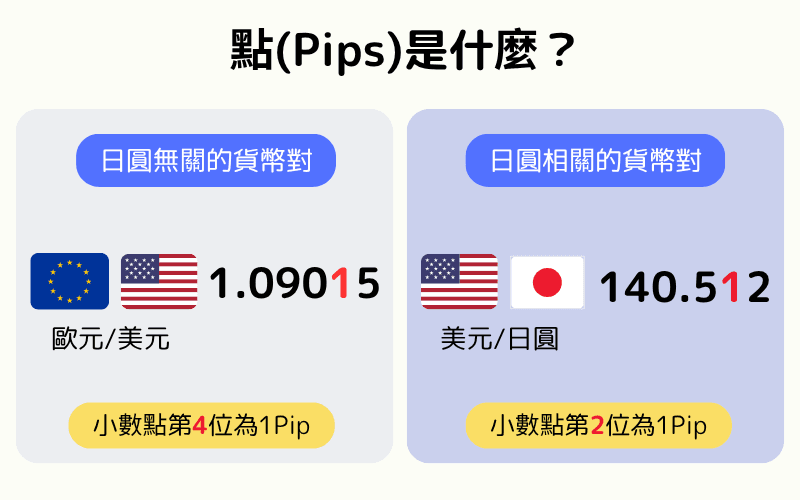
For most currency pairs (such as EUR/USD, GBP/USD, USD/CHF, and others), the exchange rate is generally quoted to the fourth decimal place:
- 1 pip = 0.0001
For example:
- If EUR/USD moves from 1.0900 to 1.0901, that is an increase of 1 pip.
- If USD/CHF moves from 0.8800 to 0.8801, that also represents a price increase of 1 pip.
Pips for JPY Currency Pairs
For currency pairs that use the Japanese yen (JPY) as the quote currency (such as USD/JPY and EUR/JPY), the quote format uses two decimal places:
- 1 pip = 0.01
For example:
- If USD/JPY moves from 149.10 to 149.11, that is an increase of 1 pip.
Pipettes
To provide more precise quotes, some trading platforms display one additional decimal place after the standard pip position (i.e., the fifth or third decimal place). This is known as:
- Pipette: one-tenth (1/10) of a pip
- For EUR/USD: 1 pipette = 0.00001
- For USD/JPY: 1 pipette = 0.001
For example:
- If EUR/USD rises from 1.09001 to 1.09012, it has moved 11 pipettes, which equals 1.1 pips.
2. Calculating and Understanding Pip Value
Pip value refers to the actual monetary impact on a trader's profit or loss for every one-pip movement in a currency's price. It is a key metric for risk management and position planning, and it is calculated based on the currency pair traded, the lot size, and the account's base currency.
The Basic Pip Value Formula
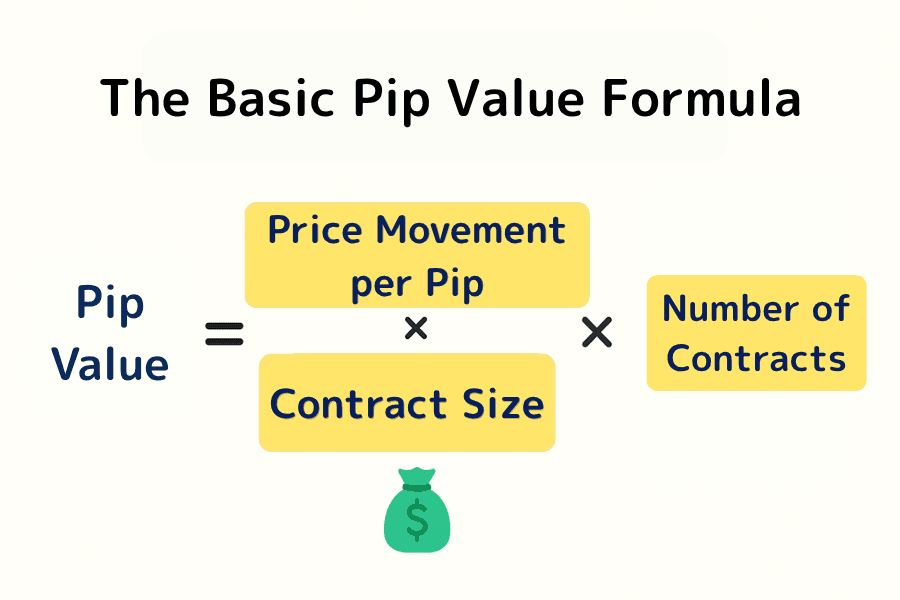
Pip Value = Price Movement per Pip × Contract Size (units per lot) × Number of Contracts (lots)
| Item | Description |
|---|---|
| Price Movement per Pip | The smallest price change of a currency pair (0.0001 for EUR/USD, 0.01 for USD/JPY) |
| Contract Specification | A standard lot is 100,000 currency units |
| Number of Contracts | The number of lots traded (e.g., 0.1 lot, 1 lot) |
If the account's base currency differs from the quote currency, the final pip value must be converted into the account's base currency (for example, a USD account trading USD/JPY requires conversion).
Example: EUR/USD Pip Value
Suppose you trade EUR/USD at 1 lot (100,000 units), with a price movement per pip of 0.0001 and a pip value of 10 USD:
- Pip Value = 0.0001 × 100,000 × 1 = 10 USD
- For every 1-pip price movement, the profit or loss changes by 10 USD.
Pip Value Table for Different Lot Sizes
- EUR/USD (1 pip = 0.0001):
| Contract Specification | Number of Contracts | Pip Value (USD) |
|---|---|---|
| 100,000 | 0.1 lot | 1 |
| 100,000 | 1 lot | 10 |
| 100,000 | 20 lots | 200 |
| 100,000 | 50 lots | 500 |
- USD/JPY (1 pip = 0.01), assuming 1 USD = 140 JPY:
- Pip Value (JPY) = 0.01 × 100,000 × number of lots
- Pip Value (USD) = Pip Value (JPY) ÷ 140.00
| Contract Specification | Number of Contracts | Pip Value (JPY) | Pip Value (USD) |
|---|---|---|---|
| 100,000 | 0.1 lot | 100 | 0.71 |
| 100,000 | 1 lot | 1,000 | 7.14 |
| 100,000 | 20 lots | 20,000 | 142.86 |
| 100,000 | 50 lots | 50,000 | 357.14 |
Note: Because the quote currency of USD/JPY is the Japanese yen, if your account is denominated in USD, you must convert using the real-time exchange rate when calculating.
3. The Role and Cost of Spread
Spread is the difference between the ask price (Ask) and the bid price (Bid). It is the primary cost of forex trading and directly affects a trader's net profit.
The Spread Formula
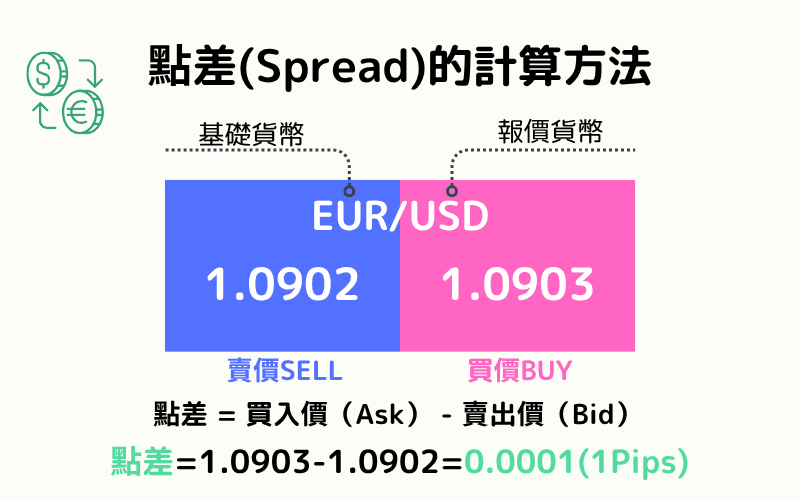
Spread = Ask Price − Bid Price
Example: EUR/USD Spread
Suppose EUR/USD is quoted as:
- Ask price: 1.0903
- Bid price: 1.0902
- Spread = 1.0903 − 1.0902 = 0.0001 = 1 pip
This 1-pip difference is automatically counted as a cost when opening a position, causing the trade to show a slight loss at the outset.
The smaller the spread, the lower the trading cost and the higher the profit potential. This is especially significant for short-term and high-frequency trading strategies.
Types of Spreads
- Fixed spread: The spread stays constant and is unaffected by market volatility. It suits beginners who want predictable costs or traders who prefer stable strategies. However, its spread level is usually higher than the market average.
- Floating spread: It changes with market liquidity. During high-liquidity periods (such as the overlap of the London and New York sessions), it can drop as low as 0.1 pip, while during low-liquidity periods (such as the late Tokyo session) it may widen.
Titan FX's Blade Account is highly favored and well-reviewed by forex traders thanks to its ultra-low spreads, fast market connectivity, and millisecond-level execution speed.
Learn more about what a spread is4. The Relationship Between Pips, Pip Value, and Spread
In forex trading, pips, pip value, and spread are inseparable. Together, they form the core of trading strategy and cost management.
| Concept | Description |
|---|---|
| Pip | The basic unit of price movement; an important basis for setting stop-loss and take-profit levels and for shaping trading strategies. |
| Pip Value | The profit or loss amount corresponding to each one-pip movement; depends on the contract size and the quote currency of the currency pair. |
| Spread | The gap between the ask and bid prices; a basic cost that traders must bear immediately on every trade. |
Worked Example: How the Three Jointly Affect Trading Results
Suppose a trader takes 1 lot of EUR/USD under the following conditions:
- Entry price: 1.0902
- Exit price: 1.0907
- Spread: 1 pip
- Value per pip: 10 USD (standard lot)
Calculation:
| Item | Description | Result |
|---|---|---|
| Price Movement | 1.0907 − 1.0902 | 5 pips |
| Profit/Loss Amount | 5 pips × $10 | $50 |
| Spread Cost | 1 pip × $10 | −$10 |
| Unrealized Net Profit | $50 − $10 (position not yet closed) | $40 (unrealized) |
Even if the market rises by 5 pips as expected, the actual profit must first deduct the spread cost. The trade shows a small loss the moment it is entered—this is known as the "spread loss."
Further Explanation: Spread ≠ Slippage
Although both spread and slippage affect the final trading cost, the two are different:
- Spread is the difference between the ask and bid prices in a quote. It is a known and fixed trading cost.
- Slippage is the difference between the price at which you place an order and the actual execution price. It usually occurs during periods of sharp market volatility and may further increase costs.
To learn more about the impact of slippage, see: What is slippage?
Trade Forex CFDs with Titan FX
Titan FX offers 50+ currency pair CFDs on MT4/MT5 with up to 1,000:1 leverage on major pairs, tight spreads, and the flexibility to go long or short. Micro accounts can reach up to 2,000:1 leverage when eligible.
5. FAQ: Spread, Pip Value, and Managing Trading Costs
Below are the questions traders most frequently encounter regarding spread, pip value, and cost management, to help you optimize your trading strategy more effectively.
Q1. When is the spread lowest, and how should I time my entries?
The spread is usually lower when market liquidity is high, especially during the overlap of the London and New York trading sessions (20:00–23:00 UTC+8).
You can use the Time Range indicator to visualize these prime trading windows, which helps with strategy adjustment and cost control.
Q2. Why do I need to calculate pip value?
Pip value represents the actual impact of each unit of price movement (pip) on your funds, and it is a core tool for risk management.
For example, if each pip is worth 10 USD, a 10-pip price movement means a profit or loss of 100 USD. Without understanding pip value, it is difficult to set the correct stop-loss levels and manage your funds.
Q3. Does pip value change?
Yes. When the quote currency is not the same as the account's base currency, pip value will fluctuate slightly with the exchange rate. For example, if you trade GBP/JPY but your account is settled in USD, the final pip value must go through a "conversion to USD" calculation.
Q4. How can I quickly work out my profit or loss per pip?
You can use the following simplified formula:
Value per Pip = (Contract Units × 1 Pip Unit) ÷ Exchange Rate Conversion (if needed)
Most platforms (such as MT4/MT5) automatically display the pip value and profit/loss change for each trade.
6. Summary
In forex trading, a "pip" represents the smallest unit of price movement, "pip value" measures the actual impact of each pip on your funds, and "spread" is the basic cost incurred the moment you enter each trade. Together, these three form the core logic of profit-and-loss calculation and risk management.
Through the definitions and worked examples in this article, you should now have a clearer understanding of the potential profit-and-loss structure in each trade, and be able to strategically adjust your entry and exit timing, position sizing, and choice of trading tools.
Whether you are a beginner just getting started or a professional trader executing high-frequency operations, precisely mastering the relationship between pips, pip value, and spread is the key foundation for improving trading efficiency, strengthening risk management, and achieving stable profits.
Further Reading
Titan FX Trade Strategy Research Lab covers forex (FX), commodities (oil, precious metals, agricultural products), stock indices, U.S. equities, and crypto assets — producing educational content for retail investors across asset classes.
Primary Sources (by Category)
- Reference: Investopedia — Pip
- Platform: MetaQuotes — MT4 / MT5