

London Session Forex Trading: Key Characteristics, Strategies, and Tips

The London session is the largest forex window, accounting for about a third of global volume; overlapping with the Asian close and the New York open, it carries the highest liquidity and volatility — roughly 15:00–24:00 (summer) or 16:00–01:00 (winter) in GMT+8.
The London trading session is considered one of the core periods in the global forex market, attracting traders worldwide with its unique characteristics and high liquidity.
As London serves as Europe’s financial hub, this session also overlaps with other active European markets, often referred to as the "European trading session."
Its overlap with the Asian and U.S. markets results in significant market volatility, offering traders both opportunities and challenges.
By understanding the features of the London session, traders can develop more targeted strategies and effectively navigate market fluctuations, enhancing their success rate during this trading period.
- Standing: the largest forex session, about a third of global volume
- Overlap effect: meets the Asian close and the New York open for peak liquidity
- Local times: GMT+8 roughly 15:00–24:00 (summer), 16:00–01:00 (winter)
- Strategies: trend-following, breakout, and overlap-window scalping
- Risk: sharp moves; strict stops and money management are essential
1. What Is London Forex Trading?
London forex trading, also known as the London session, refers to trading activity in the forex market during London’s opening hours.
As one of the key hubs in the global forex market, London accounts for approximately one-third of global forex trading volume.
This makes the London session highly influential in global market volatility and liquidity.
The London session timings vary depending on British Summer Time (BST) and Greenwich Mean Time (GMT). Below are the corresponding times for Taiwan/Hong Kong/Beijing/Singapore/Malaysia:
Summer Time (BST):
From the last Sunday of March to the last Sunday of October. The London session operates from 3:00 PM to 12:00 AM (Taiwan/Hong Kong/Beijing/Singapore/Malaysia time), equivalent to 8:00 AM to 4:00 PM (BST).
Winter Time (GMT):
From the last Sunday of October to the last Sunday of March. The London session operates from 4:00 PM to 1:00 AM (Taiwan/Hong Kong/Beijing/Singapore/Malaysia time), equivalent to 8:00 AM to 4:00 PM (GMT).
The transition between BST and GMT causes the corresponding times in these regions to shift forward or backward by an hour.
2. Characteristics of the London Trading Session
The London trading session is marked by high liquidity and significant volatility, making it a key period for forex trading.
As London sits at the heart of Europe's financial markets, it attracts a wide range of investors and financial institutions from across the globe. The large influx of capital during this session leads to frequent price movements in currency pairs.
European currencies such as the British Pound (GBP), Euro (EUR), and Swiss Franc (CHF) are particularly active during this time. Additionally, due to the global nature of market participants, major currency pairs like EUR/USD and GBP/USD often experience increased volatility during this session.
For traders, the London session offers a dynamic environment with ample opportunities to capitalize on price fluctuations, provided they employ appropriate strategies to manage the associated risks.
3. The Overlap Between the London Session and Other Markets
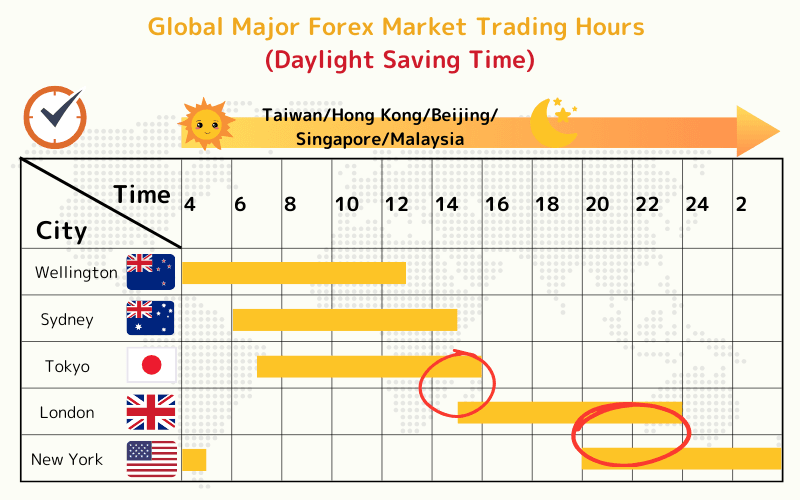
One of the defining characteristics of the London trading session is its overlap with other major markets.
In the first half of the London session, there is a brief overlap with the closing hours of the Asian market. In the second half, the session overlaps with the opening hours of the U.S. New York market.
This overlap creates heightened market volatility as it represents the period with the largest number of active participants and peak trading volumes.
When the London and New York markets overlap, particularly between 8:00 PM and 11:00 PM Taiwan/Hong Kong/Beijing/Singapore/Malaysia time, volatility reaches its peak.
This period is often accompanied by the release of critical economic data, such as the U.S. Non-Farm Payroll report or interest rate decisions, which can significantly impact the market.
Traders should approach this overlap with caution, as the increased activity and market-moving events offer both opportunities and risks. With the right strategies and risk management techniques, this time can be highly rewarding.
4. Best Trading Strategies for the London Session
Based on the characteristics of the London trading session, traders may consider the following strategies:
1. Trend Trading Strategy
The London session often exhibits strong market trends. Traders can use trend indicators such as moving averages or Bollinger Bands to identify market direction. Following the trend during clear market movements can be an effective approach.
2. Breakout Trading Strategy
Due to the high volatility in this session, breakout strategies tend to perform well.
When the price breaks through a key support or resistance level, it often triggers significant price movements, creating trading opportunities.
3. Overlap Trading Strategy
During the overlap between the London and New York sessions, traders can take advantage of heightened volatility, especially when major economic events occur.
This period is ideal for short-term traders looking to capitalize on rapid price fluctuations within a short timeframe.
By combining these strategies with proper risk management, traders can make the most of the dynamic nature of the London session.
5. How to Trade Effectively Using the Characteristics of the London Market
To successfully trade during the London session, traders should consider the following points:
1. Time Management
Understand the session's opening and closing hours, especially the overlap periods, to identify the best entry and exit times.
2. Risk Management
Given the high volatility of the London market, setting appropriate stop-loss and take-profit levels is crucial. Adjust position sizes and risk tolerance based on market conditions.
3. Monitor News and Data Releases
The London market is sensitive to major economic data. Traders should stay informed about key global economic events and use this information to plan their trades.
4. Choose the Right Currency Pairs
During the London session, currency pairs involving the British Pound (GBP), Euro (EUR), and US Dollar (USD) tend to show higher volatility. Traders can focus on these pairs based on their risk appetite.
By leveraging these strategies, traders can maximize opportunities in the dynamic London session.
6. Forex Trading with Titan FX
Titan FX offers around 60 currency pairs, allowing traders to choose between MT4 or MT5 platforms with leverage of up to 1,000x.
Advantages of Trading Forex with Titan FX
1. Low Spreads
Titan FX provides highly competitive spreads to minimize trading costs.
2. Fast Execution
Trade orders are executed quickly to ensure the best trading prices.
3. No Trading Restrictions
Supports various strategies, including scalping and hedging.
4. Leverage up to 1,000x
Offers fixed leverage as high as 1,000x.
5. Free Custom Indicators and EAs
Provides dozens of customizable indicators and EA tools.
6. Multiple Account Types
Standard, Blade, and Micro accounts are available to suit traders of all experience levels.
Currency Pairs Offered by Titan FX
Titan FX provides trading in approximately 60 currency pairs, categorized as follows:
Major Pairs
Major pairs involve the US Dollar (USD) and other major currencies, representing the most traded pairs globally. These pairs offer high liquidity and low trading costs.
Minor Pairs
Minor pairs do not include the US Dollar and typically consist of combinations of other major currencies such as the Euro, Pound, or Yen. These pairs are less liquid but still widely traded.
Exotic Pairs
Exotic pairs consist of a major currency paired with a currency from an emerging market or smaller economy. These pairs tend to have lower liquidity, higher volatility, and higher trading costs.
Trade Forex CFDs with Titan FX
Titan FX offers 50+ currency pair CFDs on MT4/MT5 with up to 1,000:1 leverage on major pairs, tight spreads, and the flexibility to go long or short. Micro accounts can reach up to 2,000:1 leverage when eligible.
7. FAQ
Q1. What are the London session forex trading hours?
In GMT+8 (Taiwan/Hong Kong/Beijing/Singapore): summer time (BST, last Sunday of March to last Sunday of October) is about 15:00–24:00; winter time (GMT) is about 16:00–01:00 the next day. That corresponds to roughly 08:00–16:00 London local time.
Q2. Why does the London session have the highest liquidity?
London accounts for about a third of global forex volume, and it overlaps the Asian close in its first half and the New York open in its second half, so participation and volume peak — driving the highest liquidity and volatility.
Q3. Which strategies suit the London session?
Trend-following, breakout, and scalping during the London–New York overlap work well. Because moves are large, strict stop losses and position sizing are essential.
Further Reading
Titan FX Research Team — investor-education content across forex, commodities (oil, precious metals, agriculture), stock indices, U.S. equities, and crypto assets.
Primary Sources (by Category)
- Market hours: General information on exchange session times
- Titan FX official: Economic calendar / Titan Time Range indicator