

New York Session Forex Trading: Key Characteristics, Strategies, and Tips

The New York session is the Americas leg of the 24-hour forex market, running roughly 8:00–17:00 local time. Because it overlaps with London and coincides with major U.S. data releases, it is one of the most liquid and volatile windows of the day.
The global forex market operates 24/7 and is primarily divided into three major sessions: Tokyo, London, and New York. The New York session, representing the Americas, is one of the most influential periods in the forex market.
With its overlap with the London session and the United States being the world’s largest economy, the New York session experiences peak market activity and volatility.
- Definition: the Americas session, roughly 8:00–17:00 local time
- Overlap effect: the London–New York overlap has the highest liquidity and volatility
- Strategies: breakout, trend-following, and data-driven event trading
- Risks: sharp moves and false breakouts; always set stops
- Tools: an economic calendar and session indicator help with timing
1. What Is New York Session Forex Trading?
New York, one of the world's largest financial hubs, represents the Americas in the forex market. The New York session refers to the opening hours of the American market. As the US Dollar (USD) is the primary reserve currency in global forex markets, currency pairs involving the USD, such as EUR/USD, GBP/USD, and USD/JPY, often dominate market activity during this session.
The timings of the New York session vary due to the implementation of daylight saving time in the United States:
| Time Period | New York Time | Taiwan/Hong Kong/Beijing/Singapore/Malaysia Time |
|---|---|---|
| Daylight Saving Time (EDT) | 08:00 ~ 17:00 | 20:00 ~ 05:00 |
| Standard Time (EST) | 08:00 ~ 17:00 | 21:00 ~ 06:00 |
Regardless of daylight saving time, liquidity and volatility in the New York session typically peak during the overlap with the London session. This overlap period is often considered the best trading window of the day by many traders.
2. Market Characteristics of the New York Trading Session
The New York trading session is characterized by high liquidity and significant volatility, especially during the release of key economic data. Major announcements, such as the U.S. Non-Farm Payrolls (NFP) report, Federal Reserve interest rate decisions, and other critical economic indicators, can cause sharp short-term market movements.
Compared to other sessions, the New York market places a stronger focus on USD-related currency pairs and reacts swiftly to global economic and political events. This often results in short-term price swings, making the New York session particularly appealing to short-term and volatility-focused traders.
During daylight saving time, the longer overlap with the London session enhances both liquidity and volatility. In contrast, during standard time, the shortened overlap slightly reduces market activity, leading to a decrease in overall volatility.
Understanding these characteristics allows traders to tailor their strategies for maximum effectiveness during the New York session.
3. Overlap Between the New York Session and Other Markets
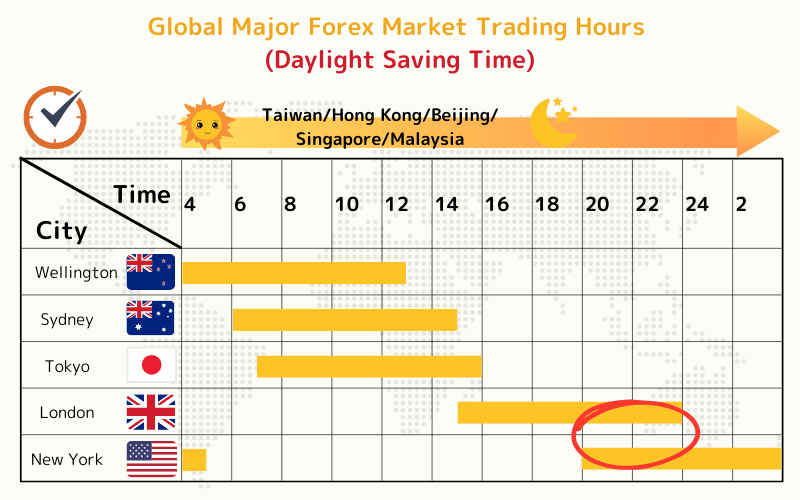
The early hours of the New York trading session overlap significantly with the London market, often referred to as the "golden trading hours." During this period, market participants from both Europe and the Americas are active, resulting in peak trading volume and heightened volatility.
This overlap period sees pronounced movements in major currency pairs like USD, EUR, and GBP, making it especially favorable for short-term traders focused on arbitrage or intraday trading.
Even after the London market closes, the New York session maintains significant volatility, particularly during major U.S. economic data releases or Federal Reserve announcements. These events often have a substantial impact on the USD exchange rate and can trigger widespread fluctuations across the global forex market.
4. Best Trading Strategies for the New York Session
Based on the characteristics of the New York trading session, traders can consider the following strategies:
1. Breakout Trading Strategy
With the high volatility of the New York session, currency rates often break through key support or resistance levels. Traders can use breakout strategies to quickly enter the market after a price breakout, capturing short-term profits.
2. Trend-Following Strategy
The high liquidity of the New York market frequently results in clear price trends. When there is a definitive upward or downward trend, traders can follow the trend to maximize opportunities, particularly with USD-related currency pairs, which tend to exhibit strong volatility during this session.
3. Economic Data Release Strategy
The New York session is marked by the release of significant U.S. economic data, such as Non-Farm Payrolls (NFP) and Consumer Price Index (CPI). Traders can engage in short-term trades before and after data releases, leveraging the rapid market fluctuations to identify profitable opportunities.
5. Forex Trading with Titan FX
Titan FX offers around 60 currency pairs, allowing traders to choose between MT4 or MT5 platforms with leverage of up to 1,000x.
Advantages of Trading Forex with Titan FX
1. Low Spreads
Titan FX provides highly competitive spreads to minimize trading costs.
2. Fast Execution
Trade orders are executed quickly to ensure the best trading prices.
3. No Trading Restrictions
Supports various strategies, including scalping and hedging.
4. Leverage up to 1,000x
Offers fixed leverage as high as 1,000x.
5. Free Custom Indicators and EAs
Provides dozens of customizable indicators and EA tools.
6. Multiple Account Types
Standard, Blade, and Micro accounts are available to suit traders of all experience levels.
Currency Pairs Offered by Titan FX
Titan FX provides trading in approximately 60 currency pairs, categorized as follows:
Major Pairs
Major pairs involve the US Dollar (USD) and other major currencies, representing the most traded pairs globally. These pairs offer high liquidity and low trading costs.
Minor Pairs
Minor pairs do not include the US Dollar and typically consist of combinations of other major currencies such as the Euro, Pound, or Yen. These pairs are less liquid but still widely traded.
Exotic Pairs
Exotic pairs consist of a major currency paired with a currency from an emerging market or smaller economy. These pairs tend to have lower liquidity, higher volatility, and higher trading costs.
Trade Forex CFDs with Titan FX
Titan FX offers 50+ currency pair CFDs on MT4/MT5 with up to 1,000:1 leverage on major pairs, tight spreads, and the flexibility to go long or short. Micro accounts can reach up to 2,000:1 leverage when eligible.
6. FAQ
Q1. What are the New York session forex trading hours?
Roughly 8:00–17:00 local time, which is about 21:00–06:00 the next day in GMT+8 (summer time; one hour later in winter). The London overlap (about 21:00–24:00) is the busiest.
Q2. Why is the London–New York overlap the most volatile?
Two major financial centers are open at once, so liquidity and volume peak, and most U.S. economic data is released then — making large price moves more likely. Day traders favor this window.
Q3. Which strategies suit the New York session?
Breakout, trend-following, and data-driven event trading work well. Because moves are large, strict stop losses and position sizing are essential.
Further Reading
Titan FX Research Team — investor-education content across forex, commodities (oil, precious metals, agriculture), stock indices, U.S. equities, and crypto assets.
Primary Sources (by Category)
- Market hours: General information on exchange session times
- Titan FX official: Economic calendar / Titan Time Range indicator