

Tokyo Session Forex Trading: Key Characteristics, Strategies, and Tips

The Tokyo session (roughly 9:00–18:00 Japan time) opens the global forex day. It is yen-led, active in Asian pairs, and relatively low in volatility — well suited to range trading. Its moves are driven by Japanese data and Asian safe-haven sentiment, it overlaps with Sydney, Hong Kong, and Singapore, and it sets the tone for the later London and New York sessions.
The global forex market operates 24/7, with trading sessions in different regions following one another. As the representative of the Asian market, the Tokyo session is the first active period in the forex market each day.
Tokyo session forex trading is a crucial part of the global forex market. Although its trading volume is smaller compared to the London and New York sessions, it holds a significant position in the opening phase of the Asian market.
- The definition of the Tokyo session and its Japan-time (JST) range
- Traits: yen-led, low volatility, Asian-data driven
- Overlap effects with Sydney, Hong Kong, and Singapore
- Strategies: range trading, sudden yen moves, data trading
- Risks like thin liquidity and safe-haven swings, and how to trade at Titan FX
- 1. What is Tokyo Session Forex Trading?
- 2. Characteristics of the Tokyo Trading Session
- 3. Overlap of the Tokyo Session with Other Markets
- 4. Best Trading Strategies for the Tokyo Session
- 5. Risks and Challenges of the Tokyo Session
- 6. How to Trade Effectively Using the Characteristics of the Tokyo Market
- 7. Forex Trading with Titan FX
- 8. Frequently Asked Questions (FAQ)
- 9. Summary
1. What is Tokyo Session Forex Trading?
Tokyo is one of the core financial hubs in Asia, and the Tokyo trading session refers to the opening hours of the Asian market.
Tokyo attracts traders from around the world, with Asian currencies like the Japanese Yen (JPY) being particularly active during this session.
The Tokyo session's schedule remains fixed throughout the year as Japan does not observe daylight saving time. Below are the corresponding Tokyo session timings:
- Tokyo Time (JST): 08:00~16:00
- Taiwan/Hong Kong/Beijing/Singapore/Malaysia Time (CST): 07:00~15:00
2. Characteristics of the Tokyo Trading Session
The Tokyo trading session is relatively stable, characterized by lower volatility, particularly when significant economic data is not being released.
However, as Japan is the third-largest economy globally, the importance of the Japanese Yen (JPY) as a safe-haven currency ensures that the Tokyo market retains considerable influence.
During this session, currency pairs involving Asian currencies, such as USD/JPY, AUD/JPY, and EUR/JPY, are particularly active, providing ample opportunities for traders focusing on these pairs.
3. Overlap of the Tokyo Session with Other Markets
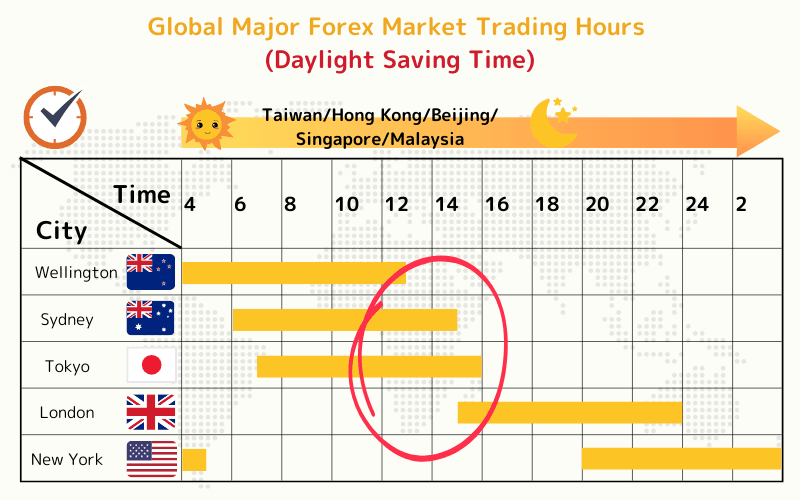
The Tokyo session partially overlaps with the Asian and Australian markets, leading to increased volatility for certain currency pairs during this time.
In the early part of the session, there is overlap with the Sydney market, while the later part coincides with trading hours in Hong Kong and Singapore. This market overlap enhances liquidity in Asian currencies.
Additionally, the Tokyo session is often regarded as a "transitional" period, bridging the gap before the opening of the more volatile London and New York sessions.
Although overall market activity is relatively calm during this time, significant economic events, such as policy announcements from the Bank of Japan, can trigger sharp market movements.
This makes the Tokyo session a unique opportunity for traders who prefer a stable environment while remaining prepared for sudden spikes in volatility.
4. Best Trading Strategies for the Tokyo Session
Based on the characteristics of the Tokyo trading session, traders can consider the following strategies:
1. Range Trading Strategy for Low Volatility
During the Tokyo session, the relatively low volatility makes range trading an effective approach.
Traders can identify support and resistance levels, buying when the price approaches support and selling near resistance.
2. Trend Trading for Yen-Related Pairs
Given the active trading of the Japanese Yen (JPY) during the Tokyo session, traders can capitalize on market trends involving yen pairs.
This is especially relevant during periods of risk-off sentiment when yen-related currency pairs tend to experience greater volatility.
3. Economic Data Release Strategy
The Tokyo session often coincides with the release of Japanese economic data, such as Bank of Japan interest rate decisions or other key indicators.
These releases can trigger significant movements in the yen and related currency pairs, offering short-term trading opportunities for those prepared to act before and after the data is released.
5. Risks and Challenges of the Tokyo Session
The Tokyo session offers stability and technical predictability, but its relatively low volume and geopolitical sensitivity carry risks worth noting.
Risk 1: Price jumps from thin liquidity
Tokyo accounts for only about 6–8% of global forex volume; without major data or news, participation is light and a "liquidity vacuum" can form. Wider spreads, gapping quotes, and slippage become more likely — especially impacting short-term and high-frequency strategies.
Risk 2: Sharp moves from safe-haven sentiment
The yen is a major safe-haven currency, so Asian geopolitical tension or sudden news from China or South Korea can send yen pairs like USD/JPY swinging hard in a short time. Without a stop-loss in place, traders face drawdown risk.
Risk 3: Uncertainty around Japanese data and policy
Although Tokyo is generally calm, reactions can be violent around Bank of Japan (BOJ) statements or key data such as CPI and GDP. A large gap from expectations triggers instant moves, so plan ahead with the economic calendar and set risk-control orders.
6. How to Trade Effectively Using the Characteristics of the Tokyo Market
To succeed during the Tokyo trading session, traders should focus on the following points:
1. Time Management
The Tokyo session is ideal for traders who prefer low-volatility markets, particularly when other major global markets are closed. Understanding the session's opening and closing times helps identify the best entry and exit points.
2. Risk Management
Although the Tokyo market is generally less volatile, significant economic data releases can still cause price swings. Setting appropriate stop-loss levels is crucial to protect capital during unexpected movements.
3. Choose Suitable Currency Pairs
During the Tokyo session, yen-related pairs such as USD/JPY, AUD/JPY, and EUR/JPY typically have the highest trading volume. Traders can focus on these pairs to find trading opportunities based on their volatility patterns.
4. Market Correlation Analysis
The Tokyo session is often considered the "opening act" of the global forex market. Traders can use the performance of the Tokyo market to gauge potential trends for the upcoming London and New York sessions, allowing for better preparation.
7. Forex Trading with Titan FX
Titan FX offers around 60 currency pairs, allowing traders to choose between MT4 or MT5 platforms with leverage of up to 1,000x (2,000x on eligible Micro accounts).
Advantages of Trading Forex with Titan FX
1. Low Spreads
Titan FX provides highly competitive spreads to minimize trading costs.
2. Fast Execution
Trade orders are executed quickly to ensure the best trading prices.
3. No Trading Restrictions
Supports various strategies, including scalping and hedging.
4. Leverage up to 2,000x
Offers fixed leverage as high as 2,000x.
5. Free Custom Indicators and EAs
Provides dozens of customizable indicators and EA tools.
6. Multiple Account Types
Standard, Blade, and Micro accounts are available to suit traders of all experience levels.
Currency Pairs Offered by Titan FX
Titan FX provides trading in approximately 60 currency pairs, categorized as follows:
Major Pairs
Major pairs involve the US Dollar (USD) and other major currencies, representing the most traded pairs globally. These pairs offer high liquidity and low trading costs.
Trade Forex CFDs with Titan FX
Titan FX offers 50+ currency pair CFDs on MT4/MT5 with up to 1,000:1 leverage on major pairs, tight spreads, and the flexibility to go long or short. Micro accounts can reach up to 2,000:1 leverage when eligible.
8. Frequently Asked Questions (FAQ)
Q1: What are the Tokyo forex trading hours?
The Tokyo session runs roughly 9:00–18:00 Japan time (JST), with the most active core around 9:00–15:00, partly overlapping Sydney, Hong Kong, and Singapore.
Q2: Which strategy suits the Tokyo session?
With relatively low volatility, range trading fits well; around Japanese data or safe-haven sentiment, you can also catch sudden moves in yen pairs.
Q3: Which pairs are most active in Tokyo?
Mainly yen pairs such as USD/JPY, EUR/JPY, and AUD/JPY, plus Asia-sensitive pairs like AUD/USD.
Q4: Why is Tokyo volatility lower?
Participants are concentrated in Asia while Western institutions are not yet active; volume is only about 6–8% of the global total, so liquidity and volatility are smaller.
Q5: What risks should I watch in the Tokyo session?
Mainly wider spreads and price jumps from thin liquidity, plus safe-haven swings from BOJ policy or sudden Asian news. Pair the economic calendar with stop-losses.
9. Summary
As the opening of the forex day, the Tokyo session is less active than London or New York, yet its stable volatility, yen-centric pricing, and density of Asian information set the tone for the broader market. Amid Asia's news sensitivity and safe-haven flows, Tokyo often offers reference value for observing trends and positioning early.
By understanding the structural traits of the Tokyo session, applying suitable strategies, and managing risk effectively, you can make rational decisions in a relatively calm environment — and gain key clues for how the later major sessions may unfold.
Further Reading
- London Session Forex Trading Guide
- New York Session Forex Trading Guide
- Forex Trading Hours Overview
- Economic Calendar
Titan FX's financial-market research team. We cover a broad set of instruments — foreign exchange, commodities (crude oil, precious metals, agricultural products), equity indices, US equities, and digital assets — producing educational content for investors.
Primary Sources (by Category)
- Sessions and market structure: BabyPips — Forex Trading Sessions, BIS — Triennial FX Survey
- Economic data: Bank of Japan