

What Is a Financial Market? Types, Functions, and Applications
In investing, the "financial market" is the foundation of every trading decision. Whether in equities, FX, or commodities, price movements fundamentally stem from the flow of capital and shifts in supply and demand.
For investors, understanding how financial markets work is more than learning terminology — it is the first step to building trading logic. Once you grasp market structure, extending that framework into practical areas like forex and CFDs becomes much easier.
1. What Is a Financial Market? Core Concepts and Key Functions
A financial market is the mechanism and venue in which suppliers and users of capital trade assets and allocate capital, covering equities, bonds, currencies, and a wide range of financial instruments. Prices are mainly determined by capital flows and supply–demand dynamics — capital flowing into an asset tends to push prices higher, while outflows tend to lower them.
These price dynamics define how markets operate, and they ensure that opportunity and risk exist side by side at all times.
Beyond the trading function itself, financial markets serve several other important roles.
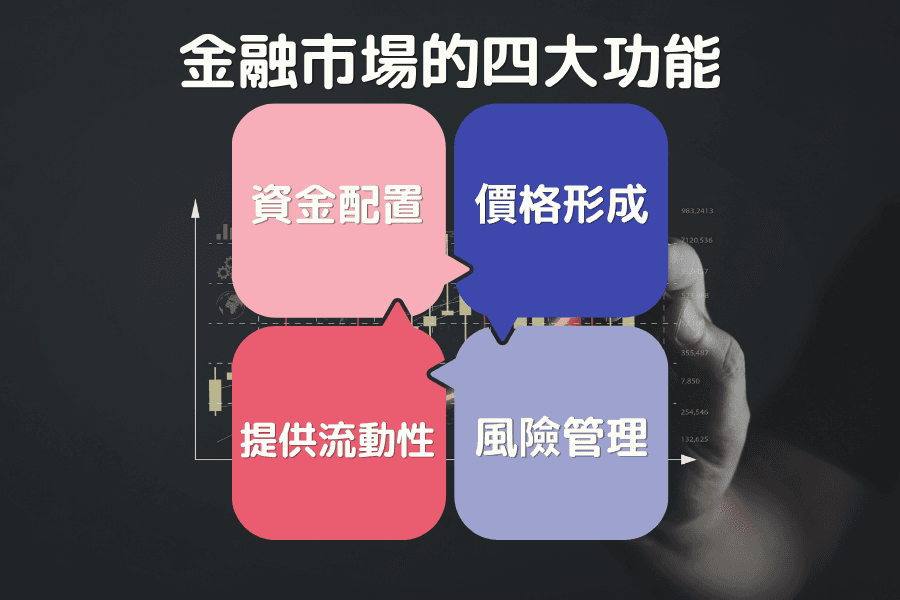
Function 1: Capital Allocation
Financial markets channel capital from savers to businesses and governments, helping resources move toward more efficient uses. When capital concentrates in higher-growth industries, it also supports broader economic development.
Function 2: Price Discovery
Market transactions continuously refresh asset prices. These prices reflect investors' expectations about the future — such as interest-rate paths, corporate earnings, and policy shifts.
Function 3: Risk Management
Through various financial instruments, investors can diversify or hedge risk. When uncertainty rises, capital tends to flow into relatively stable assets.
Function 4: Liquidity Provision
Markets allow assets to be converted into cash quickly, improving capital efficiency and letting investors adjust positions at any time.
Modern financial markets are increasingly electronic and global, and capital can move rapidly across venues — one of the key reasons price volatility has accelerated in recent years.
2. Types of Financial Markets
Based on the assets traded, financial markets are generally divided into a few main categories, each with its own operating logic and participants.
Type 1: Equity Market
Companies issue ownership claims (shares) to raise long-term capital. Investors participate in corporate growth through capital gains driven by share-price changes, or by receiving dividends.
Type 2: Bond Market
Governments and large corporates issue debt instruments to raise capital. Buying a bond is effectively lending to the issuer in exchange for steady interest income, making bonds an important defensive core in asset allocation.
Type 3: Money Market
This market handles short-term instruments with maturities of one year or less, such as Treasury bills or interbank lending. Yields are relatively low, but extremely high liquidity makes it a preferred venue for institutional investors to park short-term cash.
Type 4: Foreign Exchange Market (Forex)
Currently the world's largest market, operating 24 hours. Differences in national economies and policies translate into currency exchange-rate volatility that generates huge arbitrage and trading opportunities.
Type 5: Derivatives Market
Includes futures, options, and Contracts for Difference (CFDs). Values here are linked to underlying assets such as equities, bonds, or commodities, providing more flexible operational dimensions.
3. Trading Instruments: From Physical Assets to Derivatives
In financial markets, investors can categorize the instruments they trade by whether they take physical ownership.
Spot Trading
The most traditional model — investors pay the full amount to take actual ownership of the asset. Examples include buying physical gold from a bank or holding stocks. The advantage is genuine ownership; the drawback is higher capital usage and less operational flexibility.
Contractual Trading
Here, investors do not necessarily want to own the physical asset but instead trade on the direction of price movement, as in forex and CFDs.
This model lets investors control a larger position with limited capital through margin. As markets digitalize further, contractual trading has become the mainstream way modern traders seek swing-style returns.
4. Applications in Forex and CFD Trading
Within the broader framework of financial markets, forex and CFD trading have become strategic focus areas for individual investors thanks to their high liquidity.
Forex trading centers on the relative strength of national economies, with prices influenced heavily by rate policy and geopolitical factors. CFDs further lower the barrier by allowing investors to trade stocks, indices, and commodities in a single wrapper — without needing to open multiple physical accounts.
The defining characteristic is bidirectionality: whether the market is bullish or bearish, accurate directional reading creates the opportunity for profit. At the same time, this raises the bar on risk management.
Advantages of Trading Forex and CFDs with Titan FX
When investors step deeper into forex and CFD markets, the quality of the platform matters for operating experience and execution efficiency.
Titan FX provides a low-spread, fast-execution environment suited to strategies that need to respond quickly to market moves. Multi-market coverage (forex, indices, commodities) supports more flexible asset allocation.
Stable systems and clearly defined trading conditions help improve the precision of risk controls and the consistency of trading decisions.
| Advantage | Description |
|---|---|
| High Leverage | Standard and Blade accounts up to 1,000x; Micro accounts up to 2,000x (conditions apply) — flexibility for capital deployment. |
| Low Spreads | Competitive spreads — for example, EUR/USD from about 0.2 pips — helping reduce trading costs. |
| Fast Execution | High-efficiency order execution helps limit slippage impact during volatility. |
| Advanced Platforms | Supports MT4 and MT5, with complete technical-analysis tools and automated trading. |
| Free Tools | Technical indicators and EA automated trading tools help optimize strategies. |
| Multilingual Support | Customer support in English, Japanese, Chinese and more. |
| Educational Resources | FX fundamentals, daily market analysis, and strategy content. |
| Flexible Funding | Multiple deposit methods, with a minimum deposit of just USD 1. |
| Zero Cut (Negative Balance Protection) | Protection mechanism in extreme market conditions to prevent account balances from going negative. |
Free Trading Tools at Titan FX (Custom Indicators and EAs)
Titan FX provides multiple free trading tools — custom technical indicators and EAs (automated trading programs) — to help traders improve market analysis and execution efficiency.
Custom indicators help traders observe market trends and technical signals more clearly, while EAs automate trades based on preset strategies, reducing the impact of emotional factors on decisions.
Together, these tools make it easier to conduct analysis and execute strategy efficiently.
5. Summary
Financial markets are the core mechanism of capital flow and price discovery — the foundation of all investment activity. Different markets are linked through capital flow, so global asset prices influence one another.
Once investors understand market structure and capital flows, they can more clearly interpret the drivers of price movement and form a view on market direction. Whether choosing equities, bonds, or forex and CFD trading, building stable risk management and a consistent trading framework is the key to participating in markets over the long run.
Titan FX Trading Strategy Research Institute
The financial market research team at Titan FX. We produce educational content for investors covering a broad range of instruments including forex (FX), commodities (crude oil, precious metals, agriculture), stock indices, U.S. equities, and cryptocurrencies.
Primary sources: BIS, IMF, FRED, CME Group, Bloomberg, Reuters