

Macroeconomics Introduction: How GDP, Inflation and Rates Shape Markets
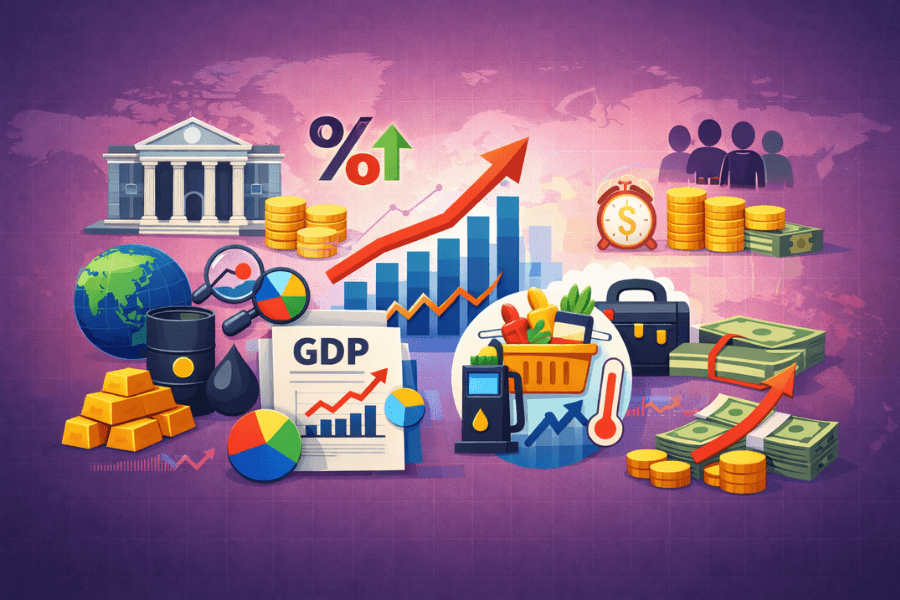
In financial markets, price movements are driven not only by individual companies or single assets, but by shifts in the overall economic environment.
Many traders focus only on technicals or isolated news and miss the real key behind trends: macroeconomics.
For investors, understanding macro helps grasp the big picture — rate changes, inflation pressure, and the growth cycle directly shape FX, equity, and commodity markets.
1. What Is Macroeconomics? Basic Concepts
Macroeconomics is the study of the overall operation of an economy, including national growth, inflation pressure, employment, and the direction of monetary policy. It treats a country — or the global economy — as a single large system, focusing on aggregate-level changes and trends.
Unlike microeconomics, which studies the decisions of individual firms and consumers, macroeconomics focuses on how the economy operates as a whole and how those dynamics influence the market environment. A macro lens lets investors identify the broad direction of markets more clearly, instead of being caught in the local swings of a single asset.
2. Key Indicators Watched in Macroeconomics
Macroeconomics observes economic health through a set of data points, which are also the ones markets watch most closely.
Indicator 1: GDP (Gross Domestic Product)
GDP measures a country's total economic activity and is a core gauge of growth. Rising GDP usually signals the economy is in an expansion phase.
Indicator 2: Inflation
Inflation reflects the pace of price increases and directly affects the purchasing power of the currency and rate policy. When inflation runs too high, central banks typically tighten policy.
Indicator 3: Unemployment Rate
The unemployment rate captures labor-market conditions. A falling rate usually indicates more active economic activity and stronger consumer capacity.
Indicator 4: Interest Rates and Central Bank Policy
Interest rates are set by the central bank and are a key driver of funding costs and market liquidity. Rate moves influence corporate investment, housing, and asset prices.
Practical Tool: Tracking Macro via Titan FX Economic Indicators
Macroeconomics is not static theory — it is driven by data releases that come out continuously. To help traders stay ahead, Titan FX provides economic indicator lists and a calendar. With these tools you can intuitively track trends across major economies, and at release time compare expected vs actual values to identify possible inflection points.
3. How Macroeconomics Moves Financial Markets
Macroeconomics influences markets through several channels, with the most direct impact coming from interest rates and inflation.
Impact 1: Cost of Capital
When rates rise, the cost of borrowing and expansion rises for companies, and consumer spending may soften, typically weighing on equity markets. Higher rates can also attract overseas flows into that currency, lifting the exchange rate.
Impact 2: Purchasing Power and Asset Pricing
When inflation heats up and domestic currency purchasing power falls, commodities such as gold and oil often rally, serving as hedges or stores of value.
Impact 3: Rate Differentials and FX
In FX, rate differentials and growth divergence between countries are the main engines of currency moves. Differences between U.S. and Japan data, for instance, are a core driver of USD/JPY.
4. Macro vs. Micro: The Relationship
Macro and micro economics interact closely — together they form a complete economic system and jointly shape the trajectory of financial markets.
Relationship 1: The Whole Shapes the Individual
When the overall economy improves, company operations tend to benefit, consumers spend more, and demand rises. These changes feed through into earnings and share prices, often lifting broad markets and related sectors.
Conversely, as growth slows or enters recession, earnings pressure rises, confidence falls, and equities and risk assets tend to come under joint pressure.
Relationship 2: Individuals Aggregate into the Whole
Corporate investment, consumer spending, and market behavior gradually aggregate into macro data. Firm expansion and rising consumption ultimately show up in GDP, which then feeds back into central-bank policy and market expectations.
In other words, every purchase and every corporate decision eventually flows into the broader economic force shaping the market.
Understanding this two-way dynamic helps investors read markets from multiple angles — not just the data itself, but the logic behind price movement.
5. Summary
Macroeconomics provides an important framework for understanding how markets work, letting investors observe capital flows and price changes from a top-down view. Through indicators like interest rates, inflation, and growth, you can gradually build a sense of where the market cycle sits.
In practice, market prices often lead macro changes. If investors can continuously track data and understand how markets interpret it, they can more easily identify trends and potential opportunities.
With tools like Titan FX's economic calendar and indicator lists, traders can follow data shifts in real time and translate macro analysis into concrete decisions. When macroeconomics stops being just theory and becomes a tool you actually use, investment decisions become more stable and logical.
Titan FX Trading Strategy Research Institute
The financial market research team at Titan FX. We produce educational content for investors covering a broad range of instruments including forex (FX), commodities (crude oil, precious metals, agriculture), stock indices, U.S. equities, and cryptocurrencies.
Primary sources: BIS, IMF, FRED, CME Group, Bloomberg, Reuters