

Alternative Investment
Beyond stocks and bonds lies a far broader investment universe. When traditional markets fall in lockstep and diversification breaks down, more investors turn to alternative investments in search of returns that move independently of the broad market.
This article breaks down what alternative investments are and how they differ from traditional assets, their main types, their advantages within a portfolio, and the risks to weigh before getting in.
- The definition of alternative investments and how they differ from traditional assets
- Common types of alternative investments and practical use cases
- Key advantages of adding alternatives to a portfolio
- Potential risks and challenges investors should consider
- Answers to frequently asked questions
1. What Are Alternative Investments? Definition and Key Characteristics
Alternative investments are asset classes and strategies outside traditional financial markets. Unlike stocks, bonds, and cash, alternatives include real estate, private equity, commodities, hedge funds, and cryptocurrencies.
These assets typically have lower liquidity, higher entry barriers, and distinct risk-return profiles, making them advanced or diversified asset allocation options.
Why Are They Called "Alternative"?
"Alternative" means non-mainstream or supplementary. These investments differ from traditional markets (listed equities, government bonds) in asset characteristics, investment methods, and trading environments. For investors seeking flexibility beyond stocks and bonds, they offer compelling complementary choices.
Traditional vs. Alternative Investments: Key Differences
| Factor | Traditional Investments | Alternative Investments |
|---|---|---|
| Common assets | Stocks, government bonds, ETFs, money market funds | Private equity, real estate, hedge funds, commodities |
| Market information | Highly transparent and publicly available | Less public; information asymmetry is common |
| Liquidity | High; easy to buy and sell | Generally low; longer time to convert to cash |
| Entry barrier | Accessible to the general public | Higher; often limited to accredited or institutional investors |
| Risk profile | Relatively predictable | High risk and high return potential coexist |
| Asset correlation | Highly correlated with equities | Often low correlation; provides diversification benefits |
Who Is Suited for Alternative Investments?
Alternative investments are particularly well-suited for investors who:
- Want to reduce overall portfolio volatility
- Seek long-term capital growth and diversified income sources
- Can tolerate limited liquidity or elevated risk levels
- Have sufficient capital and the ability to use advanced investment tools
2. Common Types of Alternative Investments
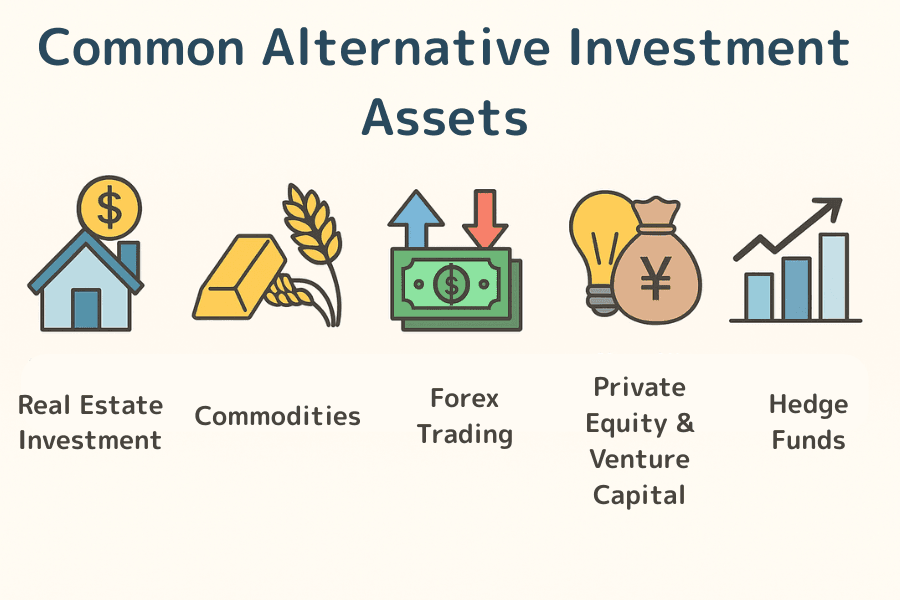
Alternative investments span a wide range of asset types with varying risk structures and return profiles. Below are five representative categories with their practical applications.
2.1. Real Estate
Includes directly purchasing residential, commercial, or industrial properties, or gaining indirect exposure through Real Estate Investment Trusts (REITs).
- Advantages: Offers both rental income and capital appreciation, with inflation-hedging properties
- Risks: Requires significant capital outlay and high transaction costs; returns are sensitive to location and economic cycles
2.2. Commodities
Encompasses gold, silver, crude oil, natural gas, and agricultural products, typically accessed through futures contracts, ETFs, or specialized funds.
- Advantages: Low correlation with equities; can provide a hedge during inflationary periods or market turbulence
- Risks: Subject to significant price swings driven by geopolitical events and supply-demand imbalances
2.3. Forex Trading
Involves profiting from exchange rate movements between currency pairs (such as EUR/USD and USD/JPY), with leverage to amplify capital efficiency.
- Advantages: The world's largest market by trading volume, offering extremely high liquidity
- Risks: Rapid and sharp price movements; leverage magnifies potential losses as well as gains
Related: Beginner's Guide to Forex Trading
2.4. Private Equity and Venture Capital
Direct investment in unlisted companies (private equity) or funding startups in exchange for equity stakes (venture capital).
- Advantages: If the target company succeeds, returns can far exceed those of traditional markets
- Risks: Extremely low liquidity with long lock-up periods; high probability of failure
2.5. Hedge Funds
Employ diverse strategies including long-short positions, leveraged trades, and cross-market arbitrage to pursue absolute returns regardless of market direction.
- Advantages: Flexible response to changing market conditions through a broad toolkit of investment techniques
- Risks: Management fees and performance fees tend to be high; strategy transparency is limited, requiring strong trust in the fund manager's ability
3. Core Advantages of Alternative Investments
Alternative investments deliver portfolio optimization effects that traditional assets alone cannot achieve. Incorporating non-mainstream asset classes enables more flexible and diversified allocation strategies.
3.1. Low Asset Correlation Enhances Diversification
Alternatives often exhibit low or even inverse correlation with stocks and bonds. During downturns, certain alternative assets can remain stable or appreciate, reducing the portfolio's systemic risk.
3.2. Returns Independent of Market Direction
Strategies such as event-driven or long-short hedging do not rely on a sustained bull market to generate profits, enabling relatively stable returns across different economic cycles.
3.3. Expanded Portfolio Diversification
Adding alternative assets opens new revenue streams such as rental income, royalties, and commodity trading profits, preventing returns from being overly concentrated in a single market or sector.
4. Potential Challenges of Alternative Investments
While alternatives can improve portfolio resilience, they present practical challenges that require careful evaluation before committing capital.
4.1. Liquidity and Redemption Constraints
Most alternatives, especially private-market assets, require extended timeframes to liquidate. Limited secondary-market demand can restrict the flexibility of capital deployment.
4.2. Difficulty in Valuation and Information Access
Alternative assets lack public-market pricing transparency. Investors must rely on professional appraisals or fund manager disclosures, increasing information asymmetry and decision-making difficulty.
4.3. High Management Costs and Entry Thresholds
Many alternative products impose high minimum investments alongside management and performance fees. For smaller allocations, fee ratios can significantly erode returns.
4.4. Complexity of Strategy and Risk
Alternatives often involve sophisticated strategies such as derivatives arbitrage and cross-market allocation, requiring solid financial knowledge and risk management capability. Missteps can lead to substantial losses.
5. FAQ
Q1: Are alternative investments suitable for every investor?
Not necessarily. Alternatives generally suit investors with moderate to high risk tolerance and sufficient financial knowledge. If your investment horizon is short or you have high liquidity needs, alternatives may not be appropriate as a core allocation.
Q2: Are alternative investments the same as "high-risk investments"?
Not exactly. While some alternatives, such as highly leveraged forex trading or venture capital funds, carry elevated risk, others, such as established real estate in prime locations or infrastructure funds, are relatively conservative. The key lies in selecting the right assets and managing risk appropriately.
Q3: How are returns on alternative investments measured?
Because alternative assets often lack real-time market pricing, returns are typically evaluated using fund net asset value (NAV), rental income, dividends, or capital gains upon exit. Investors should pay close attention to the valuation methodology and the frequency of reporting.
Q4: How can investors reduce the information opacity risk of alternative investments?
Choose products approved by regulated authorities, review third-party audit reports, and thoroughly understand the background of the management team and their investment strategy. These steps can meaningfully improve transparency and security.
6. Summary
Alternative investments offer a way to move beyond traditional asset limitations, enhancing portfolio diversification and risk resilience. Their low-correlation characteristics smooth overall volatility during turbulence while creating additional return sources.
However, challenges remain: limited liquidity, low information transparency, and high management thresholds. Investors should carefully assess lock-up periods, risk tolerance, and strategy complexity before entering these markets.
Success in alternative investing is not about chasing the highest returns but combining traditional and alternative assets in appropriate proportions for the optimal risk-reward balance. For those exploring how the FOMC influences markets or deepening their understanding of asset allocation, alternatives provide a valuable dimension of portfolio construction.
Further Reading
Titan FX's financial market research and analysis team produces investor education content across a wide range of financial instruments, including foreign exchange (FX), commodities (crude oil, precious metals, and agricultural products), stock indices, U.S. equities, and crypto assets.
Primary Sources (by category)
- Public institutions and data: SEC (U.S. Securities and Exchange Commission) -- Alternative Investments guidance; CFTC (Commodity Futures Trading Commission) -- investor resources
- Industry associations: CAIA Association -- Chartered Alternative Investment Analyst curriculum; Preqin -- Private Capital reports
- Academic and research: CFA Institute -- Alternative Investments study materials