

Plaza Accord
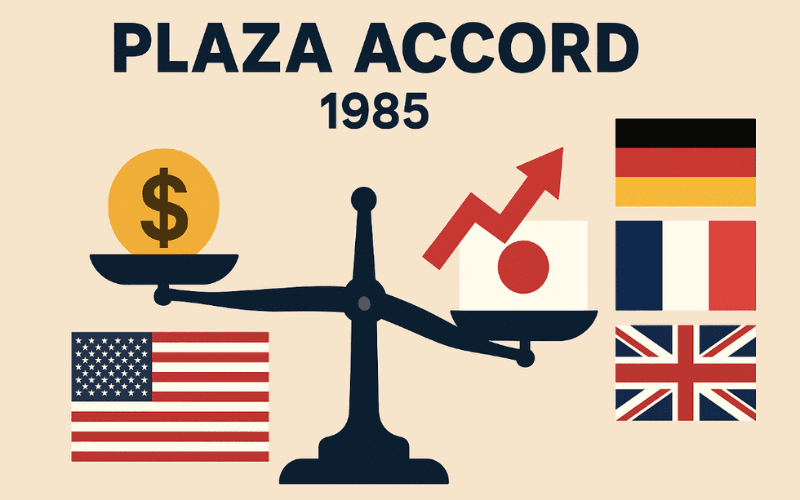
The Plaza Accord was a 1985 agreement among the G5 (US, Japan, UK, West Germany, France) to jointly intervene in currency markets to correct an overvalued US dollar.
In the history of international monetary policy, the Plaza Accord stands out as one of the few turning points that genuinely reshaped global finance. The model of coordinated FX intervention it pioneered rebalanced the relationships among major currencies and set a template for international policy cooperation for years to come.
The accord did not just shift exchange-rate trajectories — it sent ripples through Japan's economy and global markets that we are still discussing decades later. This article walks through the background, content, and lasting significance of the Plaza Accord.
Whether you are a student of economic history, a market participant, or a policymaker reading the past for clues about today, the Plaza Accord case study remains one of the richest references in modern monetary cooperation.
- The 1985 Plaza Accord: G5 (US, Japan, UK, West Germany, France) intervened jointly to push down an overvalued dollar.
- Background: high Fed rates pulled capital into the dollar, blowing out the US trade deficit, especially against Japan and West Germany.
- Mechanics: coordinated FX intervention plus aligned policy signalling — no fixed target, just orderly adjustment.
- Impact: USD/JPY almost halved in two years, Japan eased aggressively, and the 1990s asset bubble took root.
- A historical mirror: coordination works, but heavy-handed intervention has costs — the 1987 Louvre Accord was the corrective.
1. Summary of the Plaza Accord: Five Nations Pushing Down the Dollar
The Plaza Accord was a major monetary agreement reached on September 22, 1985, when the finance ministers and central-bank governors of the United States, Japan, the United Kingdom, West Germany, and France (the G5) met at the Plaza Hotel in New York.
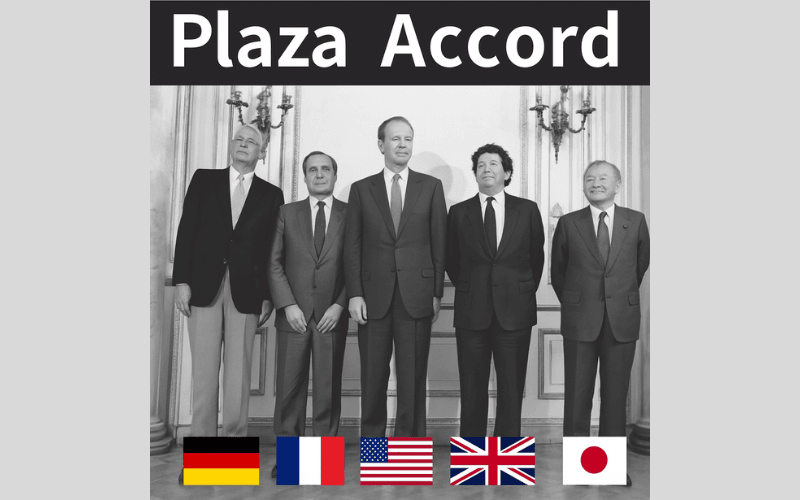
At the time, the dollar was excessively strong on the back of high US interest rates and capital inflows, a strength that was widening the US trade deficit and weakening export competitiveness.
To address this global imbalance, the G5 agreed to coordinated FX-market intervention — pushing the dollar gradually lower while letting other major currencies appreciate in an orderly manner, so as to bring international payments back into balance.
The communiqué stated that exchange rates should help adjust global imbalances, and that an orderly appreciation of major currencies against the dollar would be conducive to economic stability.
Notably, the agreement set no specific exchange-rate target. Its focus was policy direction and a posture of cooperation — an exercise of unprecedented international coordination.
The Plaza Accord did not just move exchange rates; it became a textbook case of modern monetary-policy cooperation and one of the milestones of international finance.
2. Background: Strong Dollar and Trade Imbalances
In the early 1980s, as the United States emerged from a period of high inflation and stagflation, the Federal Reserve raised interest rates sharply to tame prices. The combination drew capital into dollar assets and propelled the currency higher.
Between 1980 and 1985, the dollar appreciated more than 50% against the yen and the Deutsche mark.
A persistently strong dollar made US exports expensive abroad, eroding competitiveness. The trade deficit widened, with the imbalance against Japan and West Germany becoming particularly severe. Meanwhile, exporters in other economies benefited from weaker home currencies, deepening US frustration and economic strain.
To address this global imbalance, Washington began seeking talks with other major economies, hoping coordinated FX intervention could pull the dollar lower and produce fairer trade conditions — laying the groundwork for the Plaza Accord.
3. Main Content and Measures of the Plaza Accord
The core spirit of the accord was multinational coordinated action to address the imbalance caused by an overvalued dollar. The principal measures were:
3.1 Coordinated FX-market intervention
Central banks agreed to enter the market to buy their own currencies and sell dollars, directly pushing the dollar lower and lifting other major currencies.
3.2 Policy cooperation and unified signalling
Beyond the actual operations, the participating governments used public statements and coordinated policy direction to send a clear message to markets: "the dollar should depreciate." That posture shaped market expectations.
3.3 Emphasis on orderly adjustment
The accord did not call for sharp swings — it sought an "orderly appreciation" of major currencies, correcting the imbalance in a controlled way and avoiding market panic.
A distinctive feature was that the parties did not commit to specific numerical exchange-rate targets. Instead, they aligned on policy stance and the direction of intervention — an unusually broad consensus among the major economies of the day.
The approach is often described as a form of "managed floating," and it became a reference for subsequent international monetary-policy cooperation.
4. Impact of the Plaza Accord on Each Country
The Plaza Accord triggered coordinated G5 intervention that drove the dollar sharply lower, with broad effects on exchange rates, trade structures, and policy direction. Indirectly, it also contributed to economic restructuring and transitions across the Asia-Pacific region.
United States
As the architect of the accord, the United States hoped to weaken the dollar and shrink its trade deficit.
In the short run, the export environment improved, with sectors like autos and steel showing some recovery.
But the deficit problem was not structurally resolved — the US economy remained driven by imports and consumption.
Japan
Japan was the country most deeply affected. USD/JPY fell from roughly 240 to 120 over two years — close to a doubling of the yen.
- Export shock: autos, electronics, and other flagship industries saw exports fall sharply.
- Domestic stimulus: the government rolled out easier monetary policy and fiscal expansion, supporting consumption and investment.
- Bubble formation: capital flowed into equities and real estate, pushing asset prices to extremes — eventually leading to the bursting of the 1990s bubble and prolonged stagnation.
West Germany
The Deutsche mark's appreciation pressured exports but also helped contain inflation, with domestic demand staying steady.
The West German economy proved resilient overall and went on to play a central role in subsequent European monetary integration.
United Kingdom and France
The two countries' currencies were less affected.
The UK doubled down on developing its financial sector, with London cementing its position as a hub of international capital.
France focused on monetary stability and industrial policy, responding with a measured approach.
Hong Kong
A weaker dollar lifted Hong Kong's export competitiveness, although local manufacturing was already entering a transition.
Many manufacturers moved production to mainland China, while Hong Kong gradually transformed into a regional finance and management hub, becoming a key support platform for China's reform and opening-up.
Taiwan
Exports benefited from a weaker dollar, but the shift also pushed Taiwan to think about market diversification and industrial upgrading.
Companies began investing in Southeast Asia and mainland China, expanding global footprints and accelerating high-tech industry development.
Mainland China
The Plaza Accord indirectly accelerated foreign-capital inflows into China, with Hong Kong-Taiwanese and Japanese companies setting up operations on a large scale.
Special Economic Zones like Shenzhen developed rapidly, becoming hubs of manufacturing and exports — a key force pushing forward China's reform and opening-up.
Singapore
Although FX volatility briefly affected its financial market, Singapore successfully strengthened its position as a regional financial centre, drawing capital with stable policy and an open market and laying foundations for subsequent economic development.
5. Historical Significance and Aftermath
The Plaza Accord's Place in History
The Plaza Accord is regarded as a landmark in international monetary cooperation.
After the collapse of the Bretton Woods system in the 1970s, the world entered a floating-rate era in which exchange-rate moves often became disorderly under the sway of market sentiment.
The 1985 accord was the first time major economies formally coordinated to adjust exchange-rate trajectories through a written agreement, with a focus on policy alignment and joint intervention — an unprecedented step at the time.
Notably, no specific exchange-rate target was set. The focus was on policy direction and a posture of cooperation, an example of "managed floating."
This flexible-but-aligned approach set the tone for subsequent international economic-policy cooperation and is recognised as a precursor to the G7 governance of global imbalances.
Aftermath: From Plaza to Louvre
Louvre Accord — February 1987
After the Plaza Accord, the dollar fell faster than expected, generating market dislocation and policy strain. To prevent further excessive depreciation, the G7 met at the Louvre in Paris in February 1987 and signed the Louvre Accord as a corrective and continuation of the Plaza framework.
Key elements:
- Exchange rates should be kept around "current reasonable levels," avoiding excessive volatility.
- The United States committed to fiscal-deficit reduction and structural reform.
- Japan and West Germany committed to expanding domestic demand and reducing export dependence.
The Louvre Accord marked a shift from a depreciation-driven approach to an exchange-rate stability target — a pivotal turn in policy.
Christmas Accord — December 1987
In late 1987, although the G7 did not hold a formal meeting, an informal consensus extension known as the Christmas Accord reaffirmed the existing framework for stable exchange rates — an extension of the Louvre Accord.
While its impact was less significant than the Plaza or Louvre accords, it reflected the G7's continued commitment to global economic cooperation in the late 1980s.
6. Plaza Accord Q&A

Q1: What lessons does the Plaza Accord offer?
The Plaza Accord and the subsequent Louvre Accord show both the promise and the limits of international monetary cooperation.
What worked:
- The dollar was successfully pushed lower, easing the US trade deficit.
- The episode established a workable template for international exchange-rate coordination.
Potential problems:
- Excessive intervention can distort market mechanisms.
- Japan's response — sustained easing into yen appreciation — eventually fed an asset bubble and a prolonged downturn.
The takeaway is that exchange-rate intervention is sometimes warranted, but pacing and scope must be carefully managed to avoid long-term side effects.
Q2: What is "coordinated intervention"?
Coordinated intervention refers to multiple central banks acting jointly in foreign-exchange markets to influence exchange rates. In the Plaza Accord, for example, participating countries collectively sold dollars and bought their own currencies, pushing the dollar lower.
The exercise is not just trading — the more important effect is the policy signal sent to markets, demonstrating consensus among major economies on exchange-rate goals and shaping investor behaviour and market expectations.
7. Conclusion: A Mirror from History
The Plaza Accord was not just an episode of international cooperation on exchange-rate policy. It is a mirror reflecting the delicate balance between global economic coordination and market reactions.
It successfully pushed the dollar lower and eased trade imbalances, but it also revealed the potential cost of policy intervention.
For policymakers today, the Plaza experience still offers important lessons: coordination can deliver, but force and timing must be wielded with great care.
Further Reading
- Inflation — The 1980s strong-dollar story begins with high US inflation and Fed tightening.
- Trade Deficit — The structural imbalance the Plaza Accord set out to address.
- Raise Interest Rates — The Fed's anti-inflation rate policy of the early 1980s.
- Cut Interest Rates — The Japanese easing that followed Plaza and seeded the bubble economy.
- Monetary Policy — The policy framework central banks use to coordinate.
- Asset Allocation — Long-term investment lessons from the Plaza Accord era.
The Titan FX Research team covers global macroeconomic indicators, foreign exchange (FX), commodities (oil, precious metals, agriculture), equity indices, US stocks, and crypto assets, producing educational content for investors and traders.
Primary Sources by Category
- Official data and regulators: U.S. Department of the Treasury — "Announcement of the G5 Plaza Accord (Sept 22, 1985)"; Federal Reserve Bank of St. Louis FRED — Trade Weighted U.S. Dollar Index; Bank of Japan — "Exchange-Rate Policy and Monetary Coordination Histories"; Bundesbank archive on the 1985 G5 ministerial meeting.
- International institutions and research: International Monetary Fund (IMF) — "The Plaza Accord and Exchange Rate Coordination"; Bank for International Settlements (BIS) — Annual Economic Report (1985-1987); National Bureau of Economic Research (NBER) — Working Papers on the Plaza Accord and the Yen-Dollar Exchange Rate.
- Media and historical references: Bloomberg; Reuters; Federal Reserve History — "Plaza Accord, 1985"; coverage of the Louvre Accord (February 1987) and the Christmas Accord (December 1987); academic studies on the relationship between the Plaza Accord and Japan's bubble economy (1986-1991).