

Global Gold Trading Markets: Where Are the Spot, Futures & ETF Exchanges?
The global gold market spans spot, futures, and ETFs, with major venues including London's LME, New York's COMEX, Zurich, Shanghai's SGE, Hong Kong's CGSE, Tokyo's TOCOM, and Dubai's DGCX.
Gold is not only a precious metal but also a key safe-haven asset and a pillar of financial policy in the global economy.
From Western financial centers such as London and New York to Asian market hubs such as Tokyo, Shanghai, Dubai, and Hong Kong, international gold trading markets each have their own character shaped by geographic and economic factors, together forming the global gold trade network.
This article takes an in-depth look at the history, characteristics, and influence of these markets, helping investors and analysts understand how gold trading markets operate and the role they play in the global economy, supporting better precious-metal investment decisions.
- Gold is a key safe-haven asset and a pillar of global financial policy
- Participants span central banks, miners, investment banks, hedge funds, and retail
- Trading takes spot, futures, ETF, and over-the-counter (OTC) forms
- Seven major venues: LME, COMEX, Zurich, CGSE, SGE, TOCOM, DGCX
- COMEX gold futures and SGE physical trade are key global pricing references
1. The Historical Role of Gold as a Precious Metal and Investment Vehicle
Gold has been a symbol of wealth and power since ancient times. In ancient Egypt, gold was used to adorn temples and tombs; in medieval Europe, it became the foundation of currency, underpinning the gold standard.
In the 19th century, as the Industrial Revolution and international trade expanded, gold's financial role was further reinforced, making it a cornerstone of global economic stability.
In the 20th century, following the rise and fall of the Bretton Woods system, gold shifted into an investment and safe-haven asset, with demand surging especially during economic crises such as the 2008 financial meltdown.
Today, gold is not only a focal point of precious-metal investment but also plays a key role in inflation protection, hedging, and portfolio diversification.
2. The Key Players in the Global Gold Market
The functioning of the global gold market relies on a range of participants, including:
Central Banks
Such as the U.S. Federal Reserve and the People's Bank of China, which influence market stability through their gold reserves.
Further reading: Why Do Central Banks Favor Gold?
Mining Companies
Such as Barrick Gold and Newmont, which handle extraction and supply.
Investment Banks and Hedge Funds
Such as Goldman Sachs and Bridgewater Associates, which influence prices through trading and speculation.
Jewelers and Industrial Users
Such as Tiffany & Co. and the electronics industry, which consume gold in ornaments and technical applications.
Retail Investors
Who participate in the market through gold ETFs or CFDs, driving liquidity.
Through their diverse strategies, these participants collectively determine the supply-and-demand dynamics of the gold market.
Further reading:
3. Types and Characteristics of Gold Trading Markets
Gold trading markets are divided into several types based on their form of trading and mode of operation. The following is a comparison of their characteristics:
| Market Type | Characteristics | Representative Markets | Trading Advantages | Limitations |
|---|---|---|---|---|
| Spot Market | Instant buying and selling of physical or electronic gold, with no maturity limit | Zurich, Hong Kong CGSE | High liquidity, immediate delivery | Requires handling storage and transport |
| Futures Market | Standardized contracts for future delivery or settlement | COMEX, TOCOM, LME | Price discovery and risk hedging | Maturity pressure, high margin requirements |
| ETF Market | Funds based on the price of gold, requiring no physical holding | Major stock exchanges worldwide | Easy to invest in, no storage costs | Management fees, liquidity dependent on the fund |
| Over-the-Counter (OTC) | Direct interbank trading, flexible and customizable | Zurich, Hong Kong CGSE | Customized contracts, high privacy | Lack of standardization, higher risk |
Together, these market types enhance the depth and breadth of gold trading, meeting the needs of different investors.
4. Where Are the Spot, Futures, and ETF Exchanges?
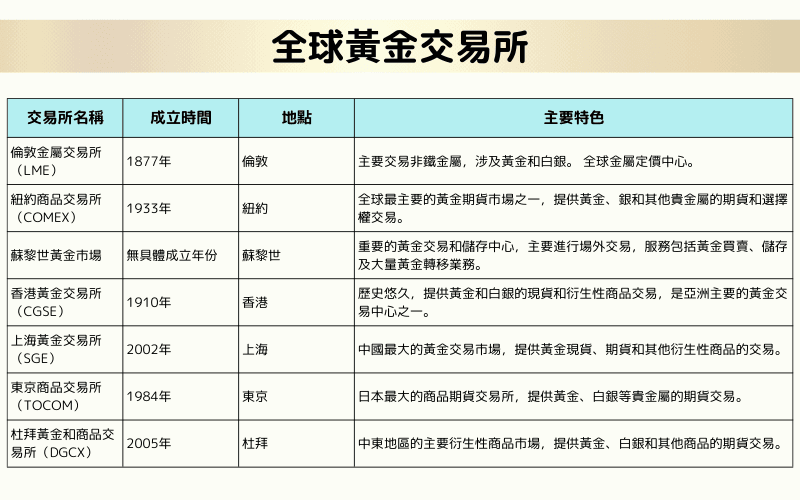
Below is the distribution of the world's major gold trading markets, covering spot, futures, and ETF trading.
4.1. London Metal Exchange (LME)
The London Metal Exchange (LME), founded in 1877, is the world's largest market for non-ferrous metals, while also covering gold and silver trading.
The LME is renowned for its diverse product range, offering trading in base metals such as copper, aluminum, and zinc, and has launched futures and options on gold and silver.
The LME's pricing benchmarks are widely recognized by metal producers, consumers, and investors around the world, exerting a profound influence on the gold market.
The LME's innovative services—such as same-day delivery settlement and electronic trading platforms—improve trading efficiency and transparency, and its price movements serve as a key indicator for analyzing the health of the global economy and industry.
4.2. New York Commodity Exchange (COMEX)
The New York Commodity Exchange (COMEX), established in 1933, is the world's leading gold futures market and also trades precious metals such as silver.
COMEX is known for its high liquidity, attracting mining companies, financial institutions, and investors, and providing tools for price discovery and risk management.
COMEX's gold futures prices serve as a global pricing benchmark, and its electronic trading system ensures efficiency and transparency.
COMEX is not only a core trading market in North America but also influences precious-metal pricing worldwide, with its data often used to assess economic conditions.
4.3. Zurich Gold Market
Although the Zurich Gold Market is not a traditional exchange, it is an important global center for gold trading and storage.
Located in Zurich, the heart of Switzerland's financial sector, the Zurich Gold Market boasts a century-long history of gold trading and has been a key hub for gold circulation and financial operations since the early 20th century.
Local banks and private vaults store vast quantities of gold, serving central banks, financial institutions, and investors.
Its over-the-counter (OTC) model is flexible, and although it is not an official pricing benchmark, it has a significant influence on global gold prices.
Zurich leads in gold recycling and refining, helping to maintain market liquidity and stability.
4.4. Chinese Gold and Silver Exchange Society (CGSE)
The Chinese Gold and Silver Exchange Society (CGSE), founded in 1910, is one of Asia's oldest financial exchanges, focusing on gold and silver trading.
Leveraging Hong Kong's status as an international financial center, the CGSE connects mainland China with global markets, offering both spot and derivatives trading.
The CGSE's over-the-counter trading model is flexible and provides storage services, attracting investors from around the world.
The CGSE's pricing and trading activity influence global trends, driving the development of both regional and international gold markets.
4.5. Shanghai Gold Exchange (SGE)
The Shanghai Gold Exchange (SGE), established in 2002, is the main platform for China's gold market and one of the world's largest physical gold trading markets.
The SGE was created to enhance the openness and international competitiveness of China's gold market by providing a unified domestic gold trading market.
The SGE offers a diverse range of gold trading products, including spot gold, gold futures, and other financial derivatives.
These products meet a wide range of needs, from individual investors to large financial institutions.
The Shanghai Gold Exchange also places particular emphasis on market standardization and transparency, adopting advanced trading and clearing technology to ensure fairness and efficiency in transactions.
As the core of China's gold market, the SGE has not only driven the development of the domestic gold market but has also strengthened the interconnectivity of the global gold market through its links with international markets.
The SGE plays an important role in regulating global gold supply and demand and in shaping the formation of gold prices, making it a key participant in global gold trading.
4.6. Tokyo Commodity Exchange (TOCOM)
The Tokyo Commodity Exchange (TOCOM) was established in 1984.
TOCOM is Japan's most important commodity trading platform, holding a particularly prominent position in the futures trading of gold and other precious metals.
The exchange offers futures trading in gold, silver, and other commodities such as rubber and petroleum products, making it one of Asia's important financial markets.
TOCOM's gold futures are the primary means by which investors in Japan and the wider Asian region participate in the global gold market.
Through its efficient electronic trading system, TOCOM provides market participants with fast, transparent trade execution, making it an ideal platform that attracts both domestic and international investors.
In addition, TOCOM's gold futures contracts—thanks to strict market regulation and strong market liquidity—are regarded as effective tools for risk management and investment.
The Tokyo Commodity Exchange plays an important role in promoting the development of regional financial markets and providing a reference point for gold prices.
Through its interaction with global markets, TOCOM has strengthened the ties between Asia and other major financial markets around the world, making a significant contribution to the internationalization of gold prices.
4.7. Dubai Gold & Commodities Exchange (DGCX)
The Dubai Gold & Commodities Exchange (DGCX) was established in 2005.
The DGCX is the Middle East's first derivatives exchange, offering a wide range of commodity and currency futures trading, including gold, silver, and crude oil.
The exchange holds an important position in connecting Eastern and Western markets and providing a diverse range of financial products.
The Dubai Gold & Commodities Exchange is particularly known for its gold futures contracts, which give global and regional investors the opportunity to trade gold in a politically and economically stable environment.
Leveraging Dubai's geographic advantages and free-trade policies, the DGCX has attracted a large number of international investors and financial institutions, becoming a center of financial innovation in the Middle East.
The DGCX's operations have improved the transparency and efficiency of the regional market, while providing global investors with an effective venue for hedging and asset allocation.
Through its advanced trading and clearing technology, the DGCX ensures the security of transactions and the overall health of the market, exerting a significant influence on advancing financial services and international trade for the regional economy.
5. Conclusion
This article has detailed the world's major gold trading markets, including the London Metal Exchange (LME), the New York Commodity Exchange (COMEX), the Zurich Gold Market, the Chinese Gold and Silver Exchange Society (CGSE), the Shanghai Gold Exchange (SGE), the Tokyo Commodity Exchange (TOCOM), and the Dubai Gold & Commodities Exchange (DGCX).
Through their diverse products and services, these markets drive gold pricing, liquidity, and risk management. From London's historical tradition to Shanghai's rapid rise, each market plays a unique role in the global landscape.
As economic globalization and market integration deepen, these markets will continue to shape gold supply chains, investment strategies, and economic policy. Understanding their functions and characteristics helps investors and analysts grasp market dynamics and make informed decisions.
Trade Gold CFDs with Titan FX
Titan FX offers gold CFDs (XAU/USD) with up to 1,000:1 leverage, tight spreads, and the flexibility to go long or short without holding physical gold.
6. Frequently Asked Questions (FAQ)
Q1. What are the most important gold exchanges in the world?
The LME, COMEX, Zurich, CGSE, SGE, TOCOM, and DGCX are the seven major markets (§4).
Q2. How do spot and futures gold markets differ?
Spot settles physical or electronic gold immediately, while futures use standardized contracts for future delivery (§3).
Q3. What is a gold ETF?
A fund that tracks the gold price without requiring physical holdings, easy to invest in and free of storage costs (§3).
Q4. Which market sets the key gold price reference?
COMEX gold futures prices are regarded as the global pricing benchmark (§4).
Q5. How can retail investors take part?
Through gold ETFs or CFDs, without handling physical storage (§2).
Further Reading
- What Is the Gold Standard
- Trading Gold CFDs
- Factors Affecting Gold Prices
- Global Gold Demand
- Central Bank Gold Reserves
Titan FX Trading Strategy Lab. We produce educational content for investors across forex, precious metals, energy, indices, US stocks, and crypto, covering technical analysis and how markets work.
Primary Sources (by Category)
- Educational & data: Investopedia, World Gold Council
- Market & data: Bloomberg, Reuters, and exchange disclosures (LME, COMEX, SGE, etc.)