

Introduction to Precious Metals Trading: Types, Applications, Price Drivers, and Trading Methods
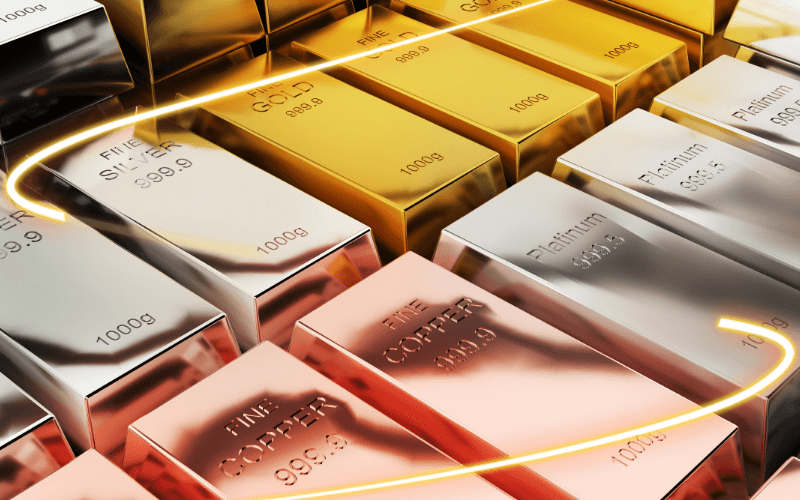
Precious metals — chiefly gold, silver, platinum, and palladium — are rare, economically valuable metals that act both as stores of value (safe-haven assets) and as industrial inputs. Their prices are driven by the global economy, monetary policy, supply and demand, and geopolitics, and they can be traded via physical bullion, ETFs, futures, or leveraged two-way CFDs (contracts for difference).
Whenever markets turn turbulent, money tends to flow toward the metals seen as safe havens — an instinct thousands of years old that still moves global markets today. This guide breaks down what shapes precious metals' characteristics, uses, and prices, and how to actually invest in and trade them.
From ancient Egyptian pharaohs to modern investors, metals like gold, silver, and platinum group metals (PGMs) have been used as currency, jewelry, and essential industrial materials.
Their durability, aesthetic appeal, and critical applications in technology, healthcare, and energy sectors underscore their importance in today’s world.
This article explores the types, properties, market behavior, and investment value of precious metals, analyzes key factors influencing their prices, and examines their evolving role and challenges in the global economy.
- Four major precious metals: how gold, silver, platinum, and palladium (PGMs) differ in properties and uses
- Dual nature: serving as both safe-haven stores of value and industrial inputs (electronics, auto catalysts, medical)
- Price drivers: the global economy, monetary policy and rates, supply and demand, geopolitics, and speculation
- Mining and supply: leading producers (China, Australia, Russia, South Africa, Mexico) and the supply chain
- Investment methods: physical, ETFs, futures, and CFDs — plus the leverage and two-way trading CFDs offer
1. Types and Characteristics of Precious Metals
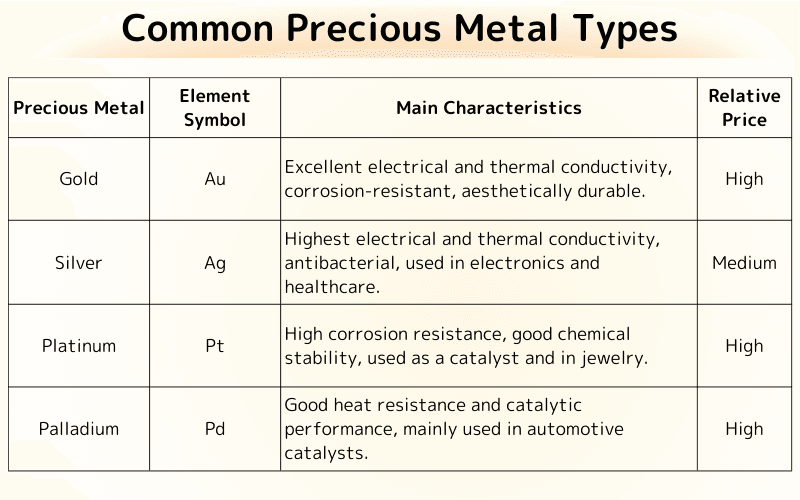
Precious metals primarily include gold, silver, and PGMs such as ruthenium, rhodium, palladium, osmium, iridium, and platinum.
These metals are celebrated for their beauty, chemical resistance, and stability, making them ideal for various applications and as stores of value. Among these, gold, silver, platinum, and palladium dominate the investment landscape.
Gold
Gold’s exceptional corrosion resistance and luster make it a staple for currency, jewelry, and art.
Its excellent conductivity and stability make it indispensable in modern electronics, such as computer chips and precision connectors.
Silver
Silver boasts the highest electrical and thermal conductivity, making it ideal for electronics and electrical applications.
Its antibacterial properties extend its use to healthcare, including wound dressings and medical devices. Additionally, its reflectivity makes it essential for photography and reflective materials.
Platinum
Highly resistant to corrosion and valued for its stability, platinum is favored in jewelry and catalytic converters in the automotive industry, helping reduce harmful emissions.
It is also used as a catalyst in petroleum refining and chemical processes.
Palladium
A member of the platinum group, palladium is crucial in automotive catalytic converters, transforming toxic emissions into less harmful gases.
It is also used in electronics, multilayer ceramic capacitors, and jewelry, often as a cost-effective alternative to white gold.
2. Mining and Global Supply of Precious Metals
Mining and global supply of precious metals involve complex processes influenced by geography, technology, economics, and politics. Major precious metals like gold, silver, platinum, and palladium are primarily mined in resource-rich countries.
| Precious Metal | Major Producing Countries & Characteristics |
|---|---|
| Gold | China, Australia, Russia, and Canada. These countries ensure stable gold supply through advanced mining and refining technologies. |
| Silver | Mexico is the largest producer, followed by Peru and China. Silver is often mined alongside base metals like copper, lead, and zinc. |
| Platinum & Palladium | Predominantly mined in South Africa and Russia, which control most of the global supply of platinum group metals. |
3. Factors Influencing Precious Metal Prices
The dynamics and prices of precious metals are affected by various factors, including global economic conditions, monetary policies, market speculation, and supply-demand changes.
Global Economic Conditions
Economic cycles significantly influence precious metal prices. Industrial demand for silver, platinum, and palladium rises during economic growth, while gold demand increases during recessions as a safe-haven asset.
Monetary Policy and Interest Rates
Central bank policies, particularly interest rate decisions, greatly impact the market. Low-interest rates lower the opportunity cost of holding non-yielding assets like gold, often leading to price increases.
Market Speculation
Speculative trading activities based on market forecasts can cause significant short-term price fluctuations in the precious metal market.
Supply and Demand Changes
Supply disruptions, such as mining strikes or political instability, can drive prices up, while advancements in mining or recycling technology may increase supply and lower prices.
Demand from new technologies, such as clean energy, can also raise prices for specific metals like platinum and palladium.
Geopolitical Factors
Instability in major producing countries or sanctions can disrupt supply chains and influence market prices.
4. Investment Methods for Precious Metals
Investing in precious metals is a key strategy for diversifying portfolios and hedging risks. Popular investment methods include:
- Exchange-Traded Funds (ETFs)
- Physical Assets (Gold Bars, Coins)
- Futures Contracts
- Contracts for Difference (CFDs)
Advantages of CFDs in Precious Metal Trading
1. High Flexibility
CFDs allow speculative trading on price movements without owning physical metals, enabling quick market entry and exit.
2. Leverage
CFDs provide leverage, enabling control over larger positions with a small margin, increasing profit potential (and risks).
3. Diversification
Access to multiple precious metals (gold, silver, platinum) without needing physical assets.
4. Bidirectional Trading
Profit opportunities from both rising and falling markets through long and short positions.
5. Cost Efficiency
CFD trading avoids storage and insurance costs associated with physical assets.
6. No Physical Delivery
Eliminates logistics and security challenges of physical metal ownership.
5. Trading Precious Metals with Titan FX
To start trading CFDs on precious metals, open a Titan FX trading account, which can be set up within a day.
With Titan FX, you can trade gold (XAU), silver (XAG), platinum (XPT), and palladium (XPD) with ease.
Benefits of Trading Precious Metals on Titan FX
1. High Leverage
- Up to 1,000x on Micro accounts.
- Up to 500x on Standard and Blade accounts.
2. Advanced Analysis Tools
Dozens of free tools for MT4 and MT5 platforms.
3. Cutting-Edge Platforms
Access to industry-standard MT4 and MT5 platforms.
4. Low Spreads
Competitive costs for efficient trading.
5. Fast Execution
Reduced slippage risk with quick order execution.
6. Strong Customer Support
Multilingual support (English, Chinese, Japanese) to assist traders.
7. Educational Resources
Comprehensive educational content and daily market analysis to enhance decision-making.
Trade Precious Metal CFDs with Titan FX
Titan FX offers gold, silver, platinum and palladium CFDs — up to 1,000:1 leverage on gold (XAU/USD) and 500:1 on silver and others, with tight spreads and long/short flexibility.
6. Frequently Asked Questions (FAQ)
Q1. What are precious metals, and which are the main ones?
Precious metals are rare, chemically stable metals with significant economic value. The most important are gold, silver, platinum, and palladium — the latter two belonging to the platinum-group metals (PGMs) alongside ruthenium and rhodium. They serve both as stores of value and as industrial materials.
Q2. Why is gold considered a safe-haven asset?
Gold carries no issuer credit risk, has limited supply, and tends to hold its value over the long run. During recessions, financial stress, or inflation, investors flock to gold, which often retains value even when equities and currencies fall.
Q3. What drives precious metal prices?
The main factors are the global economic cycle, central-bank monetary policy and interest rates, the supply-and-demand balance, geopolitical risk, and market speculation. Low rates reduce the cost of holding non-yielding gold and tend to lift its price, while silver, platinum, and palladium are more sensitive to industrial demand.
Q4. How do gold, silver, platinum, and palladium differ?
Gold is corrosion-resistant and value-preserving, used in currency, jewelry, and electronics; silver has the best electrical conductivity, used in electronics, medicine, and photography. Platinum and palladium are essential for automotive catalytic converters, with supply concentrated in South Africa and Russia.
Q5. How can I invest in or trade precious metals?
Options include physical bullion (bars, coins), ETFs, futures, and CFDs (contracts for difference). CFDs let you trade price movements without owning the metal, use leverage to control larger positions with less margin, and profit in both rising and falling markets — without storage or insurance costs.
Further Reading
- Gold CFD Trading
- Silver: Origin and Evolution
- Global Gold Exchanges
- Gold-Silver Ratio
- What Is Leverage
Titan FX Trade Strategy Research Lab covers forex (FX), commodities (oil, precious metals, agricultural products), stock indices, U.S. equities, and crypto assets — producing educational content for retail investors across asset classes.
Primary Sources (by category)
- Industry Bodies & Statistics: World Gold Council, The Silver Institute, LBMA (London Bullion Market Association)
- Official Institutions: USGS Mineral Commodity Summaries
- Education & Market Data: Investopedia, precious-metals analysis from Bloomberg and Reuters