

Why Do Central Banks Favor Gold? An In-Depth Analysis of Global Gold Reserves and Future Trends

Gold reserves are the official gold held by central banks — a strategic asset for storing value, preserving monetary-policy independence, and responding to crises. As of March 2025, official world gold reserves stood at about 36,234 tonnes, with the United States first at 8,133.5 tonnes. China, Russia, and others have been adding aggressively, reflecting de-dollarization and safe-haven demand and influencing gold prices.
Gold has long symbolized wealth and power. Even as modern monetary policy and financial instruments grow more complex, gold keeps its central place in the global financial system.
For central banks, gold is not just a safe-haven asset but a key tool for safeguarding national finances and preserving currency credibility. As global uncertainty rises, the size and strategy of central-bank gold reserves reveal each nation's readiness for uncertainty and its pursuit of economic autonomy.
This article digs into gold's role, the current state of global reserves, the economic impact, and investment opportunities — revealing gold's strategic value in international finance.
- Gold's three roles for central banks: store of value, policy independence, crisis response
- The top 10 gold-holding nations and their latest reserves (WGC 2025)
- How gold reserves affect fiscal security, credit costs, and international influence
- Recent central-bank gold buying and the de-dollarization backdrop
- How to access the gold market via Titan FX gold CFDs
1. The Role and Significance of Gold
Gold plays multiple roles on central-bank balance sheets, combining economic and strategic functions that underpin national financial stability.
1.1 Store of Value
With its scarcity, durability, and global recognition, gold is an ideal store of value. During crises, high inflation, or currency depreciation, gold preserves value better than paper money and acts as a financial "last line of defense." Independent of any single currency, it lets central banks withstand market swings and keep wealth stable. Historically, gold underpinned global monetary stability under the gold standard.
1.2 Monetary-Policy Independence
Gold strengthens a nation's autonomy within the dollar-led global monetary system. Facing sanctions, exchange-rate pressure, or market volatility, central banks can use gold to stabilize the domestic currency and reduce reliance on foreign currency — the U.S. dollar in particular. Gold reserves can also hedge a currency war, adding policy flexibility.
1.3 Crisis-Response Tool
Gold provides crucial liquidity. Amid market turmoil, foreign-reserve shortages, or balance-of-payments crises, central banks can sell gold or pledge it as collateral to raise funds and ease fiscal pressure. Its global liquidity allows quick conversion, helping steady market confidence and the economy.
2. Global Gold Reserves by Country
According to the World Gold Council (WGC) monthly statistics published in May 2025 (data as of March 2025), official world gold reserves stood at about 36,233.9 tonnes — roughly one-fifth of all gold ever mined. The Eurozone (including the European Central Bank) holds 10,765.4 tonnes, 66.1% of its foreign reserves. The International Monetary Fund (IMF) holds about 2,814 tonnes, 7%–10% of global gold reserves. The top 10 holders as of March 2025:
| Rank | Country | Tonnes | Gold as % of Foreign Reserves | Data as of |
|---|---|---|---|---|
| 1 | United States | 8,133.5 | 78.0% | Mar 2025 |
| 2 | Germany | 3,351.3 | 77.2% | Mar 2025 |
| 3 | Italy | 2,451.8 | 74.2% | Mar 2025 |
| 4 | France | 2,437.0 | 74.8% | Mar 2025 |
| 5 | Russia | 2,329.6 | 36.0% | Mar 2025 |
| 6 | China | 2,292.3 | 6.5% | Mar 2025 |
| 7 | Switzerland | 1,039.9 | 11.2% | Mar 2025 |
| 8 | India | 879.6 | 13.5% | Mar 2025 |
| 9 | Japan | 846.0 | 6.7% | Mar 2025 |
| 10 | Turkey | 623.9 | 43.7% | Mar 2025 |
The U.S. leads with 8,133.5 tonnes, stored in high-security sites such as Fort Knox and Federal Reserve banks, underscoring its long-term reliance on gold. The high ratios of Germany, Italy, and France (all above 66%) reinforce Eurozone financial stability and the euro's credibility. Active buying by China and Russia reflects de-dollarization and economic-independence strategies, driving gold-price moves and creating opportunities.
3. Economic Impact of Gold Reserves
Gold reserves profoundly shape a nation's economic policy and international standing across several dimensions.
3.1 Fiscal Security and Liquidity Support
Gold provides a liquidity buffer in crises, securing fiscal stability. Amid market turmoil or reserve pressure, central banks can sell or pledge gold to stabilize the currency and raise funds. During the 1990s Asian financial crisis, for example, Thailand and South Korea used gold reserves to ease external-debt pressure and restore confidence.
3.2 Credit Instrument and Borrowing Costs
Gold reserves lift a nation's credit rating and markedly reduce international borrowing costs, as creditors treat gold as repayment security and trim risk premia. A well-reserved country like Germany, for instance, can issue bonds at lower yields than reserve-poor peers, saving billions in interest.
3.3 International Influence
Large reserves boost influence in global economic governance. Backed by 8,133.5 tonnes, the U.S. holds a leading role in the IMF and World Bank, shaping monetary policy and aid allocation. Germany's and France's high reserves strengthen the Eurozone's role and support trade deals and currency swaps.
3.4 Strategic Defense
Gold reserves are a strategic asset against geopolitical and economic risk. In trade tensions, sanctions, or currency wars, gold acts as a hedge that shields a nation from external shocks.
4. Gold CFD Investing on Titan FX
Titan FX offers CFD trading on gold (XAU), silver (XAG), platinum (XPT), and palladium (XPD), suited to investors seeking flexibility. Account opening is fast — often within a day.
Titan FX Account Opening Guide| Advantage | Description |
|---|---|
| High leverage | Up to 1,000x on gold (XAU/USD). |
| Low spreads | Competitive spreads to lower trading costs. |
| Fast execution | Reduced slippage for efficient trading. |
| Advanced platforms | Supports MT4 and MT5. |
| Free tools | Dozens of technical-analysis tools. |
| Multilingual support | Support in English, Japanese, and Chinese. |
4.1 How to Start Gold CFD Trading
Gold CFD trading is simple: open a Titan FX account, fund it, and download MT4 or MT5 to trade gold CFDs and capture price moves.
4.2 Tools That Support Gold Trading
Gold/Silver Ratio Tool
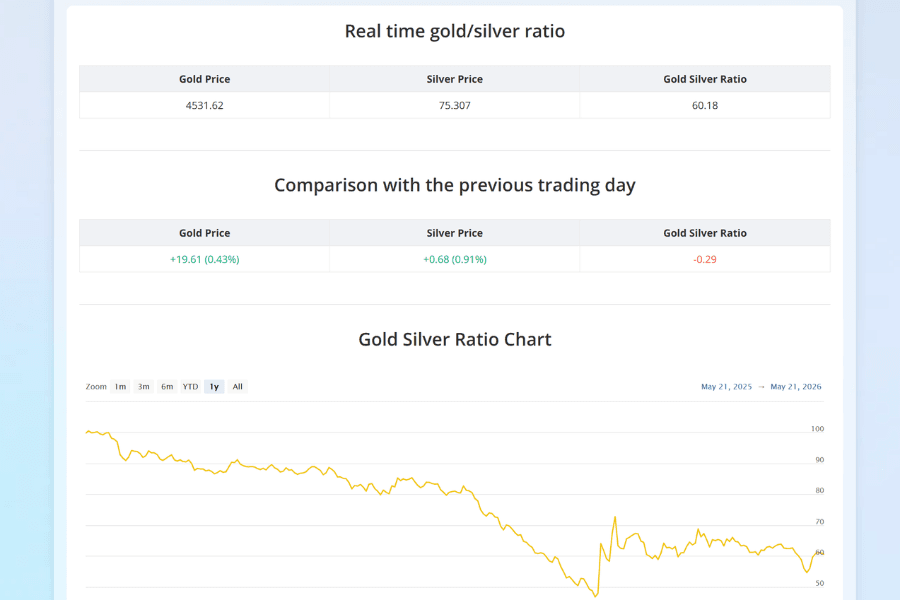
The gold/silver ratio tool compares the relative value of gold and silver, helping you spot when silver is under- or over-valued and optimize strategy.
International Gold Price Chart
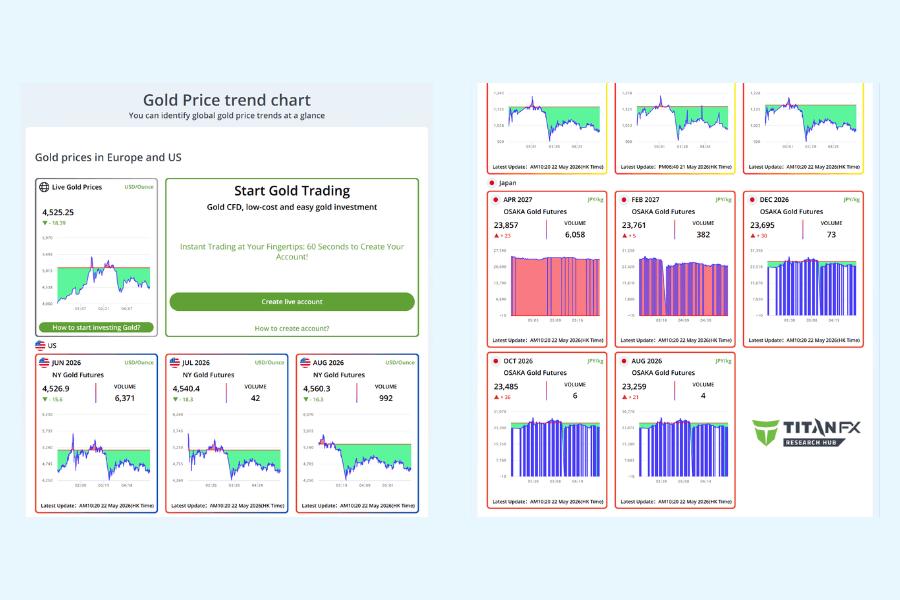
The international gold price chart provides real-time and historical prices, which you can combine with indicators such as RSI and MACD to analyze trends.
Order & Open-Interest Chart
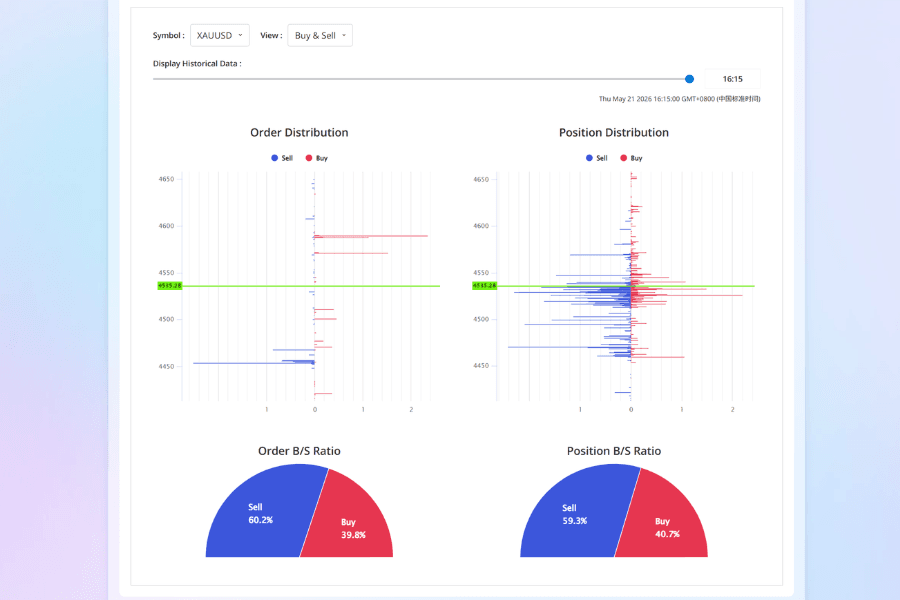
The gold (XAU/USD) order and position chart is a powerful way to read market sentiment and potential support/resistance, visualizing pending-order distribution and position concentration from Titan FX client data.
5. Recent Trends and Developments
In recent years, rising global uncertainty has pushed many nations to add gold reserves as a hedge against economic volatility and inflation. Russia and China, for example, have expanded reserves substantially, partly to cut reliance on U.S.-dollar assets and bolster economic independence and security.
Stronger "safe-haven" demand during uncertain times has also lifted gold prices, shaping the value and strategy around gold reserves. Looking ahead, reserve management is likely to keep evolving as monetary policies and international relations shift.
Trade Gold CFDs with Titan FX
Titan FX offers gold CFDs (XAU/USD) with up to 1,000:1 leverage, tight spreads, and the flexibility to go long or short without holding physical gold.
6. Frequently Asked Questions (FAQ)
Q1: Why do central banks hold gold?
Gold combines a store of value, monetary-policy independence, and crisis response. Independent of any single currency, it stabilizes a nation's money and credit during inflation, sanctions, or market turmoil — a strategic asset for diversifying risk.
Q2: Which country holds the most gold?
As of March 2025, the United States leads with about 8,133.5 tonnes (roughly 78% of its foreign reserves), followed by Germany, Italy, and France; the Eurozone's overall share is especially high.
Q3: What does a high gold share of reserves mean?
It signals heavier reliance on gold for credit and stability. The U.S. and Eurozone are often above 70%, while China and Japan sit near 6%, leaving room to add.
Q4: Why have central banks been buying gold lately?
Mainly de-dollarization, hedging geopolitical and sanctions risk, and preserving value under high inflation. China, Russia, and emerging-market central banks have led the buying, lifting gold prices.
Q5: How can a regular investor access the gold market?
Through gold CFDs (such as XAU/USD), spot, futures, or ETFs. At Titan FX you can trade gold CFDs with leverage and use free tools like the gold/silver ratio and gold price charts to inform decisions.
7. Conclusion
For central banks, gold reserves are a strategic asset that combines store of value, monetary-policy independence, and crisis response. World reserves sit at high levels led by the U.S., and buying by China, Russia, and others reflects de-dollarization and safe-haven demand that moves gold prices.
Gold also shapes a nation's fiscal security, credit, and international voice. For individual investors, accessing the gold market through instruments such as gold CFDs — combined with sound risk management — turns gold's price swings into opportunity.
Further Reading
- Global Gold Demand Explained
- Why Does Gold Rise and Fall? Price Drivers
- Gold CFD Trading Basics
- What Is the Gold Standard?
Titan FX's financial-market research team. We cover a broad set of instruments — foreign exchange, commodities (crude oil, precious metals, agricultural products), equity indices, US equities, and digital assets — producing educational content for investors.
Primary Sources (by Category)
- Official statistics: World Gold Council — Gold Reserves by Country, IMF — International Financial Statistics
- Gold market data: World Gold Council — Goldhub