

Three Methods:Rising &Falling Patterns in Candlestick Charts

The rising and falling three methods are five-candle continuation patterns from Sakata’s tactics, signaling that a trend will resume in the same direction after a brief pause.
In the field of technical analysis for Forex, stocks, and other financial markets, candlestick chart techniques are widely used by traders and analysts worldwide due to their rich information and intuitive visual expression.
For traders, the value of the Rising and Falling Three Methods lies in telling a mid-trend pause apart from a genuine reversal — once you can read these continuation patterns, you can hold positions through a pullback with far more confidence.
This article aims to explore the structure, market significance, and practical applications of these two patterns in market analysis and trading.
- Rising/falling three methods are continuation patterns from Sakata’s “three methods”
- Each is built from five candles and signals trend continuation
- Rising = a pause in an uptrend; falling = a bounce in a downtrend
- Valid only if the middle candles stay within the first candle’s range
- Do not over-trust the pattern; confirm with the broader trend
1. Origin of the Rising Three Methods and Falling Three Methods
While the specific creators of the Rising Three Methods and Falling Three Methods patterns are not clearly recorded, they are part of the candlestick chart analysis methods developed by Munehisa Homma and his successors. Over time, these patterns have been refined and perfected by later market participants and analysts.
The Rising Three Methods and Falling Three Methods, as widely used candlestick chart analysis patterns in modern financial markets, are closely related to the "Three Methods" from Sakata's Five Methods.
Introduction to Sakata's Five Methods
Sakata's Five Methods is a classic technical analysis method developed by 18th-century Japanese rice trader Munehisa Homma. It emphasizes the deep understanding of price action, market trends, and their transitions, providing the theoretical foundation and analytical framework for subsequent candlestick chart patterns.
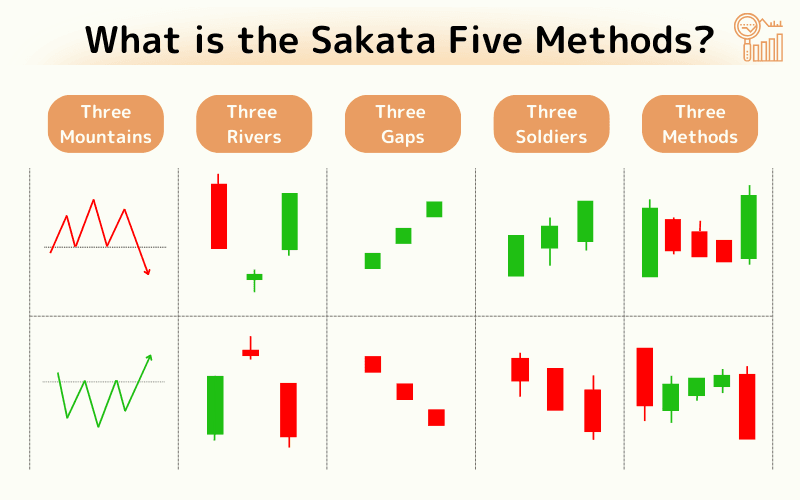
Sakata's Five Methods include Five core patterns: Three Mountains, Three Rivers, Three Soldiers, Three Gaps, and Three Methods. Each pattern reveals significant signals about market trends and potential changes.
2. Using the Rising Three Methods
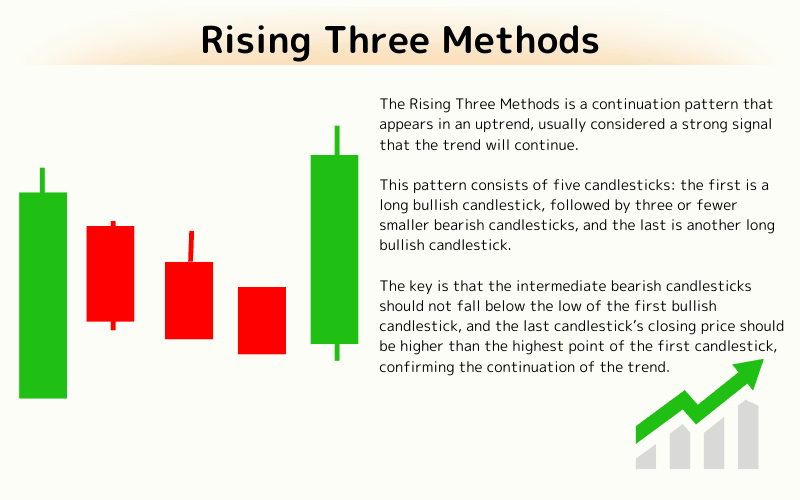
The Rising Three Methods is a continuation pattern that appears in an uptrend, usually considered a strong signal that the trend will continue.
This pattern consists of five candlesticks: the first is a long bullish candlestick, followed by three or fewer smaller bearish candlesticks, and the last is another long bullish candlestick.
The key is that the intermediate bearish candlesticks should not fall below the low of the first bullish candlestick, and the last candlestick’s closing price should be higher than the highest point of the first candlestick, confirming the continuation of the trend.
When identifying the Rising Three Methods in the market, it is crucial to pay attention to the overall trend direction and the characteristics of the intermediate candlesticks.
These three shorter candlesticks represent a brief pause or retracement in the market, and the continuation of the trend is confirmed by the strong close of the final long candlestick.
The market sentiment represented by the Rising Three Methods is that after a brief pullback, buyers regain control and push the price higher.
3. Using the Falling Three Methods
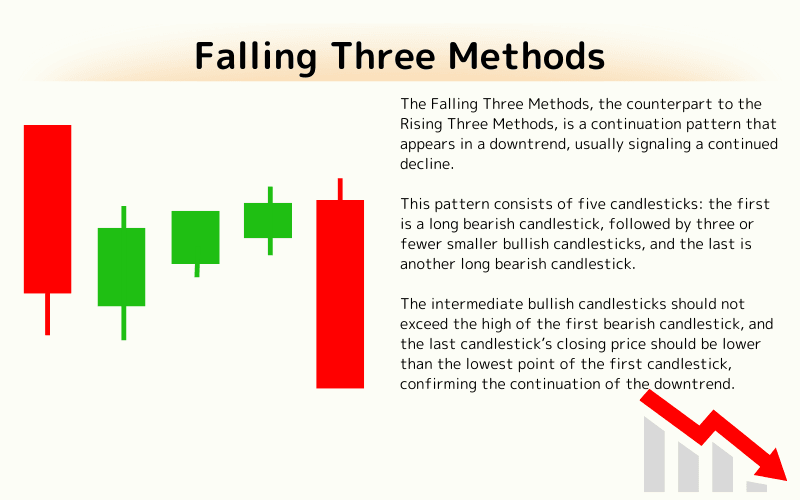
The Falling Three Methods, the counterpart to the Rising Three Methods, is a continuation pattern that appears in a downtrend, usually signaling a continued decline.
This pattern consists of five candlesticks: the first is a long bearish candlestick, followed by three or fewer smaller bullish candlesticks, and the last is another long bearish candlestick.
The intermediate bullish candlesticks should not exceed the high of the first bearish candlestick, and the last candlestick’s closing price should be lower than the lowest point of the first candlestick, confirming the continuation of the downtrend.
When identifying the Falling Three Methods, it is essential to note that this pattern appears in a clear downtrend, with the intermediate bullish candlesticks reflecting a brief market rebound or rest.
However, the continuation of the trend is confirmed by the strong downward movement of the last candlestick, indicating that sellers maintain control of the market.
The Falling Three Methods suggests that even with a short-term rebound, the dominant market forces continue to push prices further downward.
4. Important Considerations When Using the Rising Three Methods and Falling Three Methods
Here are several important points to keep in mind when using the Rising Three Methods and Falling Three Methods patterns:
1. Overreliance on a Single Pattern:
Some traders may become overconfident after identifying a particular pattern and rely solely on it for their trading decisions. It is essential to recognize that while the Rising Three Methods and Falling Three Methods are strong trend continuation signals, no technical analysis tool offers 100% accuracy.
2. Ignoring Market Context:
Trading solely based on the pattern, without considering the broader market context and the overall trend, may lead to erroneous decisions. For instance, in a clear long-term downtrend, even if the Rising Three Methods pattern appears, its reliability may be reduced.
3. Misidentification of the Pattern:
Due to the diverse nature of candlestick patterns, misidentifying these patterns is a common mistake. It is crucial to ensure that all elements of the pattern meet the definition, such as ensuring that the final candlestick in the Rising Three Methods pattern breaks above the high of the first candlestick.
5. Frequently Asked Questions (FAQ)
Q1. What are the rising and falling three methods?
Five-candle continuation patterns from Sakata’s tactics that signal trend continuation (§1).
Q2. How many candles make up the pattern?
Five: one long candle, up to three small candles, and a final long candle (§2, §3).
Q3. What confirms the pattern?
The middle candles stay within the first candle’s range, and the last candle breaks it (§2).
Q4. How do rising and falling three methods differ?
Rising signals an uptrend continuation; falling signals a downtrend continuation (§3).
Q5. What should I watch out for?
Do not over-trust the pattern; judge it together with the broader trend and context (§4).
Further Reading
- Three Mountains
- Three Soldiers and Crows
- Consolidation Patterns
- Reversal Patterns
- Candlestick Charts
Titan FX Trading Strategy Lab. We produce educational content for investors across forex, precious metals, energy, indices, US stocks, and crypto, covering technical analysis and how markets work.
Primary Sources (by Category)
- Educational & research: Investopedia, CMT Association
- Market & data: Bloomberg, Reuters, and TradingView chart analysis and commentary