

What Are Fractional Shares? Benefits, Risks & Broker Rules
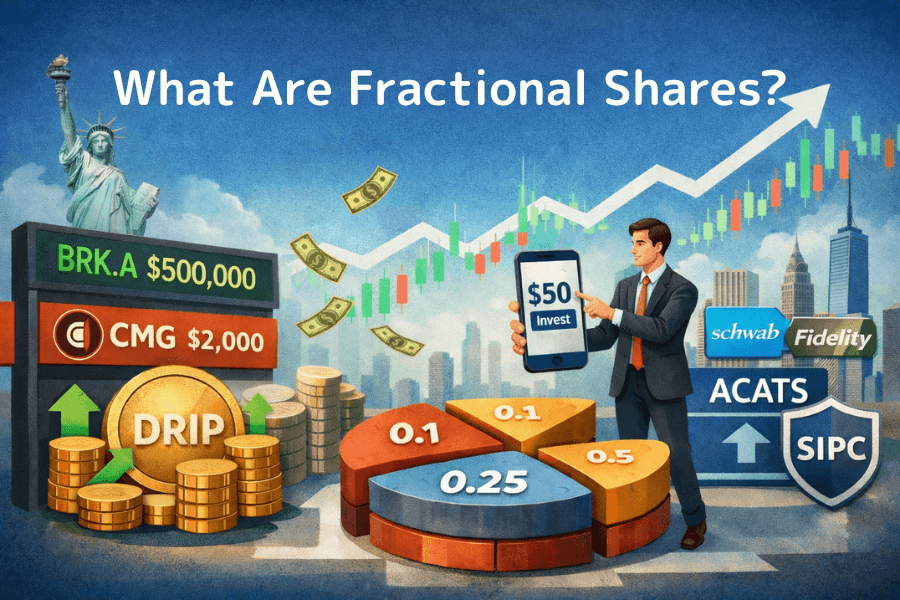
A single share of a popular U.S. company can cost hundreds of dollars, putting it out of reach for many would-be investors. Fractional shares exist to break down that price barrier — letting you buy into a high-flying stock with just a few dollars.
They are still broker-dependent. Supported symbols, voting rights, transfers and execution methods vary by platform. This article explains how fractional shares work, where they help, how they differ from whole shares, and what risks to check first.
- How fractional shares are bought, held and sold
- How they help with small-dollar investing, DRIP and allocation
- How fractional shares differ from whole shares for rights and execution
- What broker-rule, transfer and liquidity risks to check
1. Defining Fractional Shares
Fractional Shares are holdings in units smaller than one share, for example, 0.5, 0.1, or even 0.001 shares. When you buy a fractional share through a broker, you still own part of the company; your ownership stake is simply less than a whole share.
The rise of fractional shares is tied to how U.S. stocks are traded. "One share" is the basic trading unit, but many brokers have extended the logic from share-based investing ("how many shares to buy") to dollar-based investing ("how much money to invest"). Instead of thinking in share counts, you can just enter "I want to invest $100," and the broker automatically computes the corresponding ownership fraction.
This has significantly lowered the entry barrier for U.S. stocks and turned high-priced names into something that small investors can participate in too.
2. Why They Matter in U.S. Stocks: High-Price Culture and Use Cases
Fractional shares are a natural response to the structure of U.S. markets. Share prices span a huge range, from a few dollars to hundreds of thousands, and being stuck with whole-share purchases heavily constrains allocation.
U.S. broker competition is also intense; after commission-free trading went mainstream, brokers needed more ways to lower the threshold. Fractional shares became standard, and many brokers integrate them with DCA (dollar-cost averaging) and dividend reinvestment, making U.S. stocks more usable for long-term allocation.
Use Case 1: Small-Dollar Entry into High-Priced Leaders
Several high-priced names, BRK.A, CMG, COST, sit at elevated prices for years. Even mega-cap tech can be high pre-split.
Fractional shares let you become a shareholder with $50 or $100 and participate in the company's long-term growth. You don't have to wait until you've saved enough for one share, or give up on the name because the sticker price is too high.
Use Case 2: DRIP Becomes More Efficient and Complete
Many U.S. companies pay dividends regularly, and DRIP (Dividend Reinvestment Plan) is a common broker feature that automatically uses dividends to buy more of the same stock.
The key to DRIP's reinvestment growth is fractional shares. Dividend amounts usually aren't enough to buy a whole share, so without fractional support dividends just sit as cash. With fractional shares, even a few dollars can be reinvested, meaningfully affecting long-term total return.
For income-oriented U.S. stock investors or anyone building a cash-flow strategy, fractional shares are almost essential to running DRIP well.
Use Case 3: More Precise Allocation, Less Idle Cash
When building a U.S. portfolio, you may want to hold VOO, VTI, QQQ, and individual stocks at the same time. Whole-share-only buying often leaves you stuck "can't afford the next share", cash piles up idle in the account.
Fractional shares let you allocate precisely by dollar (e.g., 60% broad ETFs, 20% tech ETF, 20% single stocks), improving capital efficiency. This is especially valuable for DCA strategies, where whole-share-only buying easily skews your target weights with fixed monthly contributions.
3. Fractional vs Whole Shares: Rights and Execution
Fractional shares provide flexibility, but the execution path and treatment of rights differ in subtle ways from whole shares. Understanding that helps avoid misplaced expectations and makes sensible choices within broker feature limits.
Fractional vs Whole, Quick Comparison
| Dimension | Fractional Shares | Whole Shares |
|---|---|---|
| Minimum Unit | Less than 1 share possible (e.g., 0.1) | At least 1 share |
| Dividend Rights | Pro-rata to fractional holding | Full share dividend |
| Voting Rights | Depends on broker rules; may be limited | Typically full voting rights |
| Execution | Often internalized or aggregated by broker | Direct market matching |
| Transfer (ACATS) | Often auto-liquidated to cash | Direct transfer supported |
| Best For | Long-term / DCA | Long- or short-term |
Difference 1: Dividend Rights Are Typically Preserved
Most major U.S. brokers pay dividends to fractional holders pro-rata, hold 0.5 share, get half a share's dividend. That's also why fractional shares can power DRIP.
For investors, fractional shares typically don't come with cash-flow disadvantages; if broker rules allow, the calculation is essentially the same as whole shares.
Difference 2: Proxy Voting Depends on Broker Rules
U.S. shareholder voting is usually via Proxy Voting, and whole-share holders generally have full voting rights. For fractional shares, handling depends on the broker. Some allow pro-rata voting; some don't provide voting; some offer limited participation.
For most retail investors, voting isn't a primary driver, but if you hold names where governance issues come up frequently, check your broker's policy ahead of time.
Difference 3: Execution May Not Be a Direct Order Book
Whole-share orders typically go straight to market matching. Fractional orders are often handled internally by the broker, for example, aggregating multiple users' fractional orders into a whole-share order sent to the market, or completing the trade inside the broker via internal quoting.
That means fractional execution prices are usually near market, but may be affected by how the aggregation works, quote delays, and spreads. In volatile environments, fractional execution quality may be less stable than whole-share execution.
So fractional shares fit long-term investing and DCA better, and are not ideal for short-term trading that demands precise execution pricing.
4. Limitations and Risks to Watch
Fractional shares are convenient, but they aren't free of costs. In U.S. markets specifically, fractional processing depends heavily on broker rules, so learn a few common limitations before using them.
Limitation 1: ACATS Transfers May Force-Sell Fractional Positions
Inter-broker transfers typically use ACATS, but fractional shares often can't be transferred directly. Many brokers auto-liquidate fractional positions during transfers and send cash to the new account.
That creates two issues: you may be force-sold at an unwanted price, and you may trigger a tax event, a real consideration for long-term investors. If you expect to switch brokers frequently, keep your fractional allocation limited.
Limitation 2: Not All U.S. Stocks Support Fractional Trading
Fractional trading is a broker service rather than a market-wide standard, so coverage varies significantly across brokers.
Large-cap U.S. stocks, popular ETFs, and mainstream exchange-listed names are usually supported. OTC market names, illiquid stocks, and some niche tickers may not be available for fractional trading.
If you build your portfolio with fractional shares, check your broker's supported universe in advance to avoid surprises when placing orders.
Limitation 3: Better for Long-Term Investing, Not Short-Term Trading
Because fractional execution may be handled internally, the transparency of pricing and liquidity can be lower than whole-share orders. In volatile markets or during gap moves, fractional execution prices can drift more from expectations.
For short-term traders, execution efficiency and spread control matter, and fractional orders may not offer sufficient precision. Fractional shares fit long-term holding, DCA, and DRIP strategies well, where investors care more about long-term cost averages and allocation than single-trade precision.
Trade US Stock CFDs with Titan FX
Titan FX offers 100+ US stock CFDs on MT4/MT5 with up to 20:1 leverage, tight spreads, and full long/short flexibility.
5. FAQ
Q1: Do fractional shares pay dividends?
Yes. Most U.S. brokers pay dividends pro-rata to fractional holdings, even 0.1 shares collect the corresponding amount. If the broker supports DRIP, dividends can also be auto-reinvested.
Q2: Do fractional shares have voting rights?
Depends on broker rules. Some allow pro-rata voting; some don't. If voting matters to you, check your broker's Proxy Voting policy.
Q3: How are fractional shares handled during a stock split or reverse split?
They're usually adjusted proportionally. A 2-for-1 split doubles your share count and halves the per-share price, for example. If a split creates new fractional positions, most brokers preserve the proportion, but specifics vary.
Q4: Are fractional shares covered by SIPC?
SIPC protects customer assets when brokers fail. As long as fractional shares are part of broker-custodied assets, they're generally covered by SIPC, though specific details depend on the broker's custody arrangements. Choosing a large, compliant broker remains the core principle for reducing risk.
Q5: Is fractional-share tax reporting (1042-S) different from whole shares?
Usually not in substance. For non-U.S. tax residents, dividend income may still be withheld and reported via 1042-S annually. Fractional shares only affect the ownership ratio, they don't change dividend-tax logic or capital-gains calculation.
6. Summary
Fractional shares shifted U.S. investing from "how many shares can I buy" to "how much do I want to invest." In a high-price market culture, fractional shares effectively lower the entry barrier, let small capital participate in leading companies' growth, make DRIP reinvestment complete, and improve allocation precision.
That said, they're shaped by broker rules, ACATS forced sales, limited supported universe, and opaque execution are real constraints. The best use is as part of long-term allocation and DCA, treat fractional shares as a tool to improve capital efficiency, not as a primary tool for short-term trading.
Once you understand the rules and limits, fractional shares let more investors participate in U.S. markets at a lower bar, and make asset-allocation strategies easier to execute.
Further Reading
- What Are Growth Stocks?
- What Are Value Stocks?
- What Is Preferred Stock?
- What Is a Shareholders' Meeting?
Titan FX's financial market research and analysis team produces investor education content across a wide range of financial instruments, including foreign exchange (FX), commodities (crude oil, precious metals, and agricultural products), stock indices, U.S. equities, and crypto assets.
Primary Sources by Category