

GOOG vs GOOGL: Which Google Stock Should You Buy?
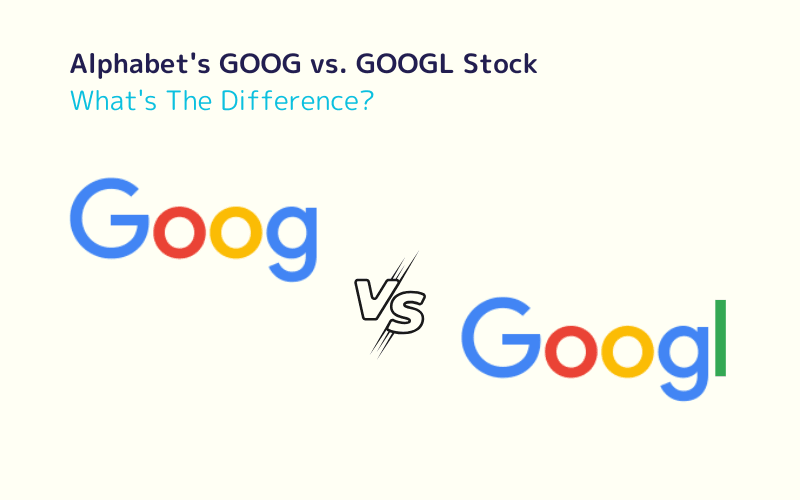
GOOG vs GOOGL: GOOGL (Class A) has 1 vote per share, GOOG (Class C) has none. Price difference is under 1%, while dividends and economic exposure are identical. GOOGL (Class A shares) carries 1 vote per share, while GOOG (Class C shares) has no voting rights. Share prices typically differ by less than 1%, but dividends and economic exposure are identical. For retail investors who don't need voting rights, GOOG is usually the more cost-efficient choice.
This article explains Alphabet's (Google's parent company) Dual Class share structure, the differences between Class A / B / C, dividend policy, and key points for making investment decisions.
For real-time Alphabet stock data, visit the Alphabet instrument page.
- Core difference: GOOG is Class C (no voting rights), GOOGL is Class A (1 vote per share). Dividends, economic exposure, and exchange (NASDAQ) are identical
- Price gap: Typically under 1%; Alphabet's arbitrage mechanism prevents long-term divergence
- Class B existence: Founder-only non-public shares with 10 votes per share, ensuring majority voting power
- How to choose: GOOGL (Class A) for voting rights, GOOG (Class C) for cost and liquidity
- Dividend: Initiated in 2024, identical across all three classes
- 1. GOOG vs GOOGL: Quick Comparison
- 2. Alphabet (Google) Company History
- 3. Why Are There Two Stock Symbols?
- 4. Class A / B / C Share Comparison
- 5. Alphabet's Dividend Policy
- 6. How to Choose Between GOOG and GOOGL
- 7. Points to Consider Before Investing
- 8. Trading U.S. Stocks with Titan FX
- FAQ
- Summary
1. GOOG vs GOOGL: Quick Comparison
Both GOOG and GOOGL represent shares of Alphabet Inc., but they belong to different share classes. The table below summarizes the main differences.
| Item | GOOGL (Class A) | GOOG (Class C) |
|---|---|---|
| Full Name | Alphabet Inc. Class A | Alphabet Inc. Class C |
| Voting Rights | 1 vote per share | None |
| Exchange | NASDAQ | NASDAQ |
| Price Tendency | Slightly higher (voting premium) | Slightly lower |
| Liquidity | Slightly lower | Slightly higher (popular with retail) |
| Dividend | Same (initiated in 2024) | Same |
| S&P 500 Constituent | Yes | Yes |
| Suitable For | Shareholders valuing voting rights | Cost-focused retail investors |
The price gap between GOOGL and GOOG is typically less than 1%, and Alphabet uses arbitrage mechanisms to prevent long-term price divergence. In practice, the two main decision factors are: whether you need voting rights and how much you want to pay.
2. Alphabet (Google) Company History
Google was founded in 1998 by Larry Page and Sergey Brin. Both were Ph.D. students at Stanford University at the time, starting their search engine business out of a friend's garage in Menlo Park, California.
From IPO to Corporate Restructuring
In August 2004, Google launched its IPO at $85 per share, raising about $1.67 billion with a market capitalization of $23 billion. It subsequently acquired YouTube for $1.65 billion in 2006, built out Android, Chrome, Google Cloud, and Google Ads, rapidly expanding beyond search.
In 2015, Google restructured by forming Alphabet, a holding company. The restructuring had two main goals.
-
Separating revenue businesses from R&D: Google (search, advertising, YouTube, cloud) focused on profitability, while Waymo (self-driving), Calico (longevity research), and DeepMind (AI research) became independent subsidiaries of Alphabet focused on long-term innovation
-
Improving financial transparency: Clearly disclosing each business unit's profitability to shareholders, reducing criticism of R&D investment
The Meaning of the Name "Alphabet"
"Alphabet" refers to the basic building blocks of language. Founder Larry Page said the name reflects the company's ambition to "support innovation from A to Z."
GOOGL Price Movement
As one of the world's highest-valued technology companies, Alphabet's (GOOGL) share price is closely watched by the market. Stock price fluctuations reflect investor confidence in the company's AI, cloud services, and digital advertising growth.
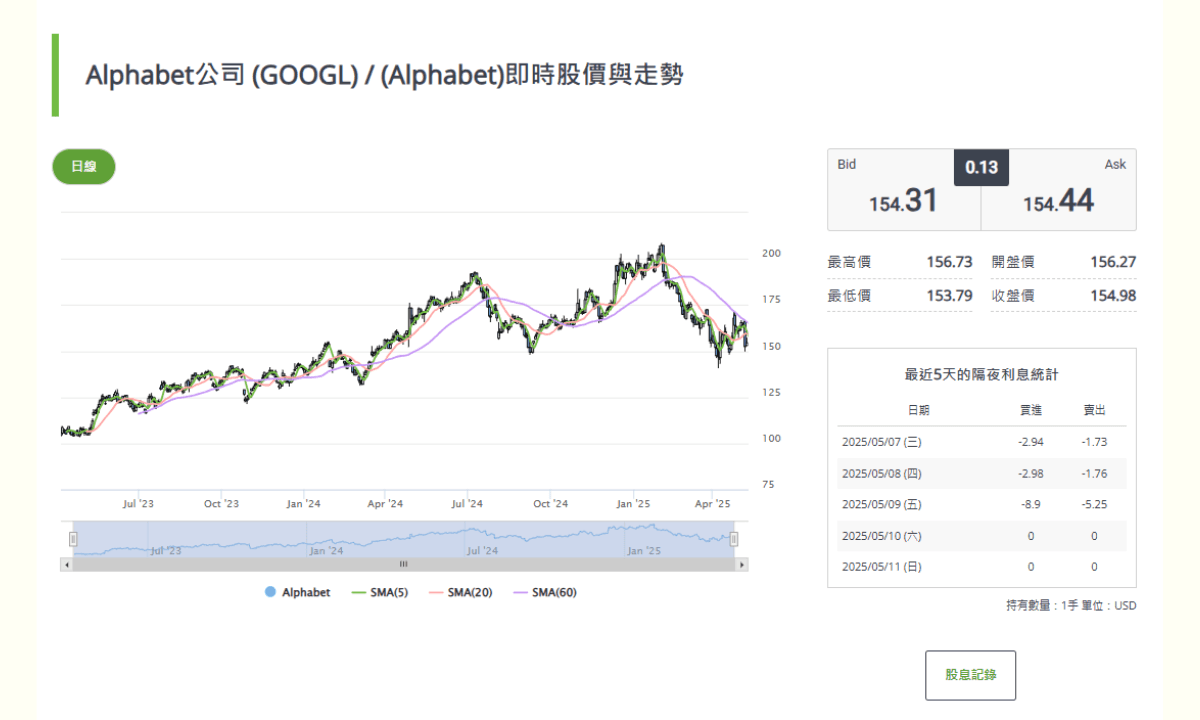
Real-time Alphabet prices are available at the Alphabet instrument page.
3. Why Are There Two Stock Symbols?
In 2014, Google split its stock into Class A (GOOGL) and Class C (GOOG). Originally, Google's only ticker was "GOOG," but this split created a second symbol.
Background of the Stock Split
As Google grew, new share issuance and employee compensation gradually diluted the founders' voting power, threatening their ability to steer the company's long-term vision. Founders Larry Page and Sergey Brin introduced a new class of non-voting shares (Class C) to preserve that control.
With this structure, new shares issued for acquisitions and employee stock options use Class C (GOOG), ensuring that existing Class A (GOOGL) shareholders' voting rights are not diluted. This structure was carried over after Alphabet was founded in 2015.
4. Class A / B / C Share Comparison
Alphabet has three share classes.
| Share Class | Symbol | Voting Rights | Available to Public |
|---|---|---|---|
| Class A | GOOGL | 1 vote per share | Yes |
| Class B | Not public | 10 votes per share | No (founders only) |
| Class C | GOOG | None | Yes |
What Are Class B Shares?
Class B shares are held by founders Larry Page, Sergey Brin, and former CEO Eric Schmidt. Each share carries 10 times the voting rights of Class A shares, and they are not publicly traded.
Through this structure, Page and Brin collectively hold a majority of the voting rights, giving them effective veto power over major corporate decisions. This is called a Dual Class structure, also used by companies like Meta (formerly Facebook) and Berkshire Hathaway.
5. Alphabet's Dividend Policy
Alphabet began paying its first-ever cash dividend in 2024, marking the first cash return to shareholders since its 2004 IPO. This policy signals that Alphabet is transitioning from a high-growth tech company to a mature enterprise with stable cash flow and profitability.
Dividends are paid equally to all Alphabet share classes (GOOGL / GOOG / Class B), so there is no difference in dividends between GOOG and GOOGL.
Dividend History (As of April 2026)
| Ex-Dividend Date | Record Date | Payment Date | Amount per Share (USD) |
|---|---|---|---|
| March 9, 2026 | March 9, 2026 | March 16, 2026 | $0.210 |
| December 8, 2025 | December 8, 2025 | December 15, 2025 | $0.210 |
| September 8, 2025 | September 8, 2025 | September 15, 2025 | $0.210 |
| June 9, 2025 | June 9, 2025 | June 16, 2025 | $0.210 |
| March 10, 2025 | March 10, 2025 | March 17, 2025 | $0.200 |
| December 9, 2024 | December 9, 2024 | December 16, 2024 | $0.200 |
| September 9, 2024 | September 9, 2024 | September 16, 2024 | $0.200 |
| June 10, 2024 | June 10, 2024 | June 17, 2024 | $0.200 |
Dividends are paid quarterly. The 2024 initial dividend was $0.200 per share; starting Q2 2025, it increased to $0.210 per share (annualized $0.84). The upcoming dividend schedule is available at the Dividend Calendar.
Key Terms
- Ex-Dividend Date: If you purchase shares on or after this date, you are not entitled to the current dividend
- Record Date: The date on which the company identifies shareholders eligible for the dividend
- Payment Date: The date the dividend is actually paid
6. How to Choose Between GOOG and GOOGL
Choosing between GOOG and GOOGL comes down to your investment objectives and strategy.
If Voting Rights Matter
Choose GOOGL (Class A). It gives you 1 vote per share at shareholder meetings. However, note that the founders hold a majority of voting power through Class B shares, so an individual investor's vote has limited practical influence.
If Cost and Liquidity Are the Priority
Choose GOOG (Class C). GOOG usually trades slightly lower than GOOGL (typically a 0.5-1% gap) and has higher trading volume, meaning better liquidity. Since dividends and economic exposure are identical, GOOG is typically more cost-efficient for investors who don't need voting rights.
For Long-Term Investment
For long-term holding, the difference between GOOG and GOOGL is minimal. Both reflect the same underlying business value of Alphabet, and their price movements are highly correlated. If lower acquisition cost is the priority, GOOG is the usual choice. Investors who want both voting and non-voting exposure can hold both.
Other Considerations
- Market environment: Technology stocks are sensitive to interest rates and inflation, so entry timing affects returns
- Company fundamentals: Monitor Alphabet's revenue structure, AI investment results, and cloud growth
- Stock splits: GOOG and GOOGL are split proportionally, so there is no fundamental rights difference
Choice Summary
| Factor | Recommendation | Reason |
|---|---|---|
| Voting Rights | GOOGL | Has voting rights (though limited practical influence) |
| Cost Efficiency | GOOG | Slightly lower price, higher volume |
| Long-Term Investment | GOOG | Same economic rights, lower cost |
| Other | Depends | Market conditions, earnings, split policy, etc. |
7. Points to Consider Before Investing
Before investing in Alphabet stock, we recommend reviewing the following.
Research Earnings and Competitive Landscape
Alphabet's main revenue sources are advertising, YouTube, cloud computing, and Android. Before investing, analyze the growth prospects of these segments and understand Alphabet's positioning in AI, self-driving, and other emerging areas. Competitive dynamics with Amazon, Microsoft, and Meta are also important.
Assess Risk Tolerance
Tech stocks can be highly volatile due to market news and rate policy. Make sure you have the financial and psychological capacity to weather short-term losses, and set a reasonable position size to avoid over-concentration in a single asset.
Monitor Real-Time Prices
Although GOOG and GOOGL prices are highly correlated, the gap can widen during volatile markets or liquidity shifts. Check live prices before placing an order to time your entry properly.
Consult a Financial Advisor
If you are uncertain about Alphabet's business structure, financials, or share class selection, consider consulting a licensed financial advisor for guidance tailored to your goals and risk profile.
8. Trading U.S. Stocks with Titan FX
In addition to buying GOOG or GOOGL shares through a traditional broker, stock CFDs (Contracts for Difference) are a flexible alternative. CFD trading offers:
-
Both long and short directions: Profit from rising or falling prices
-
Leverage: U.S. stock CFDs support up to 1:20 leverage, requiring only 5% margin
-
No physical share ownership: CFDs are cash-settled, removing the cost of holding and managing stock
Titan FX offers 100+ U.S. stock CFDs, including Alphabet, tradable on the MT4 / MT5 platform.
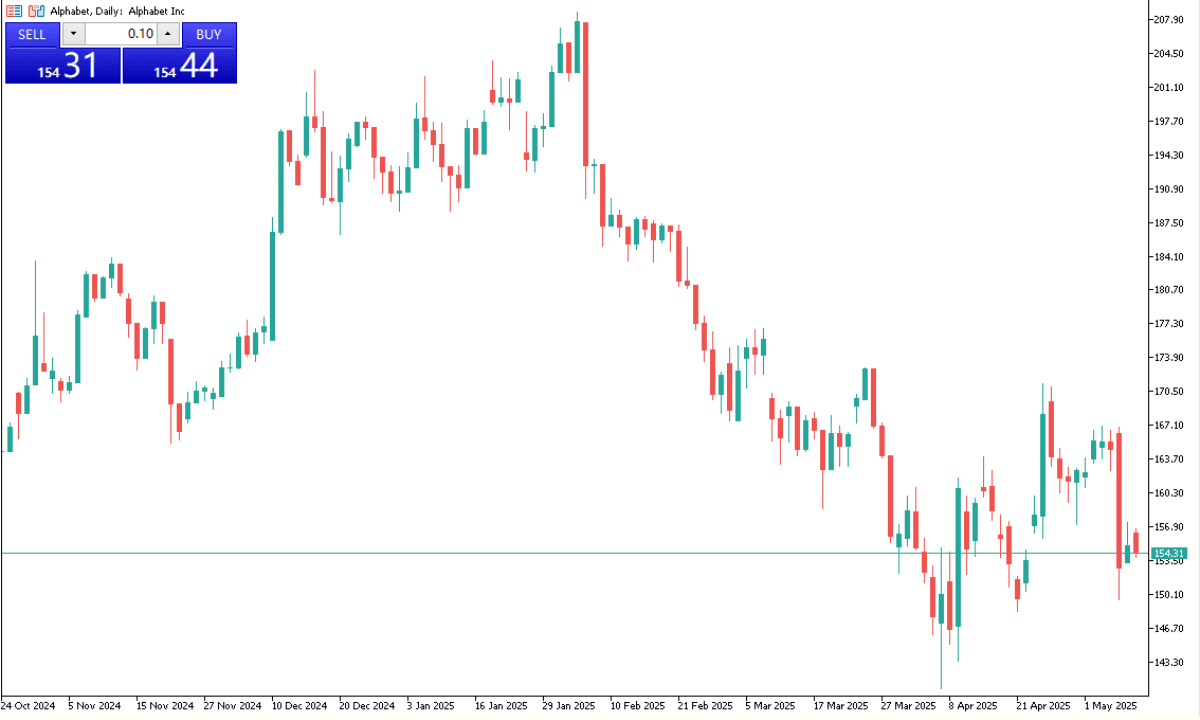
Alphabet's current spread and trading conditions are available at the Alphabet instrument page.
Trade Alphabet (GOOG / GOOGL) with Titan FX
100+ U.S. stock CFDs, up to 20x leverage, both long and short directions. Real-time charts and one-click trading on MT5.
FAQ
What is the difference between GOOG and GOOGL Google stocks?
GOOG is Alphabet's Class C share (no voting rights); GOOGL is the Class A share (1 vote per share). Dividends, economic exposure, and listing exchange (NASDAQ) are identical, and the price gap is typically under 1%. See §1 Quick Comparison for the full table.
Should I buy GOOG or GOOGL?
If you prioritize cost and liquidity, choose GOOG (Class C, slightly cheaper and higher trading volume). If you want voting rights for shareholder meetings, choose GOOGL (Class A). Alphabet's arbitrage mechanism prevents the two from diverging significantly over the long term. See §6 How to Choose for an investment-objective breakdown.
Why do GOOG and GOOGL have different prices?
The voting rights premium drives the difference. GOOGL, with voting rights, sees higher demand from institutional investors and funds, trading roughly 0.5-1% above GOOG. Both represent shares of the same Alphabet company, so long-term price movements are almost perfectly correlated. See §3 Why Two Tickers and §6 How to Choose.
Does Alphabet (Google's parent) pay dividends?
Alphabet initiated quarterly dividends for the first time in 2024. GOOG and GOOGL receive identical dividends, and Class B (founder-held, non-public) is on the same schedule. For full dividend history and per-share amounts, see §5 Dividend Policy.
How can I trade Google stocks (GOOG / GOOGL) globally?
You can buy spot shares through any U.S. brokerage with international access, or trade them as U.S. stock CFDs through Titan FX. CFDs carry no voting rights, dividends are reflected as cash adjustments, leverage up to 1:20 is available, and both long and short positions are supported. See §8 Titan FX U.S. Stock CFDs for trading conditions.
Why does Alphabet use a Dual Class share structure?
Founders Larry Page and Sergey Brin introduced this structure to prioritize long-term technology innovation over short-term shareholder interests. By holding Class B shares (10 votes each), they retain majority voting power even after new share issuance, ensuring continued investment in long-term projects like AI research and Waymo (self-driving). See §4 Class A / B / C Comparison for the structural details.
Summary
The difference between GOOG and GOOGL comes down to voting rights.
- GOOGL (Class A): 1 vote per share. For investors who value shareholder meeting participation
- GOOG (Class C): No voting rights. Trades at a slight discount. For cost-focused investors
- Class B (not public): Founders only. 10 votes per share. Holds final decision-making power
Dividends and company value are identical across all three classes, and long-term price movements are highly correlated. Either ticker gives you exposure to Alphabet's search, advertising, cloud, and AI businesses.
Consider your investment objectives and the need for voting rights to select the symbol that best fits your strategy.
Further Reading
- Alphabet instrument page
- U.S. Stock CFD trading
- NYSE, NASDAQ & AMEX explained
- What is an IPO?
- What is a CFD?
Titan FX Trade Strategy Research Lab covers forex (FX), commodities (oil, precious metals, agricultural products), stock indices, U.S. equities, and crypto assets — producing educational content for retail investors across asset classes.
Primary Sources (by category)
- Corporate filings: Alphabet Investor Relations, SEC 10-K Filings
- Markets & Exchanges: NASDAQ official site, S&P Dow Jones Indices (S&P 500 components)
- Related concepts: Dual Class share structure (Class A, B, C voting allocation), IPO and share split mechanics