

Value Investing Complete Guide: Principles, Key Metrics, and Risks
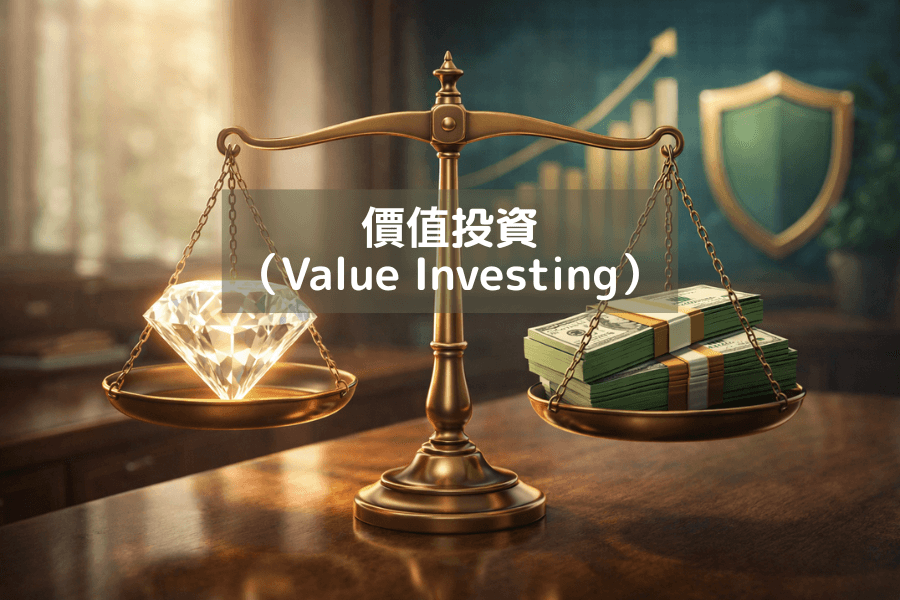
Value investing is a long-term strategy that aims to buy stocks at prices below a company's intrinsic value. At its heart sits the distinction between "price" and "value." Laid down by Benjamin Graham and developed by Warren Buffett, it has become one of the most classic investment philosophies in U.S. equity markets.
Value investors believe that short-term prices can swing on emotion and drift away from fundamentals, but over the long run, they tend to revert to a company's real value. In moments of panic or excessive pessimism, investors can often find opportunities to buy high-quality businesses with a clear margin of safety, increasing the chance of strong long-term returns. For beginners and experienced investors alike, understanding value investing's core concepts and practical methods helps maintain rational thinking and build durable long-term profits in U.S. stocks.
1. What Is Value Investing? Core Concepts
Value investing is an investment strategy that emphasizes buying assets below their intrinsic value. Its core philosophy rests on the divergence between price and value.
As investing legend Warren Buffett put it, "Price is what you pay, value is what you get." Value investors believe markets are short-term influenced by emotion, panic, or over-optimism, which causes stock prices to diverge from a company's actual fundamentals.
The strategy was first developed by Benjamin Graham and later popularized by Buffett. Graham famously compared the market to "Mr. Market" — an emotional character who offers a different quote each day. When Mr. Market is deeply pessimistic and dumping quality assets, value investors step in. Over the long term, prices tend to return to intrinsic value, and that gap is the investor's source of profit.
2. Core Principles of Value Investing
The essence of value investing is not simply buying cheap stocks; it is understanding the value and risk of the underlying business. Investment decisions are typically grounded in fundamentals, competitive advantages, and long-term operational capability.
Principle 1: Think Like an Owner
A share represents fractional ownership in a business. Buying shares is equivalent to becoming a shareholder in the company, so investors should focus on whether the company has long-term competitive strength rather than on short-term price moves.
Principle 2: Margin of Safety
Margin of safety means buying below intrinsic value to leave a buffer in the investment decision. Graham introduced this concept to help absorb valuation errors and mitigate the risks from market volatility.
Principle 3: Choose Quality Businesses
Value investors tend to prefer companies with stable earnings power and competitive advantages — brand strength, technology, or market position. These businesses are often better positioned to maintain stable performance across different economic cycles.
Principle 4: Long-Term Holding
Value investing emphasizes the power of time. Holding quality businesses for the long term allows growth and compounding to accumulate. Compared with frequent trading, long-term holding reduces emotional interference and supports a more stable investment experience.
3. Common Metrics Used in Value Investing
In practice, investors use financial metrics as tools to help judge whether a business is undervalued. These metrics help with initial screening, but they must be combined with industry context and qualitative business analysis — relying on a single data point is dangerous.
| Metric | Definition | Value-Investing Signal | Notes & Limitations |
|---|---|---|---|
| P/E (Price/Earnings) | Ratio of share price to earnings per share | Names trading below industry or historical averages | Can look cheap while growth deteriorates sharply |
| P/B (Price/Book) | Price relative to book value | Low P/B suggests price near or below asset value | Less applicable to asset-light tech or software firms |
| Dividend Yield | Cash return to shareholders from holding the stock | Stable, reasonable yields often signal solid cash flow | Excessively high yields may reflect price crashes or unsustainable payouts |
| Free Cash Flow (FCF) | Cash the business actually generates for discretion | Steady FCF growth indicates better operating quality | Firms in heavy capex phases may show weak early-stage FCF |
Why Composite Judgment Matters
Any single metric reflects only part of the picture. A low P/E can occur alongside slowing growth or industry decline. A more complete analysis cross-checks several metrics alongside debt ratios, gross margins, and industry trends to get closer to the company's real value.
4. Value Investing vs Growth Investing: A Strategy Comparison
In U.S. markets, value investing and growth investing are two landmark strategies. Understanding the differences helps investors build more resilient portfolios based on their risk tolerance and financial goals.
| Dimension | Value Investing | Growth Investing |
|---|---|---|
| Stock Selection Logic | Find names priced below intrinsic value | Find leading firms with high expansion potential |
| Key Focus | Net asset value, stable earnings, dividends | Revenue growth, market share, future possibilities |
| Valuation Stance | Favors margin of safety; low P/E and P/B | Tolerates higher valuations; focus on earnings power ahead |
| Volatility | Relatively steady; less sensitive to sentiment | Swings with growth expectations; higher risk |
| Investment Horizon | Medium-to-long term, waits for mean reversion | Long-term view, must tolerate drawdowns |
Complementary, Not Opposing
While value investing emphasizes current cheapness and growth investing chases future growth premium, the two are not strictly opposites. Many successful investors adopt the GARP approach (Growth At a Reasonable Price) — requiring both growth potential and a sensible valuation.
Market Cycles and Style Rotation
Different macro environments favor different styles. In rate-tightening, liquidity-compressed cycles, stable-cash-flow value stocks tend to play defense. In low-rate, liquidity-rich environments, high-growth tech stocks often earn richer valuation premia.
5. Risks and Common Pitfalls of Value Investing
Value investing emphasizes rationality and long-term holding, but real-world execution can still produce risks from judgment errors or market factors. Understanding these pitfalls helps avoid mistakes along the way.
Risk 1: Value Traps
Some stocks look cheap, but the underlying business continues to deteriorate — revenues shrinking, competitive edge fading, or industry decline. Such names can stay low for years, or keep falling, while investors mistakenly think they got a bargain.
Risk 2: Market Takes Too Long to Price In Value
Even with stable business operations, the market may not assign a reasonable valuation for long stretches. When capital stays out of slow-growth or unloved sectors, prices can stagnate — a real test of an investor's patience.
Risk 3: Errors in Estimating Intrinsic Value
Intrinsic value requires forecasts and assumptions, and different investors can arrive at different answers. Being overly optimistic about future growth or profitability easily leads to overestimating value, which distorts investment decisions.
Pitfall: Low Valuation Does Not Always Mean Cheap
A low P/E or depressed share price is not automatically an opportunity. Some companies are marked down by the market precisely because of stagnation, industry risk, or management problems. A single metric cannot fully reflect a business's value — broader analysis is still required.
Trade US Stock CFDs with Titan FX
Titan FX offers 100+ US stock CFDs on MT4/MT5 with up to 20:1 leverage, tight spreads, and full long/short flexibility.
6. Summary
Value investing is a long-term strategy centered on fundamentals, emphasizing the relationship between price and value. By analyzing intrinsic value and margin of safety, investors can search for relatively resilient opportunities even during market turbulence.
In practice, understanding financial metrics is as important as understanding how a business operates. Paired with proper risk management and patient holding, value investing can become a foundation for building a long-term portfolio.
Titan FX Trading Strategy Research Institute
The financial market research team at Titan FX. We produce educational content for investors covering a broad range of instruments including forex (FX), commodities (crude oil, precious metals, agriculture), stock indices, U.S. equities, and cryptocurrencies.
Primary sources: BIS, IMF, FRED, CME Group, Bloomberg, Reuters