
 Home
Home- Investment Guide: Strategies for Stocks, Forex, and Metals
- Japan's Stock Exchanges: TSE, Four Markets, Nikkei 225
Japan's Four Major Stock Exchanges: History, Market Structure, Tradable Indices and Stocks

On the broad stage of global financial markets, Japan's stock exchanges play a pivotal role.
As one of Asia's largest equity markets, they are both the core of Japan's economy and an important financial hub for international investors.
This article explores the history, types, and market structure of Japan's stock exchanges and their place in the global financial system, and looks at the investment opportunities around the Nikkei 225.
- Japan's four major exchanges: Tokyo (TSE), Nagoya (NSE), Sapporo (SSE), Fukuoka (FSE)
- The TSE is run by Japan Exchange Group (JPX); since 2022 it has Prime/Standard/Growth segments
- Core indices: the Nikkei 225 and the Tokyo Stock Price Index (TOPIX)
- Leading listings: Toyota, Sony, SoftBank, Nintendo, Hitachi, and more
- You can trade Japanese index moves via CFDs (Nikkei 225, leverage up to 500x)
1. History of Japan's Stock Exchanges
The history of Japan's stock exchanges began in 1878, when the Tokyo Stock Exchange first opened, marking the birth of the country's modern financial markets.
As Japan's economy grew rapidly, the exchanges went through several major transformations, particularly during the postwar period of economic recovery.
In 1973, the Tokyo Stock Exchange introduced an electronic trading system, a significant milestone in technological innovation.
In 2013, the Tokyo Stock Exchange merged with the Osaka Securities Exchange to form Japan Exchange Group (JPX), streamlining the market structure and strengthening its global competitiveness.
This move optimized the allocation of resources, improved market efficiency, and attracted more domestic and international investors.
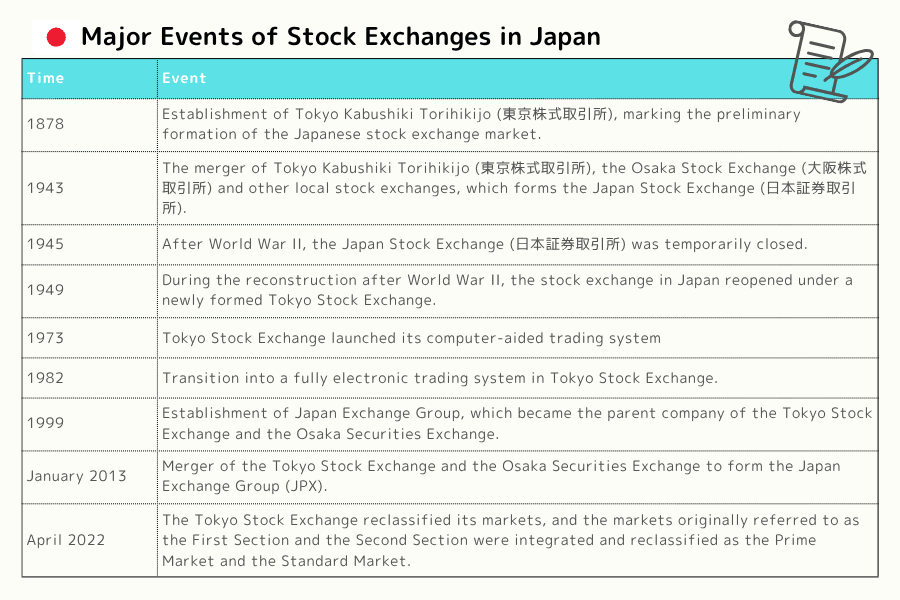
Japan's stock exchanges have long stood at the forefront of financial innovation, evolving from early trading in stocks and bonds to the development of derivatives markets and electronic trading platforms, continually enhancing market liquidity and transparency.
Today, they have grown from local trading venues into financial centers with international influence, demonstrating how technology and market integration have helped connect global finance.
2. Japan's Four Major Stock Exchanges
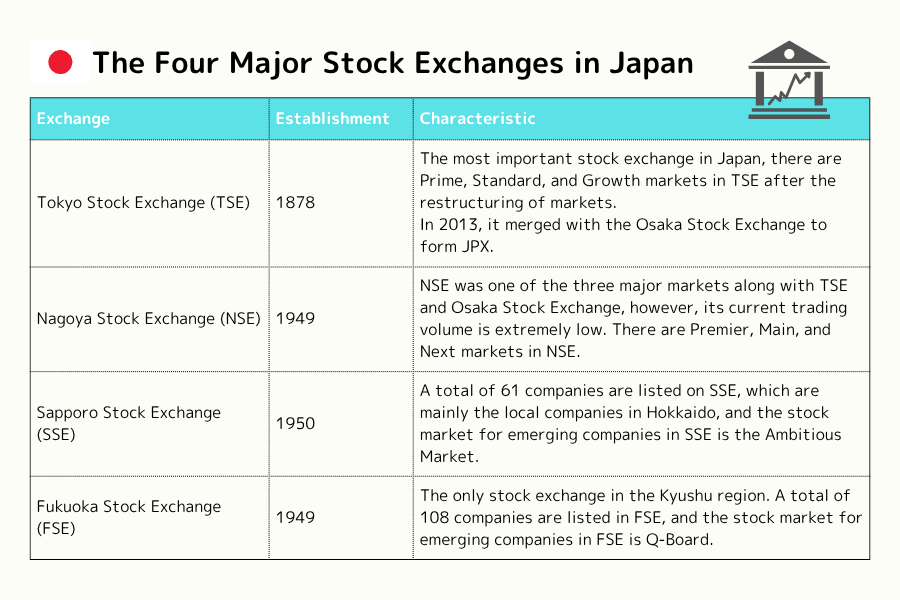
Japan's securities market is led primarily by the Tokyo Stock Exchange (TSE), with other important exchanges including the Nagoya Stock Exchange (NSE), the Sapporo Securities Exchange (SSE), and the Fukuoka Stock Exchange (FSE).
Although the TSE and the NSE are Japan's two largest exchanges, trading is far more concentrated on the TSE, so the NSE is much smaller and less significant by comparison. In addition, most companies listed on the FSE and the SSE are local businesses, making them regional stock exchanges.
Tokyo Stock Exchange (TSE)
The Tokyo Stock Exchange (TSE), founded in 1878, is Japan's primary stock exchange, where most of the country's listed companies trade.
In April 2022, following a market restructuring, it was divided into the Prime Market, the Standard Market, and the Growth Market, each targeting companies of different sizes and stages of development.
In 2013, the TSE merged with the Osaka Securities Exchange to form Japan Exchange Group (JPX), further improving market efficiency and international competitiveness.
As of the end of 2024, the TSE had 3,842 listed companies, one fewer than the previous year — the first annual decline since 2013.
Nagoya Stock Exchange (NSE)
The Nagoya Stock Exchange (NSE), founded in 1949, was once one of Japan's three major markets.
However, because trading activity is concentrated on the TSE, it accounts for just 0.02% of trading volume and remains relatively small.
After the 2022 market restructuring, it was divided into the Premier Market, the Main Market, and the Next Market, the last of which focuses on emerging companies.
Sapporo Securities Exchange (SSE)
The Sapporo Securities Exchange (SSE), founded in 1950, mainly serves local companies in Hokkaido.
As of June 2023, it had 61 listed companies, including 18 exclusively listed there.
Its market for emerging companies, the Ambitious Market, has attracted firms such as RIZAP Group, while its main market includes major corporations such as Takeda Pharmaceutical and Mitsui & Co.
In 2024, Sapporo drew attention for the growth of its tech startups, which helped drive the local real estate market and highlighted its economic potential.
Fukuoka Stock Exchange (FSE)
The Fukuoka Stock Exchange (FSE), founded in 1949, is the only stock exchange in the Kyushu region.
As of May 2023, it had 108 listed companies. Its market for emerging companies, Q-Board, was established in 2000 to provide a financing platform for growth-stage businesses.
3. Market Structure of the Tokyo Stock Exchange (TSE)
The market structure of the Tokyo Stock Exchange (TSE) is central to its efficient operation. It is divided into three main segments — the Prime Market, the Standard Market, and the Growth Market — each serving different types of companies and investment needs.
Prime Market
The Prime Market is the TSE's top-tier segment, aimed at large companies that meet the highest standards.
These companies have strong market influence and stable financial performance, attracting domestic and international institutional investors and large funds, and enjoy a strong global reputation for their high transparency and governance standards.
Standard Market
The Standard Market serves mid-sized companies that, while not as large as those on the Prime Market, have solid growth potential.
It provides companies with a platform to showcase their performance and attract investment, while giving investors the opportunity to invest in Japan's mid-sized firms.
Growth Market
The Growth Market is designed for small- and mid-sized companies with rapid growth and strong innovation, supporting businesses in the early stages of development that have innovative technologies or business models.
This segment helps companies build market reputation and attract venture capital and other investment.
4. Key Indices and Listed Companies
The key indices and listed companies of Japan's stock exchanges are important references for investors, reflecting the overall performance of the Japanese market and the strength of its companies.
Major Indices
Nikkei 225
The Nikkei 225 Index is made up of 225 leading companies listed on the TSE, spanning industries such as technology, energy, finance, and consumer goods. It is regarded as a barometer of Japan's economy and a core reference for global investors.
Tokyo Stock Price Index (TOPIX)
TOPIX covers all companies listed on the former TSE First Section, offering a more comprehensive view of the market, and is widely used to gauge the overall performance of Japanese equities.
Major Listed Companies
Here is an overview of some companies listed on the TSE:
| Company | Industry | Profile |
|---|---|---|
| Toyota | Automotive | One of the world's largest automakers, leading in electric and hybrid technology. |
| Sony Group | Electronics & entertainment | Renowned electronics maker with deep influence in film and music. |
| Mitsubishi UFJ Financial Group | Financial services | Japan's largest financial group, with operations around the world. |
| SoftBank Group | Investment & technology | Invests in technology companies worldwide through its Vision Fund. |
| Hitachi | Electronics & engineering | Operates across IT, energy, and industrial equipment. |
| Honda | Automotive | The world's largest motorcycle manufacturer and a leading automaker. |
| Panasonic | Electronics | Makes electronics and home appliances, with interests in energy and industrial equipment. |
| Nintendo | Video games | World-famous developer of video games and home game consoles. |
| NEC | Information technology | Provides IT solutions with a focus on communications and network technology. |
| Nippon Steel | Steel | Japan's largest steelmaker, with products used across many sectors. |
5. How to Trade Japanese Stock Indices
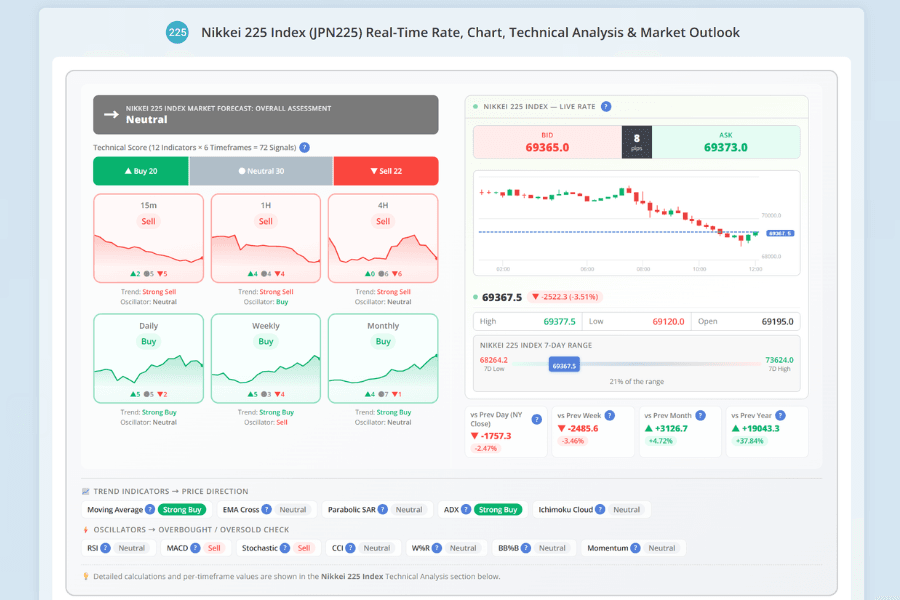
Titan FX offers a full range of contract-for-difference (CFD) trading options on the Japanese market, covering popular indices such as the Nikkei 225 Index.
Advantages of Nikkei 225 Index CFDs
| Advantage | Description |
|---|---|
| High leverage | Supports Nikkei 225 Index CFD trading with leverage of up to 500x. |
| Low spreads | Competitive spreads that lower trading costs. |
| Fast execution | Reduces slippage for efficient trading. |
| Advanced platforms | Supports MT4 and MT5, well suited to technical analysis. |
| Free tools | Dozens of technical analysis tools to support precise decisions. |
| Multilingual support | Customer service in Chinese, English, and Japanese for quick problem-solving. |
| Educational resources | Index-trading tutorials and daily market analysis. |
Nikkei 225 Index CFD Trading Hours
| Time zone / region | Winter time (GMT+2) trading hours | Summer time (GMT+3) trading hours |
|---|---|---|
| MT4/MT5 platform time | 01:00 - 23:59 (Friday close at 23:55) | 01:00 - 23:59 (Friday close at 23:55) |
| Taipei / Hong Kong / Beijing / Singapore / Malaysia (GMT+8) | 07:00 - 05:59 next day (Saturday close at 05:55) | 06:00 - 04:59 next day (Saturday close at 04:55) |
| Japan time (GMT+9) | 08:00 - 06:59 next day (Saturday close at 06:55) | 07:00 - 05:59 next day (Saturday close at 05:55) |
6. Frequently Asked Questions (FAQ)
Q1: Which is Japan's most important stock exchange?
The Tokyo Stock Exchange (TSE). Operated by Japan Exchange Group (JPX), it concentrates most of Japan's listed companies and trading volume and is one of Asia's largest stock markets; Nagoya, Sapporo, and Fukuoka are smaller and more regional.
Q2: What is the difference between the Nikkei 225 and TOPIX?
The Nikkei 225 is a price-weighted index of 225 representative TSE-listed companies, seen as a barometer of Japan's economy; TOPIX is broader (the former TSE First Section) and market-cap-weighted, reflecting the overall market.
Q3: How do the TSE's Prime, Standard, and Growth segments differ?
Prime is for large companies meeting the highest standards, Standard for mid-sized firms, and Growth for high-growth small- and mid-cap and emerging companies — each for a different size and stage.
Q4: How can retail investors take part in Japan's stock market?
Besides buying Japanese stocks directly, you can use index CFDs (such as the Nikkei 225) to trade in both directions with leverage without owning the underlying. CFDs amplify both gains and risk, so risk management matters.
7. Summary
Japan's stock exchanges began with the Tokyo Stock Exchange in 1878 and, through technological innovation and market integration, have grown into a financial hub of Asia that shapes the global investment landscape.
Their development witnessed the birth of indices such as the Nikkei 225 and TOPIX, as well as the optimization of the TSE's market structure.
The four major exchanges in Tokyo, Osaka, Nagoya, Sapporo, and Fukuoka together support Japan's economy and draw the attention of international investors.
As demand grows for both precious-metals investment and stock trading, understanding how Japan's stock exchanges operate and the investment opportunities they offer can give investors valuable insight and strategic support.
Further Reading
Titan FX Research Team. We cover a broad set of financial instruments — foreign exchange, commodities (crude oil, precious metals, agricultural products), equity indices, US equities, and digital assets — producing practical, research-backed educational content for investors.
Primary Sources (by Category)
- Exchange official: Japan Exchange Group (JPX)
- Index data: Nikkei Indexes