

What Is the Nikkei 225? Top Stocks, Calculation, History and Trading Hours
The Nikkei 225 took 34 years to get back above its 1989 bubble-era peak, finally doing so in February 2024. Since then it has climbed past 50,000, 60,000 and 70,000, and set a record close of 72,366.34 on June 25, 2026. A handful of high-priced chip and retail stocks now drive much of its daily movement.
This guide explains what the Nikkei 225 is and how it is calculated, its largest constituents and sector weights, how it differs from TOPIX, its price history and record highs, what moves it, its trading hours, and how to trade it through ETFs, futures and CFDs.
- The Nikkei 225 is a price-weighted index of 225 Prime Market stocks, calculated by Nikkei Inc. since 1950
- Four stocks, Advantest, Fast Retailing, Tokyo Electron and SoftBank Group, made up about 35% of the index as of October 19, 2026
- Technology stocks account for about 42% of the index under Nikkei's sector classification, so chip stocks have an outsized effect on daily moves
- The index set a record close of 72,366.34 on June 25, 2026, and closed at 64,916.70 on October 19, 2026
- Bank of Japan policy, the yen, chip stocks and Wall Street are the main forces that move the Nikkei 225
1. What Is the Nikkei 225?
The Nikkei 225 is the most widely quoted measure of the Japanese stock market. When news reports say "Japanese stocks rose today," they usually mean the Nikkei 225.
| Item | Details |
|---|---|
| Official name | Nikkei Stock Average (Nikkei 225) |
| Index provider | Nikkei Inc. |
| Constituents | 225 stocks listed on the TSE Prime Market |
| Weighting | Price-weighted |
| Calculation start | September 7, 1950 (base date May 16, 1949) |
| Constituent reviews | Twice a year, in April and October |
| Titan FX symbol | JPN225 |
Nikkei Inc., the publisher of the Nikkei newspaper, chooses the 225 constituents to represent Japanese industry, weighing how actively each stock trades and keeping a balance across sectors. Because the list is chosen by committee and capped at 225 names, the Nikkei 225 behaves differently from indices that include every large listed company.
2. How Is the Nikkei 225 Calculated?
The Nikkei 225 is a price-weighted index. Nikkei adds up the share prices of the 225 constituents, after adjusting some of them with a price adjustment factor, and divides the total by a number called the divisor. The Dow Jones Industrial Average (US30) is calculated the same way.
Formula:Nikkei 225 = sum of adjusted constituent share prices ÷ divisor
Divisor:29.66435840 as of October 19, 2026
The divisor changes whenever a constituent is replaced or a company splits its shares, so that these events do not cause a jump in the index on their own.
The result is that a stock's influence depends on its share price, not on the size of the company. A ¥10,000 stock that rises 10% moves the index far more than a ¥1,000 stock that rises 10%, even if the cheaper stock belongs to a much larger company. This is the main difference from capitalization-weighted indices such as the S&P 500 and TOPIX, where the largest companies carry the most weight.
3. Largest Nikkei 225 Stocks and Sector Weights
Because of price weighting, a small number of high-priced stocks carry a large share of the index. The table below shows the top 10 constituents by weight, as published by Nikkei Inc. for October 19, 2026:
| Rank | Company (code) | Sector | Weight |
|---|---|---|---|
| 1 | Advantest (6857) | Technology | 11.45% |
| 2 | Fast Retailing (9983) | Consumer goods | 9.20% |
| 3 | Tokyo Electron (8035) | Technology | 8.06% |
| 4 | SoftBank Group (9984) | Information and communications | 6.04% |
| 5 | Recruit Holdings (6098) | Consumer goods | 2.92% |
| 6 | TDK (6762) | Technology | 2.27% |
| 7 | Ibiden (4062) | Technology | 1.97% |
| 8 | KDDI (9433) | Information and communications | 1.83% |
| 9 | Shin-Etsu Chemical (4063) | Materials | 1.55% |
| 10 | Fanuc (6954) | Technology | 1.54% |
The top four together made up about 35% of the index. Advantest makes chip-testing equipment and Tokyo Electron makes chipmaking equipment, so the Nikkei 225 is strongly tied to the global semiconductor cycle. Fast Retailing, the owner of Uniqlo, is the largest non-tech weight.
Weights shift every day with share prices, and stock splits by high-priced companies can cut their weight sharply.
By sector, Nikkei Inc. reported these weights for the same date:
| Sector | Weight |
|---|---|
| Technology | 41.84% |
| Consumer goods | 22.75% |
| Materials | 12.64% |
| Information and communications | 11.37% |
| Capital goods and others | 7.04% |
| Financials | 3.01% |
| Transportation and utilities | 1.36% |
Banks, carmakers and trading houses are among Japan's largest companies, but their share prices are relatively low, so they carry little weight in the Nikkei 225.
4. Nikkei 225 vs. TOPIX
Japan has two headline stock indices. TOPIX, calculated by JPX Market Innovation & Research, covers a much broader set of TSE stocks and weights them by free-float market cap.
| Item | Nikkei 225 | TOPIX |
|---|---|---|
| Provider | Nikkei Inc. | JPX Market Innovation & Research |
| Constituents | 225 selected stocks | Well over 1,000 TSE stocks |
| Weighting | Price-weighted | Free-float market cap |
| Most influential stocks | High-priced stocks such as Advantest and Fast Retailing | The largest companies, such as Toyota and the megabanks |
| Sector tilt | Heavy in technology | Closer to the whole market, with more weight in financials and autos |
The two indices usually move in the same direction, but they can diverge. When chip stocks rally and banks lag, the Nikkei 225 tends to outperform TOPIX; when rising interest rates lift bank shares, TOPIX can do better.
5. Nikkei 225 History and Record Highs
The chart below shows the Nikkei 225's daily closes since 2020.
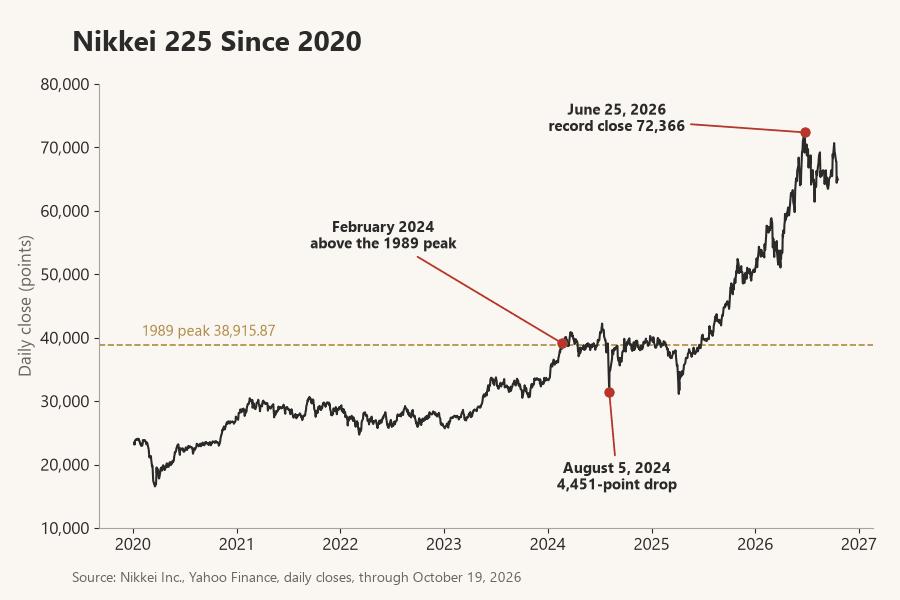
The milestones below use daily closes:
-
December 29, 1989: The index closed at 38,915.87 at the height of Japan's asset bubble. It then fell for more than a decade as the bubble burst
-
February 22, 2024: The Nikkei 225 closed above its 1989 record for the first time, 34 years later
-
August 5, 2024: The index fell 4,451.28 points in one day, its largest point drop on record. The sell-off followed a Bank of Japan rate hike, a sharply stronger yen, worries about the US economy and the unwinding of leveraged carry trades. It rebounded by 3,217.04 points the next day
-
2025: The index fell to about 31,137 in April after US tariff announcements, then crossed 50,000 for the first time on October 27, 2025. It ended the year at about 50,339, up about 26%
-
2026: The Nikkei 225 crossed 60,000 in April and 70,000 in June, and set a record close of 72,366.34 on June 25, 2026. It closed at 64,916.70 on October 19, 2026, about 10% below that high
6. What Moves the Nikkei 225?
The Nikkei 225 reacts to Japanese policy and data, but also to the yen and to global markets. These are the main drivers:
-
Bank of Japan policy: Rate decisions, the governor's press conference and the quarterly outlook report all move the index. Rate hikes tend to lift the yen and weigh on exporters. Dates are listed on the BOJ Monetary Policy Meeting calendar page
-
The yen: A weaker yen raises the yen value of exporters' overseas sales, so the Nikkei 225 often rises when USD/JPY climbs. A sudden jump in the yen, as in August 2024, can hit the index hard
-
Chip stocks and AI demand: With Advantest, Tokyo Electron and other chip-related stocks making up a large share of the index, global semiconductor news and the results of US chipmakers have an outsized effect
-
Wall Street: The Nikkei 225 opens after the US session, so overnight moves in US stocks often set its opening direction
-
Japanese economic data: The quarterly Tankan survey, GDP and inflation figures shape expectations for both corporate profits and BOJ policy
-
Trade policy: Japan relies heavily on exports, so tariffs and trade disputes affect autos, machinery and electronics makers
Positioning data can add context. The weekly CFTC report on Nikkei 225 futures shows how speculative traders are positioned.
7. Nikkei 225 Trading Hours
The Nikkei 225 is calculated during Tokyo Stock Exchange trading hours. The TSE extended its afternoon session by 30 minutes on November 5, 2024:
| Session | Japan time (JST, UTC+9) |
|---|---|
| Morning session | 9:00 a.m. to 11:30 a.m. |
| Lunch break | 11:30 a.m. to 12:30 p.m. |
| Afternoon session | 12:30 p.m. to 3:30 p.m. |
Japan does not use daylight saving time, so these hours stay the same all year. In US Eastern Time, the session runs from 7:00 p.m. to 1:30 a.m. in winter and from 8:00 p.m. to 2:30 a.m. during US daylight saving time.
Nikkei 225 futures and CFDs trade for much longer. On Titan FX, JPN225 trades from 01:00 to 23:59 server time, Monday to Friday, and closes at 23:55 on Fridays. Server time is GMT+2 in winter and GMT+3 during US daylight saving time.
8. How to Trade the Nikkei 225
You cannot buy an index directly, but there are several ways to track it:
| Method | How it works | Best suited for |
|---|---|---|
| ETFs | Funds listed in Tokyo and elsewhere hold the index constituents, such as NEXT FUNDS Nikkei 225 (1321) | Long-term holding |
| Futures | Exchange-traded contracts, mainly on the Osaka Exchange, with fixed contract sizes and expiry dates | Professional and active traders |
| CFDs | Contracts that settle on changes in the index price, allowing long or short positions | Short- to medium-term trading |
ETFs suit investors who want to hold Japanese stocks for the long term. Futures and CFDs suit traders who want to go long or short, including outside Tokyo trading hours.
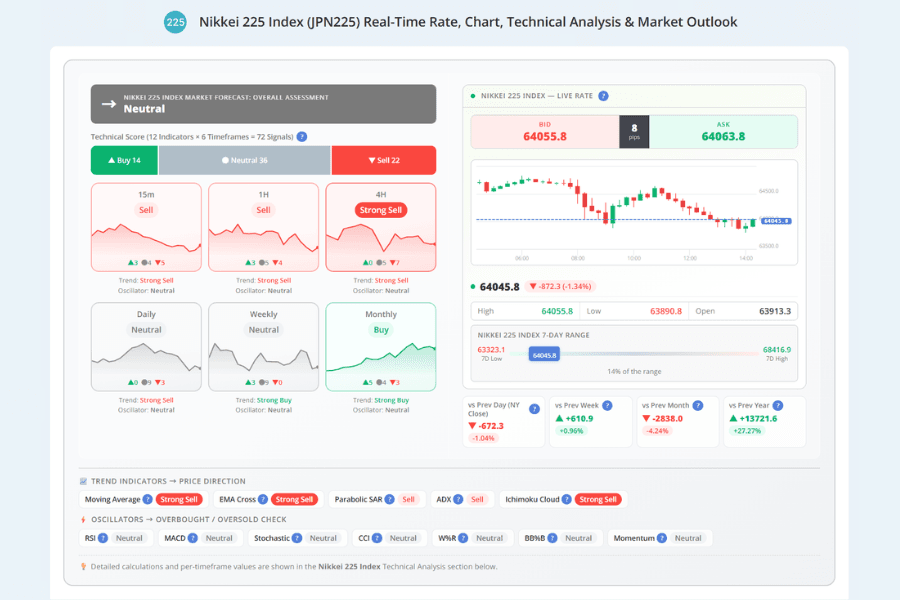
Titan FX offers the Nikkei 225 as the JPN225 CFD. The JPN225 instrument page shows the live price, chart, technical analysis and an overall signal for each timeframe:
Holding index CFDs overnight involves swap charges, and dividend adjustments apply when constituents go ex-dividend, which you can check on the Dividend Calendar. Use the Margin Calculator to check the margin a position requires before you trade.
9. Nikkei 225 FAQ
Q1. What is the Nikkei 225's all-time high?
The Nikkei 225's record close is 72,366.34, set on June 25, 2026, according to Nikkei Inc. Its previous long-standing record, 38,915.87 from December 29, 1989, was finally broken on February 22, 2024.
Q2. What time does the Nikkei 225 open and close?
The Tokyo Stock Exchange opens at 9:00 a.m. and closes at 3:30 p.m. Japan time, with a lunch break from 11:30 a.m. to 12:30 p.m. Futures and CFDs on the Nikkei 225 trade for nearly 24 hours on weekdays.
Q3. Does a weaker yen help the Nikkei 225?
Usually, yes. Many Nikkei 225 companies earn a large share of their sales overseas, so a weaker yen raises their profits in yen terms. The link is not fixed, though. In a global sell-off, the yen can strengthen as a safe haven while Japanese stocks fall.
Q4. Why does Fast Retailing affect the Nikkei 225 so much?
Because the Nikkei 225 is price-weighted, Fast Retailing's high share price gives it a large weight, 9.20% as of October 19, 2026. Toyota is a much larger company by market value, but its lower share price means it has far less influence on the index.
10. Conclusion
The Nikkei 225 is a price-weighted index of 225 Japanese companies, so a few high-priced stocks, led by Advantest, Fast Retailing, Tokyo Electron and SoftBank Group, drive much of its movement. Its heavy weighting in technology stocks makes it especially sensitive to the chip cycle.
After taking 34 years to regain its 1989 peak, the index set a record close of 72,366.34 in June 2026. Bank of Japan policy, the yen, chip stocks and Wall Street remain the main things to watch when trading it.
Further Reading
- What Is the Nasdaq-100 Index (NAS100)?
- What Is the S&P 500 Index (US500)?
- What Is a Stock Market Index?
Titan FX Trading Strategy Lab. We produce investor-education content covering forex, commodities (crude oil, precious metals, agricultural goods), stock indices, US equities, and digital assets.
Primary Sources (by Category)
- Index provider: Nikkei Inc., Nikkei 225 daily summary (component weights, sector weights and divisor for October 19, 2026) and records of daily point changes
- Exchange: Japan Exchange Group, extension of TSE trading hours from November 5, 2024
- Trading conditions: Titan FX index CFD page (JPN225 trading hours)
- Market data: Yahoo Finance (Nikkei 225 daily closes)