

What Is Leverage? Forex Leverage Calculation, Margin Ratio, Pros, Cons and Risk Control

With 100:1 leverage, for example, $10,000 of margin can control a $1,000,000 position. Leverage makes your capital work harder, but when the price moves against you, losses are calculated on the full size of that position.
This article explains how leverage works and the main types, how to calculate leverage and margin step by step, the pros and cons of leveraged trading, how position size drives risk, the principles of risk control, leverage in other financial products, and Titan FX's leverage conditions.
- Leverage lets you trade a large position with a small margin deposit. At 100:1, $10,000 can control $1,000,000
- Required margin = position value ÷ leverage. Higher leverage means less margin, but the profit or loss on the same position does not change
- The leverage set on your account only determines how much margin a trade needs; your risk depends on how large the position is relative to your account equity
- The basics of risk control: start with small positions, set a stop loss and keep enough spare margin
- At Titan FX, Standard and Blade accounts offer up to 1,000:1 on forex, and Micro accounts up to 2,000:1 for eligible clients
- 1. What is forex leverage?
- 2. How to calculate leverage: finding the required margin
- 3. Pros and cons of leveraged trading
- 4. Is higher leverage riskier? Position size and five principles
- 5. Leverage across financial products
- 6. Titan FX leverage conditions
- 7. Frequently Asked Questions (FAQ)
- 8. Summary
1. What is forex leverage?
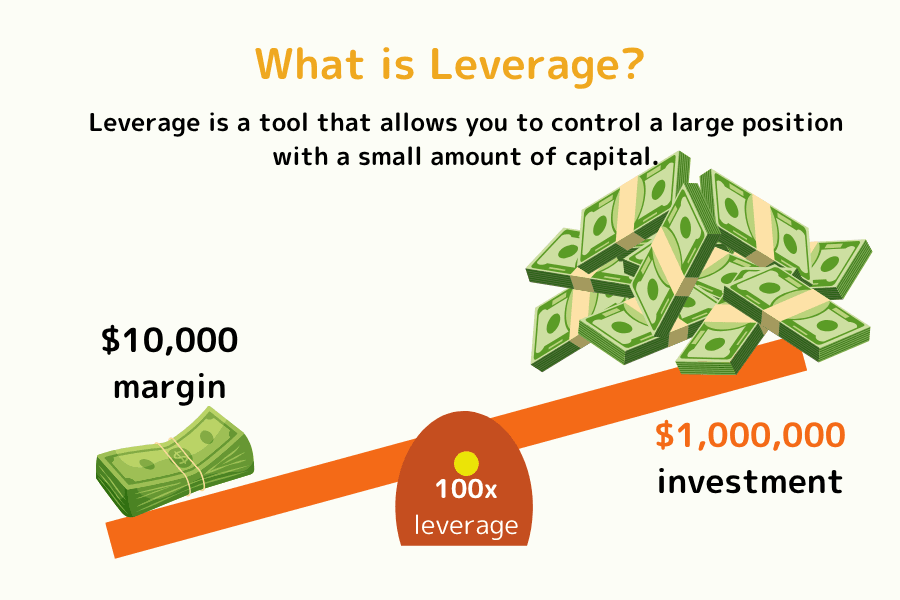
In forex and CFD markets, you do not need to put up the full value of a position. You deposit part of it as margin and can then hold the entire position. The leverage ratio tells you how many times larger the position is than the margin: at 100:1, the margin is only 1% of the position value, and you do not have to fund the rest yourself.
Why do traders use leverage?
In normal market conditions, the daily range of the major currency pairs is usually within 1%, much smaller than for individual stocks. Central bank decisions, major economic releases and unexpected events can widen that range sharply. When moves are small, a small account without leverage struggles to make a meaningful profit or loss from them. Leverage lets you take part in the same price moves with less margin, so your capital is used more efficiently.
Fixed and floating leverage
Brokers generally offer leverage in one of two ways:
-
Fixed leverage: The ratio is set in advance and does not change with position size. At 100:1, for example, $1,000 of margin controls a $100,000 position, and the ratio stays the same for the whole trade. Because the terms are clear before you enter, positions are easier to plan
-
Floating (dynamic) leverage: The broker adjusts the maximum available leverage based on position size, account equity or market conditions. For example, you might get 200:1 while your positions are small, falling automatically to 50:1 once they reach $500,000. This helps contain overall risk, but you need to watch your margin more closely
2. How to calculate leverage: finding the required margin
Leveraged trading calculations use the following formulas:
| What you want to find | Formula | What it tells you |
|---|---|---|
| Position value | Position value = lots × contract size × exchange rate | The real size of the trade, converted into your account currency |
| Required margin | Required margin = position value ÷ leverage | How much money you need to open the trade |
| Margin ratio | Margin ratio = 1 ÷ leverage × 100% | Margin as a share of the position value; it moves inversely to leverage |
| Profit or loss | Profit or loss = price change × trade size | The gain or loss produced by a price move |
Example: how much margin do you need at 100:1?
Suppose you want to buy EUR/USD under these conditions:
- Exchange rate: 1.1000
- Trade size: 1 standard lot (100,000 units)
- Leverage: 100:1
Step 1: Find the position value
Under the standard lot sizes, 1 standard lot is 100,000 units of the base currency, 0.1 lot is 10,000 units and 0.01 lot is 1,000 units. The base currency of EUR/USD is the euro, so you multiply by the exchange rate to convert into dollars:
Position value = 1 × 100,000 × 1.1000 = $110,000For pairs where the dollar comes first, such as USD/JPY, 1 standard lot is simply $100,000 and there is no need to multiply by the rate.
Step 2: Find the required margin
Divide the position value by the leverage:
Required margin = 110,000 ÷ 100 = $1,100In other words, $1,100 of margin lets you hold a position worth $110,000, a margin ratio of 1%.
Does leverage change your profit or loss?
Take the same trade. If EUR/USD rises from 1.1000 to 1.1050, a gain of 50 pips (0.0050):
Profit = 0.0050 × 100,000 = $500So each pip on 1 standard lot of EUR/USD is worth $10. Leverage does not appear anywhere in this calculation. Here is what happens when you change it:
| Leverage | Margin ratio | Required margin | Profit (+50 pips) | Loss (−50 pips) |
|---|---|---|---|---|
| Assuming no leverage (1:1) | 100% | $110,000 | +$500 | −$500 |
| 10:1 | 10% | $11,000 | +$500 | −$500 |
| 100:1 | 1% | $1,100 | +$500 | −$500 |
| 500:1 | 0.2% | $220 | +$500 | −$500 |
| 1,000:1 | 0.1% | $110 | +$500 | −$500 |
Leverage changes the required margin; the profit or loss on the same position stays the same whatever the leverage. The higher the leverage, the less money you need to open the same position. But if you use the money you save to open a bigger position, your losses grow with it.
Checking the numbers with the Margin Calculator
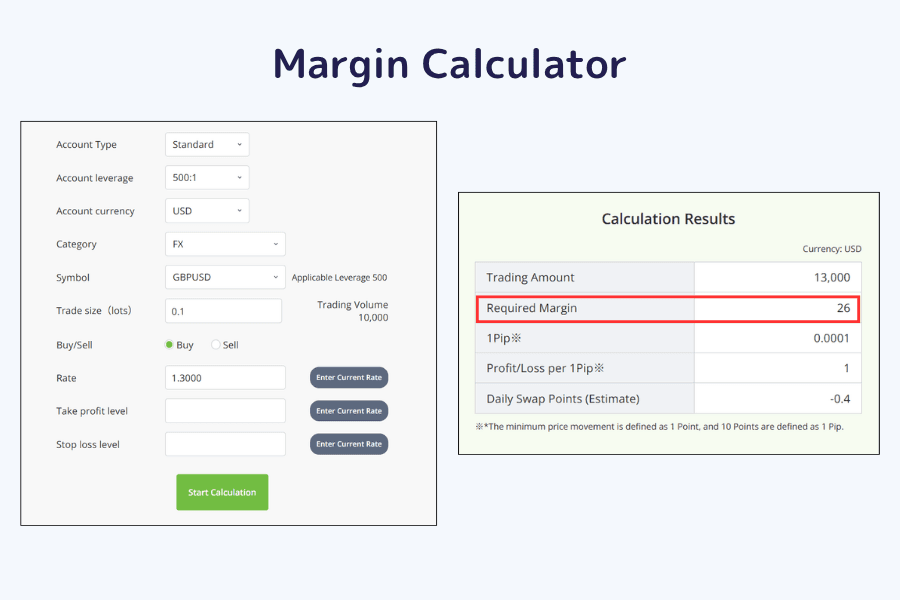
Titan FX's Margin Calculator works out the required margin and trading amount once you enter the account type, account leverage, account currency, symbol, trade size and rate. Take GBP/USD under these conditions:
- Exchange rate: 1.3000
- Trade size: 0.1 standard lot (10,000 units)
- Leverage: 500:1
Entering the same conditions in the calculator also gives $26: just $26 of margin controls a position worth $13,000.
3. Pros and cons of leveraged trading
| Details | Example | |
|---|---|---|
| Pro: Capital efficiency | You can trade a full position without putting up its full value | At 100:1, $1,000 of margin controls $100,000 |
| Pro: Greater return potential | The same capital can take part in larger price moves | A move that earns $10 without leverage earns $100 on a position 10 times larger |
| Con: Losses are magnified too | When the price moves against you, the loss is calculated on the full position; your account can fall sharply in a short time and even be liquidated | With a position 10 times larger, a 1% adverse move becomes a 10% loss |
| Con: Less room for error | If the position is too large for the account, a small move can trigger a margin closeout | Prices can jump instantly when major economic data is released |
Leverage itself is a neutral tool. It gives you more flexibility with your capital, but the larger the position, the less price movement your account can absorb.
4. Is higher leverage riskier? Position size and five principles
Risk depends on position size
The leverage set on your account (1,000:1, for example) determines how much margin a trade requires. What determines your risk is how large the position is relative to your account equity. Using the method from Section 2, assume these conditions:
- Account equity: $1,000
- Leverage: 1,000:1
- Instrument: EUR/USD at 1.1000 ($10 per pip per lot)
- Adverse price move: 50 pips
| Position size | Required margin | Loss (−50 pips) | Share of account equity |
|---|---|---|---|
| 0.01 lot | $1.10 | $5 | 0.5% |
| 0.1 lot | $11 | $50 | 5% |
| 1 lot | $110 | $500 | 50% |
All three positions use 1,000:1 leverage, and each needs only a small fraction of the account as margin. Yet on the same 50-pip adverse move, the 1-lot loss is 100 times the 0.01-lot loss and wipes out half the account in one go. High leverage makes large positions easy to open; the risk comes from opening positions that are too large.
Five principles for using leverage sensibly
| Principle | Details |
|---|---|
| 1. Set a stop loss | Decide where your stop goes before every trade so small losses do not turn into large ones |
| 2. Control position size | Base your lot size on account equity; do not max out a position just because you have the margin |
| 3. Keep spare margin | Check your margin level regularly so it stays well above your broker's loss cut level |
| 4. Practice on a demo account first | Test different combinations of leverage and position size on an MT5 demo account |
| 5. Watch major data and events | Volatility rises around rate decisions, nonfarm payrolls and similar releases; check the times in advance on the Economic Calendar |
5. Leverage across financial products
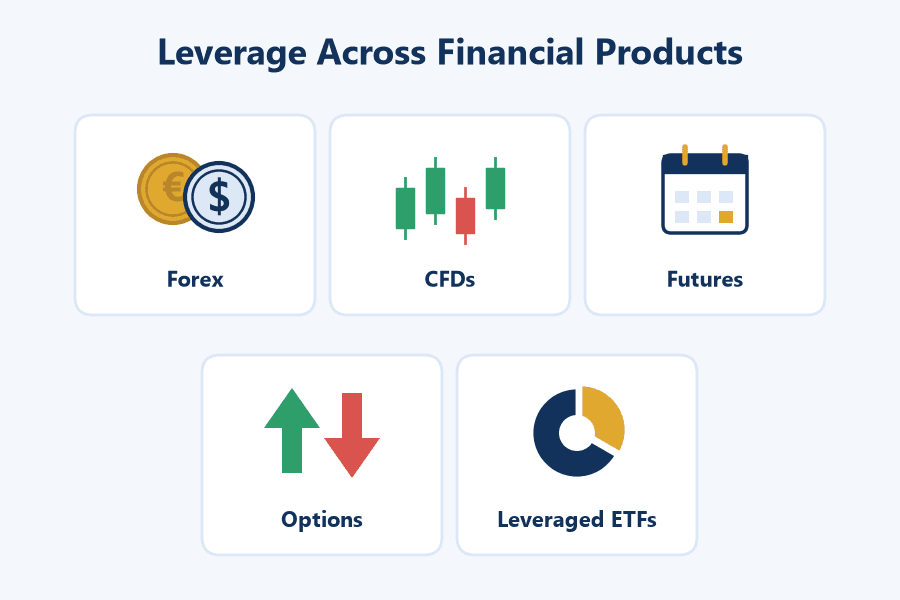
Leverage is not limited to forex. Other financial products have their own forms of leverage, each with different characteristics and risks.
-
Forex: With high liquidity and long trading hours, forex is the market most often traded with leverage. EUR/USD, with its heavy volume and tight spreads, is a good place to learn how leverage works. The basic concepts of forex trading all feed into leverage calculations
-
CFDs: A CFD lets you trade price movements on margin without owning the underlying asset. Common underlyings include stock indices (such as US500 and NAS100), gold, silver, crude oil, individual shares and ETFs
-
Futures: Futures trading also uses margin, but contracts are standardized and have expiry dates, and exchanges adjust margin requirements as volatility changes
-
Options and leveraged ETFs: An option buyer pays only the premium to gain exposure to large moves in the underlying. A leveraged ETF aims to deliver two or three times the underlying's daily return, so over longer holding periods its performance drifts away from the underlying. Both are more complex to price and carry more complex risks than forex
6. Titan FX leverage conditions
The leverage a broker can offer depends on financial regulation and varies from broker to broker. In the US, for example, retail forex leverage is capped at 50:1 on major pairs, and in the EU and the UK retail clients are limited to 30:1 on majors. Titan FX's Standard and Blade accounts offer up to 1,000:1 on forex, and Micro accounts up to 2,000:1 for eligible clients. Maximum leverage by product is shown below (from the Titan FX leverage page):
| Product | Standard and Blade accounts | Micro account |
|---|---|---|
| Forex (major and minor pairs, such as USD/JPY) | 1,000:1 | 2,000:1 (eligibility required) |
| Gold (XAU/USD) | 1,000:1 | 1,000:1 |
| Other precious metals | 500:1 | 1,000:1 |
| Major index CFDs | 1,000:1 | Not available |
| Other index CFDs | 500:1 | Not available |
| Energy (crude oil, natural gas) | 500:1 | Not available |
| Soft commodities | 50:1 | Not available |
| Crypto CFDs (such as Bitcoin) | 100:1 | 100:1 |
| Share CFDs | 20:1 | Not available |
※ To use 2,000:1 on a Micro account, all of your live accounts combined must meet every one of these conditions: total equity below $1,000, at least 10 closed trades and at least 5 standard lots of cumulative volume. Eligibility is reviewed automatically every day at 00:15 server time, and leverage is adjusted to 1,000:1 if the conditions are not met.
You choose your account leverage at Titan FX, but the maximum leverage for new positions is temporarily reduced in the following situations:
-
More volatile instruments: Crosses, exotic pairs, silver, energy and similar products have lower leverage caps
-
Major economic releases: Around releases such as CPI and nonfarm payrolls, leverage is temporarily reduced, for example from 1,000:1 to 500:1
-
Rollover periods: Around the daily close and before and after the weekend, new positions in precious metals, energy and index CFDs are subject to lower maximum leverage (currency pairs are excluded)
You can check the leverage that applies to a specific instrument in the Margin Calculator.
Titan FX trading advantages
| Item | Details |
|---|---|
| Spreads | Average EUR/USD spread of 0.2 pips on the Blade account (commission charged separately) |
| Trading platforms | MT4 and MT5, with full technical analysis features |
| Free tools | Indicators and the EA Forward Test Ranking |
| Market information | Forex education and a daily market report |
| Negative balance protection | In principle, no additional margin is required; whether it applies is decided by review of the trading operations department |
7. Frequently Asked Questions (FAQ)
Q1. Does 1,000:1 leverage mean my profits are multiplied by 1,000?
No. Leverage affects only the margin needed to open a trade, not the profit or loss produced by a price move. On 1 standard lot of EUR/USD, each pip is worth $10 whether you use 100:1 or 1,000:1. The size of your gain or loss depends on your lot size and how far the price moves.
Q2. How many lots should I trade on each position?
One approach is to work backward from the most you are willing to lose on the trade. Assume these conditions:
- Account equity: $10,000
- Maximum loss per trade: 1% of equity ($100)
- Stop-loss distance: 50 pips
- Instrument: EUR/USD ($10 per pip per lot)
Sizing positions this way means the wider your stop, the smaller your lot size, and your maximum loss per trade stays at 1% of equity. Even with a high account leverage setting, you will not end up with an oversized position.
Q3. Am I more likely to be liquidated with higher leverage?
Not necessarily. Whether you are liquidated depends mainly on position size and where you set your stop loss. With higher account leverage, the same position needs less margin, which actually leaves you more free margin. Risk rises when traders use that freed-up margin to open bigger positions. With small positions and clear stops, the risk on a high-leverage account can still be controlled.
Q4. Which product should I start leveraged trading with?
Forex is a common starting point, as the major pairs are highly liquid with tight spreads. If you are interested in indices, gold or crude oil, get used to each product's volatility and leverage conditions on a demo account first.
8. Summary
Leverage lets you hold a large position with a small amount of margin, making your capital more efficient while magnifying losses in the same proportion. To calculate it, find the position value first and divide by the leverage to get the required margin. Profit and loss depend only on lot size and the price move, not on the leverage ratio.
The maximum leverage on your account sets the margin a trade requires, while your risk depends on how large the position is relative to your account equity. Before using leverage, set a stop loss, size your positions according to your equity and keep enough spare margin.
Further Reading
- Slippage
- Can you lose money in forex? A beginner's guide to risks and defense
- The 2% rule: risk management and position sizing for beginners
- Why forex beginners fail: 10 mistakes and 7 risk strategies
The Titan FX Financial Markets Research and Analysis Team. Covering forex (FX), commodities (crude oil, precious metals, agricultural products), stock indices, US equities, and crypto assets, the team produces educational content for investors across a broad range of financial instruments.
Primary Sources (by Category)
- Trading conditions: Titan FX website leverage page
- Regulation: CFTC retail forex leverage limits (US); ESMA and FCA retail CFD leverage limits (EU, UK)
- Education and research: Investopedia: Leverage, Investopedia: Margin