

Forex Spread
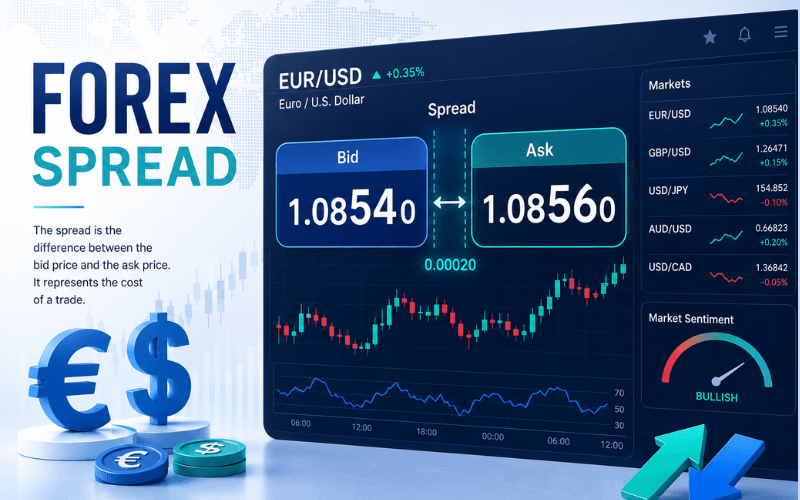
A spread is the gap between the ask (buy) and bid (sell) price in forex and CFD trading — the main cost you take on the moment you open a position, measured in pips. Spreads come in fixed and floating types and respond to market liquidity, economic events, and trading sessions; higher liquidity means tighter spreads and lower costs. Choosing a low-spread account (such as Titan FX Blade) and trading during high-liquidity hours helps cut costs.
Whether you are new to forex or an experienced trader, the spread is a cost you meet every day yet easily overlook.
This article starts from the definition and types of spread, walks through the cost formula with examples, breaks down what makes spreads move, and shares practical ways to lower your spread costs on Titan FX.
- Spread = ask − bid, the main cost incurred the moment you open
- Fixed spreads stay stable; floating spreads move with liquidity
- Spread cost = spread × lot size × units per lot × pip value
- Liquidity, economic events, and sessions are the three main drivers
- A low-spread account (e.g., Blade) plus high-liquidity hours cut costs
1. What Is Spread?
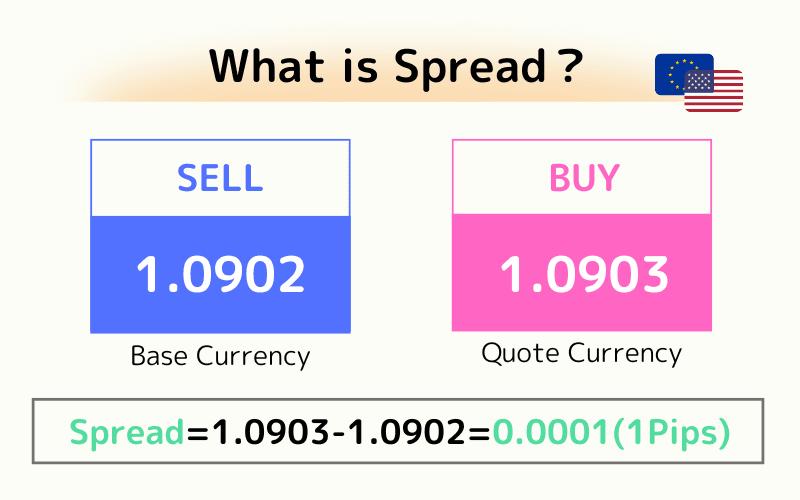
Spread is the difference between the bid price (BID) and the ask price (ASK).
Formula: Spread = Ask Price − Bid Price
For example, in the EUR/USD currency pair:
Spread = 1.0903 (Ask) − 1.0902 (Bid) = 0.0001
The spread is 1 pip.
Spreads represent the trading cost paid to the broker at the time of opening a position. The size of the spread can also indicate the liquidity of a financial product. Higher liquidity generally results in smaller spreads, while lower liquidity leads to larger spreads.
Thus, the spread serves as a key measure of trading costs and indirectly reflects market conditions and the liquidity of trading instruments.
2. Types of Spread: Fixed vs. Floating
In Forex and CFD trading, spreads are categorized into two main types: fixed spreads and floating spreads. Each type has its own advantages and disadvantages, and the choice depends on the trader's style, strategy, and risk tolerance regarding market volatility.
Fixed Spread
A fixed spread remains constant regardless of market conditions. No matter how volatile the market is, the spread stays the same.
Advantages:
- Provides stable and predictable trading costs, making cost management simpler.
- Protects traders from unexpected high costs during periods of significant market volatility.
- Suitable for traders who prioritize consistent costs and strategic planning.
Disadvantages:
- Typically higher than the average floating spread.
- The certainty in pricing comes at the expense of potentially lower spreads during stable market conditions.
Floating Spread
A floating spread, on the other hand, fluctuates based on market demand, supply, and liquidity.
Advantages:
- During high-liquidity periods with significant trading volume, floating spreads can be exceptionally low.
- Offers a cost structure that closely aligns with real-time market conditions.
Disadvantages:
- Spreads can widen significantly during market volatility, news releases, or low-liquidity periods, increasing trading costs.
- Can be less predictable for cost planning, especially during critical market events.
Comparison of Fixed and Floating Spreads
| Type | Characteristics | Advantages | Disadvantages | Broker Usage |
|---|---|---|---|---|
| Fixed Spread | Remains constant, unaffected by market changes. | Stable trading costs; easier cost management and strategy planning. | Higher than average floating spreads; pays for price certainty. | Less common. |
| Floating Spread | Changes based on market demand and liquidity. | Lower costs during high liquidity; aligns closely with market conditions. | Widens significantly during high volatility, increasing costs. | More commonly used. |
Floating spreads are widely preferred in dynamic trading environments due to their flexibility, while fixed spreads appeal to those who prioritize consistency in their trading costs.
3. Spread Cost Calculation and Payment Timing
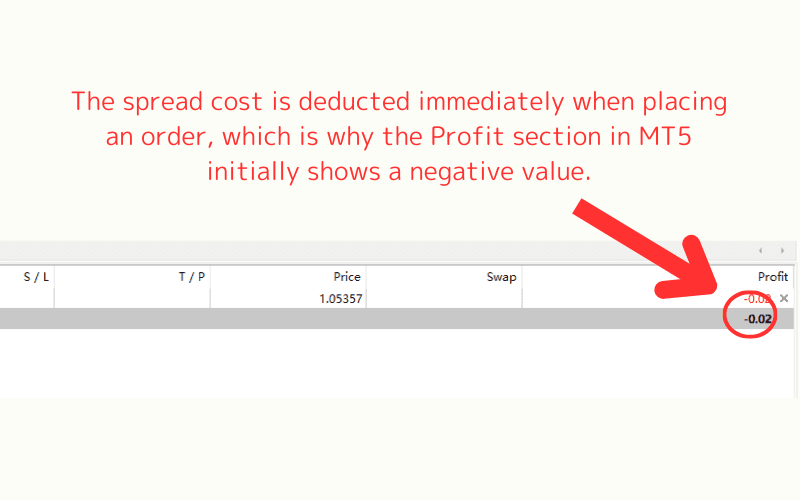
The spread is paid immediately when a trade is opened. Specifically, the moment you initiate a trade (whether buying or selling), the spread cost is deducted from your account as part of the transaction cost. This means your trade will start with a small loss equal to the spread cost.
Spread Cost Formula
The formula for calculating spread cost is as follows:
Spread Cost = Spread × Lot Size × Units per Lot
For example, in the EUR/USD currency pair, if the spread is 1 pip (0.0001), the spread cost varies based on the lot size.
| Spread | Lot Size | Units per Lot | Spread Cost (USD) |
|---|---|---|---|
| 0.0001 | 0.01 lots | 100,000 | 0.1 |
| 0.0001 | 1 lot | 100,000 | 10.0 |
| 0.0001 | 10 lots | 100,000 | 100 |
| 0.0001 | 50 lots | 100,000 | 500 |
Spread cost is proportional to trade size, so large-lot trades need careful cost management. Choosing a low-spread broker (such as the Titan FX Blade account) can significantly reduce your costs.
4. Factors Affecting Spread Fluctuations
Spreads are not fixed — they adjust in real time to market conditions and external events. The three main factors are as follows:
Market Liquidity
When liquidity is high, spreads tend to narrow as buyers and sellers are easier to match. Conversely, during low liquidity, spreads may widen.
Economic Events
Economic reports, political events, breaking news, or natural disasters can create market volatility, often leading to wider spreads. Titan FX provides an economic calendar so you can check the content and timing of key releases in advance.
Trading Sessions
During overlapping major market sessions (e.g., London and New York), liquidity is at its highest, often resulting in narrower spreads. Spreads may widen around market opening or closing hours.
The Best Timeframes for Forex Trading5. Titan FX's Spread Advantages
Titan FX offers different spreads depending on the account type. Our Standard, Blade, and Micro accounts each provide unique spread advantages.
Below are the average spreads for major currency pairs:
| Currency Pair | Standard | Blade | Micro |
|---|---|---|---|
| EUR/USD | 1.20 | 0.20 | 1.40 |
| GBP/USD | 1.57 | 0.57 | 1.77 |
| AUD/USD | 1.52 | 0.52 | 1.72 |
| USD/JPY | 1.33 | 0.33 | 1.53 |
| USD/CHF | 1.92 | 0.92 | 2.12 |
Titan FX provides competitive spreads tailored to the needs of different trading styles and strategies. You can check the latest spreads on the official live-rate page below.
View Titan FX Real-Time Spreads6. How to Check Real-Time Spreads on MT4/MT5
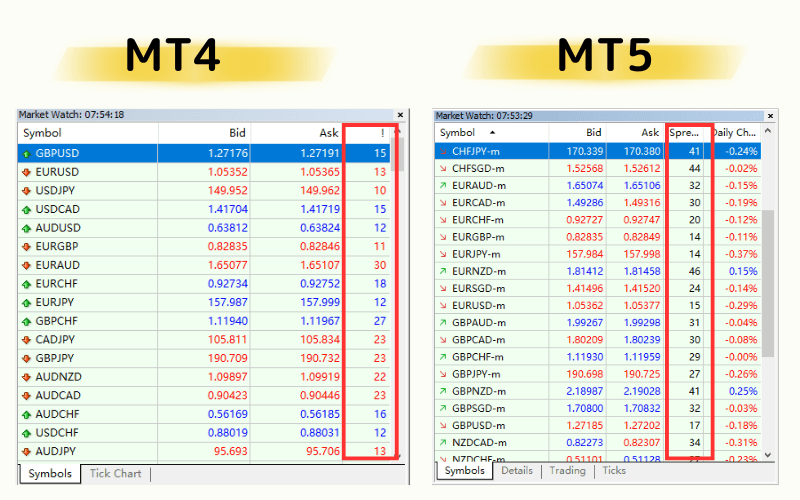
You can view real-time spreads directly in the Market Watch section of MT4/MT5.
MT4 (MetaTrader 4)
- Open Market Watch.
- Right-click anywhere in the list.
- Select Spread to view the live spreads.
MT5 (MetaTrader 5)
- Open Market Watch.
- Right-click anywhere in the list and select Columns.
- Choose Spread to display the real-time spreads.
Trade Forex CFDs with Titan FX
Titan FX offers 50+ currency pair CFDs on MT4/MT5 with up to 1,000:1 leverage on major pairs, tight spreads, and the flexibility to go long or short. Micro accounts can reach up to 2,000:1 leverage when eligible.
7. FAQ
Q1: When is the spread lowest?
Spreads are tightest when market liquidity is high. Trading during the London–New York overlap (UTC+8 20:00–23:00) is recommended.
Q2: Which currency pairs have lower spreads?
Major pairs such as EUR/USD and USD/JPY have high liquidity and stable spreads, making them well suited to cost control.
Q3: Should I avoid trading at certain times?
It's best to avoid the windows around major data releases such as the NFP report and rate decisions — use the Titan FX economic calendar to time entries.
Q4: Does high-frequency trading increase spread costs?
Yes. The spread is a fixed cost per trade, so the more you trade, the more it accumulates. Focus on higher-probability strategies and cut unnecessary entries.
Q5: Are spread and slippage the same thing?
No. The spread is a known quoted price gap, while slippage is the price deviation that can occur at order execution. Both affect your final trading cost.
8. Conclusion
The spread is one of the most basic yet most important trading costs in forex and CFD trading. Whether you are a beginner or an experienced trader, understanding its definition, types, calculation, and what makes it move is the first step toward controlling costs and improving efficiency.
By trading during high-liquidity sessions, choosing low-spread instruments and account types, and using platform quote tools and the Titan FX economic calendar, traders can time entries and exits more precisely and avoid unnecessary costs.
Building the spread into your overall risk and money-management framework is an essential part of a durable long-term trading strategy.
Further Reading
Titan FX's financial-market research team. We cover a broad set of instruments — foreign exchange, commodities (crude oil, precious metals, agricultural products), equity indices, US equities, and digital assets — producing educational content for investors.
Primary Sources (by Category)
- Quotes & spreads: Titan FX live rates, Titan FX account types
- Concept references: Investopedia — Bid-Ask Spread, Investopedia — Pip