

Forex Trading Hours & Time Zones: Global Markets and Best Times to Trade
The same strategy can produce very different results depending on when you trade. The forex market is convenient, but "when to trade" is often as important as "what to trade" — liquidity, volatility, and spreads all shift as each session opens and closes. Reading that rhythm is what lets you act at the right moment.
This article explores Forex trading hours, key market characteristics, peak activity periods, and risks to watch for, helping traders optimize their timing and decision-making.
- How the 24-hour market works: why FX trades nearly around the clock and how the four sessions relay
- The four major sessions: Wellington/Sydney, Tokyo, London, and New York — hours and key currencies
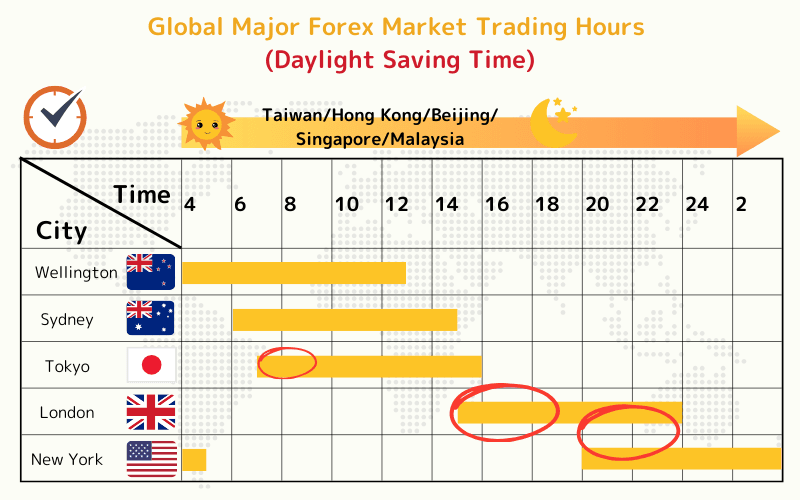
- The most active window: the London–New York overlap (21:00–1:00 UTC+8) and its high liquidity
- Best times to trade: choosing windows by liquidity and volatility
- Session-specific risks: thin liquidity, data releases, weekends, and swaps
- 1. Overview of Forex Trading Hours
- 2. Major Forex Markets: Trading Sessions and Characteristics
- 3. Peak Activity Periods and Trading Strategies
- 4. Key Risks During Specific Trading Hours
- 5. Tools for Identifying Optimal Trading Times(Titan_Time_Range)
- 6. Frequently Asked Questions (FAQ)
- 7. Conclusion
1. Overview of Forex Trading Hours
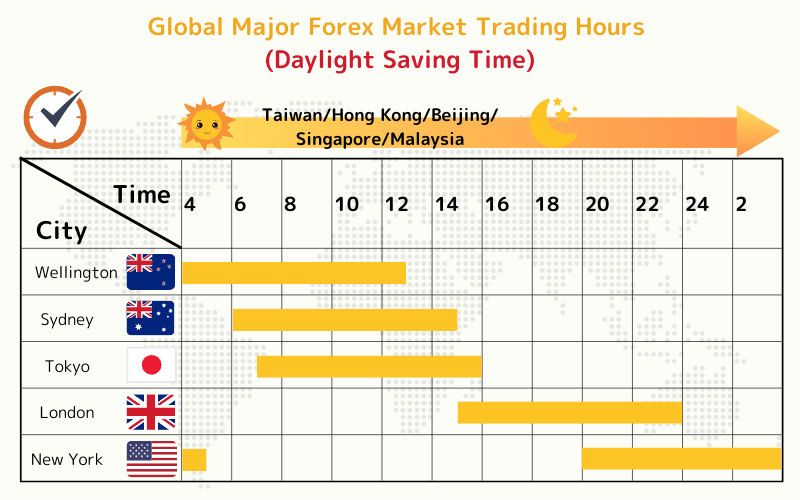
Forex trading is distinguished by its ability to operate nearly 24 hours a day on weekdays. This seamless operation is driven by global financial hubs, starting with Wellington, followed by Sydney, Tokyo, London, and New York, which relay trading activity across time zones.
This section covers three key aspects of Forex trading hours:
- Tradable Hours
- Non-Tradable Hours
- Daylight Saving Time (DST)
Tradable Hours
The Forex market is active from Monday morning to Saturday morning (UTC+8), as well as most non-weekend public holidays. However, major holidays like Christmas (December 25) and New Year’s Eve (December 31) may involve early closures or trading halts.
Unlike stock markets with defined opening and closing times, Forex operates through a global handoff between regional markets, ensuring continuous trading.
Trading Hours for Major Asian Regions
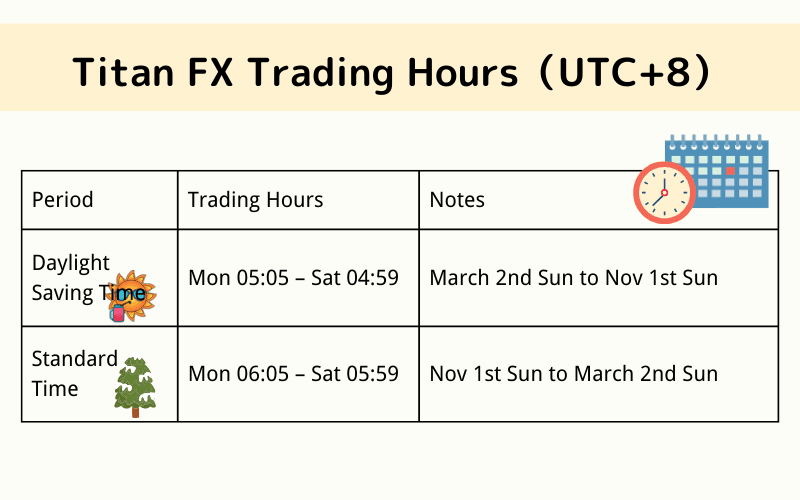
| Period | Taiwan/Hong Kong/Singapore/Malaysia (UTC+8) | Japan (UTC+9) | Notes |
|---|---|---|---|
| Daylight Saving Time | Mon 05:05 – Sat 04:59 | Mon 06:05 – Sat 05:59 | March 2nd Sun to Nov 1st Sun |
| Standard Time | Mon 06:05 – Sat 05:59 | Mon 07:05 – Sat 06:59 | Nov 1st Sun to March 2nd Sun |
Public Holidays
Trading typically continues during most public holidays, except on weekends. However, Christmas (December 25) and New Year’s Eve (December 31) often see early market closures or full trading suspensions.
Non-Tradable Hours
Forex trading is unavailable during:
- Weekends (Saturday morning to Monday morning): Most markets are closed.
- New Year’s Day (January 1): Global markets halt trading entirely.
Additionally, December 31 and January 2 may have limited trading hours or early closures, with reduced liquidity increasing the risk of volatility.
Daylight Saving Time (DST)
DST, implemented primarily in the US and Europe, shifts clocks forward by one hour in summer, affecting Forex market schedules.
- Implementation Period: 2nd Sunday of March to 1st Sunday of November
- Impact: Trading sessions and key economic data releases shift one hour earlier.
Traders should monitor DST changes to avoid missing critical events or data releases.
2. Major Forex Markets: Trading Sessions and Characteristics
The Forex market comprises multiple regional hubs, each operating in distinct time zones, creating a near-continuous 24-hour trading environment. Below, we outline the four major markets, their trading hours (based on UTC+8), and unique characteristics.
Wellington and Sydney Markets (Oceania)
Trading Hours: 4:00–13:00 (DST: 3:00–12:00)
Wellington marks the start of the global Forex trading day, followed closely by Sydney. With European and US markets inactive, liquidity is low, leading to wider spreads. Significant weekend news can trigger gap movements at Monday’s open, requiring careful risk management. Currency pairs like AUD and NZD are most active during this session.
Tokyo Market (Asia)
Trading Hours: 7:00–16:00
Tokyo is the primary Asian market, with heavy trading in JPY-related pairs. Short-term volatility often spikes around 9:55 when the interbank fixing rate is set, particularly for JPY. Monthly “5th and 10th” corporate settlements can drive USD demand, impacting USD/JPY trends.
London Market (Europe)
Trading Hours: 15:00–1:00 (DST: 14:00–0:00)
London is the world’s largest Forex market, offering high liquidity and tight spreads. EUR and GBP pairs dominate trading. Volatility may dip around 19:00 during Europe’s lunch break, while the 0:00 (DST: 23:00) “London Fix” often sees large orders and price swings. Eurozone inflation and economic data releases significantly influence market movements.
New York Market (North America)
Trading Hours: 21:00–5:00 (DST: 20:00–4:00)
New York, dominated by the USD, is most active during its overlap with London. US economic data, such as Non-Farm Payrolls or CPI, released between 20:00–22:00 (UTC+8), often drives sharp market moves. Option expiries at 23:00 (DST: 22:00) can also trigger short-term volatility.
3. Peak Activity Periods and Trading Strategies
Market volatility peaks during session overlaps and economic data releases. Below, we highlight key active periods (UTC+8), their characteristics, and recommended strategies.
| Time (UTC+8) | Market | Characteristics and Strategies |
|---|---|---|
| 05:00–13:00 / 06:00–14:00 | Oceania (Wellington/Sydney) | Low liquidity, potential gaps open. Use range-bound strategies or wait for higher liquidity. |
| 07:00–09:00 | Tokyo Open | Asian funds enter, USD/JPY volatility rises. Ideal for short-term scalping. |
| 15:00–18:00 | London Open | Global volume surges, EUR and GBP active. Trend-following strategies work well. |
| 20:00–22:00 | US Data Releases | High volatility from USD pairs due to data. Use risk management tools for event-driven trades. |
| 21:00–01:00 | New York-London Overlap | Daily trading peak, strong volatility. Short-term trades with tight stops are effective. |
| 23:00 (DST: 22:00) | New York Option Expiry | Brief spikes in select pairs. Experienced traders can capitalize on quick moves. |
Each session’s activity level and participant mix vary, so traders should align their strategies with their trading style and schedule. High-volatility periods offer opportunities but require robust risk management, including stop-loss orders and disciplined position sizing.
4. Key Risks During Specific Trading Hours
Despite its 24-hour accessibility, certain periods pose heightened risks due to low liquidity or extreme volatility. Below are critical times and events to monitor:
- 5:00–6:00 (Pre-Tokyo Open)
- Christmas (December 25)
- Year-End/New Year (December 31–January 2)
- Major Economic Events
5:00–6:00 (Pre-Tokyo Open)
Before Tokyo opens, market participation is minimal, leading to low liquidity. Spreads widen, and large orders can cause sharp price swings. Avoid unnecessary trades during this period to minimize slippage risks.
Christmas (December 25)
European and US markets close for Christmas, drastically reducing global liquidity. Wider spreads and erratic price movements increase trading costs and risks. Consider pausing trading or limiting exposure.
Year-End/New Year (December 31–January 2)
Corporate settlements and holidays reduce market participation, lowering liquidity. Price volatility can spike with minimal trading volume, and spreads may widen. January 1 is a global market closure, with January 2 seeing gradual recovery but potential for unusual volatility.
Major Economic Events
Before key data releases (e.g., US CPI, Fed rate decisions) or central bank speeches, markets often enter a quiet phase with compressed volatility. Post-release, prices can surge or plummet rapidly. Traders without stop-loss orders risk significant losses. Plan trades around economic calendars to manage exposure.
Titan FX provides economic indicators and financial calendar to allow investors to check the content and release time of important economic indicators in various regions in a timely manner.
5. Tools for Identifying Optimal Trading Times(Titan_Time_Range)
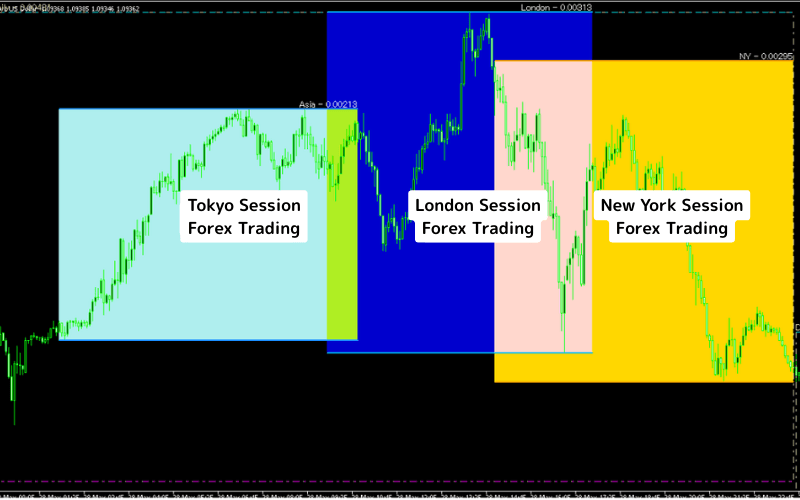
To help traders navigate market rhythms effectively, several free, customizable tools are available. One standout is the Time Range Indicator, designed for multi-time-zone traders.
This tool can clearly mark the opening and overlapping periods of the Tokyo, London and New York markets in the MT4/MT5 chart, allowing traders to quickly identify active market periods and strengthen their judgment of time period strategies. Whether it is finding volatility peaks, observing price reaction times, or setting entry and exit plans, Time Range can provide visual assistance to improve operational efficiency.
This tool can be downloaded for free from the Titan FX official website. It is applicable to all Titan FX MT4/MT5 accounts. Users can adjust the color, time zone and time range as needed, freely customize the display mode, and create an operating environment that better suits their personal trading rhythm.
Trade Forex CFDs with Titan FX
Titan FX offers 50+ currency pair CFDs on MT4/MT5 with up to 1,000:1 leverage on major pairs, tight spreads, and the flexibility to go long or short. Micro accounts can reach up to 2,000:1 leverage when eligible.
6. Frequently Asked Questions (FAQ)
Q1: Which session is best for beginner traders?
The London-New York overlap (21:00–1:00 UTC+8, or 20:00–0:00 DST) is ideal for beginners due to high liquidity and clear trends. However, beware of volatility during US data releases.
Q2: Why is the Forex market open 24 hours?
Global markets operate in relay, from Wellington and Sydney to Tokyo, London, and New York, ensuring at least one market is active at any given time, enabling continuous trading.
Q3: Can I trade Forex on weekends?
No, the market is closed from Saturday 6:00 to Monday 5:00 (UTC+8). Some Middle Eastern markets may open, but liquidity is extremely low, making trading risky and impractical.
Further reading: How to trade forex on Saturdays and Sundays
7. Conclusion
The Forex market’s near-continuous 24-hour operation offers unmatched flexibility, but varying liquidity and volatility across sessions significantly influence strategy selection.
The trading day begins with Wellington and Sydney, followed by Tokyo driving JPY movements. London anchors global liquidity, while the New York-London overlap (21:00–1:00 UTC+8) marks the daily volatility peak.
Active periods like 7:00–9:00, 15:00–18:00, and 21:00–1:00 offer prime trading opportunities, but low-liquidity times (e.g., 5:00–6:00) or major data releases require heightened risk management.
By understanding session dynamics, leveraging economic calendars, and applying disciplined risk controls, traders can navigate the fast-paced Forex market with confidence, optimizing efficiency and long-term performance.
Further Reading
- Tokyo Session Hours
- London Session Hours
- New York Session Hours
- Trading Forex on Weekends
- How the Forex Market Works
Titan FX Trade Strategy Research Lab covers forex (FX), commodities (oil, precious metals, agricultural products), stock indices, U.S. equities, and crypto assets — producing educational content for retail investors across asset classes.
Primary Sources (by category)
- Market Data & Statistics: BIS Triennial Central Bank Survey, Investopedia
- Education: BabyPips, Titan FX Swap Calendar
- Time References: Official exchange session hours; UTC and Daylight Saving Time