

CPI(Consumer Price Index)
The Consumer Price Index (CPI) measures the change in prices of a basket of consumer goods and services — a core gauge of inflation, a guide to central-bank rate decisions, and a read on real purchasing power.
Few data releases move currencies, equities, and bonds the way a CPI print can — because it directly shapes the market's view on inflation and where central banks take monetary policy next. For traders, knowing how to read CPI and why it matters counts for more than memorising a single number.
This article explores CPI's definition, origins, calculation methods, regional differences, and its impact on forex markets, helping investors grasp its practical value.
- Definition: Measures price changes for goods and services purchased by households — the "thermometer of the economy"
- Formula: Laspeyres Index — CPI = (Current Price × Base Year Quantity) ÷ (Base Year Price × Base Year Quantity) × 100
- Two types: Headline CPI (all items) / Core CPI (excludes volatile food & energy — preferred by central banks)
- vs PPI / PCE: PPI = supplier view (leading indicator) / CPI = consumer view / PCE = Fed's primary policy reference (more flexible weights)
- Release timing: U.S. ~15th 8:30 AM EST / Japan ~19th Friday / Taiwan mid-month / Eurozone HICP after national releases
- FX impact: CPI > forecast → rate hike expected → currency appreciates (cost-push inflation is the exception)
1. What Is the Consumer Price Index (CPI)?
The Consumer Price Index (CPI) measures price changes in goods and services typically purchased by households.
It tracks shifts in the cost of living and serves as a key reference for central banks—like the U.S. Federal Reserve, Bank of Japan, and European Central Bank—to maintain currency value and price stability.
CPI Basics
CPI sets a base year's price level at 100, calculating percentage changes by comparing current prices to that baseline.
For example, if a good cost $100 in the base year and rises to $110 now, the CPI is 110, indicating a 10% increase.
CPI covers major spending categories like food, housing, transportation, healthcare, and education, with weights assigned based on household spending patterns. These weights are periodically updated to reflect evolving consumption habits.
Headline CPI vs. Core CPI
- Headline CPI: Includes all surveyed items (e.g., food, energy, housing, transportation), reflecting overall cost-of-living changes.
- Core CPI: Excludes volatile items (e.g., fresh food, energy) to reveal stable inflation trends, often used by central banks for long-term policy assessment.
Which "CPI" Is Typically Meant?
Unless specified, "CPI" usually refers to Headline CPI because it includes all items, best capturing the cost-of-living shifts consumers feel.
Core CPI, explicitly labeled, filters out short-term noise to highlight underlying inflation trends, a focus for central banks like the Fed and Bank of Japan in monetary policy decisions.
Note: Japan's Core CPI uniquely excludes only fresh food (different from the U.S., which excludes both food and energy). The Bank of Japan also tracks "Core-Core CPI" (excluding fresh food + energy) for the cleanest underlying inflation read.
CPI vs. PPI
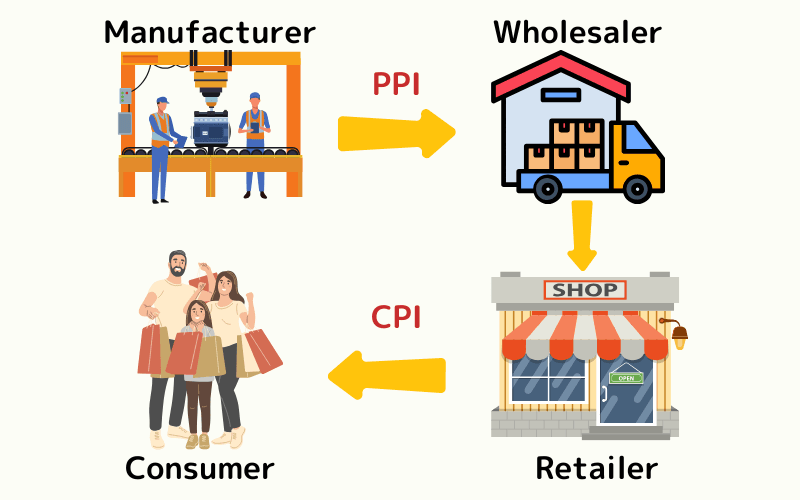
- PPI (Producer Price Index): Measures price changes from the supply side, tracking what producers receive at the factory gate—a "seller's perspective."
- CPI (Consumer Price Index): Measures price changes from the demand side, reflecting what consumers pay—a "buyer's perspective."
Since price shifts often start at production, PPI is considered a leading indicator for CPI.
| Abbreviation and Full Name | Description |
|---|---|
| CPI (Consumer Price Index) | Tracks final purchase price changes from the consumer's view |
| PPI (Producer Price Index) | Tracks factory-gate price changes from the producer's view |
Learn More: U.S. Producer Price Index (PPI) Year-over-Year
CPI vs. PCE
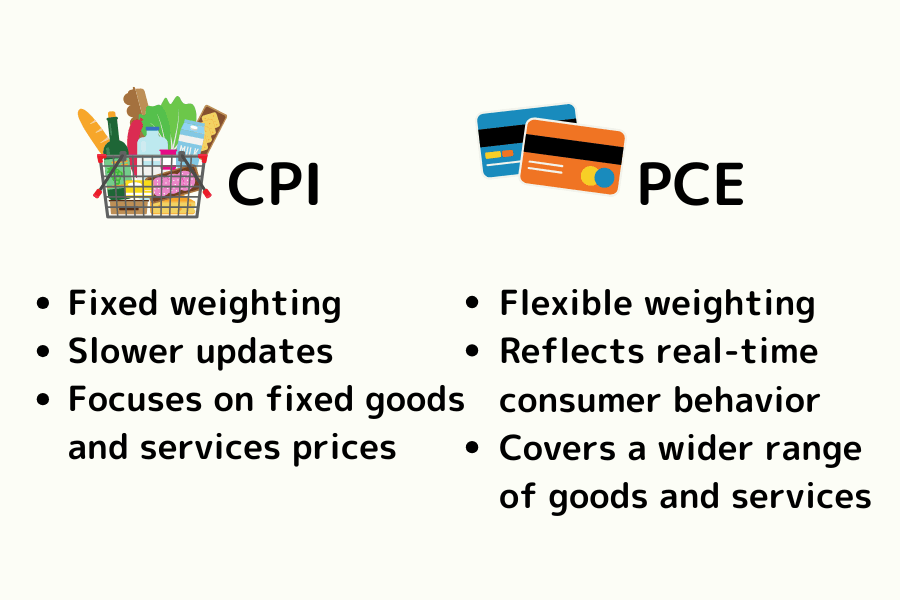
The PCE (Personal Consumption Expenditures Price Index) also measures price changes but differs from CPI in scope and methodology. CPI focuses on a fixed basket of goods and services, while PCE covers a broader range—including more services—and adjusts weights flexibly to reflect shifting consumer behavior.
| Abbreviation and Full Name | Description |
|---|---|
| CPI (Consumer Price Index) | Tracks price changes for a fixed basket, with slower weight updates |
| PCE (Personal Consumption Expenditures Price Index) | Broader scope, including services, with dynamic weights reflecting consumption shifts |
Learn More: U.S. PCE Price Index Year-over-Year
2. Origins and Base Year of CPI
CPI emerged in the late 19th century in industrialized nations to monitor price impacts on living standards, evolving into today's key inflation gauge.
CPI Systems and Base Years by Region
- U.S.: Managed by the Bureau of Labor Statistics (BLS) since 1913, with a base of 1982–1984 averages. The Fed also uses PCE as a primary inflation metric.
- Japan: Compiled by the Statistics Bureau since 1946, standardized in 1952, with the base year updated every 5 years (currently 2020).
- China: Overseen by the National Bureau of Statistics since the 1980s, with the base year adjusted irregularly (recently 2020).
- Eurozone: The European Statistical Office (Eurostat) issues the Harmonized Index of Consumer Prices (HICP), with base years varying by country but standardized for comparison.
- Hong Kong: Published by the Census and Statistics Department, updated every 5 years (currently 2020).
- Taiwan: Compiled by the Directorate-General of Budget, Accounting and Statistics, updated every 5 years (currently 2021).
- Singapore: Managed by the Department of Statistics, with the current base year as 2019.
Periodic base year updates ensure CPI reflects changes in consumption patterns, lifestyles, and price weights, accurately tracking living costs.
3. How CPI Is Calculated
CPI uses the Laspeyres Index, calculating price changes based on a fixed base-year basket.
Formula
CPI = (Current Price × Base Year Quantity) ÷ (Base Year Price × Base Year Quantity) × 100
A CPI of 110 indicates a 10% price rise. The Laspeyres method weights by base-year quantities, so current quantities (e.g., 90 units) don't affect the result.
Calculation Example
Take "monthly household electricity cost" as an example. Suppose the base year price is $0.10 per kWh and average usage is 500 kWh per month:
- Base year spending: 0.10 × 500 = $50
- Current price $0.12, same usage → current spending: 0.12 × 500 = $60
- CPI calculation: CPI = (60 ÷ 50) × 100 = 120
This indicates a 20% rise in this category since the base year.
Note: The Laspeyres index assumes consumption patterns stay fixed, which can slightly overstate the burden when consumers reduce usage (e.g., using less electricity at higher prices).
4. Comparing CPI Across Regions
CPI varies by region in terms of issuing authority, release timing, and key components:
| Item | Taiwan | Japan | U.S. | U.K. | Hong Kong | Singapore |
|---|---|---|---|---|---|---|
| Issuing Authority | DGBAS | Statistics Bureau | BLS | ONS | C&SD | DOS |
| Release Timing | Mid-month | ~19th (Friday) | ~15th | ~15th | Late month | Mid-month |
| Core CPI | Excludes food, energy | Excludes fresh food | Excludes food, energy | Excludes food, energy | Excludes food, energy | Excludes rent, transport |
| Special Index | - | Core-Core CPI | - | - | - | - |
CPI Trends (2025)
- U.S.: February 2025 CPI at 2.8% (Headline), 3.1% (Core)—easing but above the 2% target.
- Japan: CPI rose since 2023, hitting ~3% by January 2025, prompting the Bank of Japan to end negative rates.
- Taiwan: CPI steady at 1–2% in recent years, reflecting mild inflation.
- U.K.: Early 2025 CPI at ~3.2%, driven by energy and food prices, with the Bank of England maintaining tight policy.
5. CPI's Impact on Forex Markets
The Consumer Price Index (CPI) is a key reference for central banks setting monetary policy, directly influencing interest rates, money supply, and exchange rates, making it a focal point for forex markets.
CPI and Monetary Policy
Central banks adjust policy rates and money supply to manage inflation, stabilize prices, and support growth, often targeting ~2% inflation.
| CPI Condition | Description | Possible Policy Response | Example |
|---|---|---|---|
| Moderate Inflation (~2%) | Stable prices, healthy economic cycle | Maintain rates or mild hikes | U.S. post-COVID recovery, CPI ~2%, steady growth |
| High Inflation | Eroding purchasing power, rapid price rises | Rate hikes, quantitative tightening (QT) | 2022 U.S. CPI hit 9.1%, aggressive rate hikes |
| Deflation or Low Inflation | Weak demand, falling profits | Rate cuts or quantitative easing | Japan's 1990s deflationary stagnation |
Four Sources of Price Changes
CPI shifts stem from various causes, affecting policy effectiveness:
| Type | Description | Example |
|---|---|---|
| Demand Fluctuations | Changing consumer demand impacts prices | 2020 U.S. demand drop during COVID, CPI fell |
| Cost Changes | Rising labor or raw material costs | Post-COVID labor shortages raised business costs |
| Money Supply | Shifts in money circulation affect inflation | Central bank bond-buying boosted money supply |
| Exchange Rate Swings | Currency depreciation raises import prices | TWD weakening increased imported oil costs |
Inflation from demand or money supply responds well to policy; cost-driven or exchange-rate inflation may resist. Japan's prolonged easing, for instance, struggles against weak demand and imported inflation.
Interest Rates and Exchange Rates
Central banks adjust rates based on CPI, influencing capital flows and exchange rates:
| Country | Interest Rate | Amount After Depositing $1M for 1 Year | Attracts Capital? |
|---|---|---|---|
| U.S. | 5.5% | $1,055,000 | Yes |
| Japan | 0% | $1,000,000 | No |
Higher rates attract capital, strengthening currency. However, during risk-off periods, funds may favor low-rate safe-haven currencies like the yen.
Rate Hikes and Exchange Rate Reactions
| Rate Hike Type | Underlying Cause | Exchange Rate Reaction | Explanation |
|---|---|---|---|
| Healthy Rate Hike | Economic expansion, strong demand | Currency stable or appreciates | Hike cools overheating, confidence high |
| Unhealthy Rate Hike | Currency depreciation, energy spikes | Currency may depreciate | Limited effect, may worsen economic strain |
For example, if Taiwan's CPI rises due to oil prices rather than demand, rate hikes may fail to lift the TWD, adding economic pressure.
Forex Market Reactions
Post-CPI releases, markets adjust rate expectations and capital flows quickly:
| Scenario | Market Expectation | Currency Movement | Example |
|---|---|---|---|
| CPI Above Forecast | Rate hike expected | Currency appreciates | 2022 U.S. CPI surge, USD hit 150+ vs. JPY |
| CPI Below Forecast | Easing expected | Currency weakens | Japan's low inflation, zero rates, JPY at 30-year low |
| Cost-Push Inflation | Limited rate hike impact | Currency may weaken | 2023 Europe hiked rates amid energy crisis, EUR pressured |
Market Features and Risks Around CPI Releases
| Risk Type | Description |
|---|---|
| Volatility Spike | USD Index may swing 0.5%+ at CPI release |
| Spread Widening | Spreads may jump from 1–2 to 10+ pips, raising costs |
| Liquidity Issues | Large expectation gaps may cause slippage or rejections |
Trading Tips
- Preparation: Watch economic calendar (e.g., U.S. CPI around the 15th, 8:30 AM EST); avoid large positions pre-release.
- Risk Management: Use stop-loss or trailing stops to handle volatility, e.g., a 50-pip stop on a USD long position.
CPI impacts extend beyond release moments, affecting rates, stocks, bonds, and commodities. Traders should grasp its economic context and use multi-faceted analysis.
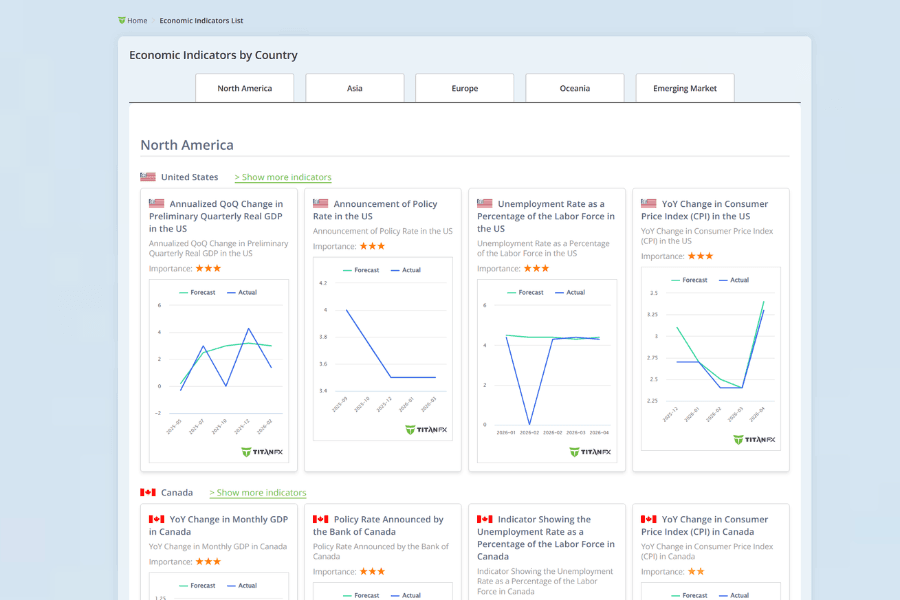
Titan FX offers a real-time global economic calendar to help traders track key data like CPI and respond to market volatility early.
6. Forex Trading Tips Around CPI Releases
CPI releases are major forex events, influencing central bank policies and market expectations, often sparking sharp volatility. Here's what traders should note to minimize risks and boost decision-making.
Heightened Volatility
CPI ties to inflation and rate expectations, driving rapid price swings. A U.S. CPI beating forecasts by 0.5% might move USD/JPY 50–100 pips in minutes. Avoid over-leveraging pre-release to sidestep sudden shifts.
Wider Spreads
During releases, liquidity can drop, pushing spreads from 1–2 to 10+ pips, hiking costs. For example, EUR/USD spreads may spike post-CPI, hitting short-term traders. Check your broker's spread policy in advance.
Execution Risks
Large CPI surprises (e.g., 1% above forecasts) can unbalance orders, causing quote delays, slippage, or failed trades. In 2023, a surprise U.S. CPI drop froze some platforms briefly. Use looser stop-loss orders over tight limit orders.
Trading Tips
- Preparation: Use economic calendars (e.g., U.S. CPI around the 15th, 8:30 AM EST) to gauge consensus and plan trades.
- Risk Management: Cut positions or set trailing stops pre-release to lock profits and cap losses, e.g., 50-pip stop on USD longs.
- Patience: Wait 5–15 minutes post-release for markets to settle before entering, confirming trends.
7. Common Questions About CPI
Q1: When Is CPI Released?
- Taiwan: Mid-month, by the Directorate-General of Budget, Accounting and Statistics (DGBAS).
- U.S.: Around the 15th, 8:30 AM EST, by the Bureau of Labor Statistics (BLS).
- Japan: Around the 19th (Friday), by the Statistics Bureau (MIC).
- Eurozone: Eurostat publishes the harmonized HICP after national-level releases.
Q2: Why Is CPI Important?
CPI tracks price changes, shaping central bank policies. Rising CPI may prompt rate hikes to curb inflation; falling CPI may trigger cuts to spur growth. These shifts impact forex, stocks, and bonds, making CPI a must-watch indicator.
Q3: Headline CPI or Core CPI — which matters more?
Both, but for different purposes. Headline CPI reflects what consumers actually feel at the checkout. Core CPI strips out volatile food and energy and is more important to central banks for setting policy. The Fed and Bank of Japan frequently cite Core CPI in policy statements.
Q4: Does high CPI always mean rate hikes?
Not necessarily. Central banks consider whether inflation is demand-pull vs cost-push (cost-push hikes have limited effect), labour market strength, and inflation expectation anchoring. The Fed hiked aggressively in 2022 (CPI 9.1%) but stayed accommodative through the 2008 crisis even when CPI temporarily rose.
Q5: How can individual investors trade CPI data?
- Trend reading: sustained CPI > 2% target signals a tightening cycle (impacts equity / bond / commodity allocation)
- Timing avoidance: de-risk 30–60 minutes before release to avoid intraday spikes
- Expectation gap: focus on consensus vs actual differential when deciding direction
- Risk management: always set stop-loss and trailing stops to handle quote interruption
8. Summary
The Consumer Price Index (CPI), born in the late 19th century, measures price changes via the Laspeyres formula and is a cornerstone of global economic policy.
CPI varies across regions like Taiwan, Japan, and the U.S. in timing, components, and base years, but universally guides central banks in managing inflation and stability.
In forex, CPI drives rate expectations and capital flows, sparking volatility around releases. Traders must watch spreads and execution risks, using sound risk management.
Understanding CPI's definition, calculation, and differences from PPI and PCE empowers investors to navigate trends, enhancing both short- and long-term strategies.
Further Reading
- What is Inflation?
- What is Quantitative Easing (QE)?
- What is Quantitative Tightening (QT)?
- What is Stop Loss?
- What is Volatility?
- Forex Trading Basics
Titan FX Trading Strategy Lab. We produce investor-education content covering forex, commodities (crude oil, precious metals, agricultural goods), stock indices, U.S. equities, and digital assets.
Primary Sources (by Category)
- Official records: U.S. Bureau of Labor Statistics (BLS) — Consumer Price Index methodology and current series; Japan Statistics Bureau (MIC) — 2020 base-year CPI specifications; Eurostat HICP — harmonized Eurozone consumer price index
- Historical background: BLS Origin History — first published in 1913 by the Bureau of Labor Statistics (US)
- Academic analysis: Boskin, M. J. et al. (1996) "Toward a More Accurate Measure of the Cost of Living", Senate Finance Committee Report — measurement bias of the Laspeyres index
- Market data: FRED (Federal Reserve Bank of St. Louis) — US CPI Year-on-Year and Core CPI historical time series