

What Is Forex Trading? Forex Margin Trading Basics: Leverage, Spread, Profit and Loss, and Risks
The foreign exchange market is the largest financial market in the world. According to the Bank for International Settlements (BIS) 2025 Triennial Central Bank Survey, global FX turnover averaged about $9.6 trillion a day. There is no central exchange: banks, brokers and financial institutions around the world trade directly over electronic networks, almost without a break from the Asian open on Monday morning to the New York close early on Saturday.
Most individual traders take part through forex margin trading. By depositing part of the trade value as margin, they can use leverage to trade a larger amount, and they can go long or short.
This guide explains what forex trading is, the basics every beginner needs, how to calculate profit and loss, the different ways to trade currencies, the features and risks of margin trading, and the Titan FX tools that help beginners most.
- Forex trading means buying and selling currency pairs to profit from exchange-rate moves; margin trading uses leverage to trade larger amounts with less capital
- Core concepts: currency pairs, pips and spread, lot size, leverage and margin, loss cut, and order types
- Profit and loss is calculated in one of three ways depending on the quote currency, then converted into the account currency
- Leverage, two-way trading and long trading hours define forex margin trading, and each comes with a matching risk
- Titan FX offers up to 1,000:1 leverage on Standard and Blade accounts, and up to 2,000:1 on Micro accounts that meet the eligibility criteria
1. What is forex trading?
Forex trading is the buying and selling of different countries' currencies to profit from changes in exchange rates.
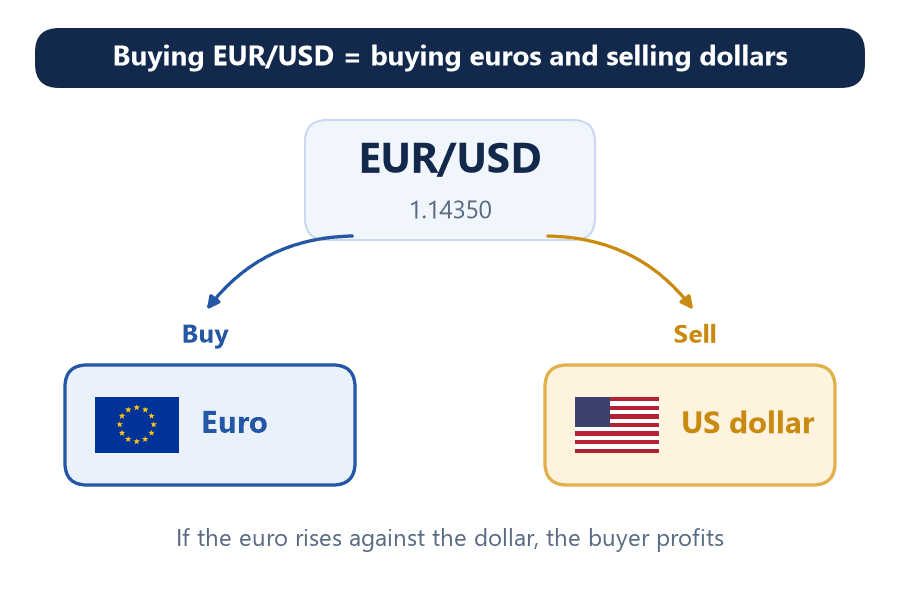
Currencies trade in pairs, such as the euro/US dollar (EUR/USD) and the US dollar/Japanese yen (USD/JPY). The currency on the left is the base currency and the one on the right is the quote currency; the base and quote currency determine the direction of a trade and the currency in which profit and loss is measured. Buying EUR/USD means buying euros and selling US dollars at the same time, expecting the euro to rise against the dollar.
The main participants in the forex market are:
| Participant | Role |
|---|---|
| Central banks | Influence exchange rates through monetary policy and intervention |
| Commercial banks | Exchange currencies for clients and trade on their own account |
| Hedge funds and institutions | Trade in size to generate returns |
| Multinational companies | Exchange currencies for trade and hedge currency risk |
| Individual traders | Trade forex on margin through a broker's platform |
Ways to trade currencies
| Method | Leverage | Two-way trading | Trading hours | Entry barrier | Best suited to |
|---|---|---|---|---|---|
| Bank currency exchange | No | No | Bank opening hours | Low | Travel and study abroad |
| Foreign currency deposit | No | No | Locked until maturity | Medium | Conservative savers |
| Forex margin trading | Yes | Yes | Nearly 24 hours, Monday to Friday | Low | Active traders |
| Currency futures | Yes | Yes | Exchange hours | High | Professional and institutional traders |
Forex margin trading has a low entry barrier, allows two-way trading and runs for long hours, which is why it is the most popular route for individual traders. You never take delivery of the foreign currency: you deposit margin, open a position, and only the price difference is settled as profit or loss when you close it. Titan FX offers 60 currency pairs as CFDs (contracts for difference), and the rest of this guide focuses on forex margin trading.
2. Forex trading basics
Currency pairs
A currency pair consists of a base currency and a quote currency. EUR/USD = 1.14350 means one euro buys 1.14350 US dollars.
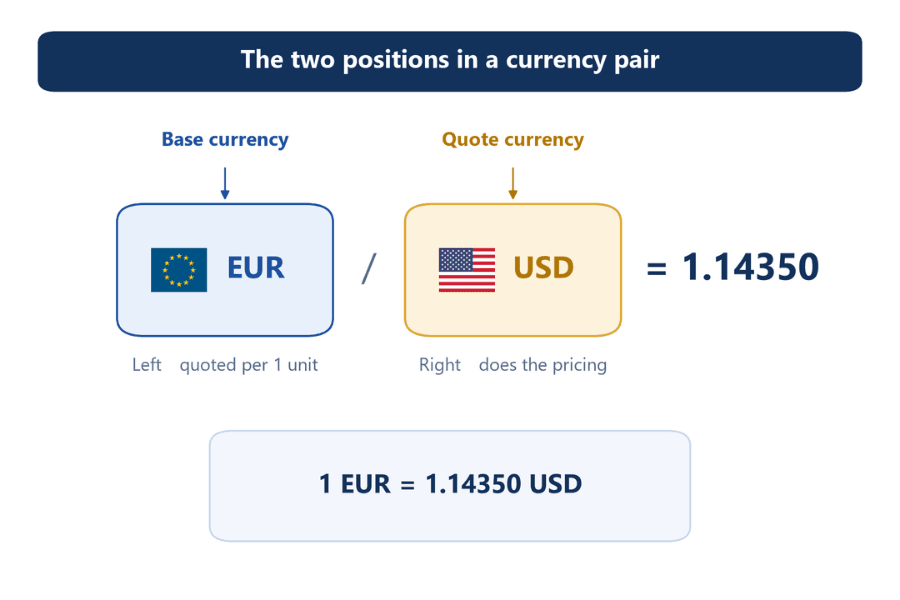
If EUR/USD rises from 1.14350 to 1.14850, the euro has strengthened against the dollar: long positions gain and short positions lose.
Beginners usually start with the major pairs, which trade in the largest volumes with the tightest spreads:
| Currency pair | Characteristics | Why it suits beginners |
|---|---|---|
| EUR/USD | The most traded pair in the world | Tight spreads and deep liquidity |
| USD/JPY | Active during Asian hours too | Easy to fit around an Asian time zone |
| GBP/USD | Larger price swings | Better once you have some experience |
Pips and spread
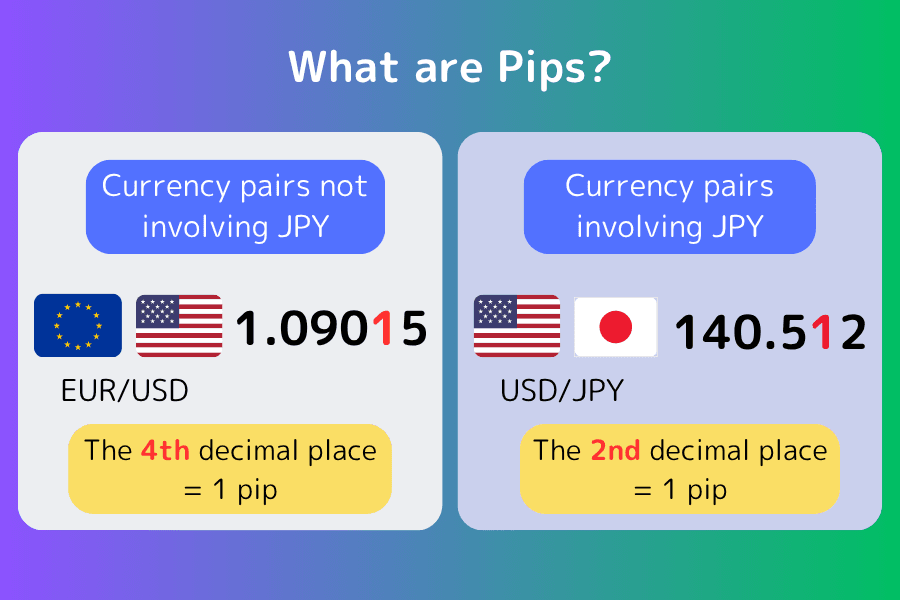
A pip is the unit used to measure exchange-rate moves. For EUR/USD, 1 pip = 0.0001; for USD/JPY, 1 pip = 0.01.
The spread is the difference between the bid and ask price, and it is the main cost of every trade.
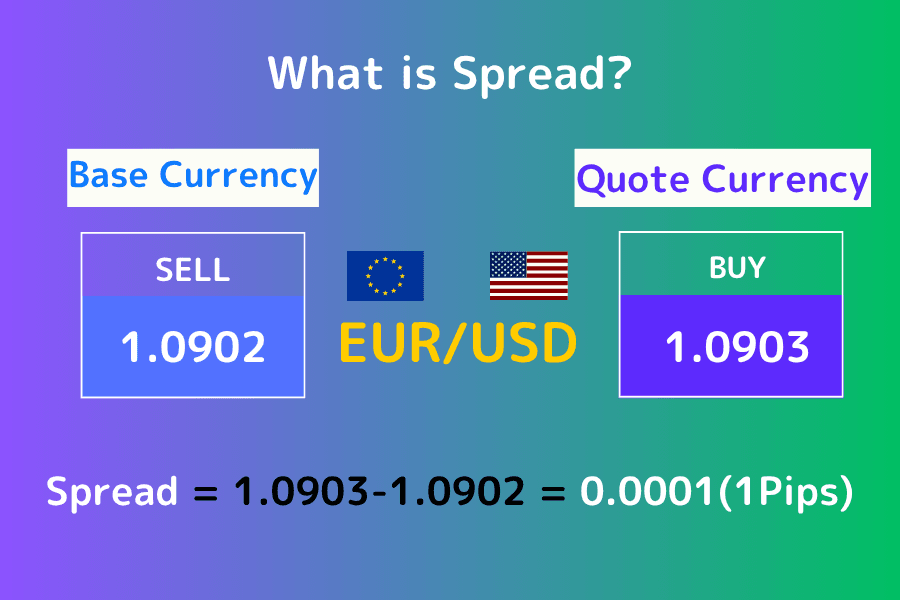
Pip value is the profit or loss from a 1-pip move on one standard lot: $10 for EUR/USD and ¥1,000 for USD/JPY. With a 1.2-pip spread on EUR/USD, trading one standard lot costs 1.2 × $10 = $12. Reading pips, pip value and spread together tells you what each trade actually costs.
Lot size
A lot is the unit of trade size in forex: 1 standard lot = 100,000 units of the base currency, 0.1 lot = 10,000 units, and 0.01 lot = 1,000 units. For EUR/USD, a 1-pip move is worth:
| Lot size | Units | Profit or loss per pip |
|---|---|---|
| 1 standard lot | 100,000 | $10 |
| 0.1 lot | 10,000 | $1 |
| 0.01 lot | 1,000 | $0.10 |
Beginners are best starting at 0.01 lot to keep each loss affordable, then adjusting their lot size as they gain experience.
Leverage and margin
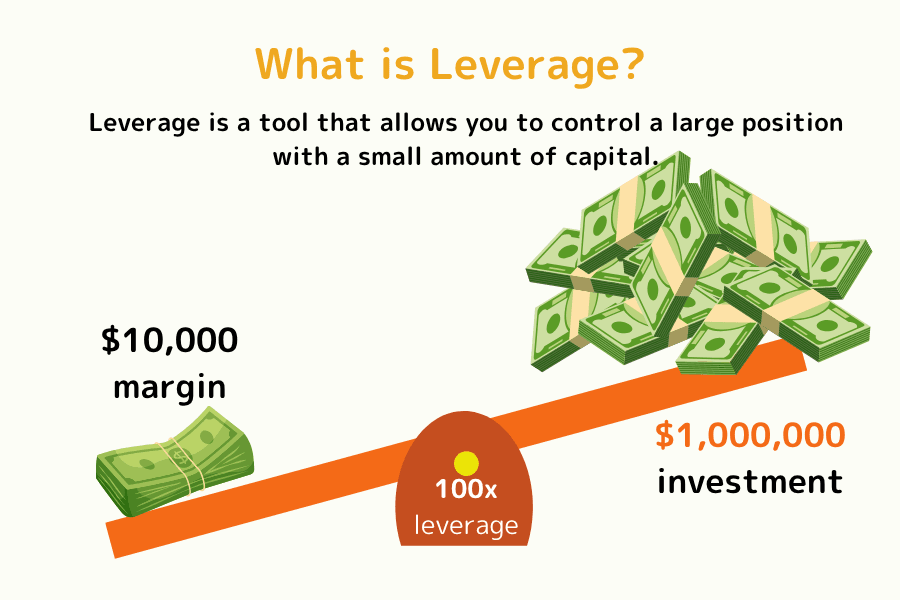
Leverage determines how large a position you can open with a given amount of margin.
For one standard lot of EUR/USD (100,000 euros) at 1.1000, the position is worth about $110,000:
| Leverage | Calculation | Required margin |
|---|---|---|
| 1,000:1 | 110,000 ÷ 1,000 | $110 |
| 500:1 | 110,000 ÷ 500 | $220 |
| 100:1 | 110,000 ÷ 100 | $1,100 |
Titan FX's maximum leverage depends on the product and account type:
| Product | Standard and Blade accounts | Micro account |
|---|---|---|
| Forex (major and minor pairs) | 1,000:1 | 2,000:1 (eligibility required) |
| Gold (XAU/USD) | 1,000:1 | 1,000:1 |
| Other precious metals | 500:1 | 1,000:1 |
| Major index CFDs | 1,000:1 | Not available |
| Other index CFDs | 500:1 | Not available |
| Energy (crude oil, natural gas) | 500:1 | Not available |
| Soft commodities | 50:1 | Not available |
| Crypto CFDs | 100:1 | 100:1 |
| Stock CFDs | 20:1 | Not available |
※ To use 2,000:1 leverage on a Micro account, all your live accounts must together have total equity below $1,000, at least 10 closed trades, and cumulative volume of at least 5 standard lots. Positions opened around major releases such as CPI and nonfarm payrolls may temporarily receive lower maximum leverage (for example, 500:1 instead of 1,000:1).
If your account currency differs from the quote currency, the margin calculation also needs an exchange-rate conversion.
Loss cut
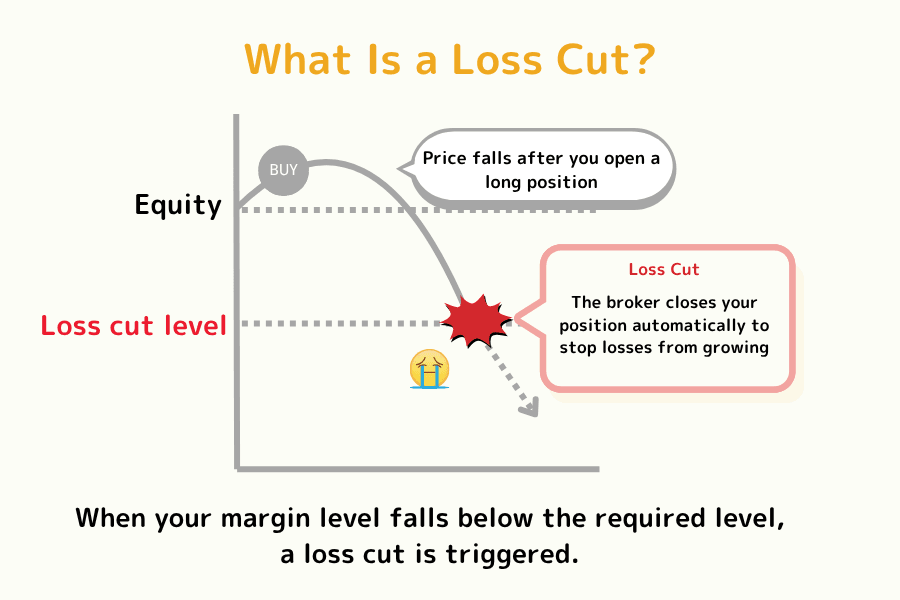
When your margin level falls to the level set by your broker, positions are closed automatically to stop losses from growing. Titan FX's loss cut level is 20%. With $500 of equity and $200 of used margin, your margin level is 250%; if equity falls to $40, the margin level drops to 20% and a loss cut is triggered.
Order types
- Market orders: filled immediately at the current price
- Pending orders: triggered when the price reaches a level you set, including limit orders and stop orders
For example, with EUR/USD at 1.1000, you could place a buy limit order to buy if the price drops back to 1.0950, or a buy stop order to buy if it breaks above 1.1050. Pending orders can also be used to set take-profit and stop-loss levels in advance.
Other common forex terms are collected in our forex glossary:
View the Forex Glossary3. How to calculate forex profit and loss
How you calculate profit and loss depends on the quote currency of the pair, and the result always needs to be converted into your account currency.
- Quote currency is USD (EUR/USD, etc.): P/L = (sell price − buy price) × units
- Quote currency is JPY (USD/JPY, etc.): calculate P/L in yen, then divide by the USD/JPY rate at closing
- Quote currency is another currency (EUR/GBP, etc.): calculate P/L in that currency, then multiply by its rate against the US dollar
Case 1: EUR/USD (quote currency is USD)
Buy 1 lot of EUR/USD at 1.1000 and sell at 1.1050:
P/L = (1.1050 − 1.1000) × 100,000 = +$500Case 2: USD/JPY (quote currency is JPY)
Buy 1 lot of USD/JPY at 150.00 and sell at 150.50:
P/L (JPY) = (150.50 − 150.00) × 100,000 = +¥50,000 P/L (USD) = 50,000 ÷ 150.50 ≈ +$332.23Case 3: EUR/GBP (quote currency is GBP)
Buy 1 lot of EUR/GBP at 0.8600 and sell at 0.8550, with GBP/USD at 1.3000:
P/L (GBP) = (0.8550 − 0.8600) × 100,000 = −£500 P/L (USD) = −500 × 1.3000 = −$650Before you trade, you can use the Titan FX margin calculator to estimate the required margin and trade value from your account type, account currency, leverage, instrument and lot size. You can also enter take-profit and stop-loss levels.
Open the Margin Calculator4. Features and risks of forex margin trading
Every feature of forex margin trading comes with a matching risk:
| Feature | Benefit | Risk to watch |
|---|---|---|
| Leverage | Trade larger amounts with less capital | Losses are magnified too, and margin can disappear quickly |
| Two-way trading | Profit opportunities whether rates rise or fall | A wrong call on direction still means a loss |
| Nearly 24-hour trading, Monday to Friday | Trade around your own schedule | Markets close at weekends, and prices can gap at the Monday open |
| Deep liquidity | Major pairs usually have tight spreads | Spreads can widen around big news, causing slippage |
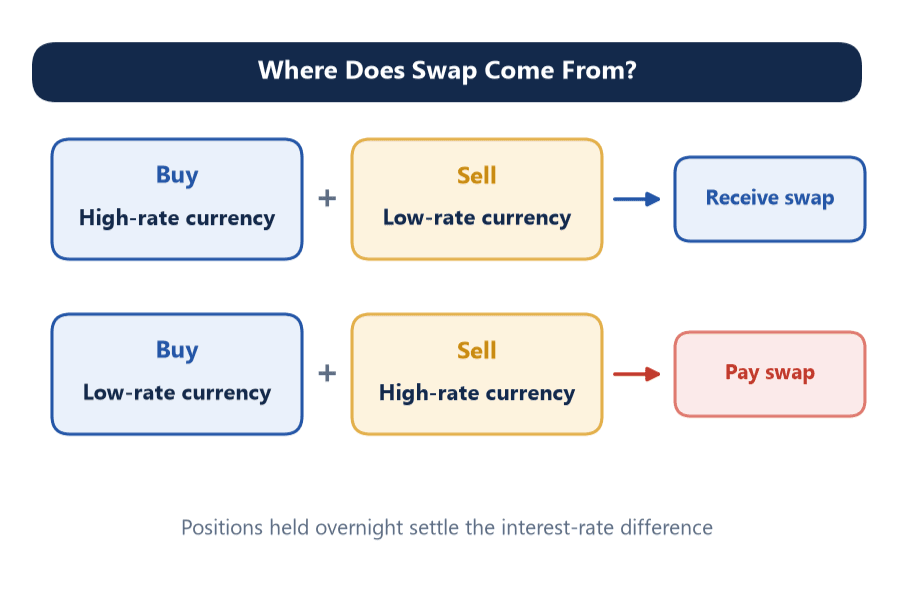
| Swap | Buying a higher-yielding currency against a lower-yielding one may earn swap | The reverse means paying swap, and the amount changes with interest rates |
Trading hours
The forex market passes from one financial center to the next as the day moves across time zones: Oceania, Tokyo, London and New York. Because currencies trade directly between banks, there is no official open or close like on a stock exchange; the sessions in the chart below are conventional, approximate divisions. During summer time in the US and Europe, London and New York overlap from 12:00 to 16:00 UTC, when liquidity is usually higher.
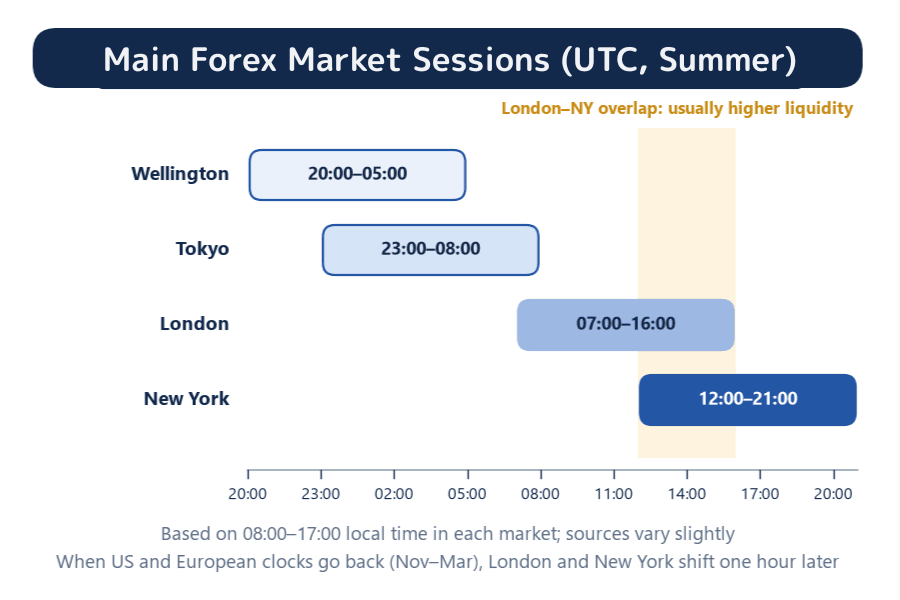
When the US and Europe return to standard time (November to March), the London and New York sessions each shift one hour later, and the overlap moves to 13:00–17:00 UTC. Our guide to forex trading hours lists both the summer and winter sessions.
Swap
When you hold a position overnight, you receive or pay swap based on the interest-rate difference between the two currencies.
Basic risk control
Exchange rates are driven by economic data, central bank policy and geopolitics, so price moves can never be predicted perfectly, and your capital is not guaranteed. Set a stop loss on every trade, keep position sizes small, and never use your maximum leverage. Most beginner losses come from excessive leverage and missing stop losses, so much of the risk of losing money in forex can be avoided in advance.
5. Titan FX tools for forex beginners
Before you trade, you need to check prices and costs, data release times, required margin, swap, and the hours you can actually trade. Titan FX Research offers a free tool for each of these, and every tool has a guide explaining how to use it:
| Tool | What it shows | When to use it | How-to guide |
|---|---|---|---|
| Live Rates | Real-time bid, ask and spread for each pair | Before placing an order, to check price and cost | How to read an instrument page |
| Economic Calendar | Release times for economic data and central bank decisions | To avoid or prepare for major releases | How to read the Economic Calendar |
| Margin calculator | Required margin based on leverage, instrument and lot size | Before deciding your lot size | Forex margin calculation |
| Swap Point Calendar | Past swap rates for each pair | Before holding a position overnight | How to check swap points |
| Volatility Heatmap | Average range for each pair by day and hour | To find pairs that are active during your trading hours | When is forex most volatile? |
6. Frequently Asked Questions (FAQ)
Q1. How much money do I need to start forex trading?
Not much. On Titan FX Standard and Blade accounts, the minimum trade size is 0.01 lot (1,000 units), which needs only a few dollars of margin. With very little capital, however, even small price moves can trigger a loss cut, so if you start forex trading with a small amount, keep your lot size especially small.
Q2. Is forex trading suitable for beginners?
Forex margin trading has a low entry barrier and long trading hours, but leverage magnifies losses. Beginners should first understand currency pairs, spreads, margin and loss cuts, then practice on a demo account and only trade real money once they are confident they can control risk.
Q3. How is forex trading different from stock trading?
The forex market trades nearly 24 hours a day from Monday to Friday, while stocks have fixed trading hours. Forex margin trading makes it easy to go long or short, whereas most stock investors simply buy. Forex leverage is also much higher than for stocks. And while a share price reflects the value of one company, an exchange rate reflects the economies, interest rates and capital flows of two countries.
Q4. What is the relationship between forex and CFDs?
Forex refers to what you trade, while a CFD (contract for difference) is a type of contract. Many brokers offer forex as CFDs: you never own the foreign currency and only settle the difference between your opening and closing prices. Gold, stock indices and crude oil can also be traded as CFDs.
7. Summary
Forex trading is the buying and selling of currency pairs to profit from exchange-rate moves. Most individual traders take part through forex margin trading, using leverage to trade larger amounts with less capital, going long or short, nearly 24 hours a day from Monday to Friday.
Before you start, make sure you understand currency pairs, pips and spread, lot size, leverage and margin, loss cuts and order types, and that you can calculate profit and loss. Leverage, two-way trading and long trading hours bring flexibility, but also the risks of magnified losses, gaps and slippage. The steps from opening an account and practicing on a demo to building a trading plan are covered in our beginner's guide to learning forex trading.
Titan FX offers 60 currency pairs on MT4/MT5, with up to 1,000:1 leverage on Standard and Blade accounts and up to 2,000:1 on eligible Micro accounts, so you can go long or short.
Further Reading
- Forex spread explained
- What are safe haven currencies? Characteristics and trading strategies
- What is a cross currency pair? Synthetic rates, major crosses and strategies
- Why forex beginners fail: 10 mistakes and 7 risk strategies
The Titan FX Financial Markets Research and Analysis Team. Covering forex (FX), commodities (crude oil, precious metals, agricultural products), stock indices, US equities, and crypto assets, the team produces educational content for investors across a broad range of financial instruments.
Primary Sources (by Category)
- Official statistics: Bank for International Settlements (BIS) 2025 Triennial Central Bank Survey: global FX market daily turnover
- Trading conditions: Titan FX website information on leverage, forex products and trading hours