

USD(US Dollar)
Due to the US's leading position in the global economy, fluctuations in the USD exchange rate have far-reaching effects on other currencies, international markets, and the global economy. This article explores the history, characteristics, key factors influencing the exchange rate, major economic indicators, and future outlook of the US Dollar from a forex trading perspective.
- USD is the world's largest reserve currency, holding 56.32% of global FX reserves (IMF COFER)
- Settles 60%+ of cross-border trade and is involved in 88.5% of FX trades (BIS 2022)
- Federal Reserve policy, US economic data, and global risk sentiment drive USD moves
- EUR/USD is the most-traded pair; USD/JPY, GBP/USD, USD/CHF are other major USD pairs
- USD is also a safe haven — capital flows into USD during geopolitical and financial crises
1. What Is the US Dollar (USD)
The US dollar (USD, United States Dollar, currency symbol: $) is the official currency of the United States, established under the Coinage Act of 1792. As one of the most influential currencies in the world, the dollar plays a central role in international trade, financial settlement, and foreign exchange reserves.
After the Bretton Woods system was established in 1944, the dollar was pegged to gold and became the world's primary reserve currency.
Although the United States ended the gold standard in 1971, decoupling the dollar from gold and entering a floating exchange rate system, the dollar's dominant position in the international financial system continues to this day.
You can check the real-time relative strength of major currencies with the Currency Strength Meter.
2. Characteristics of the US Dollar
Thanks to its global standing and high liquidity, the US dollar (USD) is regarded as the core of the international monetary system. Its unique position in the foreign exchange market stems mainly from the following characteristics:
Characteristic 1: The World's Largest Reserve Currency
According to data from the International Monetary Fund (IMF), as of Q2 2025, the US dollar accounts for about 56.32% of global official foreign exchange reserves. Central banks around the world hold US dollars to stabilize their own currencies, support international trade, and guard against exchange rate volatility.
| Currency | Reserve Amount (USD billions) | Percentage |
|---|---|---|
| US Dollar (USD) | 6,773.30 | 56.32% |
| Euro (EUR) | 2,540.43 | 21.13% |
| Japanese Yen (JPY) | 670.07 | 5.57% |
| British Pound (GBP) | 580.23 | 4.83% |
| Canadian Dollar (CAD) | 313.83 | 2.61% |
| Chinese Yuan (CNY) | 255.37 | 2.12% |
| Australian Dollar (AUD) | 250.93 | 2.09% |
| Swiss Franc (CHF) | 19.54 | 0.16% |
| Other Currencies | 621.71 | 5.17% |
| Total Allocated Reserves | 12,025.50 | — |
| Unallocated Reserves | 919.31 | — |
| Total Foreign Exchange Reserves | 12,944.80 | — |
Characteristic 2: International Settlement Currency
More than 60% of cross-border trade and commodity pricing worldwide (for example, oil and gold) is settled in US dollars, making the dollar the primary instrument for international settlement. This further cements its dominant position in the financial system.
Characteristic 3: Benchmark Currency
The US dollar is the base quote currency for most currency pairs. For example, EUR/USD is the most heavily traded currency pair in the world. Fluctuations in the dollar's exchange rate directly affect global asset prices and capital flows.
Characteristic 4: Safe-Haven Currency
When global economic uncertainty, a financial crisis, or geopolitical risk rises (such as the major regional conflicts of 2023), the US dollar is typically viewed as a safe harbor for capital. Money flows into dollar-denominated assets, pushing up its exchange rate.
Further reading: What Are Safe-Haven Currencies
Characteristic 5: Extremely High Liquidity
According to the 2022 survey by the Bank for International Settlements (BIS), total daily global foreign exchange trading volume reached USD 7.5 trillion, more than 25 times the average daily turnover of the stock market.
Of this, the US dollar was involved in 88.5% of all foreign exchange transactions worldwide, far ahead of any other currency, making it the most liquid currency in the forex market.
Share of Major Traded Currencies (BIS 2022 Data)
| Currency Code | Currency Name | Market Share |
|---|---|---|
| USD | US Dollar | 88.5% |
| EUR | Euro | 31.4% |
| JPY | Japanese Yen | 21.6% |
| GBP | British Pound | 12.9% |
| AUD | Australian Dollar | 7.0% |
3. Key Factors Influencing the USD Exchange Rate
Fluctuations in the US dollar (USD) exchange rate are driven by a range of economic and policy factors. Below are four key areas that forex traders should monitor closely:
Factor 1: US Economic Data
Core US economic indicators directly affect market confidence in the dollar and capital flows:
- GDP growth: Strong economic performance generally boosts demand for the dollar.
- Inflation rate: High inflation can erode the dollar's purchasing power, but it may also trigger expectations of rate hikes, providing short-term support for the dollar.
- Unemployment rate: A healthy labor market (low unemployment) helps support the dollar by signaling strong economic vitality.
Factor 2: Federal Reserve (Fed) Monetary Policy
The Federal Reserve's interest rate decisions and policy statements have a major impact on the dollar:
- Rate-hike cycles: These typically attract foreign capital into dollar-denominated assets, pushing the dollar higher.
- Rate cuts and quantitative easing (QE): These can weaken the dollar, as capital seeks other higher-yielding markets.
Further reading: Overview of US Economic Indicators
Factor 3: Global Risk Sentiment
As the world's safe-haven currency, demand for the dollar fluctuates noticeably in the following situations:
- Increased market uncertainty (such as war or financial crisis): Capital pours into the dollar, lifting its exchange rate.
- Market stabilization and rising risk appetite: Capital shifts toward higher-risk assets, and the dollar may weaken.
Factor 4: US Trade and Fiscal Policy
The scale of US external economic activity and fiscal policy also affects the dollar:
- Widening trade deficit: This represents an outflow of dollars and may weigh on the currency.
- Fiscal deficit and debt levels: If markets question the sustainability of government finances, investor confidence and the dollar's trajectory may be affected.
Additional tool: Global Economic Calendar
4. Major Economic Indicators for the US Dollar
The following indicators influence the US dollar exchange rate:
| Indicator | Description | Effect on Exchange Rate |
|---|---|---|
| GDP Growth Rate | Reflects the pace of US economic growth. When growth accelerates, demand for the dollar generally rises, lifting the exchange rate. | Strong growth, dollar may appreciate |
| Inflation Rate | Shows changes in US price levels. A high inflation rate erodes the dollar's purchasing power and typically leads to a falling exchange rate. | High inflation may cause depreciation |
| Nonfarm Payrolls | Reflects the health of the US labor market, particularly the number of new jobs added. Strong employment data generally supports a stronger dollar. | Strong jobs data, dollar may appreciate |
| Benchmark Interest Rate | The rate set by the Federal Reserve. When rates rise, returns on dollar assets increase, attracting more capital inflows and driving the dollar higher. | Higher rates, dollar may appreciate |
| Trade Deficit | Shows the gap between US imports and exports. A larger trade deficit can weaken market confidence in the dollar, leading to depreciation. | Wider deficit, dollar may depreciate |
| US Treasury Yields | Reflects changes in the yields on US government bonds. Rising yields increase the appeal of dollar assets, driving the dollar higher. | Higher yields, dollar may appreciate |
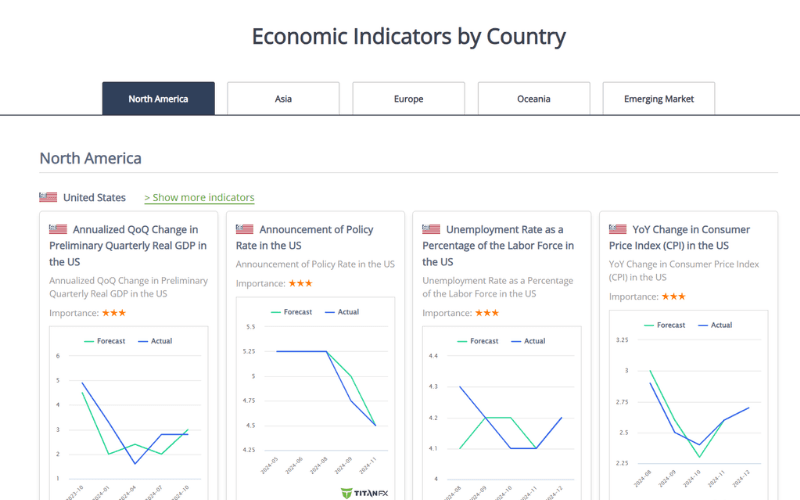
Titan FX Offers Free Economic Indicator Lookups
Titan FX provides economic data indicators for major economies around the world, including the United States, Europe, Japan, and China. You can search by release time, country, and importance.
5. The US Dollar in the Global Financial System
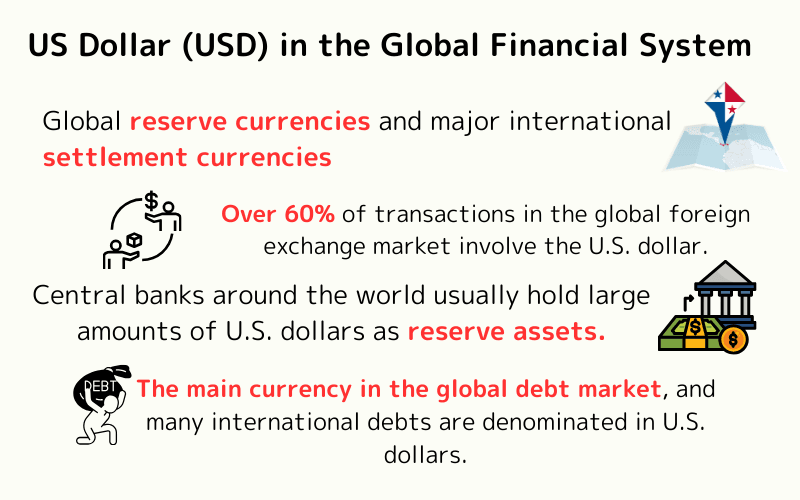
The US dollar (USD) plays an irreplaceable, central role in the global financial markets. As the world's reserve currency, a unit of account, and a primary settlement instrument, the dollar influences policymaking, international trade, and capital flows across countries.
Role 1: Commodity Pricing Currency
International commodities such as oil, gold, natural gas, and wheat are mostly priced in US dollars.
This means that when the dollar strengthens, purchasing costs rise for non-US importing countries, potentially dampening global demand; conversely, a weaker dollar can push commodity prices higher.
There is a significant inverse relationship between the dollar and commodity prices, which also affects the economic performance of emerging markets.
Role 2: Dominant Currency in the Global Forex Market
According to the 2022 survey by the Bank for International Settlements (BIS), the US dollar was involved in 88.5% of global foreign exchange transactions, far ahead of the second-place euro (31.4%). Among these, EUR/USD is the most liquid currency pair in the world, accounting for the largest share of daily turnover. The dollar's high participation gives it absolute market dominance, as nearly all forex transactions need to reference the dollar's price.
Role 3: Core Asset of Global Foreign Exchange Reserves
The US dollar is the asset of choice for central banks allocating their foreign exchange reserves. According to the International Monetary Fund (IMF), about 56.32% of official foreign exchange reserves worldwide are denominated in US dollars, reflecting long-standing trust and stability.
Central banks hold dollars for market intervention, to stabilize their own currencies, and to meet international payment obligations.
Role 4: Pricing Basis for Global Debt and Capital Markets
A large volume of international bonds issued by corporations and sovereign nations worldwide is denominated in US dollars, making dollar interest rates and US Treasury yields the benchmark for the global cost of capital.
When the dollar's interest rates rise, debtors (especially in emerging markets) face greater repayment pressure, and capital also flows back from higher-risk markets into dollar assets, further reinforcing the dollar's status as the center of global capital allocation.
Whether in commodity trade, foreign exchange trading, or international debt, the dollar's role holds an overwhelming advantage. This reflects not only the strength of the US economy but also the world's institutional trust in the dollar and its reliance on dollar liquidity.
6. How to Trade USD (US Dollar)
There are many ways to trade the US dollar (USD), the most common of which is margin forex trading. This method offers the advantage of leverage, allowing investors to control much larger positions with a small amount of capital.
In addition, margin forex trading allows two-way trading, so investors can go long or short depending on market movements.
On top of that, the forex market operates 24 hours a day, making it one of the highest-volume markets in the world. It offers a high degree of flexibility and liquidity, suiting investors with different trading strategies and risk tolerances.
Further reading: Introduction to Margin Forex Trading
Titan FX offers up to 1,000:1 leverage on major currency pairs, and up to 2,000:1 on eligible Micro accounts.
The Titan FX Margin Forex Trading Process
Step 1: Open an Account:
Opening an account with Titan FX is simple and fast. You can open an account online without submitting any proof of identity or address.
Titan FX offers Standard and Blade trading accounts. Traders can choose between different account types when registering.
How to Open a Titan FX AccountStep 2: Deposit Funds:
After successfully registering, you can deposit funds into your account. Titan FX offers a variety of deposit methods, the fastest and most convenient of which is credit card deposit, which is usually credited instantly.
Titan FX Credit Card Deposit GuideStep 3: Download and Install a Trading Platform (MT4/MT5):
Titan FX offers two trading platforms (software): MT4 and MT5. Traders can download and install them on Windows, Mac, iOS (iPhone/iPad), and Android.
Titan FX MT5 Download, Installation, and Login Titan FX MT4 Download, Installation, and LoginStep 4: Choose a Currency Pair
Titan FX offers around 60 currency pairs. Euro (EUR)/US Dollar (USD) is the most heavily traded currency pair in the world, accounting for a large share of total global forex market turnover. As the official currency of the eurozone, the euro is traded against the dollar very frequently in trade and financial transactions, i.e., EUR/USD.
View All Titan FX Currency PairsStep 5: Place a Trade:
Once you have successfully logged into the MT4 or MT5 trading platform, simply select an instrument to buy or sell.
Titan FX MT5 Interface Overview and How to Place Orders Titan FX MT4 Interface Overview and How to Place OrdersTitan FX Offers Free Trading Tools (Custom Indicators and EAs)
Titan FX is committed to providing traders with the most advanced trading support, including free trading tools such as custom indicators and EAs (automated trading programs). These tools are designed to improve traders' efficiency and the precision of their strategies.
Custom indicators help traders analyze market movements more accurately and identify potential trading opportunities.
EAs, meanwhile, can automatically execute predefined trading strategies, eliminating the interference of human emotion and ensuring that every trade is executed precisely.
With these free tools, Titan FX helps you gain an edge in the highly competitive financial markets and improve your trading performance.
All Custom Indicators EA Trading Program Rankings7. USD FAQ
Q1. Why is the US dollar called the "world currency"?
The dollar is not only the primary settlement currency for international trade but is also widely used to price commodities (such as oil and gold). Combined with the enormous size of the US bond market and strong foreign demand for dollar assets, it has become the core of global capital flows.
Q2. What are the typical currency pairs for trading the US dollar?
- EUR/USD: The most active currency pair in the world, suitable for most trading strategies.
- USD/JPY: Significantly influenced by risk sentiment and Bank of Japan policy.
- GBP/USD: High volatility, suitable for more advanced traders.
- USD/CHF: A pairing of two major safe-haven currencies, closely watched during risk events.
Q3. What strategies suit US dollar trading?
Thanks to its high liquidity and sensitivity to news, dollar trading is well suited to:
- Trend trading: Paired with moving averages or Bollinger Bands.
- News trading: Short-term entries and exits around releases such as the CPI and interest rate decisions.
- Arbitrage strategies: Combining other interest-rate currencies such as the Japanese yen for interest rate spread trading (carry trade).
Q4. What market events can affect the US dollar?
- US presidential or congressional elections
- Debt ceiling disputes or credit rating changes
- Changes in Federal Reserve leadership and shifts in monetary policy
- US-China relations and the progress of trade negotiations
These irregular events often cause sharp short-term volatility, so it is advisable to keep an eye on the market calendar and policy developments.
Q5. What is the relationship between the US dollar and safe-haven assets such as gold?
The dollar and gold typically have an inverse relationship: when the dollar strengthens, gold becomes less attractive; conversely, when the dollar weakens or markets become turbulent, capital shifts toward gold as a safe haven. Traders can use the hedging characteristics of the two for asset allocation.
8. Summary
As the world's most central international currency, the US dollar owes its standing to the strength of the US economy, policy stability, and global trust in the currency. From commodity pricing to central bank reserves, the dollar holds a pivotal place in the global financial system.
For traders, the dollar is not only the most widely traded currency but also represents the richest range of trading opportunities and strategy choices. Whether through technical analysis, trading around news events, or using its safe-haven properties for asset allocation, the dollar remains the focal point of the forex market.
Understanding the dollar's fundamental drivers, macroeconomic influences, and shifts in market sentiment is the key to navigating exchange rate movements and improving your win rate in trading.
Further Reading
The financial markets research team at Titan FX. We produce educational content across a broad range of instruments, including forex (FX), commodities (crude oil, precious metals, agricultural products), equity indices, U.S. stocks, and crypto assets.
Primary Sources (by Category)
- Central bank: Federal Reserve, FOMC statements
- Reserve currency data: IMF COFER
- FX turnover: BIS Triennial Central Bank Survey
- Treasury data: U.S. Treasury Resource Center