

EUR ( Euro )
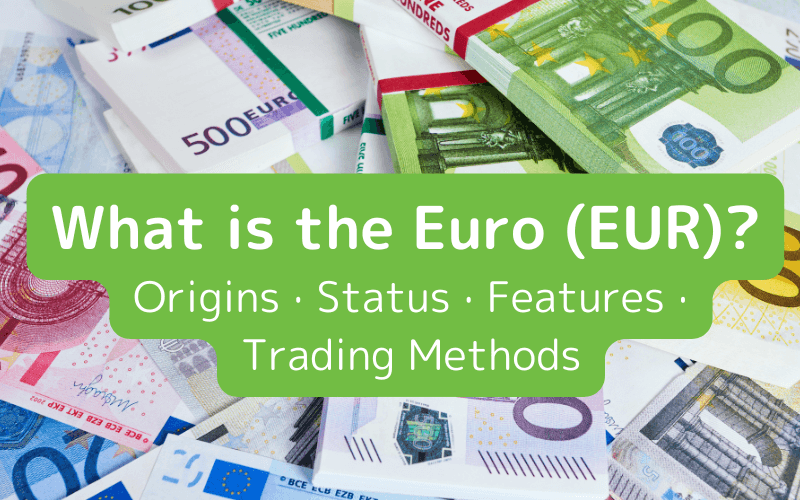
The Euro (EUR) is the official currency of the 20 Eurozone member states. It entered circulation as an accounting currency in 1999 and as banknotes and coins in 2002, is managed by the European Central Bank (ECB), and today accounts for 28.9% of global FX turnover (BIS 2025 Triennial) and 20.33% of official reserves (IMF COFER 2025Q3) — second only to the US dollar.
The Euro is not only the official currency of 20 Eurozone countries; it is also one of the most actively traded international currencies in global financial markets, second only to the US dollar. From its introduction as an accounting currency in 1999 to full circulation in 2002, the euro has witnessed European economic integration while navigating crises such as the European sovereign debt crisis, exchange rate volatility, and policy challenges.
This article provides a systematic guide to the birth of the euro, its key features, the drivers of the EUR exchange rate, major Eurozone economic indicators, and its role in the global financial system — plus a practical walkthrough of how to trade the euro on modern retail platforms.
- EUR is the EU's single currency, launched in 1999 and used by 20 countries — the world's #2 reserve currency.
- The ECB independently sets monetary policy with a 2% inflation target.
- Main drivers: ECB policy, eurozone GDP / CPI / unemployment, geopolitics, safe-haven flows.
- EUR/USD is the world's most-traded pair — deepest liquidity, typically the narrowest spread.
- Typically inverse to USD, tightly linked with GBP and CHF; core instrument for carry and hedging.
1. Origins and Development of the Euro (EUR)
The euro launched as an accounting currency on 1 January 1999 and entered physical circulation on 1 January 2002 — the largest currency unification in financial history and the cornerstone of European economic integration.
The euro (EUR, Euro; currency symbol: €) is the official currency of 20 EU member states and the second-largest reserve and trading currency in the world.
Its creation was a milestone in the EU's push for economic integration and monetary unification, reinforcing financial stability in Europe and establishing the euro as a pillar of the international monetary system.
1.1 From the Maastricht Treaty to the Birth of the Euro
By the late 20th century, EU member states recognized that fragmented monetary policies were fueling exchange rate volatility and economic instability, prompting a coordinated push toward a single currency.
In 1991, the EU signed the Maastricht Treaty, which established the timeline for a single currency and defined strict economic prerequisites — the "Convergence Criteria" — for joining the Eurozone:
| Criterion | Requirement |
|---|---|
| Inflation rate | No more than 1.5 percentage points above the average of the three EU members with the lowest inflation |
| Fiscal deficit | Not exceeding 3% of GDP |
| Government debt | Not exceeding 60% of GDP, or on a firm downward trajectory |
| Exchange rate stability | At least two years in the European Exchange Rate Mechanism II (ERM II) without severe tensions |
| Long-term interest rates | No more than 2 percentage points above the average of the three members with the lowest inflation |
On 1 January 1999, the euro was launched as an accounting currency for electronic transactions and settlements, though no physical cash yet existed.
1.2 Euro Cash Issuance and the Currency Switchover
On 1 January 2002, euro banknotes and coins entered circulation, marking a historic "currency switchover": legacy currencies such as the German mark (DEM), French franc (FRF), and Italian lira (ITL) were withdrawn, and the euro became the sole legal tender in those countries.
This was the largest coordinated currency unification in global financial history and signaled a new phase of European economic integration.
1.3 Expansion of the Eurozone
The Eurozone initially included 11 countries and has since expanded to 20 EU members, covering a population of more than 340 million. Croatia joined on 1 January 2023, becoming the 20th member and marking the end of the current expansion phase.
Additionally, several non-EU jurisdictions (including Monaco, Vatican City, Andorra, San Marino) use the euro as their official or de facto currency, extending its reach beyond the bloc's borders.
1.4 Ongoing Challenges and Evolution
The euro has promoted economic integration across Europe but has also exposed structural differences between member states, particularly during debt crises. The Greek sovereign debt crisis that began in 2010 prompted market doubts about euro stability.
Despite these challenges, the euro has maintained its status as the international monetary system's second-most important currency for both trading and reserves.
1.5 The EU 27 vs. Eurozone 20
Not every EU member uses the euro. Among the EU's 27 member states, only 20 belong to the Eurozone (which uses the euro as sole legal tender). The remaining 7 retain their own national currencies.
| # | Country | Code | Uses the Euro |
|---|---|---|---|
| 1 | Austria | AT | Yes |
| 2 | Belgium | BE | Yes |
| 3 | Croatia | HR | Yes (joined 2023) |
| 4 | Cyprus | CY | Yes |
| 5 | Estonia | EE | Yes |
| 6 | Finland | FI | Yes |
| 7 | France | FR | Yes |
| 8 | Germany | DE | Yes |
| 9 | Greece | GR | Yes |
| 10 | Ireland | IE | Yes |
| 11 | Italy | IT | Yes |
| 12 | Latvia | LV | Yes |
| 13 | Lithuania | LT | Yes |
| 14 | Luxembourg | LU | Yes |
| 15 | Malta | MT | Yes |
| 16 | Netherlands | NL | Yes |
| 17 | Portugal | PT | Yes |
| 18 | Slovakia | SK | Yes |
| 19 | Slovenia | SI | Yes |
| 20 | Spain | ES | Yes |
| 21 | Bulgaria | BG | No |
| 22 | Czech Republic | CZ | No |
| 23 | Denmark | DK | No |
| 24 | Hungary | HU | No |
| 25 | Poland | PL | No |
| 26 | Romania | RO | No |
| 27 | Sweden | SE | No |
Why Don't All EU Countries Use the Euro?
To join the Eurozone, an EU member must meet the Maastricht Treaty's Convergence Criteria — inflation, government debt as a share of GDP, exchange rate stability, and more. Some countries have not met these thresholds; others have chosen to retain monetary autonomy for domestic policy reasons.
Sweden, for example, rejected euro adoption by referendum, while several Central and Eastern European countries (such as Poland and Hungary) have deferred joining to preserve an independent monetary policy.
Learn more about the differences between the EU, Eurozone, and Schengen Area
You can check the real-time relative strength of major currencies with the Currency Strength Meter.
2. Key Features of the Euro (EUR)
The euro's six defining features: unified currency across 20 nations, ECB-managed monetary policy, second-largest FX trading currency (28.9% share), second-largest reserve currency (20.33%), high liquidity, and cross-border influence beyond the Eurozone.
Because of these unique attributes, the euro plays a central role in both regional and global financial markets:
- Feature 1: Drives Economic Integration
- Feature 2: Stable Monetary Policy
- Feature 3: World's Second-Largest FX Trading Currency
- Feature 4: World's Second-Largest Reserve Currency
- Feature 5: High Liquidity and Trading Efficiency
- Feature 6: Cross-Regional Influence
Feature 1: Drives Economic Integration
As the common currency of the Eurozone, the euro eliminates intra-Eurozone exchange rate risk, lowers cross-border transaction costs, and boosts trade and investment efficiency within the region. The Eurozone now covers 20 countries and more than 340 million people — one of the largest currency unions in the world.
Feature 2: Stable Monetary Policy
The euro is issued and managed by the European Central Bank (ECB), whose primary mandate is price stability. The ECB's transparent, rules-based policy framework gives the euro a high degree of credibility in international markets.
Feature 3: World's Second-Largest FX Trading Currency
According to the BIS Triennial Central Bank Survey 2025, the euro is on one side of 28.9% of global FX turnover — trailing only the US dollar (88.5%). The EUR/USD pair is the most heavily traded currency pair in the world, with the tightest spreads and the deepest liquidity.
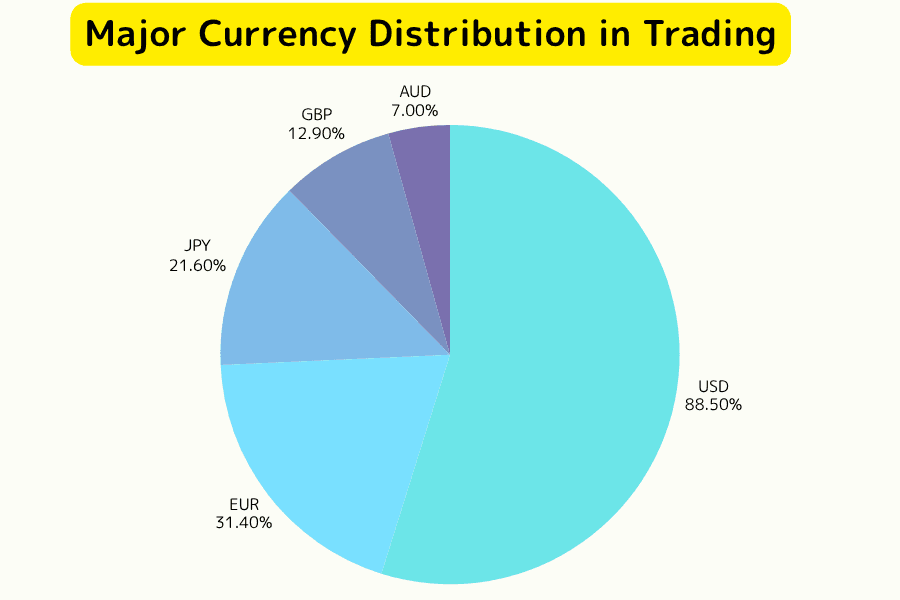
Major Currency Market Share (BIS 2022)
| Code | Currency | Market Share |
|---|---|---|
| USD | US Dollar | 88.5% |
| EUR | Euro | 31.4% |
| JPY | Japanese Yen | 21.6% |
| GBP | British Pound | 12.9% |
| AUD | Australian Dollar | 7.0% |
Feature 4: World's Second-Largest Reserve Currency
According to IMF COFER (Currency Composition of Official Foreign Exchange Reserves), Q1 2025:
| Currency | Reserves (USD billion) | Share |
|---|---|---|
| US Dollar (USD) | 6,720.31 | 57.74% |
| Euro (EUR) | 2,334.62 | 20.06% |
| British Pound (GBP) | 603.70 | 5.19% |
| Japanese Yen (JPY) | 599.10 | 5.15% |
| Other Currencies | 573.42 | 4.93% |
| Canadian Dollar (CAD) | 306.13 | 2.63% |
| Chinese Yuan (CNY) | 246.31 | 2.12% |
| Australian Dollar (AUD) | 167.74 | 1.44% |
| Swiss Franc (CHF) | 88.39 | 0.76% |
| Total Allocated Reserves | 12,537.00 | — |
| Unallocated Reserves | 897.28 | — |
| Denominator for Shares | 11,639.72 | — |
Feature 5: High Liquidity and Trading Efficiency
The euro's deep liquidity keeps trading costs low and slippage tight, making it ideal for technical analysis, day trading, and Expert Advisor (EA) strategies. EUR/USD in particular can be executed quickly at almost any time of day.
Feature 6: Cross-Regional Influence
Beyond the 20 Eurozone members, the euro is used as an official or de facto currency by non-EU jurisdictions such as Vatican City, Monaco, Andorra, and Kosovo — underscoring its role as a currency whose influence extends beyond institutional borders.
3. Key Factors Influencing the EUR Exchange Rate
Six core drivers determine the euro's exchange rate: Eurozone economic fundamentals, ECB monetary policy, global risk sentiment, trade and fiscal balance, the inverse link with the US Dollar Index (DXY), and the ECB–Fed rate differential that drives carry trade flows.
Understanding these variables helps traders read market direction and build their EUR strategies.
Factor 1: Eurozone Economic Fundamentals
The euro reflects the Eurozone's aggregate economy and reacts sharply to macroeconomic data releases, including:
- GDP growth: Stronger growth lifts demand for the euro.
- Inflation (CPI): High inflation can push the ECB to hike rates, supporting the euro short-term; persistently high inflation, however, erodes purchasing power.
- Unemployment: A low unemployment rate signals labor-market health and underpins confidence in the euro.
Most macro indicators are released monthly and tracked via economic calendars.
View released Eurozone economic data
Factor 2: ECB Monetary Policy
ECB rate decisions and policy statements are decisive for the euro:
- Rate hikes: Attract capital inflows and lift the euro.
- Rate cuts or easing: Typically weaken the euro.
- Forward guidance: Even when rates are held steady, ECB language and macro forecasts can move markets.
Tracking ECB Governing Council meetings and press conferences is essential to understanding euro dynamics.
Factor 3: Global Risk Sentiment and Safe-Haven Flows
The euro is not a primary safe-haven currency, but it still reacts to risk sentiment:
- Risk-off: Capital rotates into the US dollar or gold, and the euro tends to weaken.
- Risk-on: As risk appetite returns, the euro often rebounds.
For example, during geopolitical stress episodes in 2023, EUR/USD experienced sharp swings that reflected shifts in global risk sentiment.
Factor 4: Eurozone Trade and Fiscal Position
- Trade surplus: The Eurozone's long-standing current-account surplus signals export competitiveness and supports the euro.
- Fiscal risk: High debt or persistent deficits in member states (such as Greece or Italy) can undermine confidence in the euro as a whole.
Even as a single currency, uneven fiscal conditions across members can amplify euro volatility.
Factor 5: Inverse Correlation with the US Dollar Index (DXY)
The euro makes up roughly 57.6% of the US Dollar Index (DXY) — far more than the other five components combined (JPY 13.6%, GBP 11.9%, CAD 9.1%, SEK 4.2%, CHF 3.6%). As a result:
- DXY up ≈ EUR/USD down (dollar strength pressures the euro)
- DXY down ≈ EUR/USD up (dollar weakness supports the euro)
Comparing weekly DXY and EUR/USD charts is one of the most direct ways to gauge the euro's short-to-medium-term bias.
Factor 6: ECB–Fed Rate Differential and Carry Trade
The policy-rate spread between the ECB and the Fed is a core driver of the medium-term direction in EUR/USD.
- Spread widens (Fed > ECB): Carry-trade flows favor the dollar and EUR/USD comes under pressure.
- Spread narrows (ECB catching up to the Fed): Carry flows return to the euro and EUR/USD can rebound.
Professional traders frequently monitor the 2-year US–Germany Treasury yield spread and Overnight Index Swap (OIS) futures to gauge the forward path of ECB vs. Fed policy.
4. Major Economic Indicators for the Euro
Six indicators — GDP, CPI, unemployment, ECB policy rate, trade balance, and debt-to-GDP — determine the euro's medium- and long-term trend. CPI and the ECB rate are the highest-priority monthly/quarterly releases.
The euro's moves are closely tied to Eurozone macro data. Traders and market participants should pay particular attention to the following:
| Indicator | Frequency | Importance | Impact |
|---|---|---|---|
| GDP Growth | Quarterly | High | Gauge of overall economic momentum; stronger growth typically supports the euro. |
| Consumer Price Index (CPI) | Monthly | High | Measures inflation; high inflation can prompt ECB rate hikes, but extreme levels erode real purchasing power. |
| Unemployment | Monthly | Medium | Labor-market health reflects economic stability; low unemployment supports the euro. |
| ECB Policy Rate | Every 6 weeks | High | The ECB's benchmark rate directly affects capital flows and the euro's yield appeal. |
| Trade Balance | Monthly | Medium | A surplus indicates strong Eurozone exports and lifts euro demand. |
| Government Debt-to-GDP | Quarterly | Medium | High debt ratios can erode confidence, especially when deficits appear out of control. |
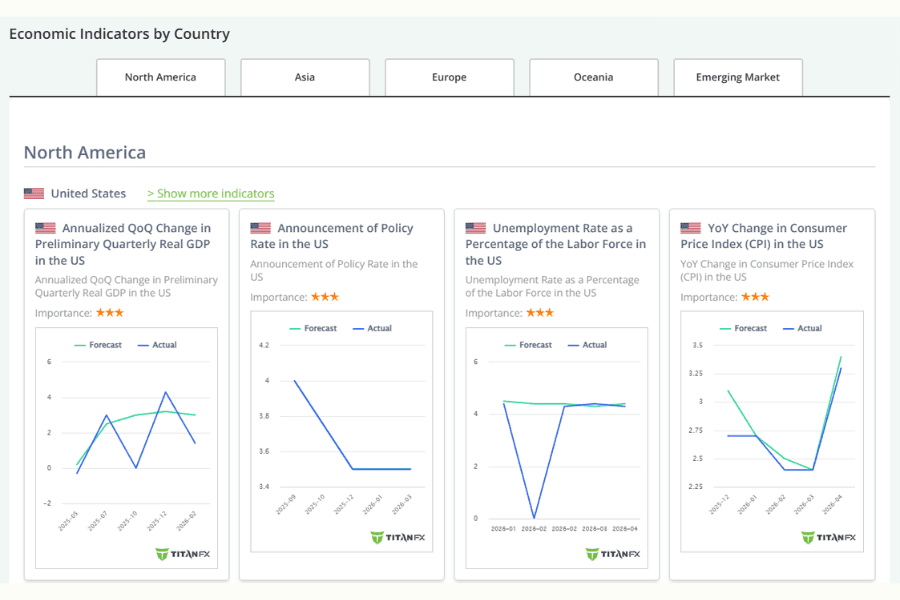
Free Economic-Indicator Lookup from Titan FX
Titan FX offers a global economic data indicator tool covering the US, Europe, Japan, China, and more — filterable by release time, country, and importance.
5. The Euro's Role in the Global Financial System
Since its launch, the euro has taken on an increasingly central role in the global monetary system — not only as the Eurozone's unified currency, but also in international finance, trade, reserves, and capital markets.
- Role 1: Leading Global FX Trading Currency
- Role 2: World's Second-Largest Reserve Currency
- Role 3: Major International Trade Settlement Currency
- Role 4: Benchmark Currency in Global Financial Markets
- Role 5: De Facto Currency Beyond the Eurozone
- Role 6: A Parallel Pillar to the US Dollar
Role 1: Leading Global FX Trading Currency
Per BIS 2022 data, the euro participates in approximately 31.4% of global FX turnover — second only to the dollar's 88.5%. EUR/USD remains the most heavily traded currency pair worldwide, with excellent liquidity and tight spreads, making it a core instrument for both retail and institutional traders.
Role 2: World's Second-Largest Reserve Currency
According to the IMF's Q1 2025 COFER data, the euro accounts for 20.06% of global official foreign-exchange reserves — firmly in second place. This reflects broad central-bank confidence in the euro's stability and its value as a tool for diversifying away from the dollar.
Role 3: Major International Trade Settlement Currency
The euro is widely used for intra-Eurozone trade and extends to cross-border settlement with other regions. Its unified nature reduces currency risk and improves transaction efficiency, particularly in energy, manufacturing, and technology exports.
Role 4: Benchmark Currency in Global Financial Markets
Euro-denominated assets — sovereign and corporate bonds, interest-rate swaps, and related instruments — are widely held in global capital markets and are often classified as "safe assets." Eurozone government bonds are especially available and liquid within European banks and among international institutional investors.
Role 5: De Facto Currency Beyond the Eurozone
Outside the 20 Eurozone members, the euro is also adopted by non-EU jurisdictions including Vatican City, Monaco, Andorra, San Marino, Kosovo, and Montenegro. These territories use the euro as their official or de facto currency, demonstrating that its natural influence has transcended formal institutional boundaries.
Role 6: A Parallel Pillar to the US Dollar
While the US dollar remains the dominant global reserve and trading currency, the euro is a credible challenger. The ECB's policy transparency, the Eurozone's economic scale, and institutional stability position the euro as a key alternative in an era of portfolio diversification and gradual de-dollarization.
As the Eurozone expands further and its capital markets deepen, the euro's role in the international monetary system is likely to strengthen.
6. How to Trade the Euro (EUR)
Trading the euro can be done in several ways, the most common of which is forex margin trading. This approach allows you to use leverage to control a larger position with a smaller amount of capital.
Forex margin trading also lets you go both long and short depending on market conditions. Combined with the forex market's 24-hour operation, this makes it one of the most flexible and liquid markets in the world, suited to a wide range of trading styles and risk profiles.
Further reading: Forex Margin Trading — Beginner's Guide
Titan FX offers leverage of up to 1,000x.
Trading Forex Margin with Titan FX — 5-Step Flow
Step 1: Open an Account
Opening a Titan FX account is fast and simple — no ID or address verification is required to open an account online.
Titan FX offers three account types: Standard, Blade, and Micro — you can choose the one that best fits your trading style during registration.
Titan FX Account Opening GuideStep 2: Fund Your Account
Once registered, you can deposit funds using any of several methods. Credit-card deposits are among the fastest and usually credit the account instantly.
Step 3: Download and Install the Trading Platform (MT4/MT5)
Titan FX supports both MT4 and MT5 on Windows, Mac, iOS (iPhone/iPad), and Android.
Titan FX MT5 Download & Login Titan FX MT4 Download & LoginStep 4: Choose a Currency Pair
Titan FX supports around 60 currency pairs, with the most popular euro pair being EUR/USD — the most heavily traded pair in the world.
Other EUR-related pairs include:
| Pair Name | Symbol | Avg. Spread |
|---|---|---|
| Euro vs. Australian Dollar | EURAUD | 2.9 |
| Euro vs. Canadian Dollar | EURCAD | 2.5 |
| Euro vs. Swiss Franc | EURCHF | 1.8 |
| Euro vs. Czech Koruna | EURCZK | 141 |
| Euro vs. British Pound | EURGBP | 1.4 |
| Euro vs. Japanese Yen | EURJPY | 1.8 |
| Euro vs. Norwegian Krone | EURNOK | 15.4 |
| Euro vs. New Zealand Dollar | EURNZD | 4 |
| Euro vs. Polish Zloty | EURPLN | 21.1 |
| Euro vs. Swedish Krona | EURSEK | 57.8 |
| Euro vs. Singapore Dollar | EURSGD | 2.2 |
| Euro vs. Turkish Lira | EURTRY | 335.1 |
| Euro vs. US Dollar | EURUSD | 1.1 |
| Euro vs. South African Rand | EURZAR | 86.9 |
Step 5: Place a Trade
After logging in to MT4 or MT5, select an instrument and place a buy or sell order.
Titan FX MT5 Order Window Guide Titan FX MT4 Order Window GuideFree Trading Tools from Titan FX (Custom Indicators and EAs)
Titan FX provides a suite of free trading tools — custom indicators and Expert Advisors (EAs) — designed to improve trading efficiency and decision precision.
Custom indicators help traders analyze the market more accurately and spot potential opportunities. EAs execute predefined strategies automatically, reducing emotional interference and ensuring consistent execution.
All Custom Indicators EA Ranking7. EUR FAQ
Q1: How does the ECB's policy reaction speed differ from the Fed's?
Compared with the US Federal Reserve, the European Central Bank tends to follow a steadier, more gradual policy path. Because the ECB is focused on overall Eurozone stability and price stability rather than any single member's economy, the euro's policy reactions to inflation and economic shocks can be slower — but typically more consistent and predictable.
Q2: Is the euro considered a safe-haven currency?
During some episodes of geopolitical stress or extreme dollar volatility, the euro does exhibit safe-haven demand, especially when Eurozone data is stable or ECB policy turns hawkish. However, relative to the US dollar and the Japanese yen, the euro remains a secondary safe haven; its safe-haven status is often weakened by internal Eurozone uncertainty (such as debt concerns).
Q3: What seasonal patterns does EUR trading show?
Between Q2 and Q3 (April–September), the euro often sees stronger inflows driven by Eurozone tourism and peak export settlement. Year-end trading may see amplified volatility as institutional rebalancing and European holiday liquidity thinning coincide.
Q4: Is EUR/USD correlated with European equity markets (e.g., DAX)?
Under certain conditions EUR/USD and European equities display an inverse correlation: a stronger euro can weigh on the profitability of export-oriented European firms. Overall, however, the correlation is modest and needs to be evaluated alongside other macro factors.
Q5: How are ECB rate expectations reflected in the euro's exchange rate?
The euro tends to price ECB rate expectations in advance. If markets expect imminent rate hikes, the euro typically rallies ahead of the actual decision; when expectations shift toward rate cuts or pauses, the euro can retrace. This sensitivity to rate expectations makes the euro a key short-term driver for FX traders.
Q6: What's the difference between the EU, the Eurozone, and the Schengen Area?
European integration has produced three distinct but closely related frameworks that are often confused:
- European Union (EU): A political and economic union of 27 member states built around a single market that guarantees free movement of people, goods, services, and capital.
- Eurozone: The subset of EU members (currently 20) that use the euro as sole legal tender; monetary policy is set by the ECB.
- Schengen Area: A passport-free travel zone that includes several non-EU members such as Switzerland and Norway.
Comparison of the Three Areas
| Dimension | European Union (EU) | Eurozone | Schengen Area |
|---|---|---|---|
| Founded | 1993 (Maastricht Treaty) | 1999 (accounting) / 2002 (cash) | 1995 (Schengen Agreement) |
| Purpose | Political & economic integration | Single currency, unified monetary policy | Passport-free border crossing |
| Members | 27 sovereign states | 20 EU member states | 27 states, incl. 4 non-EU |
| Includes non-EU? | No | No | Yes (Switzerland, Norway, etc.) |
Q7: How does the euro compete with the Chinese yuan (CNY) for global status?
Both the euro and the yuan are often discussed as alternatives in the "de-dollarization" narrative, but their positions differ. Per IMF COFER Q1 2025, the euro makes up 20.06% of global official reserves versus 2.12% for the yuan — a gap of roughly 10×. The euro benefits from institutional transparency, deep capital markets, and full convertibility, whereas the yuan is still subject to capital-account restrictions. In the near term, the euro remains the dollar's primary challenger, while the yuan's challenge is a longer-term story.
Q8: Why is EUR/USD nicknamed "Fiber"?
FX traders call EUR/USD "Fiber", a nickname coined when the euro launched in 1999. It stands alongside "Cable" (GBP/USD, referring to the transatlantic telegraph cable) — as "Fiber" refers to the newer fiber-optic communications that arrived with the euro. It is market jargon; formal documents continue to use EUR/USD.
8. Summary
Three Key Takeaways
- The euro is the world's second-largest currency: 31.4% of global FX turnover and 20.06% of official reserves — second only to the US dollar.
- ECB policy is the primary driver: Rate decisions and forward guidance are the euro's most important short-to-medium-term catalysts. Tracking the ECB–Fed rate differential is crucial for reading EUR/USD direction.
- EUR/USD is the most active FX pair: With the tightest spreads (1.1 pips average at Titan FX) and the deepest liquidity, it is suitable for both beginners and institutions.
Beginners vs. Advanced Traders
- Beginners: Start with EUR/USD and use the Eurozone economic calendar to follow CPI and ECB meetings; apply technical analysis to time entries.
- Advanced: Track the inverse EUR/USD–DXY correlation, monitor EUR-cross carry-trade opportunities, and use ECB–Fed rate-differential OIS futures to position ahead of policy shifts.
Further Reading
- EUR/USD (Euro / US Dollar) live quote — The world's most-traded currency pair, on the Titan FX product page.
- Inflation — Foundation for understanding the link between the ECB's 2% inflation target and policy decisions.
- Raise Interest Rates — How ECB hike cycles drive the euro.
- Cut Interest Rates — How ECB cuts influence the euro during slowdowns.
- Monetary Policy — Framework used by major central banks.
- Asset Allocation — Portfolio design with currencies in the mix.
The Titan FX Research team covers global macroeconomic indicators, foreign exchange (FX), commodities (oil, precious metals, agriculture), equity indices, US stocks, and crypto assets, producing educational content for investors and traders.
Primary Sources by Category
- Official data and regulators: European Central Bank (ECB) — Monetary Policy Decisions / Economic Bulletin; Eurostat — eurozone GDP / HICP inflation / unemployment statistics; Federal Reserve Economic Data (FRED) — EUR/USD historical series; Bank of England (BoE), Swiss National Bank (SNB) — for cross-rate context.
- International institutions and research: International Monetary Fund (IMF) — Currency Composition of Official Foreign Exchange Reserves (COFER); Bank for International Settlements (BIS) — Triennial Central Bank Survey of FX; OECD — Economic Surveys: Euro Area.
- Media and historical references: Bloomberg, Reuters, Financial Times; the euro launch (January 1999), the eurozone sovereign-debt crisis (2010–2012), Mario Draghi's "whatever it takes" speech (July 2012), ECB negative-rates policy (2014–2022), and the 2022 energy crisis and weak-euro episode.