

What Are Safe Haven Currencies? Characteristics and Trading Strategies

When stock markets tumble, war breaks out, or the economic outlook turns uncertain, money tends to flee riskier assets and flow into a handful of currencies seen as "safe." Those that tend to hold their value through the storm are known as safe-haven currencies.
This article explains what safe-haven currencies are, why investors favor them, the characteristics and currency pairs of the four major ones, their trading traits, and how to trade them on margin with Titan FX.
- Definition: Currencies bought to preserve value and hedge risk in turmoil
- The big four: US dollar (USD), Swiss franc (CHF), Japanese yen (JPY), euro (EUR)
- Core traits: Stable economies, deep liquidity, relatively low volatility
- Why investors use them: Capital preservation in crises and hedging risk assets
- Trading caveat: Less opportunity in low-volatility regimes; mind the counter-trend logic
1. What Are Safe Haven Currencies?
Safe haven currencies are currencies that investors choose to hold in order to preserve capital and hedge risk when global financial markets become volatile, geopolitical risk rises, or economic uncertainty increases. These currencies are typically closely associated with stable economic fundamentals, low inflation, sound financial systems, and political neutrality.
Common safe haven currencies include the US Dollar (USD), the Swiss Franc (CHF), the Japanese Yen (JPY), and the Euro (EUR). During periods of market anxiety, they attract large inflows of capital and act as a "safe harbor."
Core Characteristics of Safe Haven Currencies
Economic Stability
The countries that issue safe haven currencies generally possess robust economic systems and stable growth potential. The United States and Switzerland, for example, enjoy extremely high credibility in the global economy, so their currencies are often regarded as safe assets. Stable GDP, employment rates, and policy transparency are key to attracting capital.
High Liquidity
Safe haven currencies such as the US Dollar have extremely high market liquidity. BIS 2022 data shows that the US Dollar was involved in roughly 88% of global foreign exchange trades. High liquidity means investors can enter and exit the market quickly, improving the efficiency of capital allocation.
Lower Price Volatility
Compared with emerging market currencies or commodity currencies (such as the Australian Dollar and the Canadian Dollar), safe haven currencies perform relatively steadily in risk environments. Their volatility is lower, making them a balancing tool within a risk-asset portfolio.
Capital Inflows During Crises
During major events such as global financial crises, wars, or pandemics, capital usually withdraws from high-risk markets and flows into safe haven currencies. For example, when the COVID-19 pandemic broke out in 2020, the US Dollar and Japanese Yen appreciated rapidly, showing that the market places a high degree of trust in their safe haven function.
Further reading:
- A Complete Guide to Forex Trading Basics
- How Forex Trading Works: The Principles Behind Profit and Loss
You can check the real-time relative strength of major currencies with the Currency Strength Meter.
2. Why Do Investors Favor Safe Haven Currencies?
The main reason investors choose safe haven currencies is their ability to withstand market shocks and their capital preservation qualities. Especially when economic uncertainty or risk events arise, these currencies become a "temporary safe harbor" for capital, helping a portfolio remain stable.
Global Financial Turmoil and Safe Haven Demand
Market Background
Whenever a major financial event occurs—such as the 2008 financial crisis, the European debt crisis, or the 2022 Russia-Ukraine war—market risk sentiment heats up quickly, and investors turn to safe haven assets.
When stock markets swing violently or expectations of an economic recession emerge, capital flows toward the US Dollar, Japanese Yen, or Swiss Franc to avoid the loss of value that comes from holding high-risk assets.
The Role of Capital Preservation and Risk Hedging
Capital Preservation
Safe haven currency exchange rates fluctuate relatively little, which helps maintain the book value of assets and avoids capital erosion caused by high inflation or currency depreciation.
Risk Hedging
By holding safe haven currency assets or positions, investors can hedge the volatility of risk positions in equities, commodities, and the like, achieving portfolio balance.
For example, during periods of US-China trade tension, some hedge funds chose to add to their USD/CHF positions to counter global market instability. Such operations are often combined with carry trades and options strategies to manage overall investment risk.
3. Introduction to the Four Major Safe Haven Currencies and Their Currency Pairs
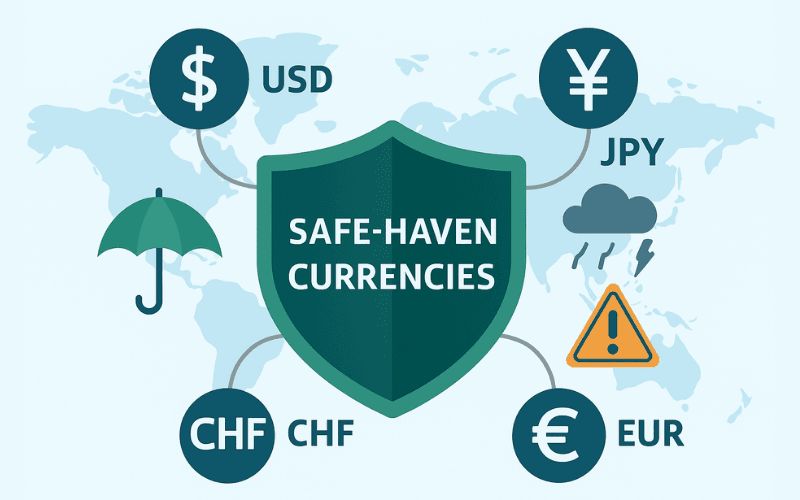
When uncertainty appears in global financial markets, capital tends to pour into currencies backed by stable economies and policy frameworks. Below we introduce the four most representative safe haven currencies—the US Dollar (USD), Swiss Franc (CHF), Japanese Yen (JPY), and Euro (EUR)—and explain their representative currency pairs and market positioning.
3.1: US Dollar (USD)

Core features: the strongest global liquidity, diverse policy tools, and clear appreciation during crises
The US Dollar is the world's primary reserve currency, involved in 88% of foreign exchange trades (BIS 2022) and accounting for roughly 58% of foreign exchange reserves (IMF 2023).
Because the United States has an enormous bond market and economic scale, combined with the powerful policy tools of the Federal Reserve (Fed), the US Dollar can absorb global safe haven capital during crises, serving the dual role of stabilizing exchange rates and providing liquidity.
When geopolitical risk or recession concerns emerge, the US Dollar usually becomes the first choice for capital seeking safety. During the 2008 financial crisis and the early stages of the 2020 pandemic, for example, the US Dollar appreciated rapidly, demonstrating its crisis resilience and liquidity advantage.
Representative currency pairs include:
- EUR/USD (Euro/US Dollar): The largest trading volume in the world with extremely high liquidity, which gives it a structurally low spread, making it one of the lowest-cost currency pairs to trade. It serves as a key indicator for observing the economic and policy gap between Europe and the US.
- USD/JPY (US Dollar/Japanese Yen): Japan is the world's third-largest economy, and there are important trade and financial ties between the US and Japan. As a safe haven currency, the yen is often used alongside the US Dollar to hedge global risk, and the relative movement between the two also reflects the market's risk appetite.
- GBP/USD (British Pound/US Dollar): Although the UK's economy is smaller than the Eurozone's, it has a developed financial market—particularly London as one of the world's financial centers—which makes GBP/USD a highly liquid currency pair, suitable for traders following capital momentum in Europe and the US.
3.2: Swiss Franc (CHF)
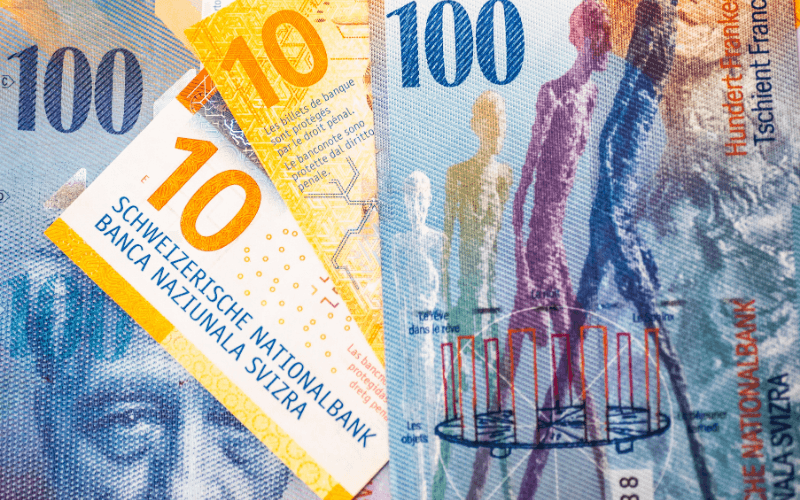
Core features: political neutrality, a sound financial system, and rapid appreciation during crises
Switzerland is renowned for its long-standing neutral stance and rigorous financial regulation, making it one of the top destinations for capital preservation and safe haven flows worldwide. The Swiss National Bank (SNB) adopts a relatively conservative monetary policy, and combined with a domestic low-inflation environment (average annual inflation of about 2.1% in 2023), the Swiss Franc enjoys a high degree of stability.
Switzerland's banking industry is highly developed, attracting large amounts of high-net-worth assets and multinational corporate capital. During periods of market panic, such as the 2015 "Swiss Franc crisis," the Swiss Franc appreciated more than 20% against the Euro in a single day, showing that while its safe haven function is strong, its volatility cannot be ignored.
Representative currency pairs include:
- USD/CHF (US Dollar/Swiss Franc): Highly defensive in nature and frequently linked to market risk indicators. The franc appreciates noticeably during risk-off periods, while it weakens when the US Dollar is strong, making it a representative combination for observing the tug-of-war between the US Dollar and global risk sentiment.
- EUR/CHF (Euro/Swiss Franc): Reflects shifts in confidence within Europe. When the Eurozone faces economic or political uncertainty, capital tends to move into the franc for safety. Its price movements are usually more moderate, making it suitable for observing the trend of safe haven capital flows.
- GBP/CHF (British Pound/Swiss Franc): Higher volatility, reflecting two currencies with very different asset styles. It is commonly seen during periods of market turbulence, when the pound falls and the franc strengthens, making it suitable for pairing with news-driven trading strategies.
3.3: Japanese Yen (JPY)
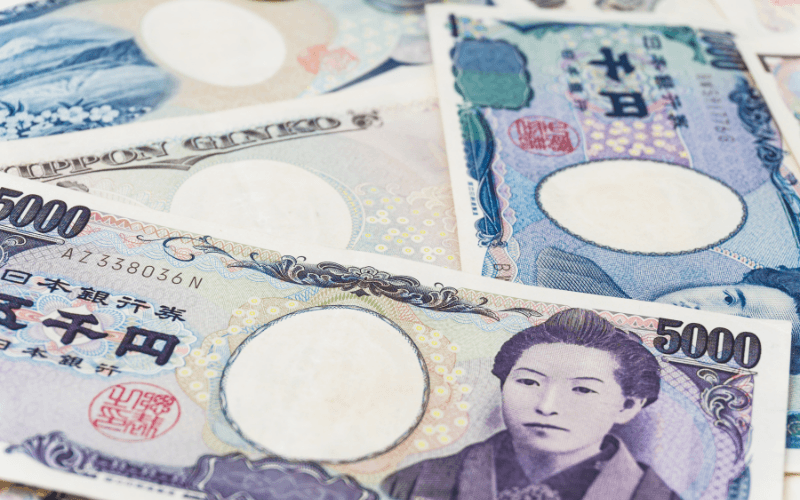
Core features: a low-interest funding currency for carry trades, a steady current account surplus, and sharp appreciation during risk reversals
The Japanese Yen has long been regarded as one of the classic safe haven currencies, owing to Japan's large current account surplus and high savings rate, as well as the world's third-largest foreign exchange reserves (about USD 1.3 trillion in 2023). The Bank of Japan has long maintained near-zero interest rates and monetary easing, making the yen a funding currency in carry trades (Carry Trade).
When market risk appetite weakens or financial markets correct, capital covers short yen positions, causing the yen to surge in the short term. During the early stages of the 2022 Russia-Ukraine conflict, for example, the yen appreciated about 10% against the US Dollar, highlighting its "risk-reversal" safe haven characteristic.
Representative currency pairs include:
- USD/JPY (US Dollar/Japanese Yen): As the yen's main counterpart currency, its movements are influenced by the US-Japan interest rate differential, equity market sentiment, and global capital flows. During rate-hike cycles the US Dollar usually strengthens, while the yen rebounds quickly when risk events occur.
- EUR/JPY (Euro/Japanese Yen): A cross-region Europe-Asia currency pair whose exchange rate is affected by Europe's economic stability and the yen's safe haven nature. It is commonly used in portfolios to hedge Euro exposure or to capture the direction of Asian capital flows.
- AUD/JPY (Australian Dollar/Japanese Yen): Frequently used to gauge the strength of global risk sentiment. The Australian Dollar, as a commodity currency, is highly volatile, and pairing it with the yen as a safe haven creates an excellent trading pair for the market's "bull-bear tug-of-war."
3.4: Euro (EUR)

Core features: a solid reserve status, support from the German and French economies, and a role as a secondary safe haven currency
As the world's second-largest reserve currency, accounting for about 20% (IMF 2023), the Euro is backed jointly by the 20 member states of the Eurozone, with Germany and France serving as its core economic engines. Although political integration in the Eurozone remains challenging, its overall economic scale and institutionalized policy coordination give the Euro a substitute safe haven role when the US Dollar weakens.
When the US Dollar swings sharply or confidence in US policy declines, the Euro often attracts capital inflows. However, internal European political and economic events—such as Brexit, sovereign debt crises, or energy shocks—can also affect the Euro's safe haven performance.
Representative currency pairs include:
- EUR/USD (Euro/US Dollar): The core battleground for the economic and policy contest between Europe and the US. Interest rate differentials, CPI data, and central bank statements all drive its movements. With clear volatility and deep liquidity, it is a popular currency pair compatible with both technical and news-based analysis.
- EUR/JPY (Euro/Japanese Yen): Combining two safe haven roles and two export-oriented economies, it is useful for observing the interplay between European political risk and Asian capital demand. When the yen is strong, this currency pair comes under clear pressure.
- EUR/GBP (Euro/British Pound): Highly influenced by regional politics and central bank policy, especially during Brexit, referendums, or shifts in energy policy. It is suitable for medium-term strategies built around the theme of policy divergence within Europe.
4. How to Trade Safe Haven Currencies on Titan FX

Step 1: Choose a Trading Platform
Titan FX offers 3 account types and 59 forex currency pairs, with trading supported on the MT4 and MT5 platforms—flexible and efficient, meeting the needs of traders at every level.
Advantages of Forex Trading with Titan FX
| Advantage | Description |
|---|---|
| High Leverage | Up to 1,000x on Standard and Blade accounts, and up to 2,000x on eligible Micro accounts—flexible leverage amplifies your trading room. |
| Low Spreads | Competitive spreads, such as EUR/USD from as low as 0.2 pips, reducing trading costs. |
| Fast Execution | Industry-leading execution speed that effectively reduces slippage risk. |
| Advanced Platforms | Support for both MT4 and MT5, providing complete technical analysis functionality. |
| Free Tools | Provides technical indicators and EA automated trading tools to improve trading efficiency. |
| Multilingual Support | Customer service in Chinese, English, and Japanese to resolve trading issues quickly. |
| Educational Resources | Forex educational resources, foundational knowledge, daily market analysis, and trading strategies. |
| Flexible Deposits and Withdrawals | Support for multiple deposit methods, with a minimum deposit of just USD 1. |
| Automatic Margin Protection | No margin calls required, reducing the risk of a blown account. |
Titan FX Account Types and Their Features
| Account Type | Features |
|---|---|
| Standard Account | No trading commission, up to 1,000x leverage, spreads below the standard level |
| Blade Account | Trading commission applies, up to 1,000x leverage, spreads lower than the Standard account |
| Micro Account | Contract size of 1,000 currency units, minimum trade of 100 currency units, up to 2,000x leverage (conditions apply) |
Spreads on Titan FX's Major Currency Pairs
| Currency Pair | Standard Avg. | Blade Avg. | Micro Avg. |
|---|---|---|---|
| EURUSD | 1.2 pips | 0.2 pips | 1.4 pips |
| GBPUSD | 1.57 pips | 0.57 pips | 1.77 pips |
| AUDUSD | 1.52 pips | 0.52 pips | 1.72 pips |
| USDJPY | 1.33 pips | 0.33 pips | 1.53 pips |
| USDCHF | 1.92 pips | 0.92 pips | 2.12 pips |
Step 2: Open an Account
The account opening process at Titan FX is simple and fast—you can open an account online without submitting any proof of identity or address.
Titan FX offers Standard and Blade trading accounts. Traders can choose between different account types during registration.
Step 3: Make a Deposit
After registering successfully, you can deposit funds into your account. Titan FX offers multiple deposit methods, the fastest and most convenient of which is credit card deposit, usually credited instantly.
Step 4: Download the Trading Platform
Download and install the trading platform (MT4/MT5): Titan FX offers two trading platforms (software), MT4 and MT5. Traders can download and install them on Windows, Mac, iOS (iPhone/iPad), and Android systems.
Titan FX MT5 Download, Installation, and Login Guide Titan FX MT4 Download, Installation, and Login GuideStep 5: Place a Trade
After successfully logging into the MT4 or MT5 trading platform, simply select a trading instrument to place buy or sell orders.
Titan FX MT5 Interface and Order Placement Guide Titan FX MT4 Interface and Order Placement GuideTitan FX Offers Free Trading Tools (Custom Indicators and EAs)
Titan FX is dedicated to providing traders with the most advanced trading support, including free trading tools such as custom indicators and EAs (automated trading programs). These tools are designed to enhance traders' efficiency and the precision of their strategies.
Custom indicators can help traders analyze market trends more accurately and discover potential trading opportunities.
EAs, meanwhile, can automatically execute predefined trading strategies, avoiding interference from human emotion and ensuring that every trade is executed precisely.
With these free tools, Titan FX helps you gain an edge in the highly competitive financial markets and improve your trading performance.
All Custom Indicators EA Trading Program RankingsTrade Forex CFDs with Titan FX
Titan FX offers 50+ currency pair CFDs on MT4/MT5 with up to 1,000:1 leverage on major pairs, tight spreads, and the flexibility to go long or short. Micro accounts can reach up to 2,000:1 leverage when eligible.
5. Frequently Asked Questions (FAQ)
Q1. Besides safe haven currencies, what are some risk currencies?
In addition to safe haven currencies (such as the US Dollar, Japanese Yen, and Swiss Franc), the market also has "risk currencies," such as the Australian Dollar (AUD), the New Zealand Dollar (NZD), and the Canadian Dollar (CAD). These currencies are usually related to commodities, global trade, and capital flows. They perform more strongly when the market is optimistic, but they also carry higher volatility risk.
Q2. Besides safe haven currencies, what other hedging tools are there?
Hedging is not limited to the currency market. Common hedging tools include:
- Gold: A physical asset that performs strongly when inflation rises or the US Dollar weakens.
- VIX Index (volatility index): Reflects the level of fear in the US equity market and is often used to assess short-term hedging demand.
- US Treasuries: Highly creditworthy with stable returns; capital often pours into 10-year Treasury notes during crises.
- Currencies such as the Japanese Yen / Swiss Franc: Hedge declines in equities or risk assets directly through forex positions. Different market tools have different hedging logic and trigger timing, and they can be combined to strengthen an asset's defensive capability.
Q3. Can safe haven currencies and gold be allocated together?
Yes. Gold and safe haven currencies play complementary roles across different market cycles. For example, when the US Dollar weakens or market inflation expectations rise, gold tends to be strong; whereas when liquidity tightens or stock markets crash, safe haven currencies may absorb capital more quickly. Pairing the two helps balance risk.
Further reading: Asset Allocation Explained: How to Allocate Your Funds to Achieve Financial Goals?
Q4. When is it not advisable to trade safe haven currencies?
If market volatility is extremely low (for example, when the VIX stays below 12 for a long time), or when the interest rate policies of the major central banks are aligned and lack direction, trading safe haven currencies may lack volatility opportunities. In addition, beginners who do not understand the contrarian logic of safe haven currencies can easily get caught in reversals and shakeouts when chasing prices.
6. Summary
Safe haven currencies have long played the role of stable assets within the global financial system. When markets face systemic risk or asset prices swing violently, currencies with high liquidity and economic stability—such as the US Dollar, Swiss Franc, Japanese Yen, and Euro—become key choices for the short-term sheltering of capital and the adjustment of asset allocation.
Through definitions, a comparison of the characteristics of the four major currencies, an introduction to common currency pairs, and practical trading guidance, this article helps readers build a complete knowledge framework for safe haven currencies. Whether you follow forex market developments or wish to strengthen the risk management strategy of your asset allocation, understanding how safe haven currencies work is an important step toward more rational decision-making.
Further Reading
Titan FX Trade Strategy Research Lab covers forex (FX), commodities (oil, precious metals, agricultural products), stock indices, U.S. equities, and crypto assets — producing educational content for retail investors across asset classes.
Primary Sources (by Category)
- Reference: Investopedia — Safe Haven
- Data: BIS Triennial Survey