

Raise Interest Rates
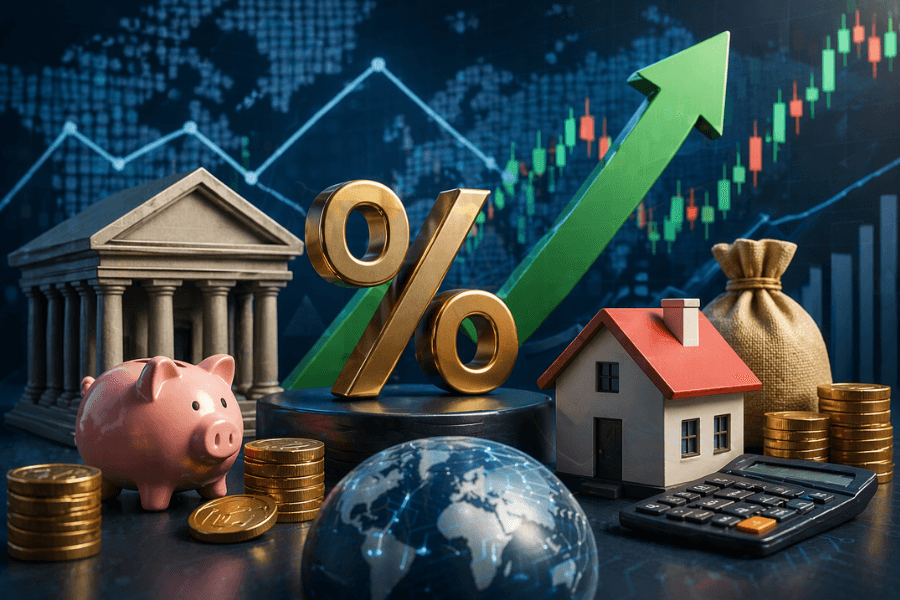
A rate hike is a monetary policy action in which a central bank lifts its benchmark interest rate to raise the cost of money in the wider economy.
When the Federal Reserve or another central bank announces a rate hike, the underlying intent is usually to curb inflation, cool overheated demand, and steer capital back toward deposits, bonds, and other rate-sensitive assets. Because a hike works through deposit yields, loan costs, mortgage payments, equity valuations, bond prices, and exchange rates, its reach extends well beyond financial markets — it reshapes household cash flow as well.
This article explains what a rate hike is, how to convert between basis points and percentage points, the direct impact on savings and lending, the spillover into stocks, bonds, and foreign exchange, and the risk-management lens investors should apply during a hiking cycle.
- How a rate hike raises the cost of capital and how central banks use rate policy to suppress inflation and overheated demand.
- How rising rates flow through to deposits, mortgages, consumer credit, and household spending.
- The typical reactions of stocks, bonds, and FX during a hiking cycle, so you stop reducing rate moves to a single bullish or bearish call.
- How basis points (bp) convert to percentage points, so policy moves in financial news become readable instantly.
- A risk-checking framework for rising-rate environments, covering debt, leverage, liquidity, and asset volatility.
- 1. What Is a Rate Hike? The Logic Behind Central Bank Tightening
- 2. Direct Impact on Personal Finances: Savings and Loans
- 3. Market Spillover: Stocks, Bonds, and Foreign Exchange
- 4. Rate Move Units: Basis Points and Percentage Points
- 5. Investment Strategy: Optimizing Allocation in a Hiking Cycle
- 6. FAQ: Practical Questions About Rate Hikes
- 7. Conclusion
1. What Is a Rate Hike? The Logic Behind Central Bank Tightening
A rate hike (Raise Interest Rates) is the monetary policy decision by which a central bank raises its benchmark interest rate .
It is one of the primary tools for adjusting economic temperature. When prices rise too quickly and inflation pressure builds, central banks push the cost of borrowing higher to drain excess liquidity from the system and stabilize prices.
Why choose to hike rates?
The core objective of rate policy is preserving the value of money. When the economy overheats, a rate hike pulls capital back into the banking system and prevents runaway inflation from eroding purchasing power. It is a defensive policy move designed to protect long-run economic health.
Relationship to rate cuts
Conversely, when the economy weakens or prices stagnate, central banks turn to a rate cut.
Rate cuts ease the borrowing burden for businesses and households, encouraging investment and consumption to reignite economic momentum. In short, hiking is meant to cool an overheating economy, while cutting is meant to spark a sluggish market.
The table below summarizes how the two stances differ across key dimensions:
| Dimension | Rate Hike (Rates Up) | Rate Cut (Rates Down) |
|---|---|---|
| Primary aim | Curb inflation, prevent overheating | Stimulate growth, encourage spending |
| Deposit yields | Rise (saving becomes more attractive) | Fall (yield erodes) |
| Borrowing cost | More expensive (heavier repayment) | Cheaper (lower interest expense) |
| Equities | Pressured short-term (capital cost up) | Generally supportive (more liquidity) |
| Consumer demand | Weakens (savings preferred) | Strengthens (more credit, more spending) |
| Currency | Often strengthens (capital inflow) | Often weakens (capital outflow risk) |
2. Direct Impact on Personal Finances: Savings and Loans
Changes in policy rates feed straight into bank balances and debt contracts.
Effect 1: Higher savings yields
For households that hold cash in checking or time deposits, a rate hike is constructive.
As the benchmark moves up, deposit rates offered by banks tend to follow. Without adding principal, savers can capture higher interest income, which lifts the incentive to save.
Effect 2: Higher loan costs and repayment burden
This is the channel most households feel directly. Mortgages, personal loans, and auto loans typically track the benchmark rate. As the policy rate climbs, monthly interest expense rises — pressure is most acute for highly leveraged borrowers.
Effect 3: A drag on real estate
Hikes raise both the entry cost and the carrying cost of property. Investors facing higher interest expense may move to sell, while owner-occupiers may delay purchases. Local supply, demand, and policy still drive housing markets, but rate hikes are generally treated as a tool to "cool overheating."
3. Market Spillover: Stocks, Bonds, and Foreign Exchange
A hiking cycle redirects capital flows, and the impact differs sharply by asset class.
Spillover 1: Equity valuations reset
Rate hikes are usually treated as short-term headwinds for stocks.
Higher financing costs compress corporate margins, and investors tend to rotate from riskier equities into deposits or bonds that look comparatively stable. High-growth, high-multiple technology names typically face the largest re-rating pressure early in a hiking cycle.
Sector impact during a hiking cycle
| Sector | Hike impact | Reason |
|---|---|---|
| Banks / financials | Net positive | Net interest margin tends to widen |
| Tech / growth | Negative | Rich multiples re-priced |
| Real estate | Negative | Mortgage costs cool demand |
| Defensive / value | Relatively resilient | Stable cash flow, lower multiples |
| Utilities | Mixed to soft | Defensive, but yield competition from bonds |
Spillover 2: Bond price volatility
Bond yields and prices move inversely.
When market rates rise, the older, lower-coupon bonds become less attractive and their prices fall. New issuance after the hike, however, offers higher yields — a clear advantage for incoming buyers.
Spillover 3: Currency rebalancing
The currency of the hiking country tends to gain attractiveness.
Take the U.S. dollar, for example. If the Fed hikes more aggressively than peers, capital rotates into dollar-denominated assets and the dollar strengthens, putting pressure on emerging-market currencies through the cross.
Recent Federal Reserve policy path
The table below traces Federal Reserve decisions since the 2022 inflation-fighting cycle began. The pivot from aggressive tightening, through a high-rate plateau, to easing becomes visible at a glance.
| Date | Move | Target range | Policy context and market reaction |
|---|---|---|---|
| Jan 2026 — present | Hold | 3.50% – 3.75% | Pause after cuts: holding to confirm whether inflation settles sustainably at target. |
| Sep 2025 – Oct 2025 | Cut 0.50% | 3.75% – 4.25% | Risk-management cut: pre-emptive easing in response to a softening labor market. |
| Sep 2024 – Dec 2024 | Cut 1.00% | 4.25% – 5.00% | Formal pivot: with disinflation confirmed, easing cycle begins, liquidity returns. |
| Jul 2023 – Sep 2024 | Hold | 5.25% – 5.50% | High-rate plateau: 14 months at a 22-year high to ensure price pressure cools fully. |
| 2023/07/27 | Hike 0.25% | 5.25% – 5.50% | Final hike of the cycle: confirmed the resilience of inflation, last move to cement progress. |
| 2023/05/04 | Hike 0.25% | 5.00% – 5.25% | Tightening was widely seen as nearing its end; rate-cut timing entered debate. |
| 2023/03/23 | Hike 0.25% | 4.75% – 5.00% | Despite regional bank stress, the Fed prioritized inflation containment. |
| 2022/11/03 | Hike 0.75% | 3.75% – 4.00% | Rapid tightening run: fourth consecutive 75bp move; global bond markets corrected sharply. |
| 2022/06/16 | Hike 0.75% | 1.50% – 1.75% | Historic step: hottest CPI in decades triggered the largest single move in 28 years. |
| 2022/03/17 | Hike 0.25% | 0.25% – 0.50% | Cycle starts: marks the formal end of zero-rate policy and unlimited QE. |
| 2020/03/16 | Cut 1.00% | 0.00% – 0.25% | Emergency response: pandemic shock, two-week move to zero rates. |
Reading the path: The pace of 2022 hikes vs. the 2024 cuts shows that tightening usually moves more aggressively than easing. The current pause window is a reasonable opportunity for portfolio rebalancing — watch yield-curve dynamics and equity multiples.
4. Rate Move Units: Basis Points and Percentage Points
Financial news flips between "bp" and "%pt" — both describe the size of a rate change. The chart below makes the conversion clear.
Standard rate-move units
"Basis points" (bp) is the standard unit in global capital markets, while percentage points (%pt) is more common in everyday reporting. Reading both fluently is essential for accurate interpretation.
| Move size | Percentage (%pt) | Basis points (bp) |
|---|---|---|
| Smallest | 0.125% | 12.5 bp |
| Standard | 0.25% | 25 bp |
| Larger | 0.50% | 50 bp |
| Big move | 1.00% | 100 bp |
Understanding bp: 1 basis point equals 0.01%. When the market prices in a "50bp hike" at the next meeting, that is a 0.5% rate increase.
[Practical example] Mortgage impact of a 0.25% hike
For a 30-year fixed mortgage of USD 300,000, with equal principal-plus-interest installments (approximate):
- Pre-hike at 6.50%: monthly payment ≈ USD 1,896
- Post-hike at 6.75%: monthly payment ≈ USD 1,946
- Result: about USD 50 more per month, roughly USD 600 more per year. That is why rate sensitivity is so sharp at the household level.
5. Investment Strategy: Optimizing Allocation in a Hiking Cycle
Rather than panicking, cross-border investors should recalibrate position sizing in line with a rising cost of capital.
Strategy 1: Lean into stable-cash-flow value assets
Rate-hike cycles favor financial institutions that capture wider net interest margins, and value stocks with stable cash flow and modest debt usually hold up better than richly priced growth names when liquidity tightens. Reviewing the portfolio to dial back rate-sensitive tech growth and rotate toward steady-yield defensive holdings is a typical move.
Strategy 2: Lock in yield via short-duration bonds
During a hike, the real value of cash improves. Shifting part of the allocation into higher-yielding deposits or short-duration bonds reduces price-volatility exposure, captures the post-hike yield, and preserves dry powder for re-entry on dips.
Strategy 3: Run a dynamic deleveraging plan
Higher rates mean higher debt-servicing costs — a clear headwind for margin trading and high-leverage strategies. Reviewing the personal liability stack, paying down higher-rate debt first, and maintaining a healthy capital-adequacy position are sensible moves to keep rates from eating into investment returns.
6. FAQ: Practical Questions About Rate Hikes
Q1: How long does a hiking cycle typically last?
There is no fixed formula — duration depends on whether inflation returns to the central bank's target (commonly 2%). Stubborn price growth can extend the cycle for several quarters or years; once the data confirms inflation has cooled or recession risks emerge, central banks shift to "hold" or "cut."
Q2: Are rate hikes always good news for savers?
Nominal deposit yields rise, but the right benchmark is the real interest rate. If post-hike yields still trail local inflation, purchasing power continues to erode in real terms — meaning a portion of capital should still be allocated to inflation-resistant assets (e.g., gold, quality equities).
Q3: Why do rate hikes work to suppress inflation?
Higher borrowing costs reduce discretionary household spending and slow corporate expansion plans. As aggregate demand cools, the pace of price increases moderates.
Q4: When the Fed hikes, do other central banks follow?
Not necessarily, but often. Each central bank weighs its own inflation, growth momentum, and capital-flow risks. To preserve currency stability and avoid wide rate differentials that drive capital out, many central banks tend to keep pace with major peers like the Fed.
7. Conclusion
Rate hikes are a recurring and important market cycle. In the short term they can shake equities, raise mortgage burdens, and pressure borrowers — yet they also lift deposit yields, improve return profiles for some assets, and pull markets back from excessive looseness toward more rational pricing.
For new investors, the key is not memorizing whether a hike is "bullish" or "bearish," but reading the signal underneath: rising capital cost, falling risk appetite, and asset re-pricing.
If you can answer the questions below, you can hold your financial rhythm steady through the rate-policy cycle:
- How does the hike affect my mortgage and cash flow?
- Which assets tend to be defensive in a rising-rate environment?
- Am I carrying excess debt or leverage?
- Where am I in the hiking cycle right now?
Further Reading
- Cut Interest Rates Explained: Stocks, Mortgages and Beneficiary Sectors
- Trade Deficit Explained: Causes, FX Impact and Stock Market Effects
- What Is the FOMC? Schedule, Policy Rate, and Dot Plot Explained (2026)
- Value Stocks: A Practical Guide for U.S. Equity Investors
Titan FX's financial market research and analysis team produces investor education content across a wide range of financial instruments, including foreign exchange (FX), commodities (crude oil, precious metals, and agricultural products), stock indices, U.S. equities, and crypto assets.
Primary Sources by Category
- Central bank policy: Federal Reserve Board "Open Market Operations," "FOMC Statement"; European Central Bank "Key ECB interest rates"; Bank of Japan "Monetary Policy Meeting" materials.
- Macroeconomic statistics: U.S. Bureau of Labor Statistics "Consumer Price Index"; U.S. Bureau of Economic Analysis "PCE Price Index"; IMF "World Economic Outlook."
- Market data and rates: FRED (Federal Reserve Bank of St. Louis) "Federal Funds Effective Rate"; CME Group "FedWatch Tool"; Bank for International Settlements "Statistics on policy rates."