

Trade Deficit
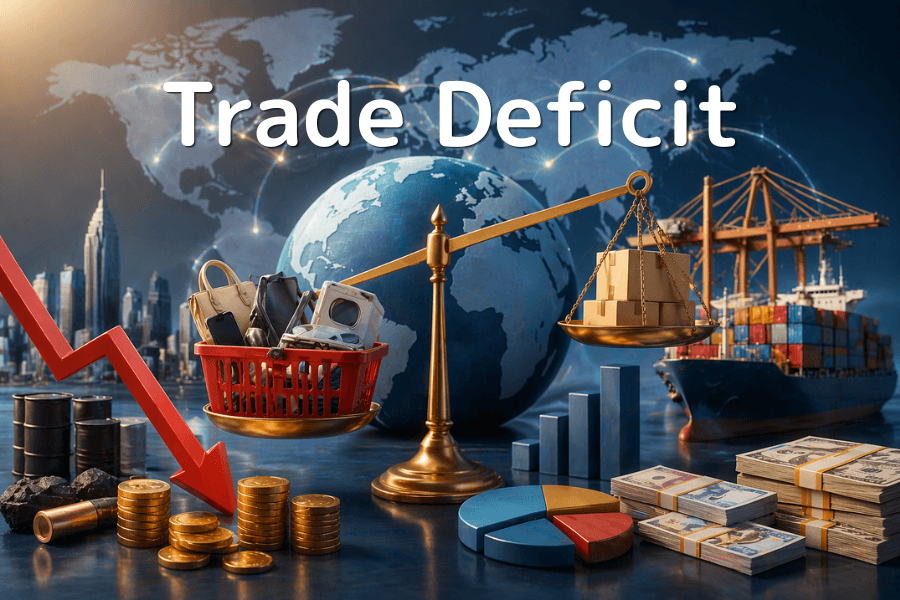
A trade deficit (Trade Deficit) is an economic condition in which a country's total imports exceed its total exports.
When a country pays more for foreign goods and services than it earns through exports, capital is flowing outward. This pattern is common in economies with strong domestic demand or in industrial transition phases, and it can affect exchange rates, capital flows, and market expectations — but it does not necessarily signal economic deterioration.
This article covers the definition and calculation of a trade deficit, its main causes, common misconceptions, and the impact on exchange rates and equity markets, helping readers build a macroeconomic interpretation framework.
- The core definition of a trade deficit and the trade-balance formula, with a clear distinction between deficit (imports > exports) and surplus (exports > imports).
- The four main causes of a trade deficit, so you avoid treating a deficit as a purely negative economic signal.
- How to dispel the common misconception that a deficit always indicates economic weakness, and how to assess health from a macro-structural angle.
- How a trade deficit can affect FX and different asset classes, building your awareness of capital flow patterns.
- A cause-based, practical reading method for sharper portfolio decisions when macro data is released.
1. What Is a Trade Deficit? Terminology and Logic
A trade deficit (Trade Deficit) is an economic condition where a country's total imports exceed its total exports.
In financial reporting, the terms "trade imbalance" or "import surplus" are sometimes used; both carry the same meaning as a trade deficit — the payments for goods and services exceed the receipts.
Trade balance formula
Trade Balance = Total Exports − Total Imports
- Result < 0: Trade deficit (imports > exports)
- Result > 0: Trade surplus (exports > imports)
| Term | Alternate name | Core characteristic | Cash-flow direction |
|---|---|---|---|
| Trade Deficit | Import surplus / trade imbalance | Imports > Exports | Outflows > Inflows |
| Trade Surplus | Export surplus | Exports > Imports | Inflows > Outflows |
Note: Reports referring to "trade deficit" usually focus on goods trade. To assess a country's full external accounts, services trade and the broader balance-of-payments data (current account, capital account) need to be considered together.
2. Why Do Trade Deficits Form? Four Core Causes
A trade deficit does not necessarily mean a country's economy is in trouble. It usually emerges from the combined effects of domestic demand, industrial structure, raw-material prices, and exchange-rate movements.
Four main causes of a trade deficit
| Cause | How it generates a deficit | Common interpretation |
|---|---|---|
| Stronger domestic demand | Steady growth lifts import demand | A sign of an active domestic economy |
| Higher commodity prices | Rising costs of energy, food, etc. | External price pressure |
| Industrial transition / capex | Imports of equipment, technology, and components rise | Potential to lift long-run competitiveness |
| Strong domestic currency | Imported goods become relatively cheaper, lifting purchase intent | FX-driven |
Cause 1: Stronger domestic demand drives import growth
When an economy grows steadily and incomes rise, households gain more capacity to buy foreign goods — imported cars, brand-name appliances, cosmetics, premium consumer products. A deficit of this kind usually accompanies domestic demand growth and is not necessarily negative.
Cause 2: Rising energy and raw-material prices
For countries that rely on imported energy or resources, sharp upticks in international prices for oil, natural gas, food, or metals expand the import bill quickly even without higher import volumes — widening the deficit.
Cause 3: Industrial upgrade or capital expenditure
If domestic companies are upgrading production lines, expanding plants, or importing high-end equipment and key components, imports may rise short-term and produce a deficit. This is a common pattern in industrial-transition phases — typically a neutral structural change that may set up future export growth.
Cause 4: A strong domestic currency makes imports cheaper
When the local currency is relatively strong, the cost of buying foreign goods falls, and households and firms become more willing to import — widening the deficit. Exchange rates are an important factor in trade balance, but rarely the only one.
3. Is a Trade Deficit Necessarily Bad? Dispelling Common Myths
A trade deficit is not equivalent to recession or poverty. Judgment requires looking at the underlying causes and the broader economic structure.
A mature consumption-driven economy may carry a deficit for the long run while still reflecting strong domestic demand and global resource-allocation capacity. If the deficit is driven primarily by capital expenditure or industrial upgrades, it may, over time, actually strengthen productivity.
The case to truly watch for is a deficit that is widening alongside rapid foreign-debt accumulation, insufficient FX reserves, large-scale capital outflows, or a clearly declining industrial competitiveness. In those situations, a deficit can evolve into systemic risk.
A further note: the unique status of the U.S. dollar as the world's reserve currency allows the United States to sustain large trade deficits without triggering a credit crisis — a structural privilege not easily replicable by other currency issuers. When reading trade-deficit data, whether the country issues a global reserve currency is a key dimension for assessing the risk profile.
4. Practical Investor View: Trade Deficit, FX, and Stocks
Markets focus on trade deficits because they are not just a data point — they can affect FX, corporate earnings, and equity valuations. The impact, however, is rarely one-directional and must be read in light of the underlying causes.
Quick reference: market impact of a trade deficit
| Market | Likely impact | Underlying reason |
|---|---|---|
| FX | Domestic currency under pressure | Importers sell domestic currency to buy foreign currency for payments, increasing FX demand. |
| Import-related sectors | Depends | Strong domestic demand with stable FX may benefit retailers; rapid currency depreciation raises import costs. |
| Export-related sectors | Mixed to slightly positive | A weaker currency can support pricing and FX gains, but reliance on imported inputs raises costs. |
| Equities overall | Not necessarily negative | The key is whether the deficit reflects fundamental deterioration or capex / domestic-demand strength. |
Effect 1: FX tends to weaken
In international trade, importers exchange domestic currency for foreign currency to pay for goods. When a country runs a sustained trade deficit, demand for foreign currency tends to exceed demand for the domestic currency, leaving the latter under depreciation pressure.
That said, FX is influenced by more than the trade deficit — capital flows, interest-rate policy, FX reserves, and market sentiment must be considered together.
One more nuance worth flagging: right after a sharp FX move, the trade balance does not always respond textbook-style. When the home currency depreciates, contracts already in flight settle at higher foreign-currency amounts on the import side, so the deficit can briefly widen — the J-curve effect. Export competitiveness gains take time to filter into the trade data, creating a lag of a few months to several quarters before the FX move shows the expected effect on the trade balance.
Effect 2: Import sectors and retailers are not always hurt
If the deficit reflects strong domestic demand and active consumption — and the local currency is stable — then retailers and distributors that rely on overseas sourcing may benefit from broader product variety and steady demand.
If, however, the deficit comes alongside rapid currency depreciation, imported-goods costs rise, putting pressure on profitability for those same sectors.
Effect 3: Exporters may have a relative advantage, but not in every case
If the local currency weakens because of the deficit, export-oriented companies can see better pricing competitiveness and FX gains as overseas revenue translates back to local currency.
If the same companies depend heavily on imported inputs, equipment, or components, however, costs also rise — so "deficit = export-stock positive" is an oversimplification.
Effect 4: Equity-market reading depends on the deficit's source
If the deficit reflects expanding capex, industrial upgrading, or strong domestic demand, the market may not treat it as a headwind and could even read it as constructive for the medium-term fundamentals.
If the deficit reflects falling competitiveness, excessive import dependency, or rapid currency weakness, the market is more likely to turn cautious.
For investors in export-oriented economies: when watching trade-deficit or surplus prints, distinguish between data for your own country and data for a major consumer market like the United States. The same "deficit" can mean very different things across countries.
5. FAQ: Deeper Questions on Trade Deficits
Q1: Does a larger trade deficit mean greater national risk?
It depends on the country's balance-sheet structure.
A country with ample FX reserves and strong creditworthiness can run a trade deficit while still attracting financing or investment, with relatively contained risk.
In contrast, a fragile economy that relies on borrowing to finance consumption can see a large deficit trigger a credit crisis.
Q2: Is a trade deficit or trade surplus better?
There is no absolute answer. For export-oriented economies, a stable surplus typically supports FX accumulation and employment. For mature consumption-driven economies, a measured deficit may reflect strong domestic demand and global resource allocation. The point is not deficit vs. surplus, but whether the underlying drivers are healthy.
Q3: Why do governments often pursue a trade surplus?
A surplus implies a country is earning foreign currency through exports, building national wealth and supporting employment. For economies that depend on exports for growth, a surplus is a key pillar for FX stability and steady economic expansion.
Q4: How should investors react when trade data deteriorates?
Three angles help frame the response:
- ① What is the cause of the widening deficit? Higher commodity prices, or declining industrial competitiveness?
- ② Is the currency also weakening? If the local currency is under clear pressure, FX risk needs to be on the radar.
- ③ Which sectors are most affected? Import-dependent sectors and export-oriented sectors react differently to the same deficit print.
6. Conclusion
A trade deficit is one expression of global capital flows and economic structure. At its core, it is the gap between import and export-related cash flows. It can stem from domestic-demand growth, industrial transition, FX moves, or external price factors — and does not necessarily indicate fundamental deterioration.
For markets, what matters about a trade deficit is its potential effect on FX, capital flows, and investment expectations — not the headline number itself.
Once investors learn to read deficits across multiple lenses — causes, capital flows, sector impact — they can fold the data into broader market judgment instead of being swept up by short-term volatility.
Further Reading
- Raise Interest Rates: Impact on Stocks, Mortgages and FX
- Cut Interest Rates: Stock, Mortgage and Beneficiary Sectors
- Natural Gas Trading Guide: Pricing Drivers and Market Characteristics
- What Is the FOMC? Schedule, Policy Rate, and Dot Plot Explained (2026)
Titan FX's financial market research and analysis team produces investor education content across a wide range of financial instruments, including foreign exchange (FX), commodities (crude oil, precious metals, and agricultural products), stock indices, U.S. equities, and crypto assets.
Primary Sources by Category
- Trade and balance-of-payments data: U.S. Department of Commerce "U.S. International Trade in Goods and Services," Japan Ministry of Finance "Trade Statistics," World Trade Organization "Trade statistics," IMF "Balance of Payments Statistics."
- Macroeconomic statistics: U.S. Bureau of Economic Analysis "International Trade," OECD "Trade in Goods and Services," IMF "World Economic Outlook."
- Market and FX data: Bank for International Settlements "Foreign exchange statistics," FRED (Federal Reserve Bank of St. Louis) balance-of-payments series.