

AUD(Australian Dollar)
The Australian Dollar (AUD) is Australia's legal tender and one of the world's most-traded "commodity currencies," highly sensitive to commodity prices, China's economy, RBA policy, and global risk sentiment.
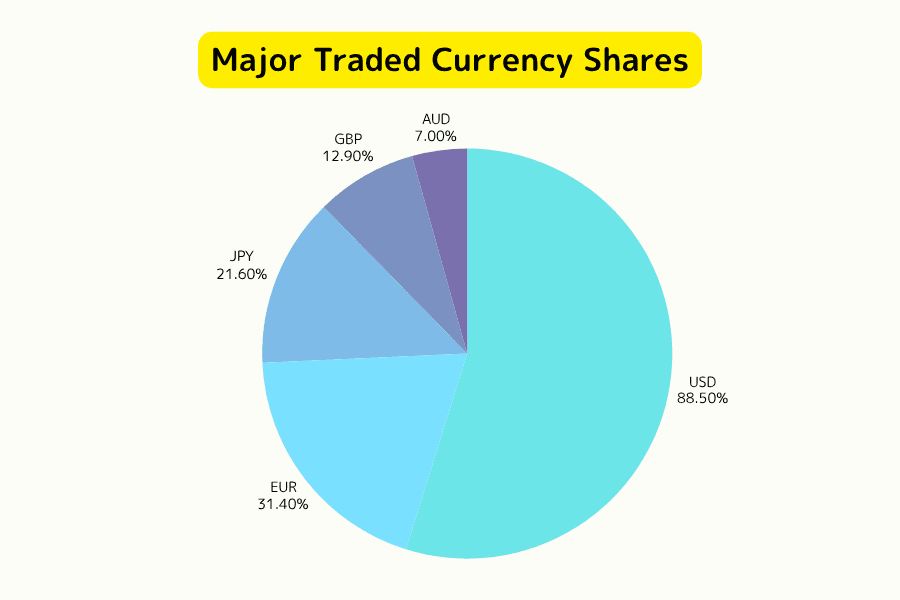
According to the Bank for International Settlements (BIS) 2022 survey, the Australian Dollar accounts for 7.0% of global FX turnover, making it one of the most liquid major currencies.
As the sixth-largest traded currency globally, the AUD holds an important position in international markets.
Its exchange rate is closely linked to the global commodities market, Australia's economic interaction with key trading partners, monetary policy, and global risk sentiment.
This article explores the Australian Dollar's role in the global financial system, the key factors affecting its exchange rate, its characteristics, and future outlook.
- AUD basics: Australia's official legal tender (A$); succeeded the Australian pound in 1966 and floated in 1983
- Global standing: the 5th-most-traded currency (BIS 2022), around 7.0% of global turnover
- Six traits: major / commodity / risk-on currency / carry appeal / floating rate / Asia-Pacific liquidity
- Core drivers: commodity prices / China and other trade partners / RBA policy / global risk sentiment
- Key pairs: AUD/USD (largest), AUD/JPY (a sentiment gauge), AUD/NZD (range-bound)
- Australia’s History and Economic Development
- Key Factors Influencing the AUD Exchange Rate
- Characteristics of the Australian Dollar
- The Australian Dollar’s Role in the Global Financial System
- The Future Outlook for the Australian Dollar
- How to Trade AUD (Australian Dollar)
- Titan FX Forex Margin Trading Process
Australia’s History and Economic Development
Australia, one of the most developed countries in the world, boasts abundant natural resources and a stable economic system. Its economy has long been dependent on resource exports, particularly bulk commodities like iron ore, coal, and liquefied natural gas. These resources have driven Australia's economic growth and established its key role in global trade. Historically, Australia's economic development transitioned from agriculture to industrialization, and then to a modern service-based economy. Each stage of economic transformation has had a profound impact on the exchange rate of the AUD.
Before the 1970s, Australia adhered to a fixed exchange rate system, with the government directly managing the exchange rate. However, as global economic integration deepened, Australia shifted to a floating exchange rate system in 1983. A floating exchange rate means that the currency’s value is determined by market supply and demand, rather than government intervention, allowing the AUD to adjust more flexibly and quickly to global economic changes.
You can check the real-time relative strength of major currencies with the Currency Strength Meter.
Key Factors Influencing the AUD Exchange Rate
The exchange rate of the AUD is influenced by various economic and market factors, including global commodity markets, economic interactions between Australia and key trading partners, Australian central bank monetary policy, and global market risk sentiment.
1. The Relationship Between the Global Commodity Market and the AUD
Australia is a major global exporter of commodities, and its economy heavily relies on the export of mineral and energy products. Commodity prices directly affect Australia's export revenue, which in turn influences the AUD exchange rate. Specifically, when iron ore and coal prices rise, Australia's export income increases, boosting demand for the AUD and pushing its value up. Conversely, when commodity prices decline, the AUD often faces downward pressure.
2. Economic Relations with Key Trading Partners
Australia’s main trading partners include China, Japan, South Korea, and India. The economic performance of these countries directly affects the AUD exchange rate. For example, China is Australia's largest trading partner, and changes in demand for iron ore and energy imports from China directly influence the AUD’s movements. Similarly, economic growth and energy demands in Japan, South Korea, and India also have an impact on the AUD.
3. The Role of the Reserve Bank of Australia’s Monetary Policy
The monetary policy of the Reserve Bank of Australia (RBA) has a significant effect on the AUD exchange rate. When the RBA raises interest rates, the AUD becomes more attractive relative to other currencies, leading to an increase in capital inflows and pushing the AUD up. Conversely, when the RBA lowers interest rates to stimulate the economy, the AUD may experience downward pressure. Additionally, monetary policy changes from other countries, particularly the U.S. Federal Reserve, indirectly affect the AUD.
4. Global Forex Markets and Risk Sentiment
The AUD is often viewed as a “risk currency,” meaning that when global economic prospects are good and risk appetite increases, investors tend to favor high-yield currencies like the AUD. However, in times of global economic uncertainty or heightened market risk aversion, investors often sell the AUD and move into safer assets like the U.S. Dollar or Japanese Yen. Therefore, global economic uncertainty and market sentiment frequently contribute to increased volatility in the AUD.
Characteristics of the Australian Dollar
As an international currency, the AUD possesses several key characteristics:
1. Commodity Currency:
The AUD is highly correlated with commodity prices, particularly mineral and energy commodities. Since Australia is a major exporter of iron ore, coal, and natural gas, the AUD tends to appreciate when commodity prices rise, and conversely depreciates when commodity prices fall.
2. Risk Currency:
The AUD is considered a “risk currency.” This means that when the global economy performs well and risk appetite rises, investors are more likely to hold high-yield currencies like the AUD. However, in times of global economic uncertainty or market risk aversion, investors tend to sell the AUD and move to safer assets like the U.S. Dollar or Japanese Yen.
3. High-Yield Currency:
For a long time, the AUD has attracted international investors due to relatively high interest rates, especially in an environment where global interest rates are lower. Australia’s interest rate policy makes the AUD a popular currency for carry trades, with international capital flowing into Australia to gain higher returns.
4. Floating Exchange Rate System:
Since 1983, the AUD has followed a floating exchange rate system, meaning its value is entirely determined by market supply and demand, and adjusts in response to fluctuations in international financial markets. As such, the AUD’s exchange rate is flexible and exhibits relatively high volatility, allowing it to quickly reflect global market changes.
5. Major Global Trading Currency:
The AUD is the sixth-largest traded currency in the world, accounting for about 6-7% of global forex market transactions. Due to Australia’s economic influence in the Asia-Pacific region, the AUD plays a significant role in international trade and financial transactions in this region.
6. High Volatility:
Due to its close correlation with global commodity prices and market risk sentiment, the AUD often experiences significant fluctuations. This makes it a favored currency for forex traders, particularly in times of high economic volatility, when AUD’s exchange rate movements are more pronounced.
The Australian Dollar’s Role in the Global Financial System
Although the AUD does not rival major currencies like the U.S. Dollar or Euro in global financial markets, it still plays a significant role in the global financial system.
1. Global Trading Currency
The AUD is the sixth-largest traded currency globally, accounting for approximately 6-7% of forex market transactions. Due to Australia’s role as a major exporter of commodities, many international trades and transactions are settled in AUD, especially in the Asia-Pacific region, where the currency enjoys strong importance.
2. Reserve Currency
The AUD has been increasingly included in the foreign exchange reserves of countries and international financial institutions. While it accounts for only about 1.5-2% of global forex reserves, this proportion has been steadily growing. Countries with strong economic ties to Australia tend to hold AUD as part of their forex reserves to reduce reliance on currencies like the U.S. Dollar or Euro.
3. Commodity Currency Representative
Given Australia’s reliance on commodity exports, the AUD is often seen as a “commodity currency,” with its exchange rate closely tied to global commodity prices. Therefore, the AUD’s movements are frequently viewed as an indicator of the global commodity market situation.
4. High-Yield Currency
The AUD has long attracted international investors due to its relatively high interest rates, especially in a low global interest rate environment. Australia’s interest rate policies make the AUD a favored currency for carry trades, with international funds flowing into Australia for higher returns.
5. High Volatility
Due to the AUD’s close relationship with global commodity prices and market risk sentiment, its exchange rate often experiences large fluctuations. This volatility makes the AUD a popular currency for forex traders, particularly in periods of economic turbulence when its fluctuations are more noticeable.
The Future Outlook for the Australian Dollar
Looking ahead, the AUD’s performance will continue to be influenced by a range of factors, including global economic conditions, changes in the commodity markets, the economic performance of key trading partners, Australian monetary policy, and external risks.
1. Commodity Market Prospects
In the future, as the global energy transition and demand for new energy sources increase, Australia may further develop its rich rare earth metals and renewable energy resources, which could help support the long-term value of the AUD.
2. Economic Growth of Trade Partners
The economic performance of China, Japan, South Korea, and India will continue to have a direct impact on the AUD’s performance. If the economies of these countries experience stable or accelerated growth, Australia’s export demand will remain strong, supporting the appreciation of the AUD.
3. Climate Change and Energy Transition
As the global economy shifts toward green energy, Australia’s traditional energy exports may face challenges. However, if Australia can capitalize on opportunities in renewable energy development, the AUD may benefit from the global transition to a greener economy.
4. Development of Digital Currencies and Fintech
The Reserve Bank of Australia is exploring the feasibility of central bank digital currencies (CBDC). The development of digital currencies may further enhance the AUD’s role in the global financial system.
How to Trade AUD (Australian Dollar)
The Australian Dollar (AUD) can be traded through various methods, with forex margin trading being one of the most common. This type of trading offers the advantage of leverage, allowing investors to control larger positions with a smaller amount of capital.
Additionally, forex margin trading allows for both long and short positions, enabling investors to trade in both directions according to market fluctuations.
With the forex market operating 24/7, it is one of the largest global markets, offering high flexibility and liquidity, suitable for various trading strategies and risk profiles.
Titan FX offers up to 1,000x leverage.
Titan FX Forex Margin Trading Process
1. Open a Trading Account:
Titan FX offers a fast and simple account opening process with no requirement for ID or address verification.
Titan FX provides Standard and Blade account types. Traders can choose their preferred type during registration.
Titan FX Account Opening Guide2. Deposit Funds:
After registration, deposit funds into your account. Titan FX supports multiple deposit methods, with credit card deposits being the fastest and most convenient, usually processed instantly.
Titan FX Credit Card Deposit Guide3. Download and Install Trading Platforms (MT4/MT5):
Titan FX offers MT4 and MT5 platforms for Windows, Mac, iOS (iPhone/iPad), and Android.
Titan FX MT5 Installation and Login
Titan FX MT4 Installation and Login
4. Select Currency Pairs
Titan FX offers around 60 currency pairs, with the most common ones being the AUD/USD.
Other AUD-related currency pairs include:
| Currency Pair | Average Spread |
|---|---|
| AUD/CAD | 1.2 |
| AUD/CHF | 0.6 |
| AUD/JPY | 1 |
| AUD/NZD | 1.4 |
| AUD/SGD | 2.7 |
| AUD/USD | 0 |
| NZD/CAD | 1.8 |
| NZD/CHF | 1.2 |
| NZD/JPY | 1.3 |
| NZD/USD | 0.3 |
5. Place Trades:
Log into the MT4 or MT5 platform, select your trading instrument, and start buying or selling.
MT5 Interface and Order Methods
MT4 Interface and Order Methods
Titan FX Provides Free Trading Tools (Custom Indicators and EAs)
Titan FX is dedicated to providing traders with advanced trading support, including free trading tools such as custom indicators and EAs (Expert Advisors). These tools are designed to enhance traders' efficiency and strategy precision.
Custom indicators help traders analyze market trends more accurately and identify potential trading opportunities.
Meanwhile, EAs can automatically execute pre-set trading strategies, avoiding emotional interference and ensuring that each trade is executed accurately.
With these free tools, Titan FX helps you gain an edge in the competitive financial market and improve your trading performance.
All Custom Indicators EA Trading Program RankingsFurther Reading
- What is USD (US Dollar)?
- What is JPY (Japanese Yen)?
- What is GDP (Gross Domestic Product)?
- What is CPI (Consumer Price Index)?
- What is Volatility?
- Forex Trading Basics
Titan FX Trading Strategy Lab. We produce investor-education content covering forex, commodities (crude oil, precious metals, agricultural goods), stock indices, U.S. equities, and digital assets.
Primary Sources (by Category)
- Official records: BIS (Bank for International Settlements) — 2022 Triennial Central Bank Survey, global forex turnover data; Reserve Bank of Australia (RBA) — official rates and policy statements
- Historical records: Reserve Bank of Australia — AUD introduction (1966) and float adoption (1983)
- Economic indicators: Australian Bureau of Statistics (ABS) — GDP / CPI / unemployment / trade balance; FRED (Federal Reserve Bank of St. Louis) — AUD/USD historical exchange rates
- Academic analysis: Cairns, Ho & McCauley (2007) "Exchange Rates and Global Volatility: Implications for Asia-Pacific Currencies", BIS Quarterly Review