

Currency Pairs: Trading, Strategy, and Selection Tips

Open any forex trading platform and the first thing you see is a wall of currency pair quotes — EUR/USD, USD/JPY, and so on. These pairs are the trading units of the forex market and the starting point of every profit and loss. According to BIS, the global forex market turned over $7.5 trillion a day in its 2022 survey, running 24 hours a day with extremely high liquidity.
Using charts and key points, this article walks you through what a currency pair is, the main categories (USD majors and cross pairs), the basic principles of trading, the major market sessions, currency pair correlation, and how beginners should pick and trade pairs — so you can take your first step into live forex with confidence.
- A currency pair has a base and a quote currency; the rate = quote units per one base unit
- Pairs split into USD majors vs cross pairs, and major vs minor by liquidity
- Costs and risk hinge on spread, lot size, leverage, and volatility
- Pairs move in positive or negative correlation — key for hedging and risk control
- Titan FX offers ~60 pairs via CFDs, with flexible leverage and low spreads
- 1. What Is a Currency Pair? Definition and Basics
- 2. Classification of Currency Pairs: USD Majors and Cross Pairs
- 3. Basic Principles of Currency Pair Trading
- 4. How Beginners Should Choose Currency Pairs
- 5. Correlation Between Currency Pairs
- 6. Common Currency Pair Trading Strategies
- 7. How to Start Forex Trading: A Titan FX Practical Guide
- 8. Frequently Asked Questions (FAQ)
- 9. Summary
1. What Is a Currency Pair? Definition and Basics
A currency pair is the basic unit in forex trading, made up of two currencies:
- Base currency: the first currency in the pair.
- Quote currency: the second currency in the pair, used to express the exchange value of the base currency.
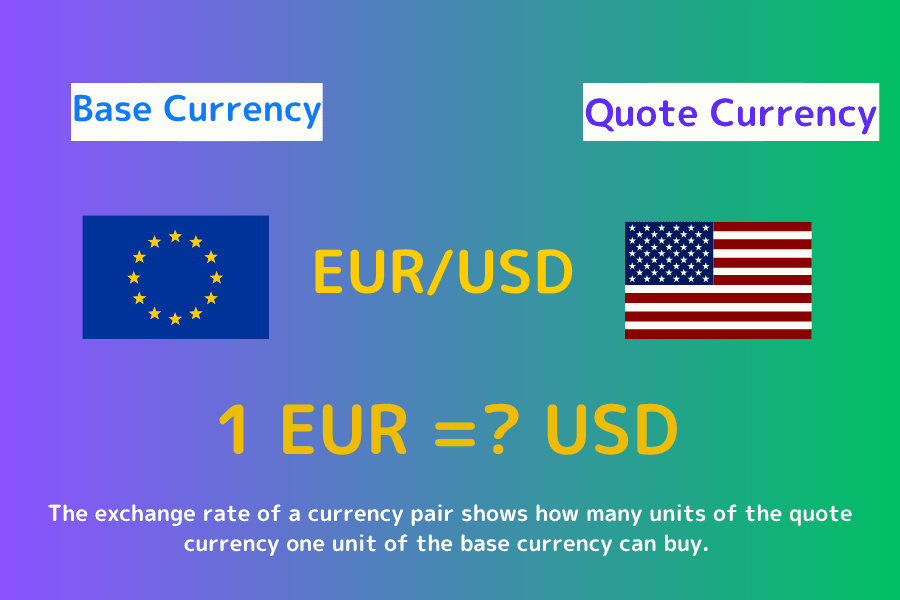
The exchange rate of a currency pair shows how many units of the quote currency one unit of the base currency can buy. For example, EUR/USD shows how many US dollars one euro can be exchanged for.
Example of Exchange Rate Movements (Using EUR/USD)
- When the rate is 1.1000, 1 euro can be exchanged for 1.10 US dollars.
- If the euro strengthens, the rate may rise to 1.1200, meaning the dollar weakens relatively, so buying EUR/USD can be profitable.
- If the euro weakens, the rate may fall to 1.0800, meaning the dollar strengthens relatively, so selling EUR/USD can be profitable.
These price movements of a currency pair are exactly how forex traders earn profits through buying and selling.
Market Participants

The forex market is the world's largest financial market, with daily turnover reaching 7.5 trillion US dollars (2022 BIS data). Liquidity is high, and participants include:
- Central banks: such as the Federal Reserve and the Bank of Japan, which influence exchange rates through monetary policy.
- Commercial banks: which provide currency exchange and trading services.
- Investment institutions: such as hedge funds, which profit from fluctuations.
- Retail traders: individuals who participate through brokers.
Further reading: A Complete Guide to the Basics of Forex Trading
2. Classification of Currency Pairs: USD Majors and Cross Pairs
Currency pairs are divided into two main categories based on whether they include the US dollar:
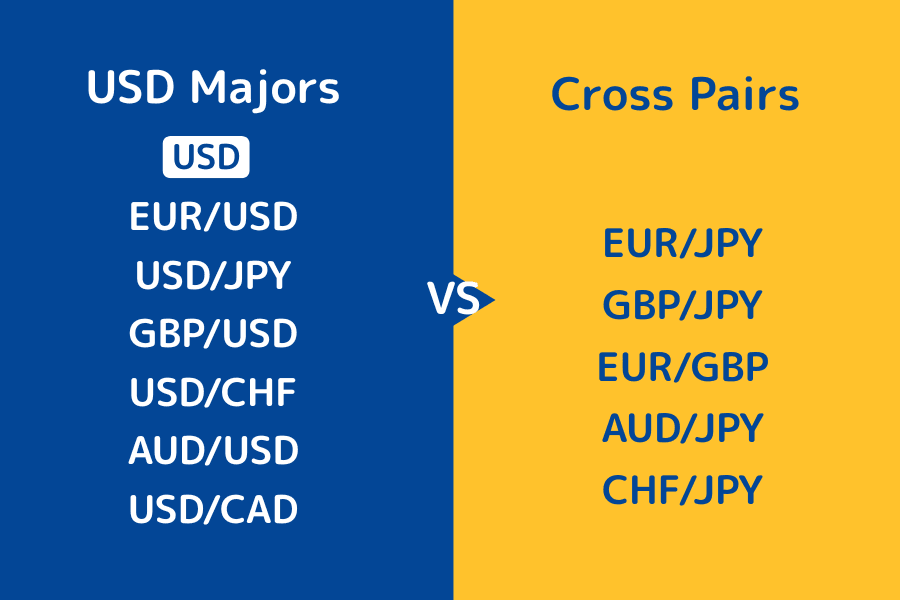
USD Majors
USD majors are currency pairs that include the US dollar (USD), with the dollar as either the base or the quote currency. These are the most actively traded pairs in the forex market, because the dollar is the world's most important reserve and trading currency.
Cross Pairs
Cross pairs are currency pairs that do not include the US dollar; neither of the two currencies in the pair involves the dollar. The exchange rate of a cross pair is usually derived from the corresponding USD major rates.
Common USD Majors and Cross Pairs
Main Differences
| Item | USD Majors | Cross Pairs |
|---|---|---|
| Currencies involved | Always includes the US dollar | Never includes the US dollar |
| Liquidity | Usually higher liquidity | Relatively lower, with exceptions such as EUR/JPY |
| Volatility | Generally lower | Usually higher, not directly influenced by the US dollar |
| Transaction costs | Usually lower (smaller spreads) | Transaction costs can be higher |
Additional Note: Major Pairs vs Minor Pairs
| Classification method | Description | Relationship |
|---|---|---|
| USD majors / cross pairs | Classified by whether the pair contains the US dollar (USD) | A technical classification based purely on the presence of the dollar |
| Major pairs / minor pairs | Classified by trading volume and liquidity | A liquidity-based classification that usually, but not always, overlaps with USD majors |
Besides USD majors and cross pairs, the market is also commonly classified by trading volume and liquidity:
Major Pairs
- The highest trading volume and best liquidity; all major pairs include the US dollar.
- Low trading costs and small spreads, suitable for traders of all levels.
Minor Pairs
- Some do not include the US dollar and fall within the cross-pair category.
- Liquidity is lower and volatility larger, suitable for more advanced strategies.
Major Pairs vs Minor Pairs Comparison
| Major Pairs | Minor Pairs |
|---|---|
| EUR/USD (Euro/US Dollar) | EUR/GBP (Euro/British Pound) |
| USD/JPY (US Dollar/Japanese Yen) | EUR/JPY (Euro/Japanese Yen) |
| GBP/USD (British Pound/US Dollar) | GBP/JPY (British Pound/Japanese Yen) |
| AUD/USD (Australian Dollar/US Dollar) | AUD/JPY (Australian Dollar/Japanese Yen) |
| USD/CHF (US Dollar/Swiss Franc) | CHF/JPY (Swiss Franc/Japanese Yen) |
| USD/CAD (US Dollar/Canadian Dollar) | |
| NZD/USD (New Zealand Dollar/US Dollar) |
Notes:
- Major pairs are almost all USD majors.
- Most cross pairs are minor pairs, but some highly liquid cross pairs (such as EUR/JPY and GBP/JPY) are often referred to as "mainstream cross pairs."
3. Basic Principles of Currency Pair Trading
3.1 Spread
The spread is the difference between the buy price and the sell price of a currency pair. For example, if the ask for USD/JPY is 150.10 and the bid is 150.08, the spread is 0.02 yen (2 pips).
What Is a Spread? Definition, Influencing Factors, and How to Calculate It3.2 Lot Size
A lot is the standard unit of forex trading; typically 1 lot equals 100,000 units of the base currency. Trading 1 lot of USD/JPY means trading 100,000 US dollars.
What Is a Lot?3.3 Leverage and Margin
Leverage is a tool that lets traders control a much larger position with a small amount of margin. For example, 100:1 leverage means that just 1,000 US dollars in margin can control a 100,000 US dollar position.
Margin is the minimum amount of funds required in leveraged trading, ensuring that traders can withstand the risk from exchange rate fluctuations.
What Is Leverage and How to Use It3.4 Long and Short Positions
Long: when a trader expects USD/JPY to rise, they buy USD/JPY first, which means going long on the US dollar.
Short: when a trader expects USD/JPY to fall, they sell USD/JPY first, which means going short on the US dollar.
3.5 Types of Currency Pair Trading Instruments
In practice, currency pairs can be traded through several different instruments. Common trading products include:
| Instrument | Description | Suitable For |
|---|---|---|
| Spot FX | Traditional interbank physical currency exchange, usually settled T+2 | Large financial institutions, corporate hedging |
| CFD | Profit from price differences with no physical delivery; flexible leverage and easy entry/exit | Retail traders, online traders |
| Currency Futures | Standardized contracts listed on an exchange with fixed delivery months | Some institutions, professional investors |
| Currency Options | The right, but not the obligation, to buy or sell | Risk management, arbitrage strategies |
| Forward FX | Two parties agree to settle on a future date at an agreed rate | Large-corporate hedging, multinational companies |
Currently, the forex trading Titan FX offers is in the form of CFDs, which lets you use leverage flexibly, participate in the movements of major global currency pairs at low cost, and trade without delivery obligations — suitable for short-, medium-, and long-term trading.
4. How Beginners Should Choose Currency Pairs
As a forex beginner, choosing the right currency pairs is very important for learning and mastering trading skills. Below are some tips to help beginners select suitable currency pairs.
Tip 1: Choose Currency Pairs with High Liquidity
Highly liquid currency pairs have large trading volumes, lower market volatility, and more stable price movements, making them suitable for beginners.
Common highly liquid currency pairs include EUR/USD (Euro/US Dollar), USD/JPY (US Dollar/Japanese Yen), GBP/USD (British Pound/US Dollar), and USD/CHF (US Dollar/Swiss Franc).
Tip 2: Trade Major Currency Pairs
Because they involve the US dollar, major currency pairs usually have large trading volumes, moderate volatility, and low trading costs, making them ideal for beginners.
Major currency pairs include EUR/USD, USD/JPY, GBP/USD, USD/CHF, AUD/USD, and USD/CAD.
Tip 3: Avoid Cross Pairs and Exotic Pairs
Cross pairs (such as EUR/JPY and GBP/JPY) and exotic pairs (such as USD/ZAR and USD/TRY) tend to have higher volatility, lower liquidity, and more drastic price movements. They carry higher risk for beginners and are not ideal for those just starting out.
Tip 4: Focus on Currencies You Are Familiar With
If you already have a deeper understanding of the economy and politics of certain countries, choosing related currency pairs will be easier to get to grips with. For example, if you are familiar with the European economy, you can choose EUR/USD or EUR/GBP.
Tip 5: Learn Fundamental and Technical Analysis
Before choosing a currency pair, learning how to perform fundamental analysis (e.g. economic indicators and political events) and technical analysis (e.g. chart patterns and technical indicators) will help you better understand and predict price movements of currency pairs.
Tip 6: Practice with a Demo Account
Before committing real funds, use a demo account to practice and get familiar with the trading platform and the volatility characteristics of currency pairs. This builds experience and reduces the risk in live trading.
Tip 7: Manage Risk
Whichever currency pair you choose, always pay attention to risk management. Set a stop-loss, avoid overtrading, and manage your funds carefully to prevent major losses.
5. Correlation Between Currency Pairs
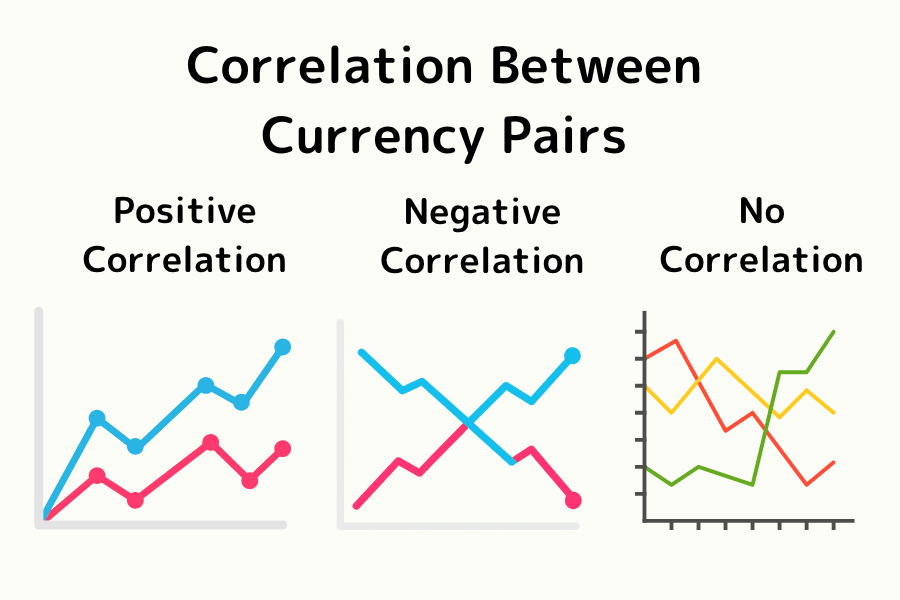
Currency pair correlation refers to the interrelationship between the price movements of different currency pairs. Understanding correlation helps traders manage risk, hedge positions, and develop strategies. Below are some common correlations between currency pairs and the factors that influence them:
Positive Correlation
When two currency pairs usually move in the same direction, they are positively correlated. Positively correlated pairs tend to show similar volatility trends.
Example 1: EUR/USD and GBP/USD The euro and the pound are both major European currencies with a similar relationship to the dollar, and the UK and Eurozone economies are usually somewhat linked. As a result, these two pairs typically have a very high positive correlation.
Example 2: AUD/USD and NZD/USD The Australian dollar and the New Zealand dollar are both highly correlated with commodity prices, especially movements in mineral and agricultural prices, so they also tend to be positively correlated.
Negative Correlation
When two currency pairs move in opposite directions, they are negatively correlated. The price movements of negatively correlated pairs are opposite to each other.
Example 1: EUR/USD and USD/CHF These two pairs typically have a negative correlation, because when the euro rises against the dollar, the dollar tends to fall against the Swiss franc.
Example 2: GBP/USD and USD/JPY When the British pound rises against the dollar, it usually means the dollar falls against the Japanese yen, so they often show a negative correlation.
No Correlation
When there is no clear interrelationship between the price movements of two currency pairs, they are said to have no correlation. The price movements of uncorrelated pairs are independent of each other.
Factors Affecting Currency Pair Correlation
Factor 1: Economic Ties
The stronger the economic ties between two countries, the stronger the positive correlation between their related currency pairs may be.
Factor 2: Commodity Prices
Some currency pairs, such as the Australian dollar and the New Zealand dollar, are influenced by commodity prices (such as metals and agricultural products), so these pairs tend to be positively correlated.
Factor 3: Market Sentiment
Changes in market risk appetite or risk-aversion sentiment can affect multiple currency pairs at the same time. For example, when risk aversion increases, safe-haven currencies (such as the yen and the Swiss franc) usually rise.
Factor 4: Political Events
Major political events (such as elections and policy changes) can affect multiple currency pairs simultaneously, thereby altering their correlations.
Understanding the correlations between currency pairs helps traders better predict market trends, develop more effective strategies, and manage investment risk more effectively.
Additional Note: Effective Exchange Rate (EER)
Beyond analyzing the direct correlation between two currency pairs, traders can also use the Effective Exchange Rate (EER) to observe the weighted-average exchange rate of one currency against multiple major foreign currencies, gaining a fuller picture of that currency's overall strength and international competitiveness.
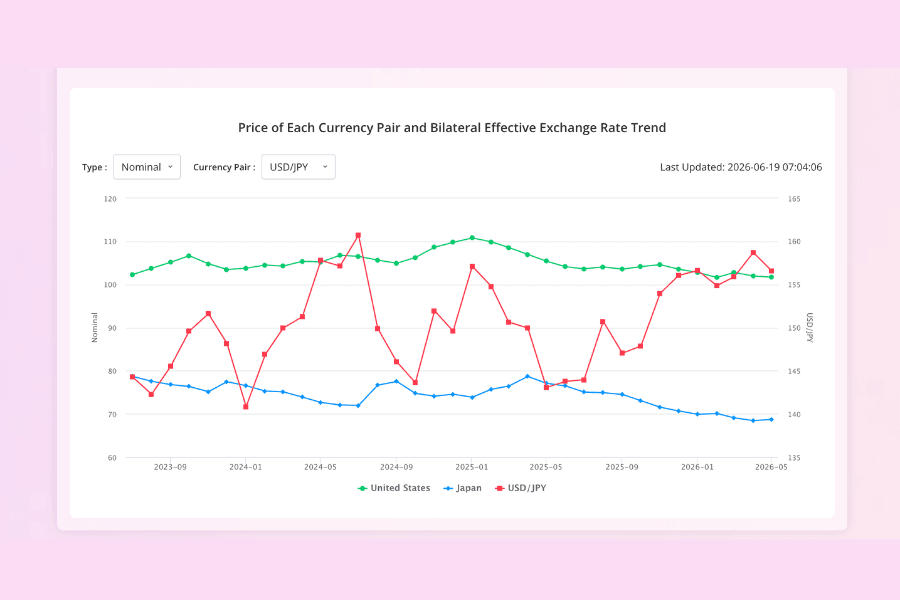
The chart below shows the effective exchange rate (REER) indices for the United States and Japan, alongside the actual USD/JPY exchange rate.
As the chart shows, when the US REER is relatively high while Japan's REER weakens, USD/JPY tends to move in step, reflecting a stronger dollar and a weaker yen.
This shows that changes in a single country's effective exchange rate are highly linked to the market price of a bilateral currency pair over the medium to long term, making the EER a useful supporting indicator for observing macroeconomic conditions and exchange-rate parity.
Key Points to Watch:
- Green line: the US effective exchange rate index, showing the overall strength of the dollar against most foreign currencies;
- Blue line: the Japanese effective exchange rate index, showing the overall strength of the yen against most foreign currencies;
- Red line: the USD/JPY spot rate, which moves in line with changes in the gap between the two countries' REERs.
To understand the principles and applications of the EER in more detail, see 👉 Effective Exchange Rate (EER) Analysis
6. Common Currency Pair Trading Strategies
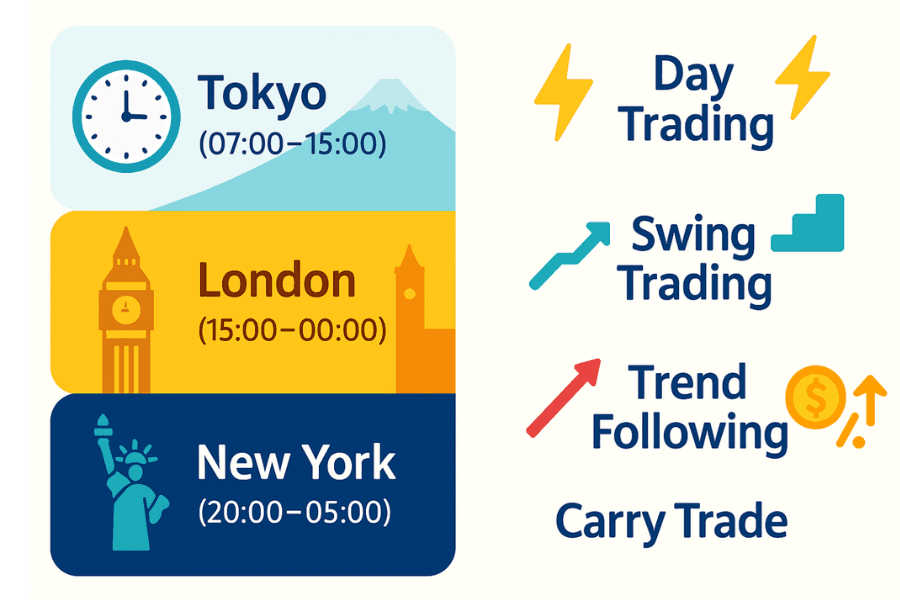
The forex market runs 24 hours a day, covering three major sessions: Asia, Europe, and the Americas. Liquidity and volatility differ across sessions, so trading strategies need to be adjusted flexibly:
| Session | Active Hours (GMT+8) | Characteristics and Representative Pairs |
|---|---|---|
| Asia (Tokyo) | 07:00–15:00 | Stable liquidity; suitable for trading USD/JPY and AUD/USD |
| Europe (London) | 15:00–00:00 | Increased volatility; EUR/USD and GBP/USD are active |
| Americas (New York) | 20:00–05:00 next day | Sharp price movements; suitable for high-liquidity strategies |
Further reading: A Complete Guide to Forex Trading Hours
The overlap of these sessions also creates opportunities for strategies such as day trading, swing trading, and carry trading. Below are strategy types suitable for beginners:
Strategy 1: Day Trading
Day traders capitalize on short-term price fluctuations by entering and exiting quickly — for example, trading the small movements of USD/JPY during the Asian session.
Strategy 2: Swing Trading
Swing traders hold positions for several days to several weeks, profiting from a currency pair's medium-term trend. For example, when the market expects the Federal Reserve to raise rates, traders may go long on USD/JPY; if the European economic outlook improves, they may go long on EUR/USD.
Strategy 3: Trend Following
Trend following is a form of trend trading that trades in the direction of the market's medium- to long-term trend. When a currency pair shows a clear bullish or bearish trend, traders enter with the trend and follow its extension. For example, going long on USD/JPY on pullbacks during a long-term uptrend.
Strategy 4: Carry Trade
A carry trade is a strategy that exploits the interest-rate differential between two countries. Because Japan's interest rates have been ultra-low for a long time, investors often borrow yen and buy higher-yielding currencies, such as the US dollar, to capture the interest-rate spread.
7. How to Start Forex Trading: A Titan FX Practical Guide
Step 1: Choose a Trading Platform
Titan FX offers 3 account types and around 60 forex currency pairs, with support for trading on the MT4 and MT5 platforms — flexible and efficient, meeting the needs of traders at every level.
Advantages of Trading Forex with Titan FX
| Advantage | Description |
|---|---|
| High leverage | Up to 1,000x on Standard and Blade accounts, and up to 2,000x on the Micro account (eligibility required), giving you flexible leverage to expand your trading. |
| Low spreads | Competitive spreads, with EUR/USD from as low as 0.2 pips, lowering your trading costs. |
| Fast execution | Industry-leading execution speed, effectively reducing slippage risk. |
| Advanced platforms | Support for MT4 and MT5, with full technical-analysis features. |
| Free tools | Technical indicators and EA automated-trading tools to boost trading efficiency. |
| Multilingual support | Customer service in Chinese, English, and Japanese to resolve trading issues quickly. |
| Educational resources | Forex tutorials, foundational knowledge, daily market analysis, and trading strategies. |
| Flexible deposits and withdrawals | Multiple deposit methods, with a minimum deposit of just 1 US dollar. |
| Negative-balance protection | No need to add margin, reducing the risk of liquidation. |
Titan FX Account Types and Features
| Account Type | Features |
|---|---|
| Standard Account | No commission, up to 1,000x leverage, spreads below standard |
| Blade Account | Commission applies, up to 1,000x leverage, spreads lower than the Standard account |
| Micro Account | Contract size of 1,000 units, minimum trade of 100 units, up to 2,000x leverage (conditions apply) |
| Currency Pair | Standard Average | Blade Average |
|---|---|---|
| EURUSD | 1.2 pips | 0.2 pips |
| GBPUSD | 1.57 pips | 0.57 pips |
| AUDUSD | 1.52 pips | 0.52 pips |
| USDJPY | 1.33 pips | 0.33 pips |
| USDCHF | 1.92 pips | 0.92 pips |
Step 2: Open an Account
Opening an account with Titan FX is simple and fast — you can open one online without submitting any identity or address verification.
Titan FX offers Standard, Blade, and Micro accounts. Traders can choose the account type they want during registration.
How to Open an Account with Titan FXStep 3: Deposit Funds
Once registration is complete, you can deposit funds into your account. Titan FX provides multiple deposit methods; the fastest and most convenient is credit-card deposit, which is usually credited instantly.
How to Deposit by Credit Card with Titan FXStep 4: Download the Trading Platform
Download and install the trading platform (MT4/MT5): Titan FX offers both MT4 and MT5 trading platforms (software). Traders can download and install them on Windows, Mac, iOS (iPhone/iPad), and Android.
How to Download, Install, and Log in to Titan FX MT5 How to Download, Install, and Log in to Titan FX MT4Step 5: Place an Order
After successfully logging into the MT4 or MT5 platform, select a trading instrument to buy or sell.
Titan FX MT5 Interface and How to Place Orders Titan FX MT4 Interface and How to Place OrdersTitan FX Offers Free Trading Tools (Custom Indicators and EAs)
Titan FX is committed to providing the most advanced trading support, including free trading tools such as custom indicators and EAs (automated trading programs). These tools are designed to enhance traders' efficiency and the precision of their strategies.
Custom indicators help traders analyze market trends more accurately and spot potential trading opportunities.
EAs can automatically execute predetermined trading strategies, avoiding the interference of human emotion and ensuring that every trade is executed precisely.
With these free tools, Titan FX helps you gain an edge in the highly competitive financial market and improve your trading performance.
All Custom Indicators EA Trading Program RankingsTrade Forex CFDs with Titan FX
Titan FX offers 50+ currency pair CFDs on MT4/MT5 with up to 1,000:1 leverage on major pairs, tight spreads, and the flexibility to go long or short. Micro accounts can reach up to 2,000:1 leverage when eligible.
8. Frequently Asked Questions (FAQ)
Q1: How are profits and losses calculated in currency pair trading?
Forex P&L is usually measured in pips, and the amount depends on your lot size, the number of pips the price moves, and the value per pip. Your trading platform's built-in P&L calculator gives you the exact figure quickly.
Q2: What are the risks of using leverage?
Leverage magnifies profits but also magnifies losses. Without a stop-loss, even a small adverse move can erode your capital quickly and trigger a margin call (liquidation).
Q3: Does currency pair trading incur overnight interest?
When you hold a position past the daily rollover, you pay or receive a swap (overnight interest). It varies by pair according to the two countries' interest-rate differential — the basis of carry-trade strategies.
Q4: Is forex suitable for long-term investing?
Forex is mainly short-to-medium-term, but large trends (policy cycles, long-run rate differentials) can be positioned for over the medium-to-long term. Even then, careful leverage management and tolerance for volatility are essential.
Q5: Is forex affected by major economic data?
Yes. The forex market closely watches GDP, CPI, employment data, and rate decisions. Releases often bring sharp volatility, so keep an eye on the economic calendar.
9. Summary
A currency pair is the core unit of forex trading, with each pair made up of a base currency and a quote currency. Through changes in the exchange rate, traders buy and sell between different currencies to earn returns.
This article has systematically introduced the definition of a currency pair, the classification into USD majors and cross pairs, the difference between major and minor pairs, the basic principles of trading (spread, lot size, leverage, and long/short direction), the correlation between currency pairs, and the trading strategies and pair-selection methods suitable for beginners.
In real trading, choosing major pairs with high liquidity, low spreads, and stable volatility (such as EUR/USD and USD/JPY) is best for beginners. Learning fundamental and technical analysis, combined with demo-account practice and strict risk control, can effectively reduce risk and improve your win rate.
The Titan FX platform offers around 60 currency pairs, flexible leverage, low spreads, fast execution, a wide range of technical tools, and comprehensive educational resources, making it an ideal choice for both beginners and professional traders. Open an account now and begin your hands-on forex trading journey!
Further Reading
- Forex Trading Basics
- Forex Trading Hours Explained
- What Is Spread?
- What Is Leverage and How to Use It
- Effective Exchange Rate (EER) Analysis
Titan FX Research Team. We cover a broad set of financial instruments — foreign exchange, commodities (crude oil, precious metals, agricultural products), equity indices, US equities, and digital assets — producing practical, research-backed educational content for investors.
Primary Sources (by Category)
- Forex market statistics: BIS Triennial Central Bank Survey 2022
- Economic data: Titan FX Economic Calendar