

GBP (Great Britain Pound)
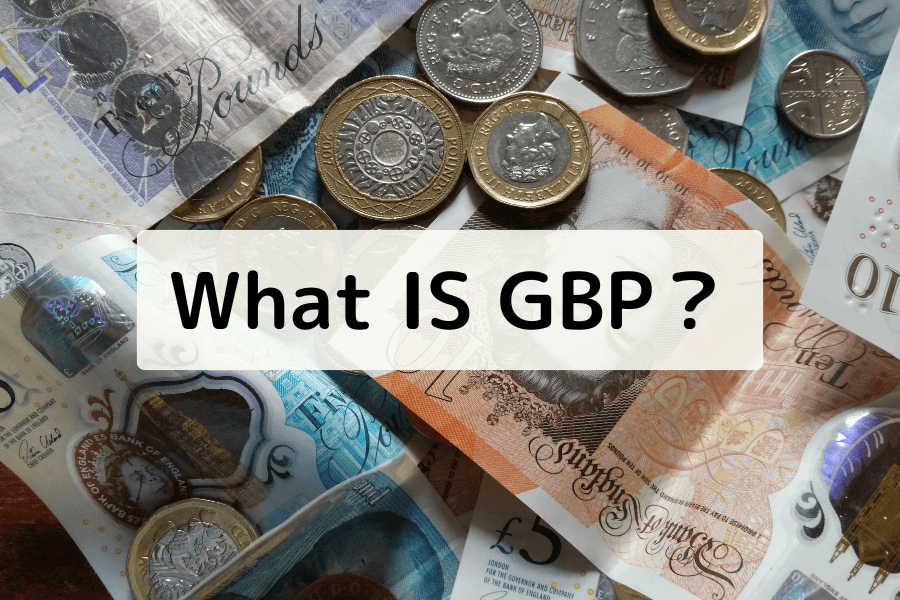
The British Pound (GBP) is not only the legal tender of the United Kingdom but also one of the world's oldest continuously circulating currencies, with over 1,200 years of financial history. From its dominance during the British Empire to its modern role at the heart of the City of London, the Pound has consistently held a key position on the international financial stage.
This article walks through the Pound's evolution, its standing as a global currency, the drivers behind its exchange rate, and how to actually trade it — equipping forex newcomers and experienced traders alike with a working understanding of GBP.
- GBP is one of the world's oldest active currencies (origin in 760 AD), issued by the Bank of England (BoE).
- The 4th most-traded currency in global FX (BIS 2022, ~13%) and the 4th-largest reserve currency (IMF COFER, ~5%).
- Main drivers: BoE monetary policy, UK inflation / GDP / unemployment, fiscal posture, post-Brexit trade dynamics.
- GBP/USD ("Cable") is one of the world's oldest currency pairs — high volatility, well-suited to event trading.
- Moderately correlated with USD, tightly linked with EUR (EUR/GBP) — watch London-session liquidity.
- 1. Origins and Historical Evolution of the British Pound (GBP)
- 2. Five Key Characteristics of the British Pound (GBP)
- 3. Major Drivers of the Pound's Exchange Rate
- 4. Key Economic Indicators for the Pound
- 5. The Pound's Position in the Global Financial System
- 6. How to Trade the British Pound (GBP)
- 7. Frequently Asked Questions
- 8. Summary
1. Origins and Historical Evolution of the British Pound (GBP)
The British Pound (GBP, Great British Pound, currency symbol: £) is the official currency of the United Kingdom and one of the world's oldest legal tenders still in active circulation. Its origins trace back to Anglo-Saxon England in the 8th century, giving it more than 1,200 years of monetary history.
During the 19th-century British Empire, the Pound dominated global trade settlement and international finance, holding an international status comparable to the modern US Dollar. Even after two world wars and the Empire's decline, the Pound retained significant influence thanks to London's enduring role as a global financial hub.
In 1971, when the United Kingdom departed from the gold standard, the Pound formally moved to a floating exchange rate, with its value set by the supply and demand of the foreign exchange market.
To this day, the Pound is widely used in international trade, FX trading, and global investment, and remains one of the major participating currencies in the foreign exchange market.
You can check the real-time relative strength of major currencies with the Currency Strength Meter.
2. Five Key Characteristics of the British Pound (GBP)
As one of the world's major currencies, the Pound exhibits multiple characteristics in financial markets that together establish its value in trading, reserves, and risk management.
Characteristic 1: Third-Largest Global Reserve Currency (2025 Q1 data)
According to the International Monetary Fund (IMF), in Q1 2025 the Pound accounted for approximately 5.19% of the world's official foreign exchange reserves, trailing the US Dollar, the Euro, and the Japanese Yen.
| Currency | Reserves (USD billions) | Share |
|---|---|---|
| US Dollar (USD) | 6,720.31 | 57.74% |
| Euro (EUR) | 2,334.62 | 20.06% |
| British Pound (GBP) | 603.70 | 5.19% |
| Japanese Yen (JPY) | 599.10 | 5.15% |
| Other currencies | 573.42 | 4.93% |
| Canadian Dollar (CAD) | 306.13 | 2.63% |
| Chinese Yuan (CNY) | 246.31 | 2.12% |
| Australian Dollar (AUD) | 167.74 | 1.44% |
| Swiss Franc (CHF) | 88.39 | 0.76% |
| Total allocated reserves | 12,537.00 | - |
| Unallocated reserves | 897.28 | - |
| Denominator used for share calculation | 11,639.72 | - |
Although its share is smaller than that of the Dollar or the Euro, its long-term stability and transparency make it an important option for central banks pursuing diversification and risk dispersion.
Characteristic 2: Floating Exchange Rate System
Since the UK left the gold standard in 1971, the Pound has operated under a floating exchange rate. Its price is set entirely by market supply and demand, allowing it to react quickly to economic data, policy shifts, and market sentiment.
This mechanism delivers higher flexibility and market efficiency, making the Pound an important instrument for both short-term and medium-to-long-term trading.
Characteristic 3: London as a Global Financial Hub
London is one of the world's three largest financial centers and home to one of the largest foreign exchange trading markets globally.
Trillions of dollars in transactions flow through London every day, keeping the Pound highly liquid and deeply traded across international forex trading — particularly attractive to institutional investors.
Characteristic 4: Secondary Safe-Haven Currency Properties
While the Pound does not carry the strong safe-haven status of the US Dollar or the Japanese Yen, it still attracts capital inflows during market turbulence or rising geopolitical risk.
For example, during the 2023 regional conflicts and equity-market shocks, the Pound's short-term strength reflected its role as a secondary safe-haven currency.
Characteristic 5: High Sensitivity to Politics and Data, Strong Volatility
Pound exchange rates are particularly sensitive to UK domestic politics (Brexit, referendums), economic data (GDP, CPI), and central-bank policy.
This makes the Pound more volatile than other major currencies and a favored target for technical analysis and short-term traders, especially in the GBP/USD (Pound vs. Dollar) currency pair.
3. Major Drivers of the Pound's Exchange Rate
The GBP exchange rate is shaped by multiple economic and policy factors. The four core drivers traders should monitor closely are:
- Driver 1: UK Economic Fundamentals
- Driver 2: Bank of England (BoE) Monetary Policy
- Driver 3: Global Risk Sentiment and Safe-Haven Demand
- Driver 4: UK Trade and Post-Brexit Effects
Driver 1: UK Economic Fundamentals
The Pound responds quickly to macroeconomic indicators, especially the following three:
- GDP growth rate: Economic growth typically lifts demand for the Pound.
- Consumer Price Index (CPI): High inflation can erode purchasing power and weigh on the Pound.
- Unemployment rate: A low unemployment rate signals a healthy labor market and supports the Pound.
These releases come monthly — track them on the Economic Calendar.
Driver 2: Bank of England (BoE) Monetary Policy
The official Bank of England monetary policy page publishes the latest rate decisions and meeting minutes — a primary source for tracking GBP direction.
The BoE's interest-rate decisions and policy stance directly drive Pound movement:
- Rate hikes: Attract capital flows into the UK market, supporting Pound appreciation.
- Easing policies: Including rate cuts or asset-purchase programs, typically weigh on the Pound.
The Pound reacts quickly to BoE forward guidance and policy statements — keep an eye on the BoE monetary policy meeting calendar.
Driver 3: Global Risk Sentiment and Safe-Haven Demand
The Pound carries secondary safe-haven properties during global financial turmoil:
- Risk-off responses: During the 2023 Middle East tensions and equity-market shocks, the Pound was relatively resilient.
- Compared with the Dollar: The Pound's safe-haven status falls short of the Dollar or the Yen, but its stability still attracts certain capital inflows.
When global markets shift into risk-off mode, the Pound often experiences cross-currency volatility — proceed with caution.
Driver 4: UK Trade and Post-Brexit Effects
The UK's external trade relationships and geopolitics remain key to the Pound's medium-to-long-term trajectory:
- Widening trade deficit: Structural deficit pressure can weaken the Pound's fundamentals.
- Post-Brexit agreements: Progress on UK trade agreements with the EU, the US, and Asia-Pacific shapes capital confidence and Pound performance.
4. Key Economic Indicators for the Pound
The GBP exchange rate is influenced by several macroeconomic indicators. The table below summarizes the indicators most representative of Pound volatility and how they impact the rate:
| Economic Indicator | Description |
|---|---|
| GDP growth rate | Reflects overall economic momentum; accelerating growth typically supports demand for the Pound and lifts the exchange rate. |
| Consumer Price Index (CPI) | Measures inflation; high inflation can erode the Pound's purchasing power and trigger rate-hike expectations. |
| Unemployment rate | Reflects labor-market health; a low unemployment rate generally boosts market confidence and supports the Pound. |
| BoE policy rate | The Bank of England's policy rate; hikes attract inflows and benefit the Pound, while cuts can drive depreciation. |
| Trade balance | The export-import differential signals the balance of payments; persistent trade deficits can pressure the Pound. |
| Retail sales | Measures domestic demand and consumer confidence; strong data typically lifts the Pound, while weak data can suppress the rate. |
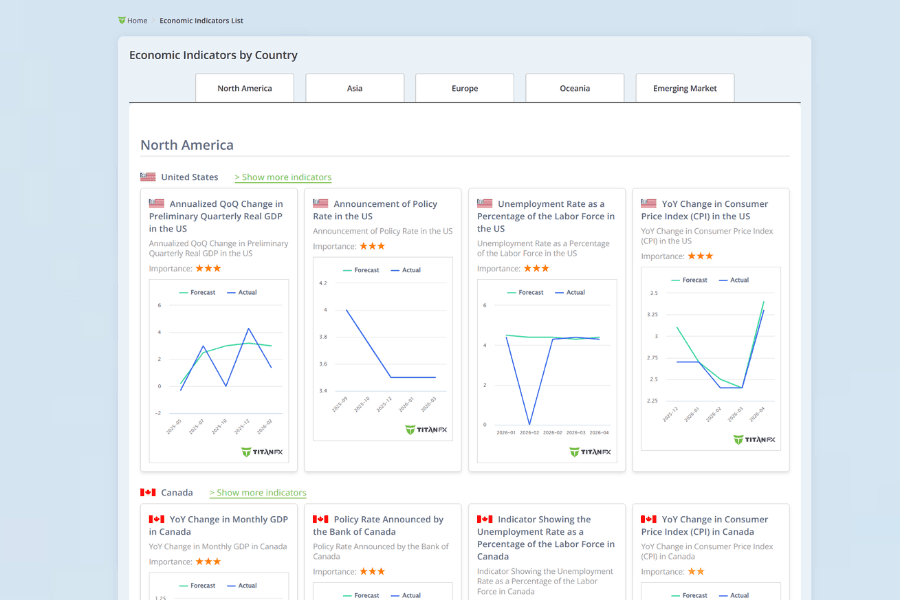
Free Economic Indicator Lookup on Titan FX
Titan FX provides economic data indicators for major countries including the United States, Europe, Japan, and China. You can search by release time, country, and importance.
5. The Pound's Position in the Global Financial System
As one of the oldest continuously circulating currencies, the British Pound (GBP) still plays a key role in the international financial system. Although it is smaller in scale than the US Dollar or the Euro, the Pound holds a meaningful place in global financial markets thanks to its liquidity, market depth, and London's financial standing.
- Position 1: A Core Currency in Forex Trading
- Position 2: A Global Official Reserve Currency
- Position 3: An International Trade and Investment Tool
- Position 4: A Benchmark Currency in Financial Markets
Position 1: A Core Currency in Forex Trading
According to the Bank for International Settlements (BIS) 2022 Triennial Survey, the Pound participated in 12.9% of global FX trading, ranking fourth. Daily forex turnover reached $7.5 trillion, underscoring the Pound's exceptional market liquidity.
Among Pound pairs, GBP/USD (GBP/USD) is one of the most commonly traded pairs globally — also nicknamed "Cable."
Major Global Forex Trading Currencies (BIS Triennial Survey 2022)
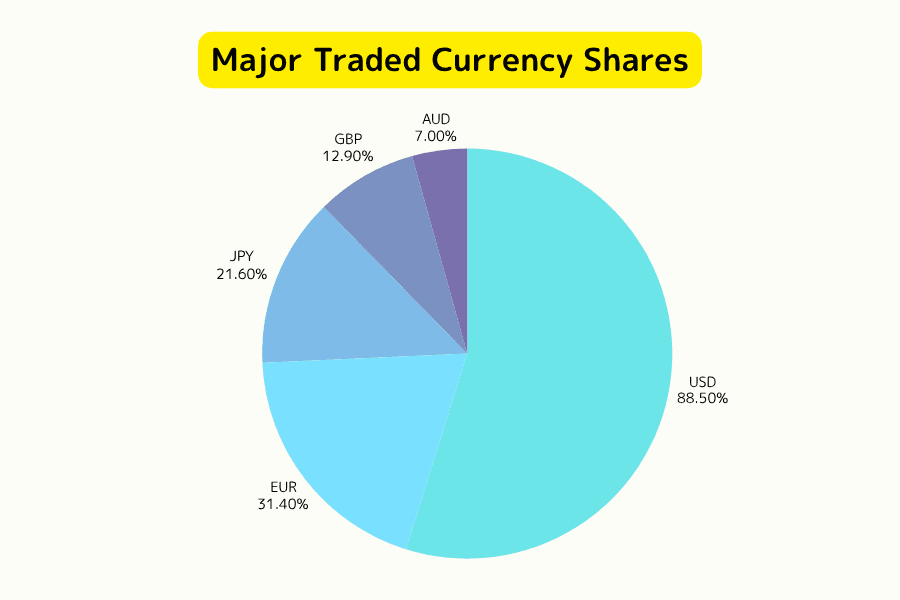
| Currency Code | Currency Name | Market Share |
|---|---|---|
| USD | US Dollar | 88.5% |
| EUR | Euro | 31.4% |
| JPY | Japanese Yen | 21.6% |
| GBP | British Pound | 12.9% |
| AUD | Australian Dollar | 7.0% |
Position 2: A Global Official Reserve Currency
According to IMF data, the Pound accounts for approximately 5.19% of the world's official foreign-exchange reserves, ranking fourth. While this is below the Dollar and the Euro, it remains valued for its stability and market trust, and is regularly included in central-bank reserve portfolios for risk diversification.
Position 3: An International Trade and Investment Tool
The Pound is widely used in trade between the UK and major economies including the United States, the EU, and Asia, particularly as a settlement currency in energy, insurance, and high-end manufacturing.
In addition, many international institutions issue Pound-denominated bonds and conduct cross-border investment in GBP, increasing its frequency of use in international capital flows.
Position 4: A Benchmark Currency in Financial Markets
London is one of the world's largest forex and derivatives trading centers, giving the Pound a notable advantage in swap, bond, and derivative markets. Strong infrastructure and a sound regulatory environment further support its role as a major pricing currency for global financial assets.
6. How to Trade the British Pound (GBP)
There are multiple ways to trade the British Pound (GBP); the most common is forex margin trading. This approach offers leverage, allowing investors to control larger positions with smaller capital.
In addition, forex margin trading allows two-way operations — investors can go long or short based on market direction.
Combined with the fact that the forex market runs 24 hours a day, it is one of the largest trading markets globally, offering flexibility and liquidity that suit a wide range of strategies and risk tolerances.
Further reading: Forex Margin Trading Beginner's Guide
Titan FX offers up to 1,000x leverage on major currency pairs (Standard and Blade accounts), and up to 2,000x on eligible Micro accounts.
Trading Forex Margin with Titan FX
Step 1: Open an Account
Titan FX account opening is simple and fast — you can register online without submitting identity or address proof.
Titan FX offers Standard and Blade trading accounts. Traders can choose the account type that fits their needs at registration.
Titan FX Account Opening GuideStep 2: Deposit
After registration, you can fund your account. Titan FX supports multiple deposit methods, with credit-card deposit being the fastest and most convenient — typically credited instantly.
Titan FX Deposit GuideStep 3: Download and Install the Trading Platform (MT4/MT5)
Titan FX provides both MT4 and MT5 trading platforms (software). They are available for Windows, Mac, iOS (iPhone/iPad), and Android.
Titan FX MT5 Download, Install, and Login Titan FX MT4 Download, Install, and LoginStep 4: Choose a Currency Pair
Titan FX offers around 60 currency pairs. The most common pair traded with the Pound (GBP) is the US Dollar (USD), i.e., GBP/USD (Pound vs. Dollar).
This is one of the most heavily traded major pairs globally, commonly referred to as "Cable."
All Titan FX Currency PairsStep 5: Place an Order
Once logged into the MT4 or MT5 trading platform, select an instrument and execute a buy or sell order.
Titan FX MT5 Interface and Order Placement Titan FX MT4 Interface and Order PlacementFree Trading Tools (Custom Indicators and EAs) from Titan FX
Titan FX is committed to providing traders with the most advanced trading support, including free tools such as custom indicators and EAs (automated trading programs). These tools are designed to enhance trader efficiency and strategy precision.
Custom indicators help traders analyze market direction more accurately and identify potential trading opportunities.
EAs can automatically execute predefined trading strategies, removing emotional interference and ensuring each trade is executed precisely.
These free tools help you gain an edge in competitive financial markets and improve your trading performance.
All Custom Indicators EA Trading Program Rankings7. Frequently Asked Questions
Q1. What does "Cable" mean for the Pound?
The term "Cable" dates back to the 19th century, when a transatlantic telegraph cable was laid between the United Kingdom and the United States. This cable transmitted financial data, including FX rates.
Because the cable was critical for transmitting the GBP/USD exchange rate, traders began using "Cable" to refer to the GBP/USD pair.
The term is still used in forex trading today as a tribute to that communications breakthrough.
Q2. How does the London market influence Pound trading?
London is the world's largest forex trading center, and Pound pairs (especially GBP/USD) have the highest liquidity during the London trading session. The overlap between London and the New York session brings particularly sharp moves — a prime window for day trading.
Q3. What is special about the Pound's volatility and risks?
The Pound has notable market volatility. It is also highly sensitive to politics and breaking news — Brexit developments, central-bank meetings, or election outcomes often trigger sharp moves, so strict stop-loss and money-management rules are essential.
Q4. Is the Pound a safe-haven currency?
The Pound has some secondary safe-haven function, especially when the Dollar is under pressure or European markets are relatively stable. However, its safe-haven role is less defined than that of the Dollar or the Yen and is more often shaped by an interplay of market risk sentiment and UK domestic politics.
Q5. Why does Brexit have such a far-reaching impact on the Pound?
Brexit reshaped the UK's trade and capital-flow framework with the EU, generating high uncertainty about the UK's outlook. Both the negotiation and the agreement-signing phases triggered large moves in the Pound. Even after the formal exit, UK-EU trade and financial regulations continue to influence the Pound's trajectory.
8. Summary
The British Pound (GBP) is a currency that combines deep historical heritage with modern market influence. It plays an irreplaceable role in global forex trading, official reserves, and financial investment. Its exchange rate reflects not only the UK's economic and policy dynamics but also the combined effects of global risk sentiment and geopolitics.
Whether for short-term trading or medium-to-long-term market positioning, a deep understanding of the Pound's characteristics and drivers is an important foundation for entering the forex market. Going forward, as the global economic and policy environment evolves, the Pound will remain an indispensable element of the international monetary system.
Further Reading
- GBP/USD (Cable) live quote — The famous "Cable" pair on the Titan FX product page.
- EUR/GBP live quote — The EUR cross most tightly linked to the UK economy.
- Inflation — Foundation for the BoE 2% target and how it shapes policy decisions.
- Monetary Policy — Framework used by major central banks (BoE / Fed / ECB).
- Raise Interest Rates — How BoE hike cycles drive the pound.
- Asset Allocation — Multi-currency portfolio thinking that includes GBP.
The Titan FX Research team covers global macroeconomic indicators, foreign exchange (FX), commodities (oil, precious metals, agriculture), equity indices, US stocks, and crypto assets, producing educational content for investors and traders.
Primary Sources by Category
- Official data and regulators: Bank of England (BoE) — Monetary Policy Reports / Inflation Report / Financial Stability Reports; UK Office for National Statistics (ONS) — UK GDP / CPI / unemployment statistics; HM Treasury — UK fiscal data; Financial Conduct Authority (FCA).
- International institutions and research: International Monetary Fund (IMF) — Currency Composition of Official Foreign Exchange Reserves (COFER); Bank for International Settlements (BIS) — Triennial Central Bank Survey of FX (2022); OECD — Economic Surveys: United Kingdom.
- Media and historical references: Bloomberg, Reuters, Financial Times, The Economist; the 1992 Black Wednesday ERM exit (the Soros sterling crisis), the 2008 GFC and BoE QE, the 2016 Brexit referendum and sterling slide, the 2022 Truss "mini-budget" crisis and BoE emergency gilt purchases.