

Foreign Exchange Reserves
Global foreign exchange reserves reported to the IMF's COFER database totaled about $13.22 trillion in the second quarter of 2026, and the US dollar still makes up more than half of them. That figure covers foreign-currency assets only; it does not include gold, SDRs or IMF reserve positions. For currency traders, reserves matter most when a central bank uses them, as Japan did in 2026 when it sold dollars from its reserves to support the yen.
This guide explains what foreign exchange reserves are made of, why countries hold them, which countries hold the most, which currencies they are held in, how much is enough, and how reserve data and currency intervention affect exchange rates.
- Foreign exchange reserves are a central bank's external assets: foreign-currency deposits and bonds, gold, SDRs and its IMF reserve position
- Countries hold reserves to pay for imports and external debt, defend their currency and maintain confidence in a crisis
- China holds the largest reserves, at more than $3 trillion, followed by Japan and Switzerland; the United States holds relatively little because it issues the main reserve currency
- In Q2 2026, the US dollar made up 56.70% of global reserves and the euro 20.60%, according to IMF COFER data
- Reserves move markets mainly through intervention: Japan bought about ¥27 trillion of yen across two rounds in 2026, one of which included an operation coordinated with the US Treasury
- 1. What are foreign exchange reserves?
- 2. Why do countries hold foreign exchange reserves?
- 3. Which countries have the largest foreign exchange reserves?
- 4. Which currencies are reserves held in?
- 5. How much in reserves is enough?
- 6. How foreign exchange reserves affect exchange rates
- 7. Foreign Exchange Reserves FAQ
- 8. Summary
1. What are foreign exchange reserves?
Foreign exchange reserves, also called forex reserves or FX reserves, are external assets that a central bank or monetary authority can use at short notice. They must be liquid and readily convertible, which is why most of them sit in major currencies and high-quality government bonds.
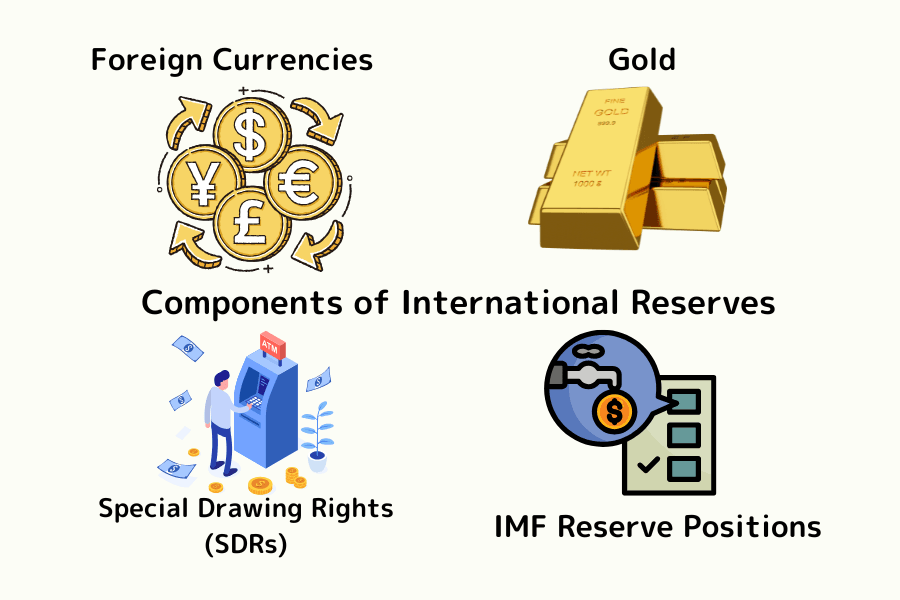
In the IMF's broader measure of official reserves, often called international reserves or reserve assets, there are four parts:
-
Foreign-currency assets: deposits and bonds denominated in reserve currencies such as the US dollar, the euro and the Japanese yen. This is by far the largest part
-
Gold: monetary gold held by the central bank. Gold has become a bigger part of many reserve portfolios as central banks keep buying gold
-
Special Drawing Rights (SDRs): an international reserve asset created by the IMF, valued against a basket of major currencies
-
Reserve position in the IMF: the part of a country's IMF quota that it can draw on without conditions
Strictly speaking, foreign exchange reserves are only the first of these, the foreign-currency assets. International reserves add gold, SDRs and the IMF reserve position. The IMF's COFER data on currency composition covers foreign exchange reserves only, so headline figures are not always comparable: some country rankings count only foreign-currency assets, while others include gold, which can change a total considerably.
2. Why do countries hold foreign exchange reserves?
-
① To pay for imports and external debt: reserves guarantee that a country can keep paying for essential imports and servicing foreign-currency debt even if export income or market funding dries up
-
② To manage the exchange rate: a central bank can sell foreign currency from its reserves to support its own currency, or buy foreign currency to slow a rise. Countries with fixed or tightly managed exchange rates rely on reserves the most
-
③ To maintain confidence: rating agencies and investors treat ample reserves as a sign that a country can withstand capital outflows, which lowers borrowing costs
-
④ To act as a buffer in a crisis: during a financial crisis, sudden capital flight or sanctions, reserves provide emergency foreign currency to keep markets and banks functioning
Because reserves are an emergency buffer, central banks put safety and liquidity ahead of return, and most reserves sit in short- and medium-term government bonds that can be sold quickly, even though their yields are modest.
3. Which countries have the largest foreign exchange reserves?
Reserves are concentrated in Asia and in export-driven economies. China holds the largest reserves in the world, at more than $3 trillion, followed by Japan, with more than $1 trillion, and Switzerland. These countries built their reserves through years of trade surpluses or, in Switzerland's case, through currency purchases made to limit the franc's appreciation.
The United States holds relatively small reserves for an economy of its size. Because the dollar is the world's main reserve currency, the US can pay for imports and service its debt in its own currency and has little need for a large stock of foreign currency.
Rankings differ by source and date. Some count only foreign-currency assets and others include gold, so check the definition and the reference date when comparing countries.
4. Which currencies are reserves held in?
The IMF publishes the currency composition of global reserves every quarter in its COFER (Currency Composition of Official Foreign Exchange Reserves) data. In the second quarter of 2026, total foreign exchange reserves rose to about $13.22 trillion, and the shares were:
| Currency | Share of global reserves (Q2 2026) |
|---|---|
| US dollar (USD) | 56.70% |
| Euro (EUR) | 20.60% |
| Japanese yen (JPY) | 4.96% |
| Chinese renminbi (CNY) | 2.11% |
| British pound, Canadian dollar, Australian dollar, Swiss franc and others | About 15.6% |
Source: IMF COFER, released September 30, 2026. Shares are based on reserves whose currency composition is reported.
The dollar's share slipped from 57.18% in the first quarter of 2026 as holdings of the euro and other currencies grew.
Why is the US dollar the main reserve currency?
The dollar has lost ground slowly over two decades, but it remains far ahead of any other currency for three reasons: the US Treasury market is the deepest and most liquid bond market in the world, much of global trade and cross-border debt is priced in dollars, and central banks can buy or sell dollar assets in large amounts quickly when they need to.
5. How much in reserves is enough?
There is no single right level. Policymakers and analysts use several benchmarks:
| Benchmark | What it measures | Common reference point |
|---|---|---|
| Import cover | How many months of imports reserves can pay for | Around 3 months |
| Greenspan–Guidotti rule | Reserves compared with external debt due within one year | About 100% of short-term external debt |
| IMF reserve adequacy (ARA) metric | Reserves compared with a weighted mix of exports, short-term debt, other external liabilities and broad money | Country-specific |
These are rules of thumb, not legal minimums. Import cover fits countries whose main risk is paying for imports. The Greenspan–Guidotti rule grew out of the 1990s Asian financial crisis, when sudden withdrawals of short-term foreign funding drained reserves. The IMF's metric combines several of these risks.
More is not always better. Reserves earn low returns, and building them up often means the central bank creates domestic money or issues debt to buy foreign assets, which has its own costs.
6. How foreign exchange reserves affect exchange rates
Intervention: when reserves are used
The most direct link between reserves and exchange rates is currency intervention. When a currency falls too fast, the central bank or finance ministry sells foreign currency from its reserves and buys its own currency.
Japan offers the clearest recent example. With the yen at historic lows, Japan's Ministry of Finance carried out yen-buying intervention worth about ¥11.7 trillion between late April and late May 2026, and about ¥15.4 trillion between late July and late August, both record amounts. Japan said its July 31 operation was coordinated with the US Treasury, the first joint US–Japan intervention to buy yen since 1998. Earlier rounds came in 2022 (about ¥9.2 trillion) and 2024 (about ¥15.3 trillion across April–May and July).
Intervention tends to cause sharp, short-lived moves in USD/JPY, but it rarely changes the trend on its own if interest-rate differentials keep pulling the other way. Japan's large reserves let it intervene repeatedly; a country with thin reserves cannot defend its currency for long.
What traders can watch
-
Monthly reserve data: a sharp fall in a country's reserves can signal that it has been selling foreign currency to defend its exchange rate
-
Intervention announcements: some countries, including Japan, publish their intervention totals monthly, confirming what the market suspected
-
Quarterly COFER data: shifts in the currency mix show long-term trends in demand for the dollar, euro and other reserve currencies
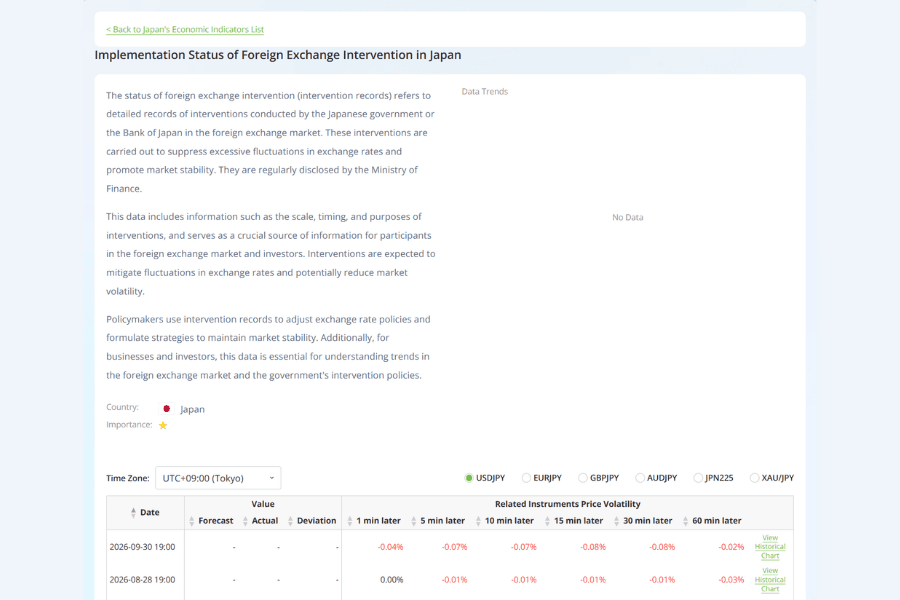
Titan FX's Implementation Status of Foreign Exchange Intervention in Japan page lists the dates on which Japan's Ministry of Finance publishes its monthly intervention figures, along with how USD/JPY, EUR/JPY and other yen pairs moved in the hour after each release. The reactions are usually small: after the August 28, 2026 release, USD/JPY moved only about 0.03% over the next hour, because the market had already seen the intervention itself in late July and August. The large moves come on the days the intervention happens, not on the day it is confirmed. You can check upcoming release dates on the Economic Calendar.
Reserve figures are best read alongside other fundamental factors, such as interest-rate policy, the current account and capital flows, rather than as a stand-alone trading signal.
7. Foreign Exchange Reserves FAQ
Q1: Why does the United States hold so few foreign exchange reserves?
Because the dollar is the world's main reserve currency, the US can settle trade and service its debt in its own currency. It does not need a large stock of foreign currency to defend the dollar, so its reserves are small relative to the size of its economy.
Q2: Is gold part of foreign exchange reserves?
Yes. Under the IMF's definition, monetary gold held by a central bank counts as an official reserve asset. Some rankings of foreign exchange reserves exclude gold, though, so check which definition a figure uses. Many central banks have added gold in recent years, a trend covered in our look at why central banks favor gold.
Q3: Are more reserves always better?
No. Reserves need to match a country's risks, such as its import bill and short-term external debt. Holding far more than needed ties up funds in low-yielding assets and can be costly to finance.
Q4: Where can I find foreign exchange reserve data?
The IMF publishes global currency composition (COFER) quarterly, and most central banks or finance ministries publish their own reserves monthly. Japan's Ministry of Finance also publishes its intervention totals, and China's foreign exchange regulator publishes its reserves early each month.
8. Summary
Foreign exchange reserves are the external assets a central bank holds to pay for imports and debt, steady its currency and keep confidence in a crisis. Foreign exchange reserves reported to the IMF total about $13.2 trillion, and the US dollar still accounts for more than half of them, even as its share edges lower.
For traders, reserves matter most when they are used. Japan's record yen-buying intervention in 2026 showed how reserves can jolt an exchange rate, and also how the effect fades if the underlying rate differential does not change. Watch reserve data, intervention announcements and the currency mix together with interest rates and capital flows.
Further Reading
The financial market research team at Titan FX. We produce educational content for investors across foreign exchange, commodities (crude oil, precious metals, agricultural products), stock indices, US equities and digital assets.
Primary Sources
- Official statistics: IMF Currency Composition of Official Foreign Exchange Reserves (COFER), Q2 2026 release; IMF guidance on international reserves and reserve adequacy
- Intervention data: Japan Ministry of Finance foreign exchange intervention reports, as covered by Nikkei and Jiji Press
- Research: Guidotti–Greenspan rule on short-term external debt; European Commission note on reserve adequacy