

Impact of Loss Cut and Strategies for Forex & CFD Traders
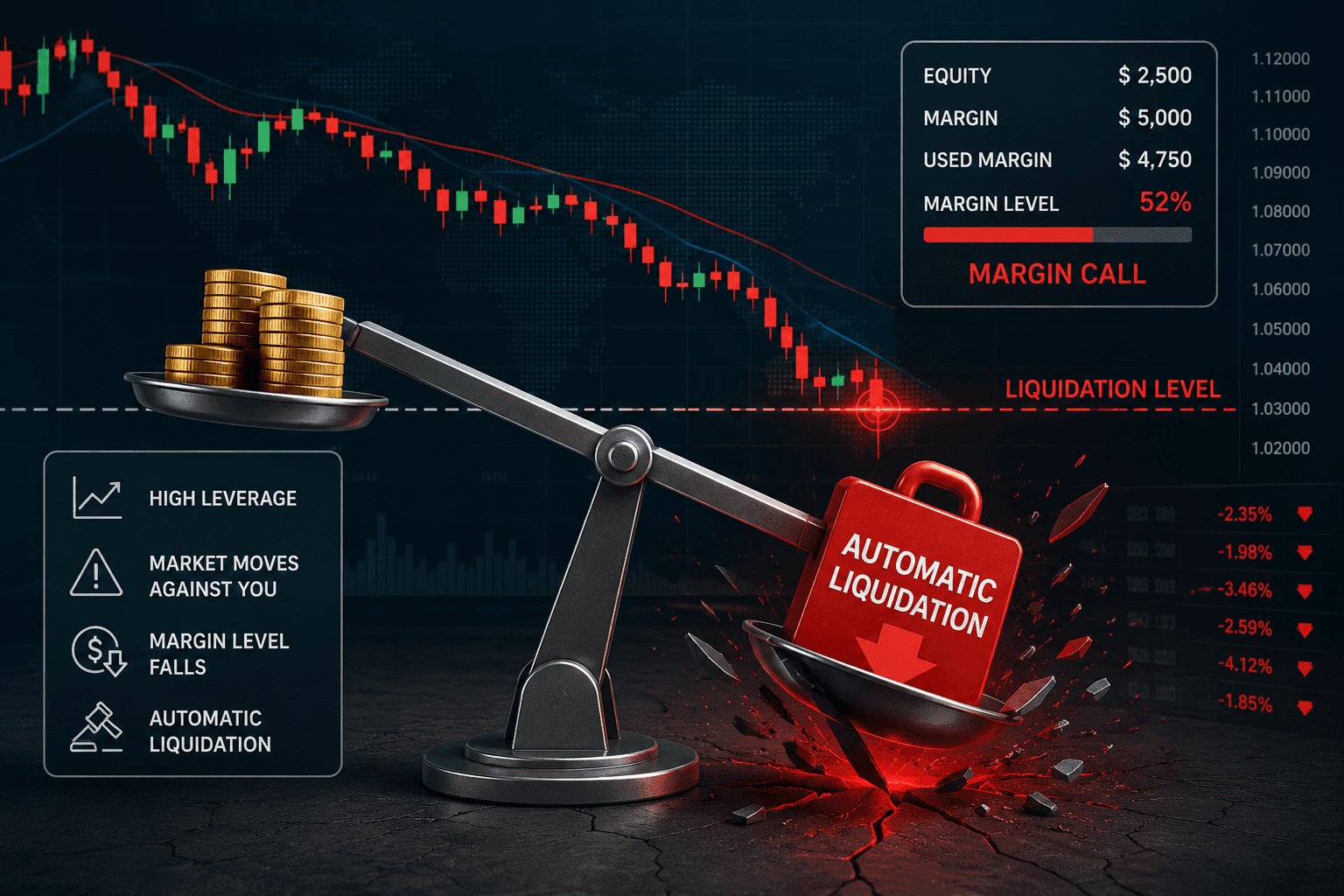
A loss cut automatically closes your positions when your margin level falls below the broker's required level — a risk-control mechanism that stops losses from growing.
Forex and CFD (Contract for Difference) trading offer high leverage and flexible trading opportunities, but they also come with high risks. Without proper fund management, traders may face loss cut, which could even lead to margin call and wipe out their capital.
To avoid this scenario, traders should understand the mechanism of loss cut and its impact, and reduce risks by properly controlling leverage, setting stop-loss orders, and managing margin.
This article will explain the principles of loss cut, its calculation methods, and how to effectively prevent margin call situations.
- Definition: auto-closes positions when margin level is insufficient
- Trigger: margin level falls below the broker's set level (e.g., Titan FX 20%)
- Calculation: based on equity ÷ required margin
- Vs stop-loss / margin call: automatic vs manual; a margin call is the prior warning
- Prevention: manage leverage, set stops, keep ample margin, diversify, watch margin level
1. What Is a Loss Cut?
In Forex and CFD (Contract for Difference) trading, loss cut (Loss Cut) is an automatic liquidation mechanism activated by the broker when the account's floating losses exceed the margin threshold set by the broker.
Due to the leverage system in Forex trading, investors can use a small amount of margin to execute leveraged trades, which can enhance capital efficiency, but also increases the risk.
Without proper risk management, high leverage may lead to losses far beyond expectations, potentially triggering a margin call.
To prevent traders from taking on further risk due to expanding losses, most Forex brokers implement loss cut mechanisms to automatically close positions and reduce the risk of losing all capital.
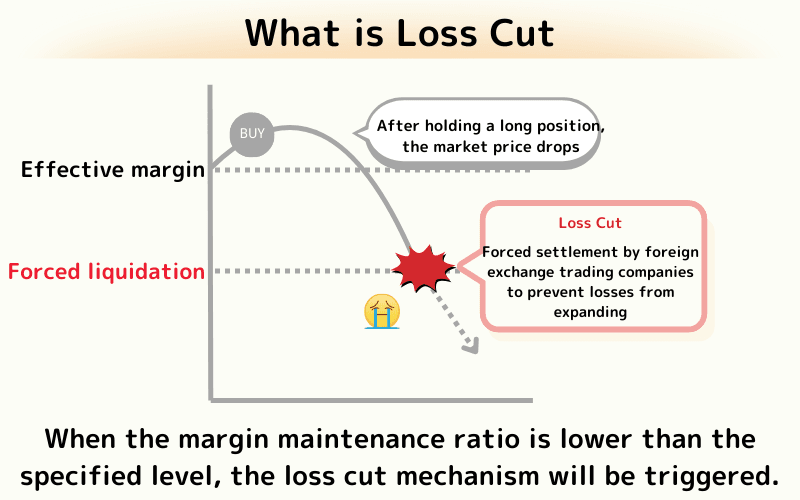
Titan FX Loss cut Rules
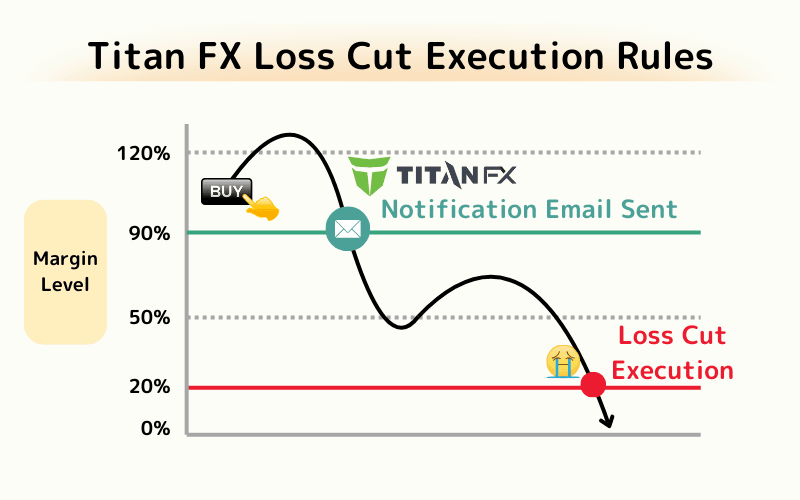
Titan FX's loss cut rate (Margin Maintenance Ratio) is 20%. When a trader's margin level falls below 20%, loss cut will be triggered.
To avoid loss cut, Titan FX sends a notification email to the trader when the account's equity falls below 90% of the required margin.
2. How Is a Loss Cut Calculated?
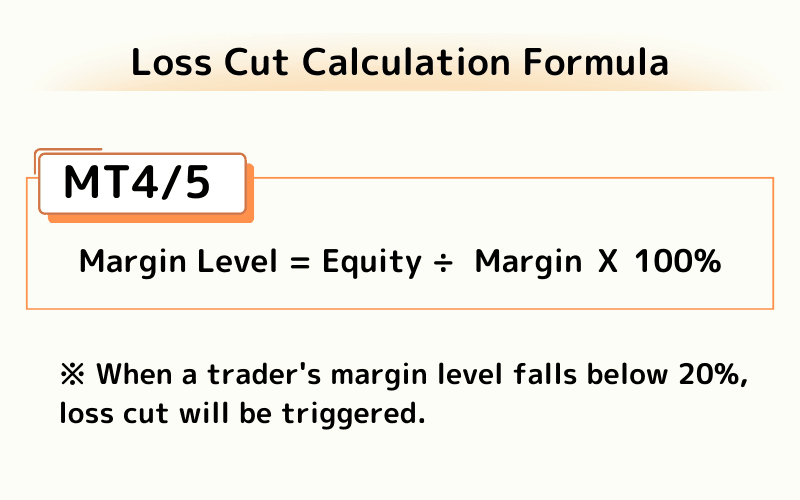
When the margin level (or margin maintenance ratio) of a trading account falls below the ratio specified by the broker, the account will be forcibly liquidated by the broker.
For both MT4 and MT5, the calculation formula is as follows:
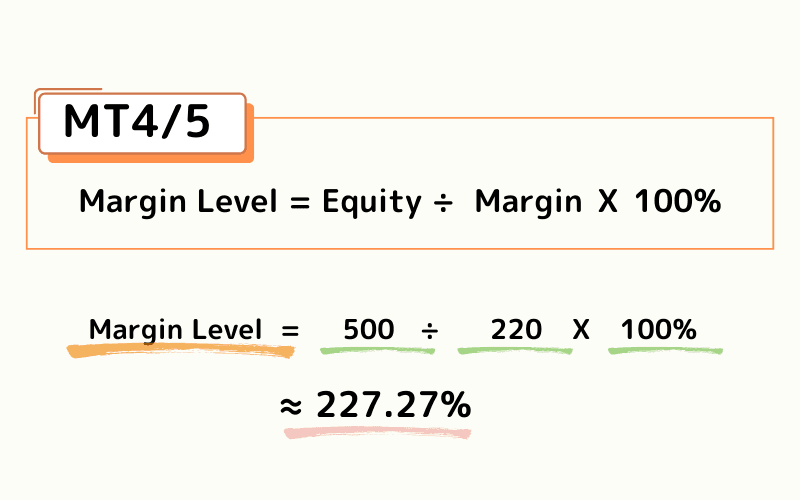
Margin Level = Equity ÷ Margin × 100%
| Term | Description |
|---|---|
| Equity | Account balance plus unrealized profit and loss from open positions. When floating profits increase, equity rises; when floating losses increase, equity decreases. |
| Margin | The total margin used for open positions. |
For example, using $500 margin to trade the EUR/USD currency pair with 500x leverage:
※ To simplify the calculation, ignore the spread loss at the entry point.
Trader A believes the price will go up and buys 1 lot at 1.1000. The margin level calculation method is:
Margin / Minimum Margin = 1.1000 (current exchange rate) × 1 (lot size) × 100,000 (currency units) ÷ 500 (leverage) = 220
Margin Level = 500 (equity) ÷ 220 (margin) × 100% ≈ 227.27%
Later, the market starts to decline, and the price drops to 1.0954. Based on 1 pip = $10, the equity is:
Equity = 500 - (1.1000 - 1.0954) × 1 (lot size) × 100,000 (currency units) = $40
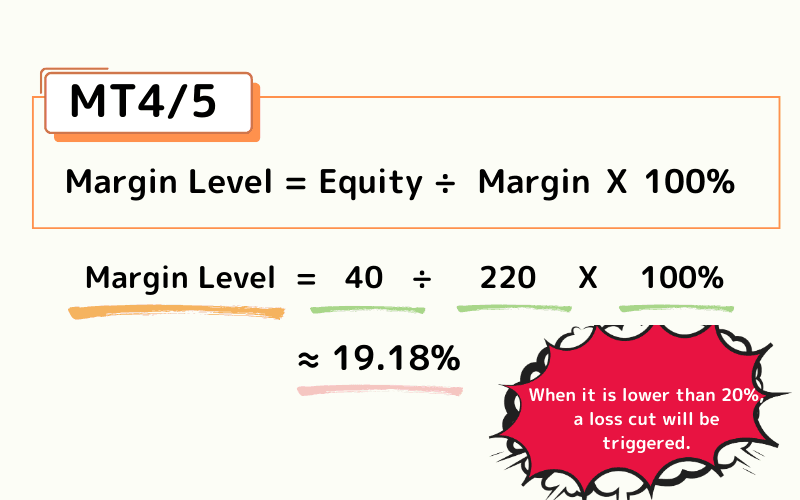
Margin Level = 40 (equity) ÷ 220 (margin / minimum margin) × 100% ≈ 19.18%
Since Titan FX's loss cut rate (margin level) is 20%, when the margin level drops to 19.18%, loss cut will be triggered.
※ Note: Different brokers or account types may have different loss cut rules.
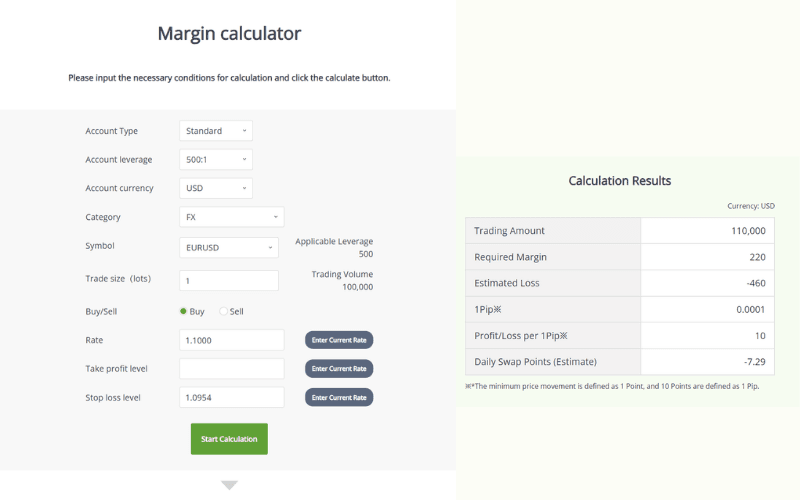
The above example does not include spread or overnight interest, and is simplified for explanation. To accurately calculate the loss cut level, you can use Titan FX’s "Forex/CFD Margin Calculator".
Titan FX Forex/CFD Margin Calculator
Titan FX provides a "Forex/CFD Margin Calculator" that automatically calculates the margin level. Simply select the trading instrument, input the price, lot size, and leverage, to confirm the required margin and trading amount. Anyone can easily use it.
3. Notes on Loss Cut
Loss cut is designed to protect investors, but there are two important things to keep in mind:
1. Loss cut May Not Always Be Executed According to Rules
The loss cut mechanism does not guarantee that it will always be executed according to the established rules. Traders should be particularly cautious.
When the market experiences extreme volatility or insufficient liquidity, loss cut may occur at a lower-than-expected price, leading to a discrepancy between the actual transaction price and the system's calculated theoretical price. This could result in losses greater than originally expected. Therefore, traders should plan their risk management in advance, avoid excessive leverage or failure to set stop-loss orders, and ensure the safety of their capital.
2. Risk of Loss Exceeding Margin
If there is a sudden sharp price fluctuation, loss cut may occur at a loss exceeding the available margin.
If the loss exceeds the margin, the account balance will become negative, and additional funds (margin call) must be deposited to cover the negative balance.
The lower the effective margin (and the lower the margin level), the higher the likelihood of loss cut.
5 Ways to Avoid Loss Cut
When a position is automatically closed due to a loss cut, it means significant losses are already confirmed. Therefore, traders should try to avoid situations where loss cut occurs.
Here are 5 ways to avoid loss cut:
- 【Method 1】Reduce leverage in trading
- 【Method 2】Set stop loss proactively
- 【Method 3】Partial closure to reduce positions
- 【Method 4】Add margin to supplement the margin balance
- 【Method 5】Choose a broker with a lower loss cut rate
By implementing these risk management measures, traders can reduce the risk of loss cut and ensure trading stability.
【Method 1】Reduce Leverage in Trading
Using lower leverage is one way to avoid loss cut.
In forex trading, leverage allows traders to trade amounts much larger than their initial margin. While leverage can bring greater profits, it also increases the potential for massive losses.
In other words, the higher the leverage, the greater the risk of loss cut.
Therefore, for beginners who are not yet familiar with trading, it's recommended to start with lower leverage.
What is Leverage Trading? Types and Calculation
【Method 2】Set Stop Loss Proactively
Setting a stop loss in time is more important than holding onto floating losses. Proper stop losses can prevent margin from depleting further and protect capital.
If you hesitate to stop loss, losses could continue to expand, creating a vicious cycle of "refusing to accept losses → increased losses → harder to stop loss."
Thus, setting clear stop loss rules, such as "stop loss immediately if the floating loss of a single trade reaches X%," helps manage risk and prevent excessive losses.
【Method 3】Partial Closure to Reduce Positions
When facing the risk of loss cut, traders can adjust their position size, for example, by reducing part of the position or implementing partial closure.
Partial closure can increase effective margin and improve the margin rate.
However, be aware that if the market moves unfavorably, the margin rate may decrease again.
【Method 4】Add Margin to Supplement the Margin Balance
A higher account balance (margin) can reduce the risk of loss cut because the margin rate changes with the account balance.
Basically, the more balance in the account, the higher the margin rate, and the smaller the risk of loss cut.
Therefore, if the position relative to the account balance is too low, you can add margin to increase the account balance.
By adding margin, the effective margin increases, restoring the margin rate and reducing the risk of loss cut.
However, increasing the margin balance means that if the market trend turns unfavorable, the losses when a loss cut happens may be larger.
【Method 5】Choose a Broker with a Lower Loss Cut Rate
Choosing a forex broker with a lower loss cut rate is also a strategy. The lower the loss cut rate, the less likely it is to trigger loss cut.
Titan FX's loss cut rate is 20%, and it sends an alert email when the margin rate falls to 90%.
Trade Forex CFDs with Titan FX
Titan FX offers 50+ currency pair CFDs on MT4/MT5 with up to 1,000:1 leverage on major pairs, tight spreads, and the flexibility to go long or short. Micro accounts can reach up to 2,000:1 leverage when eligible.
4. Loss Cut FAQs
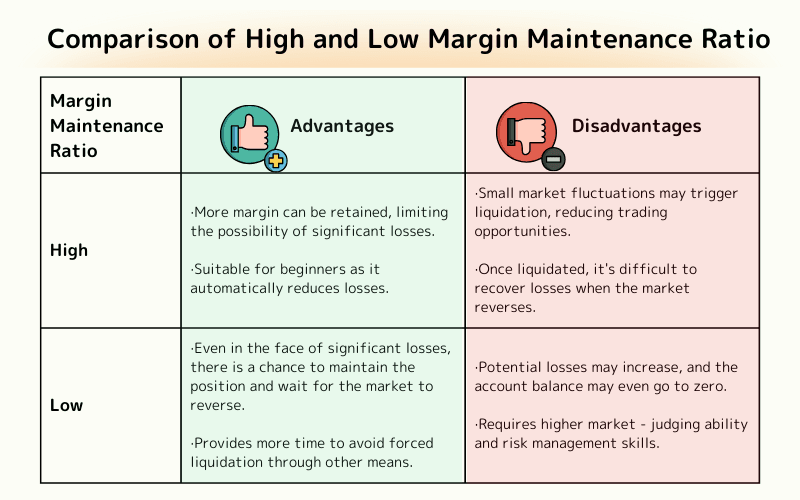
Q1. Is it better to have a higher or lower loss cut rate?
The choice of a higher or lower loss cut rate has its pros and cons, as outlined below:
| Loss Cut Rate | Pros | Cons |
|---|---|---|
| High | - Allows more margin to remain, limiting the potential for expanding losses. - Suitable for beginners, automatically reducing losses. | - Small market fluctuations may trigger loss cut, reducing trading opportunities. - Once loss cut occurs, it's difficult to recover losses with a market reversal. |
| Low | - Allows a position to remain even when facing large losses, providing more time for a market reversal. - Gives more time to avoid loss cut through other means. | - Potential losses could increase, even leading to account balance reaching zero. - Requires higher market judgment and risk management skills. |
Q2. Difference Between Loss Cut and Stop Loss?
Loss cut and stop loss are two different concepts in forex trading with different functions and execution methods. The table below compares them:
| Feature | Loss Cut | Stop Loss |
|---|---|---|
| Proactivity | Passive measure | Active measure |
| Trigger Mechanism | Activated when the account margin rate drops below the broker's set threshold | Set by the trader at a price level when entering the trade |
| Control | Automatically executed by the broker | Set and controlled by the trader |
| Execution Timing | Automatically executed when the margin rate reaches a certain level | Automatically executed when the market price hits the stop loss price |
| Purpose | Prevent losses from expanding to uncontrollable levels | Limit losses and protect the trader's capital |
| Execution Method | Automatically closes the position by the broker | Automatically closes the position by the broker |
| Flexibility | More limited, depending on the broker's settings | Flexible, trader can set the stop loss based on their strategy |
Q3. Relationship Between Loss Cut and Margin Call
Loss cut occurs when the account margin rate falls below the broker's set threshold, and the system automatically closes part or all of the position to prevent further depletion of funds.
Margin call, on the other hand, occurs when the account funds are exhausted, or the balance becomes negative, leading to a total loss of trading capital.
The purpose of loss cut is to prevent margin call, but during extreme market fluctuations, if the loss cut is not executed in time, it may still lead to margin call.
Therefore, properly controlling leverage, setting stop losses, and ensuring sufficient margin can effectively reduce risks.
Conclusion
Loss cut is a mechanism designed to prevent traders from bearing further risks due to excessive losses. By understanding how it works and implementing measures such as reducing leverage, setting stop losses, and adding margin, traders can effectively reduce the risk of triggering loss cut.
Titan FX’s loss cut rate is 20%, and it sends an alert when the margin rate hits 90%, helping traders control risk. However, extreme market fluctuations may still cause loss cut to fail to execute as expected. Therefore, establishing a solid risk management strategy is crucial.
Traders should adjust their strategies according to their risk tolerance, stay alert to market movements, and ensure the safety of their funds to minimize unnecessary losses.
Further Reading
- What is leverage?
- Forex margin trading basics
- What is stop loss?
- What is liquidation (margin call)?
- What is a CFD?
Titan FX Trading Strategy Lab. We produce investor-education content covering forex, commodities (crude oil, precious metals, agricultural goods), stock indices, U.S. equities, and digital assets.
Primary Sources (by Category)
- Trading rules: Brokers' margin-maintenance and loss-cut rules, and the general margin-regulation framework
- Titan FX official: What is leverage?, What is stop loss?