

What is Forex Hedging? What are its Advantages and Disadvantages?
Forex hedging means holding long and short positions on the same currency pair at once so their P&L offsets — a risk-control method that can temporarily freeze gains/losses and buy time to decide.
For those without forex trading experience, the concept of "hedging" might seem difficult to understand, and its purpose and advantages may not be clear.
Hedging is a technique in forex trading. While opening positions in both directions can effectively avoid significant losses, in certain situations, this strategy may incur higher trading costs.
This article introduces hedging in forex trading, explaining its definition, advantages, and disadvantages.
- Definition: holding both sides on one pair to offset P&L
- Why use it: to manage volatility, high leverage, and swap risk
- Pros: temporarily freeze losses, adjust exits flexibly
- Cons: double spread and swap, risk of a long passive lock
- Vs stop-loss / arbitrage: freeze vs realize loss vs capture price gaps
1. What Is Hedging in Forex Trading?
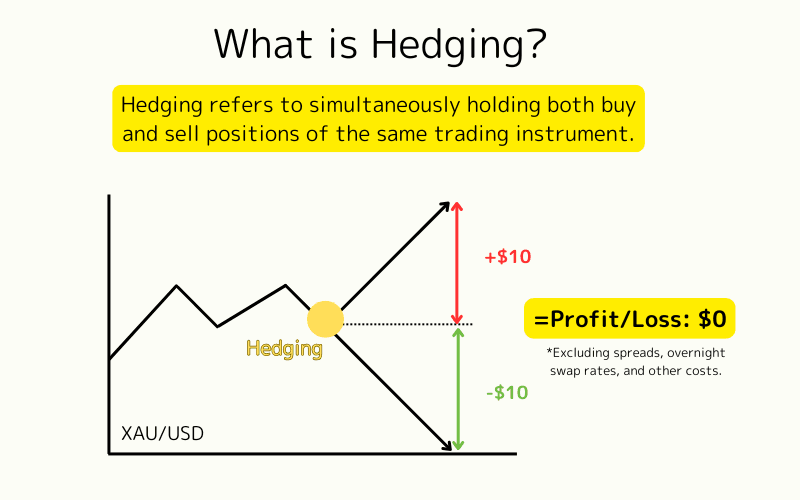
In forex trading, hedging is a strategy that involves simultaneously holding buy and sell positions in the same trading instrument. By doing so, traders can mitigate the impact of market price fluctuations on their portfolios.
In forex trading, the act of buying or selling a currency is referred to as a "position." Typically, profits are made by holding either a "buy" or "sell" position and capitalizing on price differences. However, through hedging, it is possible to hold both "buy" and "sell" positions for the same currency pair.
Here is an example to illustrate the concept of hedging:
You can view the latest correlation coefficients between major currency pairs in real time with the Correlation Matrix.
Suppose trading XAU/USD (Gold/USD):
- Open a position when the gold price is $2,000.
- Close the position when the gold price rises to $2,010 (excluding spread and other costs).
If you only have a buy or sell position, the following scenarios occur:
- Holding only a buy position results in a $10 profit.
- Holding only a sell position results in a $10 loss.
However, by holding both buy and sell positions, the loss on the sell position can be offset by the profit on the buy position. As shown in the table below, hedging aims to reduce losses incurred when holding a single-direction position:
| Market Uptrend | Market Downtrend | |
|---|---|---|
| Only Buy | Generates Profit | Generates Loss |
| Only Sell | Generates Loss | Generates Profit |
| Hedging | Buy profit offsets sell loss | Sell profit offsets buy loss |
When hedging, the two positions are not affected by price fluctuations until settlement. Depending on market conditions, traders can first settle either the "buy" or "sell" position, retaining the profitable one for further trading.
However, it’s important to note that spreads and overnight swap rates due to interest rate differences between currencies are disadvantages of hedging. Forex trading typically profits from predicting price movements, and hedging may not always be economically viable.
Further reading: What are Swap Rates? Calculation Methods, Advantages, and Disadvantages
2. Advantages and Disadvantages of Hedging
When should hedging be used? To better understand, here are the advantages and disadvantages of hedging:
Advantages of Hedging
One of the main advantages of hedging is preventing temporary losses from escalating.
In forex trading, prices sometimes make temporary highs or lows before returning to their original range. During volatile market conditions, when traders do not wish to settle their current positions immediately, hedging is an effective method.
Example:
Suppose a buy position of 1 lot (100,000 EUR) is held at 1 EUR = 1.10500 USD.
- If the price drops to 1 EUR = 1.10000 USD, the unrealized loss will be (1.10500 - 1.10000) × 100,000 = $500.
- If the price continues to drop to 1 EUR = 1.09500 USD, the loss increases by another $500, bringing the total unrealized loss to $1,000.
However, if a sell position of 1 lot is added at 1 EUR = 1.10000 USD and settled at 1 EUR = 1.09500 USD, the realized profit will be $500.
This reduces the total unrealized loss to $500.
This shows that timely hedging can reduce unrealized losses.When unrealized losses grow, the risk of forced liquidation also increases. If forced liquidation occurs, positions cannot be held long enough for the market to recover.
By reducing unrealized losses, hedging lowers the risk of forced liquidation, allowing traders to settle positions for a profit once the market recovers.
Disadvantages of Hedging
Despite its advantages, hedging has drawbacks.
Firstly, both positions in a hedge are subject to spreads.
Spreads may widen during low market liquidity (e.g., early mornings) or due to sudden fluctuations caused by major announcements, increasing trading costs and reducing profitability.
Additionally, swap rates vary between buy and sell positions.
While some currency pairs may earn swap rates for one position, hedging can result in offsetting or even incurring swap costs.
Hedging may also lead to "trapped positions," where unrealized losses remain for extended periods. Feeling secure with a hedge might lead to holding positions too long without closing them. Prolonged dual-direction positions may result in forced liquidation due to sudden market changes or cumulative swap costs.
Finally, for hedging to be effective, both "buy" and "sell" positions must be closed at the right time, requiring strong market observation skills. Accurate market judgment and well-timed settlement are essential but challenging.
Trade Forex CFDs with Titan FX
Titan FX offers 50+ currency pair CFDs on MT4/MT5 with up to 1,000:1 leverage on major pairs, tight spreads, and the flexibility to go long or short. Micro accounts can reach up to 2,000:1 leverage when eligible.
3. Forex Hedging FAQs
Q1. What do I need to hedge in forex?
A platform that supports two-way (hedging) positions — not every broker allows holding long and short at the same time.
Q2. What are the costs and risks of hedging?
Beyond spread and fees, you pay swap on both legs; without a clear unwind plan it can turn into a long-term lock that misses opportunities.
Q3. How does hedging differ from a stop-loss?
A stop-loss realizes the loss and exits immediately; a hedge freezes the floating loss and keeps flexibility to wait for a reversal.
Q4. How does hedging differ from arbitrage?
Hedging controls risk and locks P&L; arbitrage exploits price or rate discrepancies for near risk-free profit — different goals and logic entirely.
4. Hedging Is Not a Guaranteed Strategy — Use with Caution
Hedging is one of many strategies in forex trading. It helps mitigate risks from market volatility and, in some cases, achieve profitability. While successful hedging has significant benefits, it is not a guaranteed strategy for success.
Considering costs like swap rates and spreads, hedging may sometimes result in losses. For beginners, overly aggressive use of hedging strategies can increase losses due to the difficulty of accurately timing hedges.
Nonetheless, understanding hedging as a temporary risk-avoidance strategy remains essential. Titan FX provides hedging services, but traders are advised to use hedging strategies cautiously in practice.
Further Reading
- What is leverage?
- Forex margin trading basics
- What is stop loss?
- What is liquidation (margin call)?
- What is a CFD?
Titan FX Trading Strategy Lab. We produce investor-education content covering forex, commodities (crude oil, precious metals, agricultural goods), stock indices, U.S. equities, and digital assets.
Primary Sources (by Category)
- Trading rules: Brokers' hedging permissions, swap and spread mechanics in general
- Titan FX official: What is leverage?, What is stop loss?