

Financing cost
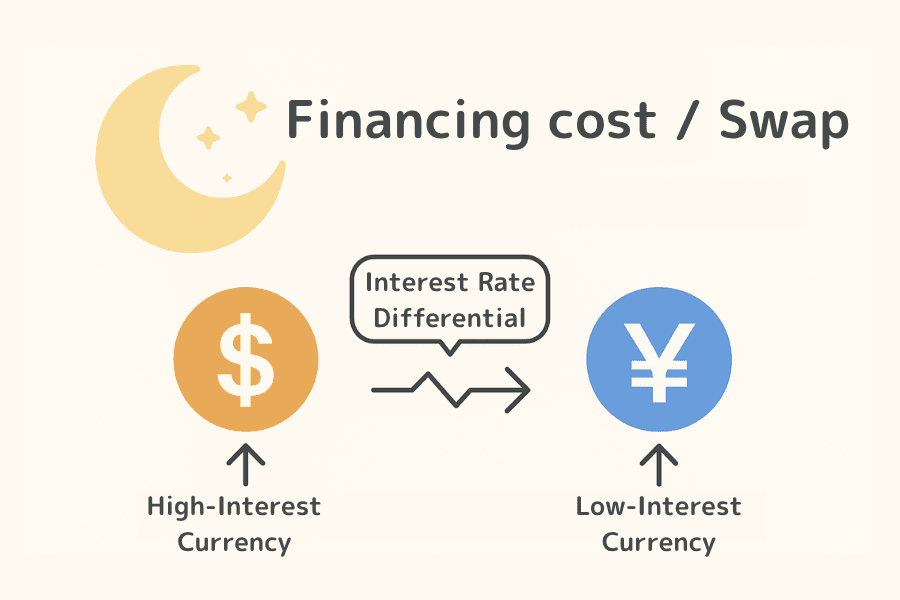
When traders hold a position overnight, the broker automatically rolls it over and calculates the interest based on the rate differential. Understanding how financing costs work, how they are calculated, and the associated risks helps traders plan strategies and manage costs more effectively.
Key Takeaways
- What financing costs (swap points) are and how they arise
- How to calculate overnight financing charges with examples
- Key considerations for managing costs in longer-term positions
- How to read a swap calendar and understand triple-swap days
1. What Is Financing Cost?
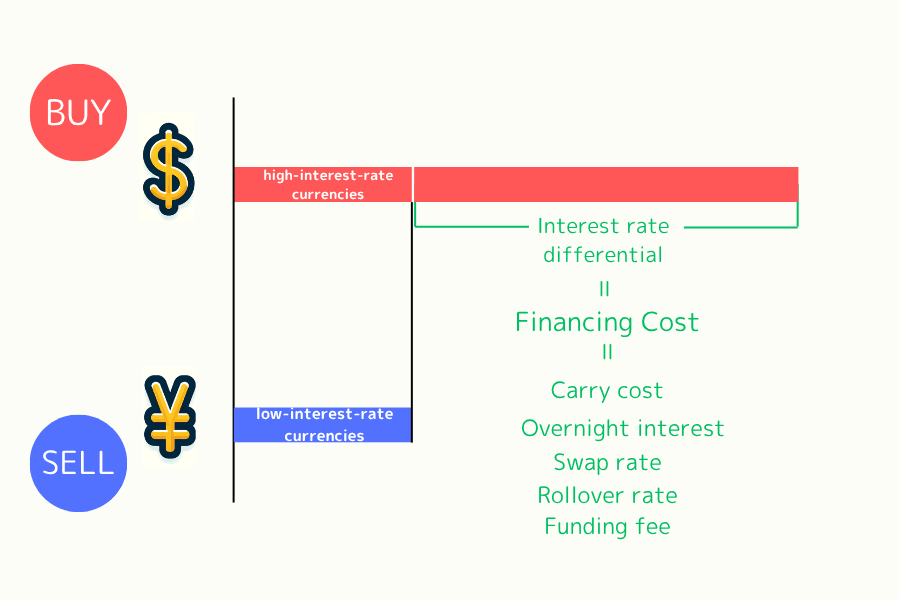
Financing cost (also known as swap, rollover interest, or overnight interest) is the profit or loss arising from the interest rate differential between two currencies in forex and CFD trading.
Other common terms include "interest rate differential adjustment fee" and "storage fees." For consistency, this article uses the term "financing cost."
When a trader holds a position overnight, the broker calculates interest based on the difference in short-term interest rates between the two currencies involved. The position is automatically rolled over to the next trading day.
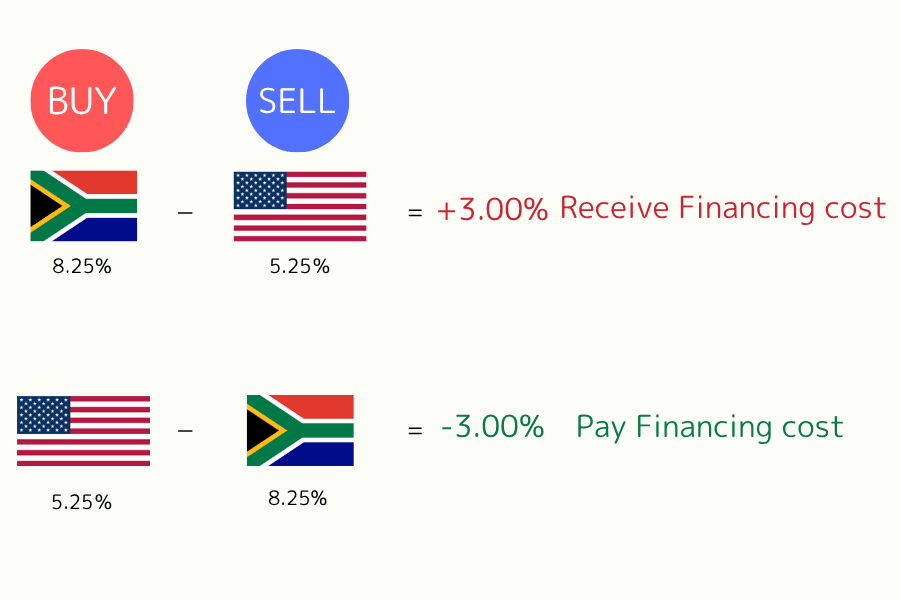
When you "sell a low-interest-rate currency and buy a high-interest-rate currency," you typically receive a positive financing cost (profit). Conversely, selling the higher-rate currency and buying the lower-rate currency results in a negative financing cost (payment).
Because interest rate environments change over time, the relationship between positive and negative financing costs can reverse. In some cases, both long and short positions may carry negative financing costs simultaneously.
2. Calculation Method
Financing costs are not fixed values. They fluctuate daily based on short-term money market interest rates and exchange rates, and the exact calculation may vary slightly between brokers.
Importantly, financing costs are generally not based directly on central bank policy rates. Instead, they reference actual interbank money market rates.
General formula:
Financing Cost (USD) = Position Size x Interest Rate Differential (%) / 365 (days)
In the forex market, spot transactions normally settle two business days after the trade date. However, most retail traders do not intend to take physical delivery of the currency.
To address this, brokers use a rollover (swap) mechanism to automatically extend the settlement date to the next trading day. The financing cost for the extended period is calculated and credited or debited at that point.
This process typically occurs after the New York market close. As long as the position remains open, the day's financing cost is reflected in the account.
3. Advantages and Disadvantages
Financing costs are not just a trading expense. They can also serve as a strategic tool. Below is a breakdown of the key advantages and disadvantages.
Advantages
| Advantage | Description |
|---|---|
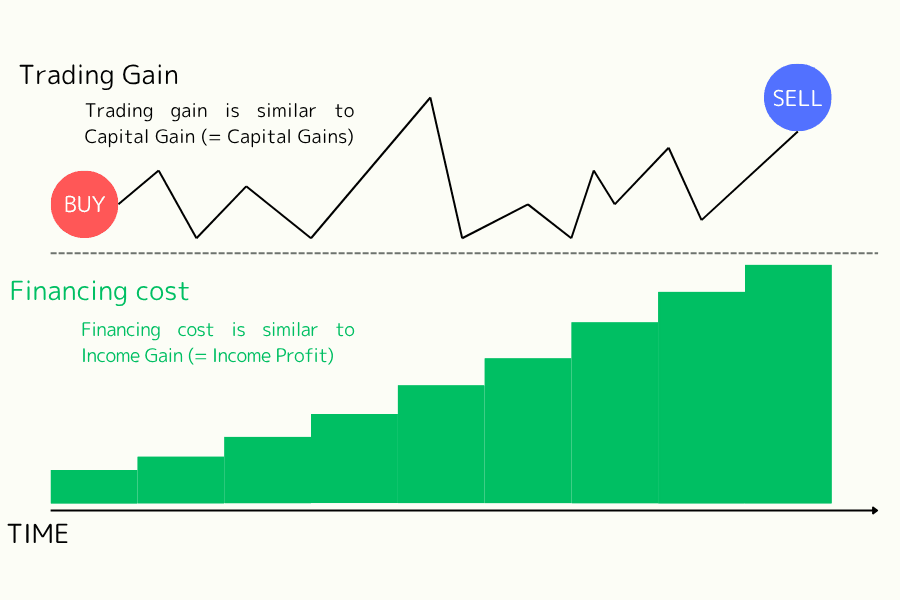
| Dual income streams | In addition to capital gains from price movements, traders can earn income from the accumulated interest rate differential. |
| Steady accumulation | Financing costs accrue daily as long as the position is held, creating a steady cash flow. |
| Compatible with trading profits | When the price trend is also favorable, traders can capture both trading profits and financing cost income, making it particularly suitable for medium- to long-term strategies. |
Disadvantages
| Disadvantage | Description |
|---|---|
| Negative financing costs | If the position direction involves buying a low-interest-rate currency and selling a high-interest-rate currency, the trader must pay interest, increasing costs. |
| Direction-dependent outcomes | For the same currency pair, one direction may yield positive financing costs while the other incurs negative costs. |
| Interest rate reversal risk | Changes in central bank policies can cause previously positive financing costs to turn negative, introducing uncertainty. |
| High volatility of high-yield currencies | High-interest-rate currencies often come from economies with elevated risk, leading to large price swings that can offset or exceed financing cost gains. |
| High-Interest-Rate Currency | Low-Interest-Rate Currency | Financing Cost |
|---|---|---|
| Buy | Sell | Positive (income) |
| Sell | Buy | Negative (payment) |
4. Key Points to Avoid Mistakes
Financing costs can be a source of extra income, but poor management can turn them into a persistent cost burden. The following points help traders reduce risk.
| Key Point | Description |
|---|---|
| Choose suitable currency pairs | Select pairs with narrower spreads to reduce transaction costs. Observe the interest rate differential between the two countries and target "high-rate vs. low-rate" combinations to avoid negative financing costs. |
| Monitor the size of the interest rate gap | The larger the differential, the greater the financing cost income. When the differential is small, it may reverse to negative. Always review interest rate levels before trading. |
| Diversify your positions | High-interest-rate currencies tend to be volatile, and concentrating funds in a single pair increases risk. Spreading capital across pairs with low correlation helps mitigate potential losses. |
| Control leverage | Leverage amplifies both profits and losses. For volatile high-yield currencies, consider using lower leverage to manage risk more effectively. |
| Maintain your margin ratio | Once a forced liquidation is triggered, financing cost accumulation stops. Regularly check your account's margin level to avoid liquidation and preserve the opportunity for long-term income. |
5. Historical Data and Applications
Financing cost values are not fixed. They shift with each country's interest rate policy, money market conditions, and individual broker rules.
For traders who hold positions long term or build strategies around financing costs, tracking historical data helps with better planning and execution.
Broker-specific rule differences
Each broker's calculation method and crediting rules differ, so actual financing cost values may vary between providers.
Titan FX historical data
Titan FX provides a detailed swap calendar where traders can look up the financing cost for any currency pair on any specific date.
By reviewing these records to understand "when" and "how much" financing cost is applied, traders can make better-informed decisions about entry and exit timing.
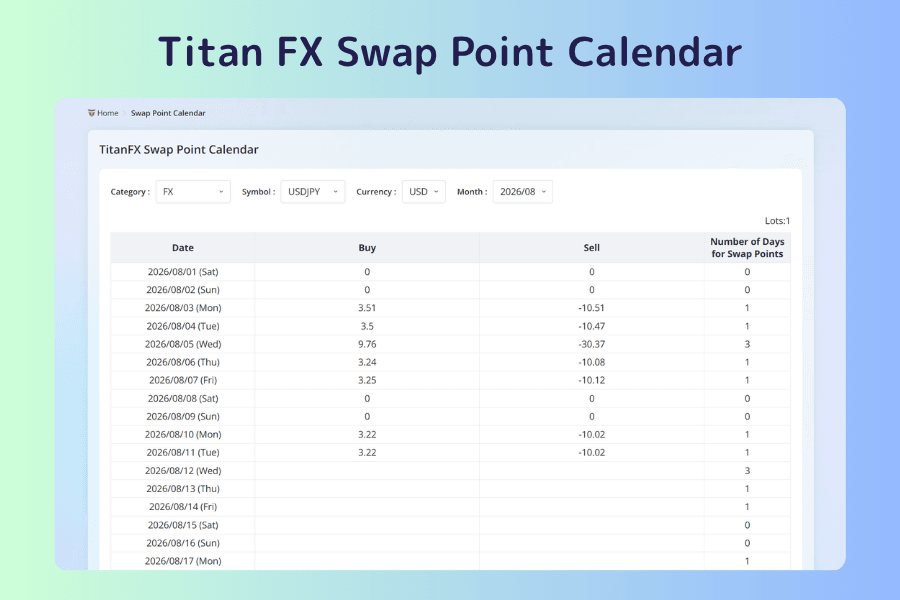
Triple Swap Day
In most cases, financing costs on Wednesday are tripled to account for the weekend settlement gap. Ignoring this can lead to unexpected differences in costs or income.
Practical example
In USD/JPY historical data, a typical daily buy-position financing cost might be around $7. On Wednesday, however, the triple calculation brings it to over $21. This reminds traders to factor in periodic financing cost fluctuations when planning how long to hold a position.
6. Important Notes for Traders
Note 1: Watch for negative financing costs
If your position direction is "buy low-interest-rate currency, sell high-interest-rate currency," you will pay interest every day, increasing your holding costs. If the market also moves against you, losses can compound further.
Note 2: High-interest currencies come with high volatility
High-interest-rate currencies often belong to countries with less stable economies, resulting in large price swings. While the interest income may look attractive, sharp exchange rate movements can offset or even exceed financing cost gains.
Note 3: Financing cost is not a standalone strategy
Relying solely on financing cost income is not a robust approach. It should be part of a broader trading plan that incorporates technical analysis, risk management, and capital allocation to balance returns against risk.
Understanding FX basics also supports a smoother experience with swap-focused strategies. Additionally, FOMC interest rate decisions directly influence financing costs, so keeping an eye on the economic calendar is important.
Frequently Asked Questions (FAQ)
Q1: Can swap points be positive?
Yes. When you buy a high-interest-rate currency and sell a low-interest-rate currency, you receive the interest rate differential as swap points. However, the amount fluctuates with changing interest rate environments.
Q2: When are swap points applied?
Swap points are typically applied when a position is held past the NY market close (early morning Japan time). On Wednesdays, triple swap is applied to account for the weekend.
Q3: How can I minimize financing costs?
Day trading (closing positions within the same day) eliminates overnight costs entirely. For longer-term holds, check the swap calendar and avoid currency pairs with large negative swaps.
7. Summary
Financing cost (swap) is the cost or income arising from interest rate differentials between currencies in forex and CFD trading.
Used wisely, it can become an additional source of income. However, ignoring the risks can turn it into a trading burden.
Traders should understand the calculation method, stay alert to interest rate changes, and combine risk management with their trading strategy to make the most of financing costs.
Further Reading
Related Articles
Titan FX Research. We produce educational content for investors, covering a wide range of financial instruments including forex, commodities (crude oil, precious metals, agricultural products), stock indices, U.S. equities, and digital assets.
Primary Sources by Category
- Interest rates and monetary policy: Central bank official websites (Federal Reserve, ECB, BOJ, etc.), BIS interest rate statistics
- FX market mechanics and rollovers: Investopedia ("Forex Rollover," "Swap Points"), CFTC educational materials
- Broker-specific information: Titan FX official site — Swap Calendar, trading conditions page