

How to Read Candlestick Charts: Body, Wicks, Single and Multi-Candle Patterns
A candlestick chart is a price chart that draws each period's open, high, low, and close as a single "candle." The length and color of the body show whether buyers or sellers had the upper hand during the period, and the wicks above and below record how far price traveled before being pushed back. It is the most common chart type in stocks, forex, futures, precious metals, and crypto, and the starting point of technical analysis.
Reading a candle comes down to three things: the size of the body, which way the wick extends, and where the candle sits in the trend. The body reflects the net move from open to close, the wick records the range price touched but could not hold, and the location decides whether the same shape means anything for a trade. There are many pattern names, single-candle and multi-candle alike, but every one of them is read from these three elements.
This guide starts with the structure of a single candle, explains how to read the body, the wicks, and the colors and how to choose a timeframe, then organizes the common single-candle and multi-candle patterns, and finishes with how candlestick analysis is used in actual trading. Every combination pattern links to its dedicated article on this site.
- A candle is made of four prices: open, high, low, and close. The body is the distance from open to close; the wicks are the range price reached but did not hold
- Colors are only a convention: East Asian markets mostly draw rising candles in red, Western charts mostly in green, and MT4/MT5 colors can be set to anything, so check the scheme before reading
- Single-candle patterns are read from body size plus wick position, not memorized by name: a long body means one side dominated, a long wick means a rejected excursion, a small body means indecision
- The same shape means different things in different places: a hammer at the end of a decline is a reversal candidate; the identical shape at the end of a rally is a hanging man
- Multi-candle patterns fall into reversal, continuation, and momentum types, and each still has to be read by location; three white soldiers and three black crows are momentum patterns, and a gap can signal a breakaway, a continuation, or exhaustion depending on its type
- No candlestick pattern has a fixed success rate across instruments and timeframes; trend, location, volatility, and confirmation decide the outcome. Place the stop where the reasoning fails
- 1. What Is a Candlestick Chart? The Four Prices in One Candle
- 2. How to Read a Candle: Body, Wicks, and Color
- 3. Which Timeframe Should You Use?
- 4. Single-Candle Patterns: Body and Wicks First
- 5. Multi-Candle Patterns: Reversal, Continuation, and Momentum
- 6. How to Use Candlestick Analysis: Location, Confirmation, and Stops
- 7. Candlestick Chart FAQ
- 8. Conclusion
1. What Is a Candlestick Chart? The Four Prices in One Candle
A candlestick chart records four prices for each period—the open, high, low, and close—in one candle-shaped figure. Each candle corresponds to one timeframe, which can be one minute, one day, or one month.
A candle has two parts. The body is the rectangle between the open and the close: a close above the open makes a bullish candle, a close below the open a bearish one. The wicks (also called shadows) are the thin lines extending above and below the body; the top points to the high and the bottom to the low, marking the range price reached during the period but failed to hold by the close.
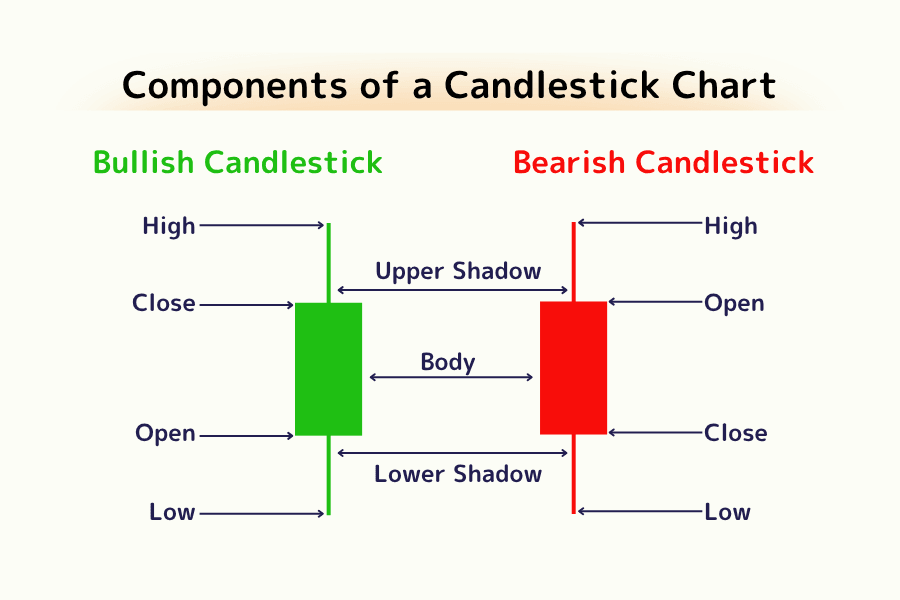
| Component | Description |
|---|---|
| Open | The first traded price when the period begins |
| Close | The last traded price when the period ends |
| High | The highest price traded during the period; the tip of the upper wick |
| Low | The lowest price traded during the period; the tip of the lower wick |
| Body | The rectangle between the open and the close; bullish if the close is above the open, bearish if below |
| Wicks | The thin lines above and below the body; the range price reached during the period but did not hold at the close |
Candlestick analysis grew out of the price records and trading techniques of Japan's rice markets. Munehisa Homma, a rice merchant at the Dojima market in 18th-century Osaka, is often regarded as its pioneer, although the chart in its modern form took shape over time. After Steve Nison introduced Japanese candlestick techniques to Western markets systematically in the 1990s, the candlestick chart became the standard price chart in financial markets worldwide.
Compared with a line chart, which plots only closes, or a bar chart, which marks the four prices with thin lines, the candlestick's body has width and color, so the direction and force of each period are visible at a glance. That is why it became the default, and it is also its limit: a candlestick chart records the path price took and contains no information about volume or positioning. The strengths and weaknesses of the format are covered in Advantages and Disadvantages of Candlestick Charts.
2. How to Read a Candle: Body, Wicks, and Color
The body: length, and where the close sits
The longer the body, the clearer one side's advantage during the period: a long bullish candle means buyers led, a long bearish candle means sellers led. A very short body means the two sides were evenly matched, or the market had no clear direction.
Body length is judged against the last few candles. The same 30-pip body is large in a quiet Asian session and unremarkable right after a US data release. Also note where the close sits within the whole candle: a close near the high means buyers held the upper hand to the last moment; a close in the middle means the intraday push up or down was half undone by the end.
The wicks: prices reached but not held
A long lower wick means price fell sharply during the period and was bought back before the close; a long upper wick means price spiked and was sold back down. The longer the wick, the farther price traveled in that direction without staying there. Whether that counts as a genuine rejection has to be judged together with the surrounding candles, the volatility at the time, and the location.
A wick has no bullish or bearish bias of its own; the meaning comes from where it appears. A long lower wick after a decline says there are buyers at the lows; a long upper wick after a rally says there are sellers at the highs. The same wick in the middle of a range is usually just noise.
Color: check which convention the chart uses
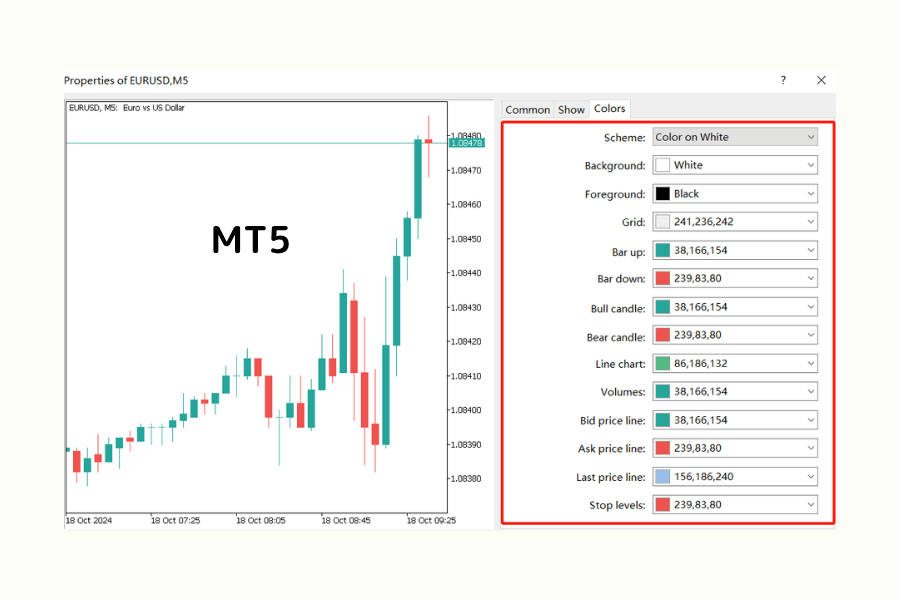
Markets in Japan, Korea, and the Chinese-speaking world mostly draw rising candles in red (or white) and falling candles in green, blue, or black; Western charts mostly use green for rising and red for falling. The same chart can show opposite colors on software from different regions, so check the legend or the settings before reading, and when in doubt look at the open and the close directly.
MT4/MT5 ship with several color schemes—Green on Black, Black on White, Color on White—and the colors of bullish candles, bearish candles, wicks, and the background can each be changed. On MT5 for Windows, for example, the default Green on Black scheme shows black-filled bullish candles with green outlines and white-filled bearish candles on a black background, using neither red nor green. Right-click the chart, open Properties, and switch to the Colors tab to set the scheme you are used to; the steps are in Setting Chart Colors in MT5 and Setting Chart Colors in MT4. The diagrams in this article use green for bullish and red for bearish candles.
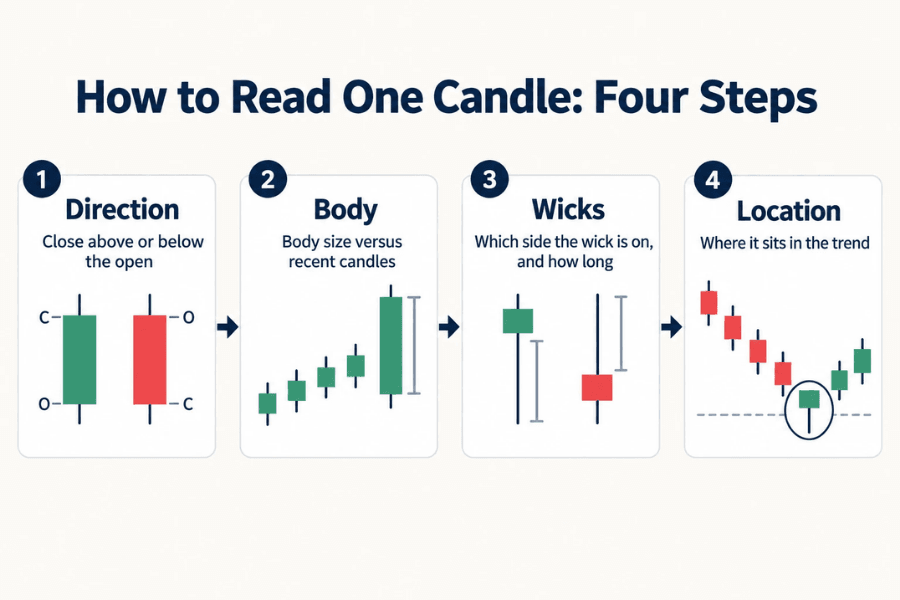
Put the three together and you have the order for reading a candle: first whether the close is above or below the open, then whether the body is large relative to recent candles, then which side the wick is on and how much of the candle it takes up, and finally where the candle sits in the trend.
3. Which Timeframe Should You Use?
Each candle represents one timeframe, and the same stretch of price looks completely different on different timeframes. MT4 offers 9 timeframes, from one minute to monthly; MT5 expands the list to 21 with intermediate options such as 2-minute, 3-minute, 2-hour, and 12-hour bars. Switching is covered in Changing the Chart Timeframe in MT5, and if your chart shows lines or bars instead of candles, Changing the Chart Type in MT5 shows how to switch back.
The choice depends on holding time. Traders who hold for minutes watch the 1- and 5-minute charts, those who hold for days watch the 1-hour and 4-hour charts, and those who hold for weeks or longer watch the daily and weekly charts. The table below shows the usual pairing; in practice, let your own holding time decide.
| Trader type | Usual timeframes | Description |
|---|---|---|
| Scalper | M1, M5 | Small moves over very short periods, frequent entries and exits |
| Day trader | M5, M15, M30, H1 | Opens and closes within the day, no overnight positions |
| Short-term swing | H1, H4 | Holds from a day to several weeks, riding one leg of a trend |
| Medium-term swing | D1, W1 | Holds for weeks to months, analyzing the medium-term trend |
| Long-term investor | W1, MN | Holds for months or longer, combined with fundamental analysis |
Two principles hold on every timeframe. A candle on a higher timeframe covers more time and more price action, so it is less easily thrown off by a single tick than a very short timeframe, and the same shape usually carries more weight on a daily chart than on a 5-minute chart; whether the signal is more effective still depends on the strategy, the instrument, and the market at the time. The other principle is set the direction on the higher timeframe, find the location on the lower one: confirm the trend on H4 or D1, then go down to M15 or H1 to find the entry, and you will make far fewer mistakes than by staring at one timeframe.
Why daily candles differ from platform to platform
Forex is an over-the-counter market with no central exchange. Brokers use different price feeds and different server time zones, and once the cut-off time of the daily candle differs, the open, the close, and sometimes the high and low of the same day all differ slightly, and so do the weekly and monthly candles. When comparing candlestick patterns, stay on one platform and one price feed, and do not mix daily candles from different platforms.
4. Single-Candle Patterns: Body and Wicks First
There are only five groups of single-candle patterns. Learn the shapes from the overview below first, then read the three lines for each group: what it looks like, where it tends to appear, and what it means. Forgetting a name does not matter; the shape and the location are what you judge by.
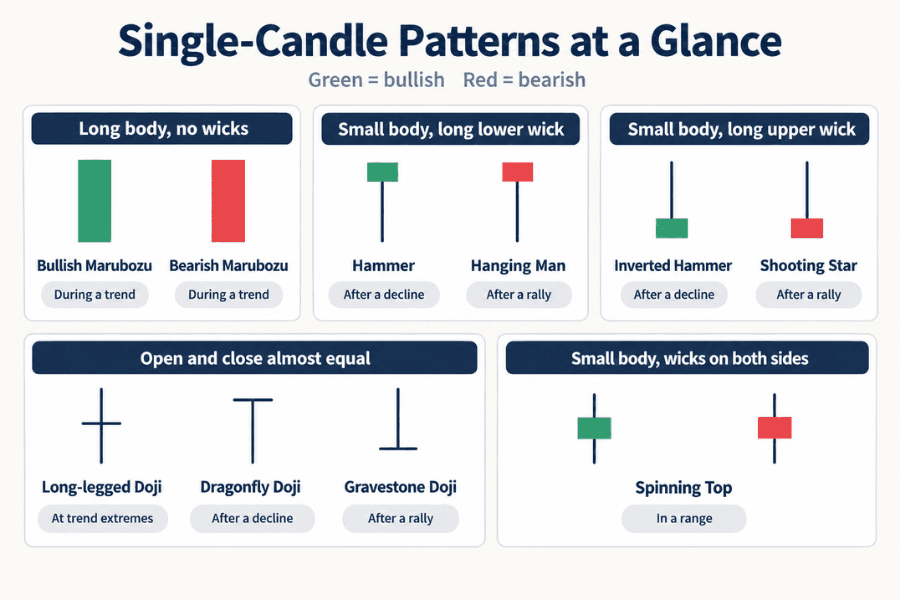
Marubozu (long bullish and bearish candles)
- Shape: a long body with almost no wicks
- Location: most common in the middle of a trend
- Meaning: one side dominated the period. At the end of a sharp rally or sell-off it may be the last wave of chasing, so watch whether the next candle follows through
Hammer and Hanging Man
- Shape: a small body near the top, a lower wick about twice the body or longer, and almost no upper wick
- Location: at the end of a decline it is a hammer; at the end of a rally it is a hanging man
- Meaning: price fell sharply during the period and was bought back. The hammer is a candidate for an upward reversal; the hanging man is a warning that dips are appearing at the highs
Inverted Hammer and Shooting Star
- Shape: a small body near the bottom, an upper wick about twice the body or longer, and almost no lower wick
- Location: at the end of a decline it is an inverted hammer; at the end of a rally it is a shooting star
- Meaning: price spiked and was pushed back. The inverted hammer shows an upward probe at the lows; the shooting star shows sellers at the highs
Doji
- Shape: the open and close are almost equal, and the body shrinks to a line
- Location: meaningful at the end of a trend; frequent and unremarkable inside a range
- Meaning: a tug-of-war that ended back where it started—indecision. The long-legged doji has long wicks on both sides, the dragonfly doji only a long lower wick (leaning bullish), and the gravestone doji only a long upper wick (leaning bearish)
Spinning Top
- Shape: a small body with upper and lower wicks of similar length
- Location: inside a range, or in the later stage of a trend
- Meaning: both sides tried and neither succeeded. After a run of long bodies it signals fading momentum; wait for the next direction
Three reminders. The hammer and hanging man, and the inverted hammer and shooting star, are identical shapes; location decides the meaning. Single-candle reversal patterns should not be judged on one candle alone; they are confirmed only when the next candle closes in the expected direction. The wick-to-body ratios are common identification rules rather than fixed standards, and textbooks differ slightly. Finally, the four-price-equal "price line" candle is common at limit-up and limit-down in stocks and almost never appears in forex.
Single-candle quick reference| Pattern | Shape | Typical location | Meaning |
|---|---|---|---|
| Bullish/Bearish Marubozu | Long body, little or no wick | Mid-trend | One side dominates; at the end of a sharp move, watch the next candle |
| Hammer | Small body on top, long lower wick | End of a decline | Buying at the lows, upward reversal candidate |
| Hanging Man | Same shape as the hammer | End of a rally | Dips appearing at the highs, the rally may be ending |
| Inverted Hammer | Small body at the bottom, long upper wick | End of a decline | Upward probe at the lows, needs the next candle to confirm |
| Shooting Star | Same shape as the inverted hammer | End of a rally | Sellers at the highs, downward reversal candidate |
| Doji | Open and close almost equal | End of a trend | Indecision; dragonfly leans bullish, gravestone leans bearish |
| Spinning Top | Small body, similar wicks both sides | In a range or late in a trend | Fading momentum, wait for direction |
5. Multi-Candle Patterns: Reversal, Continuation, and Momentum
Combinations of two to five candles describe the course of a battle between buyers and sellers. Look at the overview first, then remember them by candle count: for two candles, check whether the second engulfs the first; for three, whether the middle one is small; for five, whether the middle three stay inside the range of the first. Each pattern has its own article on this site, so only the essentials are given here.
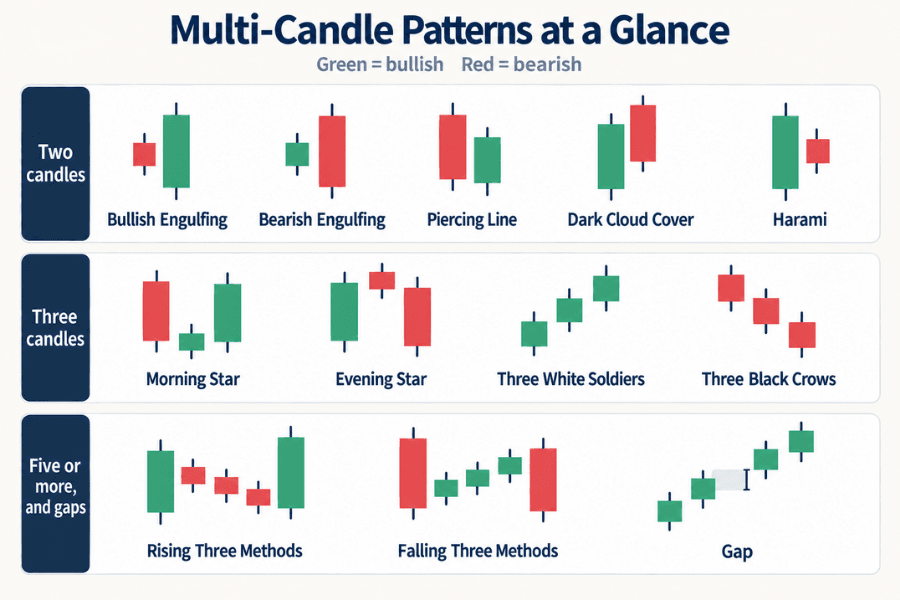
Two candles
- Bullish and Bearish Engulfing: the second candle's body completely covers the first. A bullish engulfing at the end of a decline is a counterattack by buyers; a bearish engulfing at the end of a rally is the reverse
- Piercing Line and Dark Cloud Cover: weaker versions of the engulfing, where the second candle closes only past the midpoint of the first body. The piercing line appears at the end of a decline, the dark cloud cover at the end of a rally
- Harami: the second candle's body sits entirely inside the first body, showing that momentum suddenly disappeared; confirm with the direction that follows
Bottom formations are collected in Bullish Reversal Candlestick Patterns and top formations in Top Reversal Candlestick Patterns.
Three candles
- Morning Star and Evening Star: a long bearish candle, a small body, and a long bullish candle make the morning star at the end of a decline; the evening star is the reverse. Japanese tradition groups them under the Three Rivers
- Three White Soldiers and Three Black Crows: three bullish candles of similar size with rising closes are the Three White Soldiers; three bearish candles with falling closes are the Three Black Crows. Both are strong momentum patterns: at the end of a clear decline or rally they are reversal candidates, after a trend has already started they read more like continuation
The full classification of multi-candle reversals and their entry timing is in Reversal Patterns; the combinations sorted by rising and falling scenarios are in Bullish Candlestick Patterns and Bearish Candlestick Patterns.
Five or more, and gaps
- Rising and Falling Three Methods: a long bullish candle, three small bearish candles that stay inside its range, then a fifth long bullish candle that closes above the first—the pullback was only a pause. The falling three methods is the reverse. The identification rules are in Rising and Falling Three Methods
- Gap: an untraded price range between two adjacent candles. A gap by itself does not tell you continuation or reversal: breakaway and runaway gaps usually support the trend, while an exhaustion gap can appear at its end. The four types are covered in Price Gaps, and three gaps in a row, the Three Gaps pattern, is often read as a sign of an overheated market
Most of these three- and five-candle patterns come from Japan's Sakata Five Methods: three mountains, three rivers, three gaps, three soldiers, and three methods. Rivers, gaps, soldiers, and methods are covered above; the Three Mountains is a larger reversal structure made of three peaks or three troughs. Widen the view further and the double top and bottom, head and shoulders, triangle, flag, and wedge—structures built from dozens of candles—belong to chart patterns, whose entry points are Continuation Patterns and the Reversal Patterns article mentioned above.
Multi-candle quick reference| Pattern | Candles | Typical use | Typical location |
|---|---|---|---|
| Bullish/Bearish Engulfing | 2 | Reversal | End of a decline/end of a rally |
| Piercing Line/Dark Cloud Cover | 2 | Reversal | End of a decline/end of a rally |
| Harami | 2 | Reversal (needs confirmation) | End of a trend |
| Morning Star/Evening Star | 3 | Reversal | End of a decline/end of a rally |
| Three White Soldiers/Three Black Crows | 3 | Reversal or trend confirmation | End of a trend or early in a trend |
| Rising/Falling Three Methods | 5 | Continuation | Within an uptrend/within a downtrend |
| Gap | 2 | Depends on type: breakaway, continuation, or exhaustion | Early, middle, or late in a trend |
6. How to Use Candlestick Analysis: Location, Confirmation, and Stops
A pattern is only the shape of a signal; whether it is worth trading depends on where it appears. In practice, check in the following order.
Confirm the location and the trend first
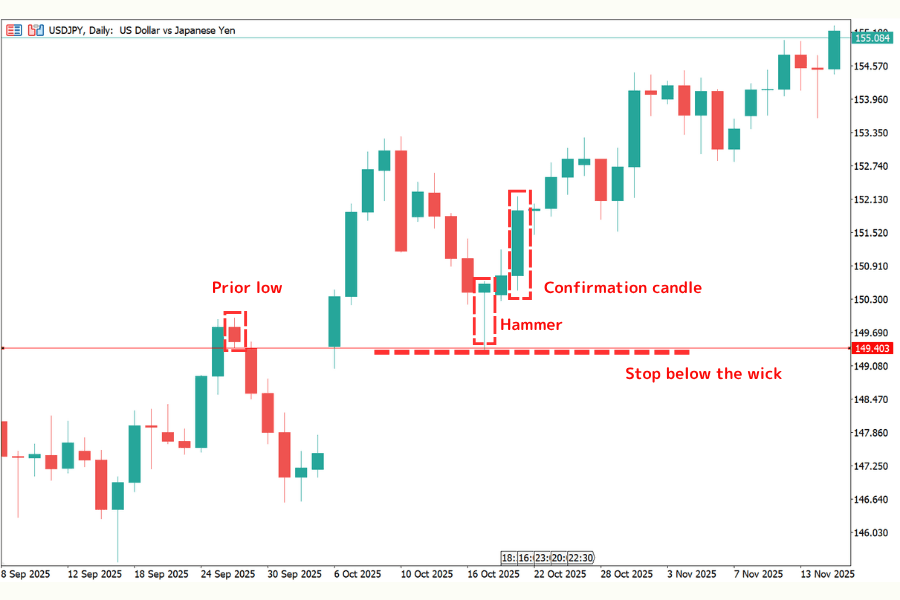
A hammer is worth attention only when it lands somewhere meaningful: the previous swing low, near a trendline or support and resistance, at a moving average, or at a computed reference such as a pivot point. The same shape in the middle of a range is mostly noise.
The direction also has to agree with the higher timeframe. In a D1 uptrend, a bearish engulfing on H1 is usually just the start of a pullback; shorting it as a reversal is the most common way candlestick patterns lose money.
Wait for the close, then look for confirmation
Until a candle closes, its shape can still change. What looks like a shooting star mid-session can be bought back into a long bullish candle before the close, so always judge the closed shape, and most reversal patterns only count once the next candle moves in the expected direction. A false breakout—price crossing a key level without holding it—is the classic price of entering before the close.
Volume is a common confirmation tool in stock markets, but forex needs a different approach. Spot forex has no central exchange, and the Volume shown on MT4/MT5 charts is tick volume, the number of quote changes. It works as a rough gauge of relative activity, but it is not the real turnover of the forex market and can only be compared within the same instrument and timeframe.
Entry, stops, and tools
The stop goes where the reasoning fails. If the reason for entering is a candlestick pattern, the stop usually sits just beyond the pattern's extreme: below the low of the lower wick when buying a hammer, above the high of the upper wick when selling a shooting star; once price crosses that point, the pattern has failed. If your strategy sets the stop loss by ATR, a structural low, or a fixed risk distance, keep your own rule and do not change it for the pattern. The stop distance also determines position size and the risk-reward ratio.
To scan many instruments at once, the Chart Pattern Scanner automatically detects patterns forming on the major instruments from M5 to D1, and Key Support and Resistance Levels lists reference prices computed by several methods for each instrument, which helps confirm where a pattern appeared. Trend followers who find standard candles too noisy can look at Heikin-Ashi, a candle redrawn from averaged prices.
Common mistakes
-
Reading a single candle in isolation: one candle describes only one period's battle. Without the surrounding candles and the trend location, any pattern has counterexamples
-
Interpreting every candle: most candles mean nothing special. A pattern deserves time only at a key location; anywhere else, a shape is just a shape
-
Fading a strong trend: reversal patterns fail repeatedly inside a strong trend. Use patterns in the direction of the higher timeframe and the hit rate improves dramatically
-
Treating a pattern as a fixed win rate: the same pattern performs very differently across instruments, timeframes, and market conditions. Capping each loss with a stop is more realistic than hunting for high-probability patterns
7. Candlestick Chart FAQ
Q1: What do red and green candles mean?
The color shows whether the close is above or below the open, but which color means "up" is a regional convention. Markets in Japan, Korea, and the Chinese-speaking world mostly use red (or white) for rising candles; Western charts mostly use green (or white); and MT4/MT5 colors can be set to anything. Check the settings before you read a chart, and when in doubt, compare the open and the close directly.
Q2: Can I trade a candle before it closes?
Not recommended. A candle in progress is only a temporary shape, and the last few minutes can turn a shooting star into a long bullish candle. Always judge the closed shape. If you must act early, watch closed candles on a lower timeframe and accept that the signal may not hold.
Q3: Why does the same day's candle look different at different brokers?
Forex is an over-the-counter market: brokers use different price feeds and server time zones, so the daily cut-off differs and the open, high, low, and close of the same day differ with it. Stay on one platform's data for analysis, and when comparing candles from different sources, first check that both use the same server time.
Q4: Can a candlestick pattern be an entry signal on its own?
It can serve as the trigger, provided the location is right, the direction agrees with the higher timeframe, and you wait for the close to confirm. There is no fixed success rate that holds across markets and timeframes; the same pattern performs very differently by instrument and conditions. Set the stop at the moment of entry, and manage risk through the cap on each loss rather than through expectations about win rates.
Q5: Which indicators work well with candlesticks?
Three kinds are most common: moving averages and trendlines to judge the direction of the trend, RSI and MACD to judge whether price is overextended, and support and resistance or pivot points to mark key levels. The principle is to use indicators to confirm the location and context of a pattern; stacking more indicators does not make a signal more reliable.
Q6: Why does forex show fewer gaps than stocks?
Forex trades 24 hours a day with continuous prices, so gaps on the daily chart usually appear only at the Monday open, most visibly when major news breaks over the weekend. Stocks have fixed opening and closing times, and overnight news is concentrated into the opening price, so gaps are far more common. Forex also has no limit-up or limit-down rules, so the four-price-equal candle almost never appears.
Q7: What is the difference between standard candles and Heikin-Ashi?
Standard candles record each period's open, high, low, and close faithfully. Heikin-Ashi recalculates the open and close from averages, producing a smoother chart in which trending stretches stay one color, but the prices on its bars are computed values rather than real trades. Heikin-Ashi suits judging whether a trend is still running; actual orders and stops should be placed against the real prices on standard candles.
8. Conclusion
A candlestick chart compresses a period's battle into one candle: the body shows who won and by how much, the wicks show which prices were tested and rejected, and the color is only a convention for direction. Once these three elements are clear, a single-candle pattern is just a combination of body and wick proportions, and a multi-candle pattern is the course of a battle over several consecutive candles.
The value of a pattern comes from its location. A key level at the end of a trend, a direction that agrees with the higher timeframe, and a confirmed close—only when all three are present does a hammer or an engulfing pattern deserve an order. Place the stop where the reasoning fails, so the cost of being wrong is fixed in advance. For the details of each pattern, the dedicated articles on this site take it from here.
Further Reading
- Bollinger Bands Complete Guide: Principles, Standard Deviation, Formula, Pros & Cons and MT4/MT5 Plotting
- Stochastic Oscillator: Definition, Setup, and Trading Tips
- Double Top and Bottom Patterns: Features and Strategies
- Head and Shoulders Top and Bottom: Structure, Measuring Rule, and Trading Strategies
- Triangle Patterns: Features, Analysis Methods, and Strategies
Titan FX Research Team. We cover a broad set of financial instruments — foreign exchange, commodities (crude oil, precious metals, agricultural products), equity indices, US equities, and digital assets — producing practical, research-backed educational content for traders.
Primary Sources (by Category)
- Technical analysis classics: Steve Nison, Japanese Candlestick Charting Techniques (1991) — definitions and reading principles of single- and multi-candle patterns; John J. Murphy, Technical Analysis of the Financial Markets — pattern confirmation, gap classification, and trend context
- Historical background: the price-recording techniques of the 18th-century Dojima rice market in Osaka and Munehisa Homma, the origin of Japanese charting
- Platform and tools: MetaQuotes MT4/MT5 documentation — number of timeframes, chart color schemes and properties, Volume as tick volume; the Titan FX Chart Pattern Scanner and Key Support and Resistance Levels tool pages