

Forex Trading Structure: Key Mechanisms for Profit & Risk

To achieve consistent profits in forex trading, it’s essential to understand the mechanisms behind gains and losses, as well as the reasons for fluctuations in the forex market.
This article explains the basics of forex operations in a simple, easy-to-understand way, with illustrative examples.
- Forex trading = using margin to buy/sell currency pairs for exchange-rate gains
- Profits/losses come mainly from the spread and swap points (overnight interest)
- Rates move on supply and demand; 24 hours split into Asian, European, US sessions
- Leverage scales both size and risk; watch spreads, forced liquidation, and slippage
- Manage risk with technical/fundamental analysis plus stop-loss and take-profit
- 1. What is Forex? Definition and Basics
- 2. How Profits and Losses Work in Forex
- 3. How Forex Margin Trading Works
- 4. Causes and Impacts of Exchange Rate Fluctuations
- 5. Trading Hours Forex Beginners Should Know
- 6. Other Key Mechanisms for Forex Beginners
- 7. Forex Risks and How to Manage Them
- 8. Frequently Asked Questions (FAQ)
- 9. Summary
1. What is Forex? Definition and Basics
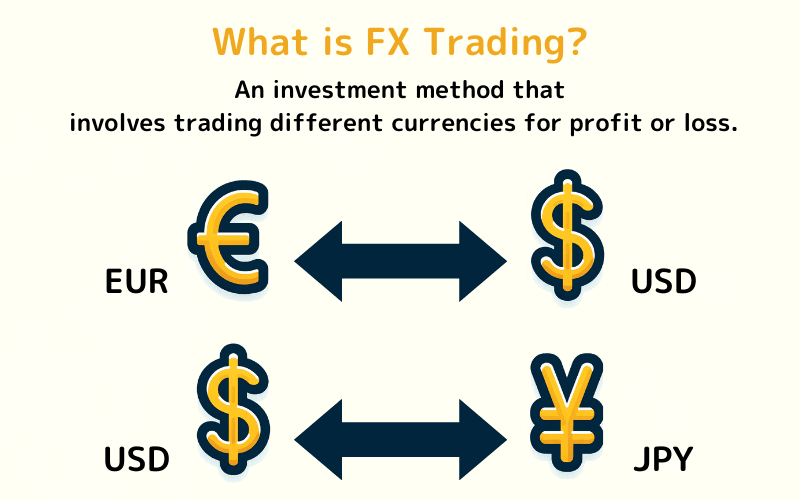
Forex, short for "Foreign Exchange," refers to the trading of currencies. In forex margin trading, investors use margin as collateral to exchange one currency for another.
Simply put, forex involves swapping different currencies, while margin trading means conducting trades with margin as security.
In essence, forex is an investment method where you use margin to buy and sell currencies, aiming to profit from exchange rate movements.
The "exchange rate" fluctuates based on the buying and selling activities of market participants. These trades, in turn, generate either profits or losses.
For more details: What is Forex Trading?
2. How Profits and Losses Work in Forex
In forex trading, profits and losses stem from two main mechanisms: spread profits/losses and financing cost (swap points).
Spread Profits and Losses
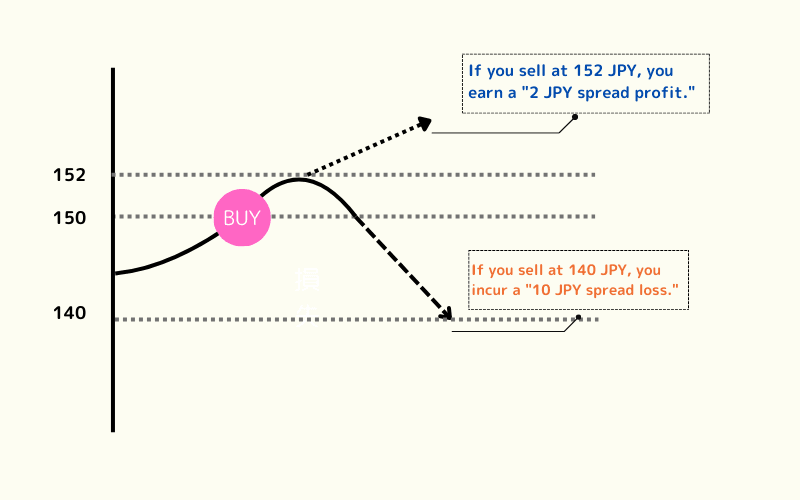
"Spread profits" refer to gains made from exchange rate changes. Conversely, "spread losses" occur when exchange rate movements result in a loss.
In forex, after initiating a buy trade, exchange rate shifts can lead to either a spread profit or loss, as shown below (the reverse applies to sell trades).
Suppose you buy USD at 150 JPY:
- ① If you sell at 152 JPY, you earn a "2 JPY spread profit."
- ② If you sell at 140 JPY, you incur a "10 JPY spread loss."
Financing Cost (Swap Points)
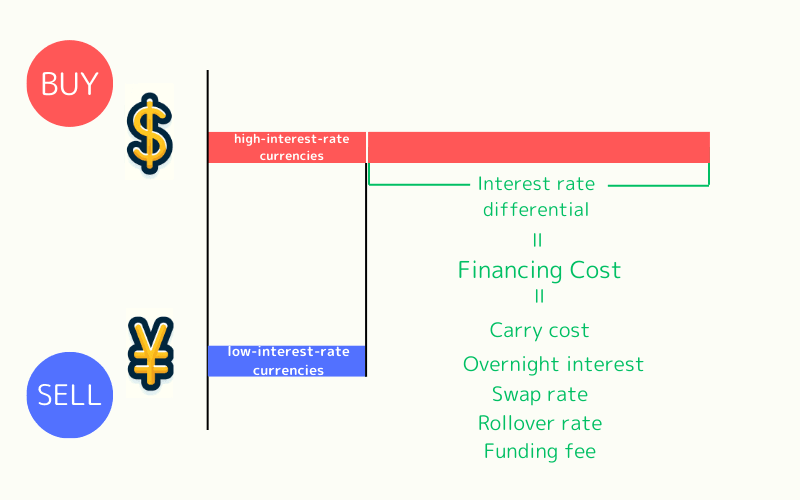
Financing Cost, or swap points, arises from the interest rate difference between two currencies.
When you hold a position where you "buy a high-interest-rate currency and sell a low-interest-rate currency," you earn financing cost. This strategy, known as a "carry trade," leverages interest rate differentials for profit.
Conversely, holding a position where you "buy a low-interest-rate currency and sell a high-interest-rate currency" results in a loss.
Examples of high-interest-rate currencies include the Mexican Peso, Turkish Lira, and South African Rand (emerging market currencies), while low-interest-rate currencies include the Japanese Yen and Swiss Franc.
3. How Forex Margin Trading Works
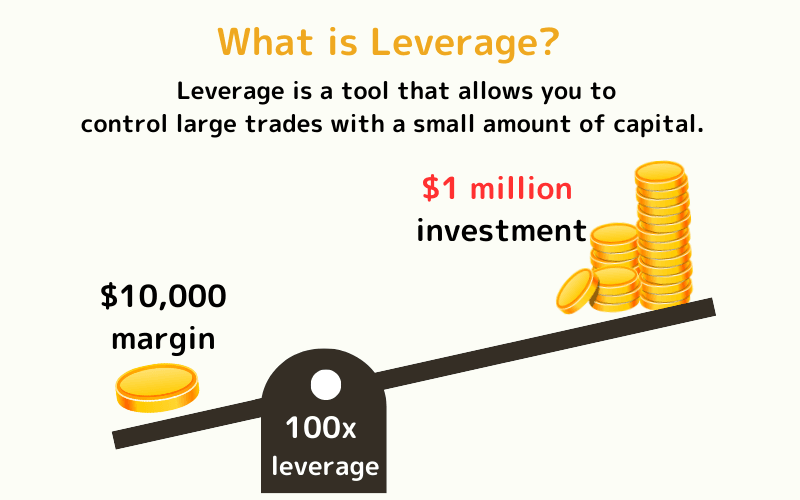
In forex trading, investors deposit funds known as "margin" with a forex broker, using it as collateral to execute trades.
Thanks to "leverage," traders don’t need to fund the full value of their positions.
For example, with Titan FX’s 100:1 leverage, you only need to deposit 1% of the trade value as margin to control a position 100 times larger.
To illustrate: with 100:1 leverage, a $100 margin allows you to trade a $10,000 position.
Titan FX offers up to 1,000:1 leverage on Standard and Blade accounts and up to 2,000:1 on Micro accounts (eligibility required), enabling traders to amplify their potential with minimal capital.
4. Causes and Impacts of Exchange Rate Fluctuations
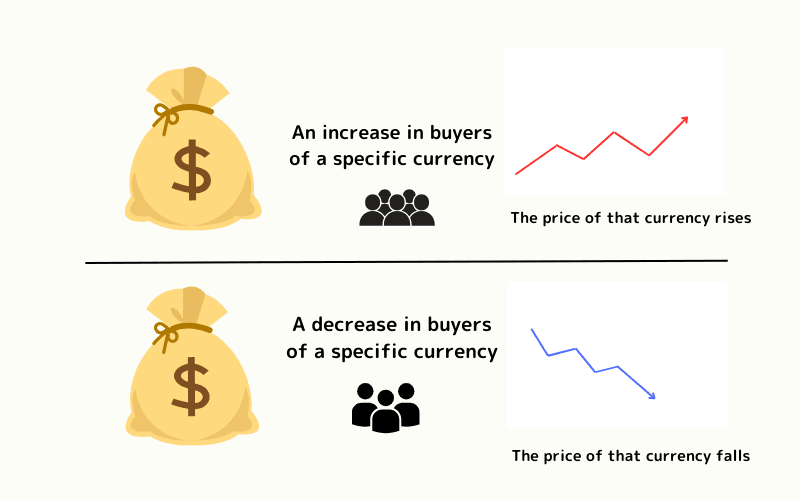
Exchange rates (market prices) are determined by the balance of supply and demand.
As illustrated below, an increase or decrease in buyers for a specific currency causes its price to fluctuate.
Take the USD/JPY pair as an example:
- If USD is bought, the exchange rate rises (USD value increases, JPY value decreases).
- If USD is sold, the exchange rate falls (USD value decreases, JPY value increases).
The two currencies in a pair act like a seesaw: in the USD/JPY market, the trend will either be "JPY strengthens, USD weakens" or "JPY weakens, USD strengthens."
5. Trading Hours Forex Beginners Should Know
The forex market offers highly flexible trading hours. Typically, it operates 24 hours a day, except during Christmas and New Year’s, with markets open globally in places like Tokyo, Hong Kong, Singapore, London, and New York. On weekdays, some market is always active.
Unlike stock trading, which is limited to daytime hours, forex trading can occur at night or even early morning, making it a convenient investment option for various lifestyles.
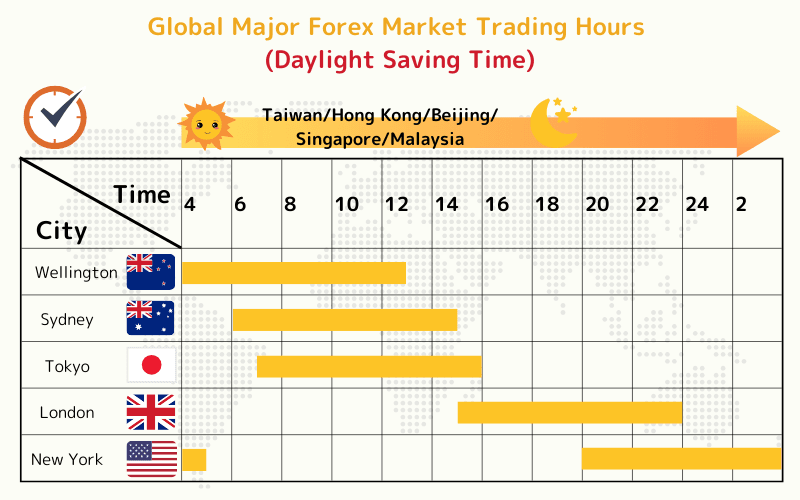
Understanding the characteristics of different sessions is crucial for short-term trading, as profiting during low-volatility periods can be challenging.
| Market Name | Trading Hours (GMT+8) | Active Trading Hours (GMT+8) |
|---|---|---|
| Tokyo Market (Asian Session) | 7:00–15:00 | 7:00–9:00 |
| London Market (European Session, Daylight Saving Time) | 15:00–24:00 | 15:00–18:00 |
| New York Market (American Session, Daylight Saving Time) | 20:00–Next Day 05:00 | 20:00–24:00 |
Full Guide to Forex Trading Hours
6. Other Key Mechanisms for Forex Beginners
Forex beginners should familiarize themselves with these additional mechanisms:
- Leverage Mechanism
- Spread Mechanism
- Loss Cut (Forced Liquidation) Mechanism
- Slippage Mechanism
Leverage Mechanism
Leverage allows traders to use deposited funds (margin) as collateral to trade amounts exceeding their deposit.
For example, with 100:1 leverage, a $10,000 margin enables a $1,000,000 trade.
Leverage is a powerful tool in forex, letting traders control larger positions with less capital. While it can magnify profits, it also heightens risk. Proper leverage use boosts efficiency and aids risk management.
Titan FX offers up to 1,000:1 leverage on Standard and Blade accounts (and up to 2,000:1 on Micro accounts, eligibility required), varying by product:
| Product Category | Trading Instruments | Maximum Leverage |
|---|---|---|
| Forex | EUR/USD, USD/JPY, etc. | 1,000 |
| Precious Metals | Gold, Silver, etc. | 1,000 |
| Energy | Crude Oil, Natural Gas | 500 |
| Soft Commodities | Soybeans, Wheat, etc. | 50 |
| International Indices | US500, NAS100, etc. | 500 |
| Cryptocurrencies | Bitcoin, Ethereum, etc. | 100 |
| Stock CFDs | U.S. Stocks, Japanese Stocks | 20 |
Spread Mechanism
The spread is the difference between the bid (sell) and ask (buy) prices.
Formula: Spread = Ask Price - Bid Price
For example, with EUR/USD:
Spread = 1.0903 - 1.0902 = 0.0001 (1 pip).
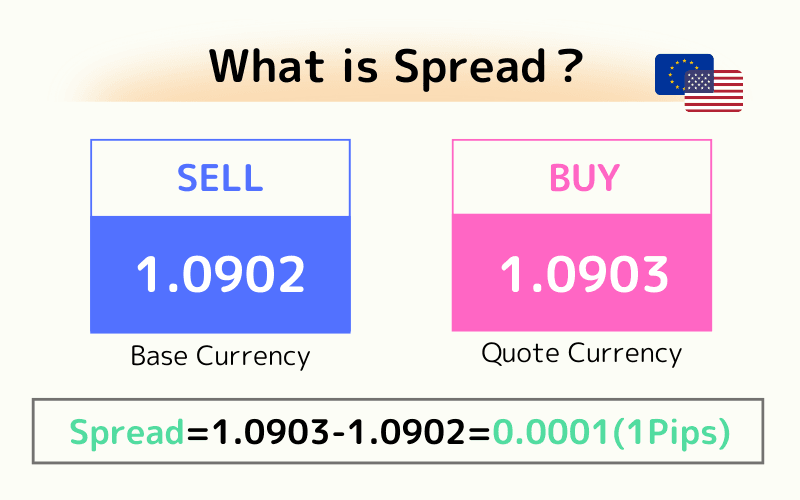
The spread represents the cost of each trade, paid to the broker upon opening a position. Its size reflects a product’s liquidity—higher liquidity typically means smaller spreads, and vice versa.
Thus, spreads are both a key cost indicator and a measure of market conditions and liquidity.
Loss Cut (Forced Liquidation) Mechanism
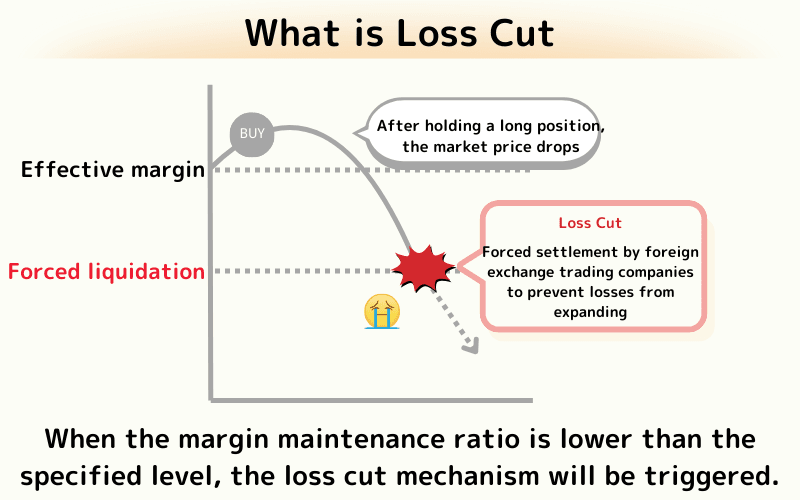
In forex and CFD trading, a loss cut is an automatic closure of positions when floating losses exceed a broker’s margin threshold.
Leverage allows traders to operate multiplies of their margin, boosting efficiency but also risk. Without proper risk management, losses can escalate, potentially wiping out accounts.
Most brokers, including Titan FX, use loss cuts to limit excessive losses. Titan FX’s loss cut triggers at a 20% margin maintenance level—positions are closed if this drops below 20%.
To prevent this, Titan FX sends alerts when account equity falls below 90% of the margin. Loss cut rules vary by broker, so check them beforehand.
Impact and Strategies for Loss Cuts
Slippage Mechanism
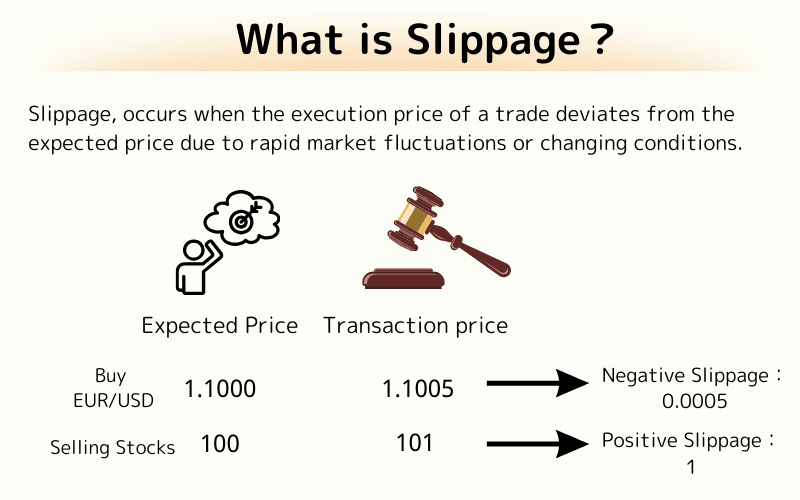
Slippage is the difference between an order’s expected price and its actual execution price.
Orders are sent to a broker’s server via the internet, and slight delays can cause price deviations. Slippage can be positive (favorable) or negative (unfavorable).
While not always detrimental, reviewing a broker’s slippage history is wise to ensure acceptable performance.
7. Forex Risks and How to Manage Them
This section covers forex trading risks and mitigation strategies in three categories:
- Exchange Rate Fluctuation Risk
- Leverage Risk
- Interest Rate Change Risk
Exchange Rate Fluctuation Risk
This risk arises from losses due to exchange rate movements.
Mitigation includes using technical analysis and fundamental analysis to predict trends. Setting stop-loss and take-profit levels also helps manage trades.
Leverage Risk
Leverage risk occurs when amplified losses result from high leverage.
For instance, with 100:1 leverage, both profits and losses are magnified 100 times.
Leverage Risk Example (EUR/USD, $100,000 Margin)
Conditions:
- Margin: $100,000
- Pair: EUR/USD
- Rate Change: 1.0000 → 0.9950 (50-point drop = 0.0050)
- 1 Standard Lot: 100,000 EUR
- Per Pip Value (0.0001): $10 per lot
| Margin (USD) | Leverage Ratio | Operable Amount | Lot Size (EUR Buyable) | Profit/Loss per Pip | Loss from 50-Pip Drop |
|---|---|---|---|---|---|
| $100,000 | 1x | $100,000 | 1 lot (100,000 EUR) | $10/pip | $500 |
| $100,000 | 10x | $1,000,000 | 10 lots (1,000,000 EUR) | $100/pip | $5,000 |
| $100,000 | 100x | $10,000,000 | 100 lots (10,000,000 EUR) | $1,000/pip | $50,000 |
Mitigation strategies include controlling position sizes, enforcing strict stop-losses, and balancing efficiency with loss-cut risks.
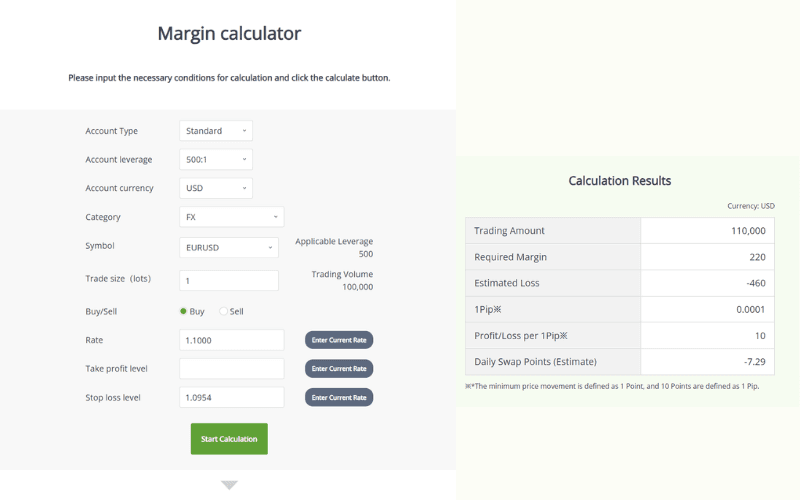
Titan FX offers a Forex/CFD Margin Calculator to estimate required margin and trade size based on price, lots, and leverage.
Interest Rate Change Risk
This risk stems from losses due to interest rate shifts, which can reduce swap points, turn them negative, or increase negative swaps.
For long-term positions, monitor interest rate trends and adjust strategies accordingly.
Trade Forex CFDs with Titan FX
Titan FX offers 50+ currency pair CFDs on MT4/MT5 with up to 1,000:1 leverage on major pairs, tight spreads, and the flexibility to go long or short. Micro accounts can reach up to 2,000:1 leverage when eligible.
8. Frequently Asked Questions (FAQ)
Q1: How are profits generated in forex trading?
Mainly from the price spread (buying low and selling high) and swap points (overnight interest). When a pair moves in your favor and you close the position, you realize the exchange-rate gain; holding overnight may earn or cost swap points.
Q2: What is the relationship between margin and leverage?
Margin is the collateral needed to open a position, and leverage determines how large a position you can control with that margin. At 100:1, for example, just 1% margin controls the full position; the higher the leverage, the greater both potential profit and risk.
Q3: What is forced liquidation (loss cut), and how do I avoid it?
When account equity falls below the maintenance margin, the system closes positions automatically to prevent further losses. To avoid it: keep leverage modest, set stop-losses, maintain sufficient margin, and avoid overtrading.
Q4: What are the main costs of forex trading?
Mainly the spread (bid-ask difference) and swap points (overnight interest), plus possible slippage during high volatility. Choosing a low-spread account and watching trading sessions helps reduce costs.
9. Summary
Forex trading revolves around using margin as collateral to exchange currencies for profit.
Profits and losses come from spreads and swap points, driven by market supply and demand. Leverage amplifies trade size but heightens risk, while spreads, loss cuts, and slippage are critical cost and mechanics factors for beginners.
Technical and fundamental analysis, paired with stop-loss/take-profit strategies, manage exchange rate, leverage, and interest rate risks effectively.
Mastering these basics, alongside tools like margin calculators or demo accounts, helps beginners start steadily in forex.
Further Reading
- Forex Trading Basics
- What Is Leverage and How to Use It
- What Is Spread?
- What Is Loss Cut?
- Margin Calculation
Titan FX Research Team. We cover a broad set of financial instruments — foreign exchange, commodities (crude oil, precious metals, agricultural products), equity indices, US equities, and digital assets — producing practical, research-backed educational content for investors.
Primary Sources (by Category)
- Forex market statistics: BIS Triennial Central Bank Survey
- Platform tools: Titan FX Margin Calculator