

Understanding Ethereum (ETH):Key Features,Factors,and Trends
Ethereum is an open-source blockchain platform for running smart contracts and decentralized applications (DApps), and its native token, Ether (ETH), is the second-largest cryptocurrency by market capitalization.
This article breaks down Ethereum's features and the role of ETH, how it differs from Bitcoin, what drives its price, its recent moves, and how to trade it via CFDs.
- Ethereum is a smart-contract blockchain platform launched in 2015 by Vitalik Buterin and others
- Its native token ETH pays gas fees and powers PoS staking, DeFi, NFTs and DApps
- Unlike Bitcoin's "digital gold" role, ETH is a programmable smart-contract platform
- The 2022 Merge moved it from PoW to PoS; EIP-1559 burns fees, adding deflationary pressure
- ETH's price tracks upgrades, ecosystem demand, regulation and macro; CFDs allow two-way trading with risk
1. What is Ethereum
Ether (ETH) is the native cryptocurrency of the Ethereum blockchain network. Ethereum is an open-source blockchain platform designed to allow developers to build and deploy decentralized applications (DApps) and smart contracts. Below are some characteristics of Ethereum:
1. Background
Ethereum was co-founded in 2015 by Vitalik Buterin and other developers with the aim of overcoming the limitations of Bitcoin in terms of smart contracts and decentralized applications.
2. Use Cases
Ether is primarily used to pay for the "gas" fees required to execute transactions and run smart contracts on the Ethereum network. In addition, Ether is used for decentralized finance (DeFi) operations, non-fungible token (NFT) transactions, and as the internal currency for other DApps.
3. Smart Contracts
One of Ethereum's core features is its smart contracts—self-executing agreements that automatically perform actions when certain conditions are met. This allows decentralized applications to run without the need for intermediaries.
4. Blockchain Technology
Ethereum's blockchain technology ensures that all transactions and smart contract executions are transparent and immutable, providing high levels of trust and security.
5. Upgrade Plans
Ethereum 2.0 is a significant upgrade plan for Ethereum, aimed at improving the network’s scalability, security, and energy efficiency. This upgrade will transition Ethereum from a Proof of Work (PoW) consensus mechanism to Proof of Stake (PoS).
6. Market Position
Ether is the second-largest cryptocurrency by market capitalization and is widely used and accepted globally. Overall, Ether is not only the fuel for the Ethereum network but also a key foundation for the development of decentralized applications and smart contracts.
2. Differences Between Ethereum and Bitcoin
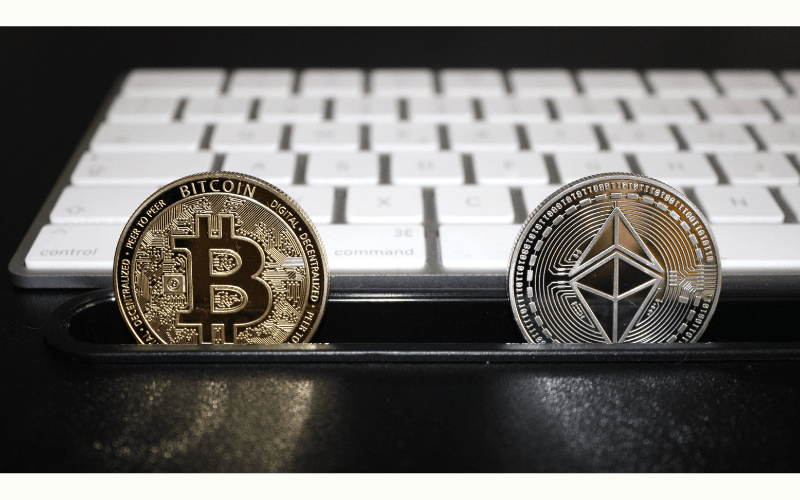
Ethereum (ETH) and Bitcoin (BTC) differ in several ways. Below are some key distinctions:
1. Function and Use:
Ethereum (ETH)
In addition to being a store of value and medium of exchange, Ethereum's primary use is to pay for the "gas" fees required to execute smart contracts and decentralized applications (DApps) on the Ethereum network. This makes Ethereum a powerful platform for developing and deploying various decentralized applications.
Bitcoin (BTC)
Bitcoin is the first cryptocurrency, primarily serving as digital gold, a store of value, and a peer-to-peer payment system. The focus of Bitcoin’s design is decentralization, security, and scarcity.
2. Technical Foundation:
Ethereum (ETH)
Ethereum is a Turing-complete blockchain platform that allows developers to write and run smart contracts. This enables Ethereum to support complex decentralized applications.
Bitcoin (BTC)
Bitcoin’s blockchain is relatively simple, focused on processing transactions and lacks the ability to support smart contracts.
3. Consensus Mechanism:
Ethereum (ETH)
Ethereum is transitioning from Proof of Work (PoW) to Proof of Stake (PoS) in an effort to improve the network’s scalability and energy efficiency.
Bitcoin (BTC)
Bitcoin uses Proof of Work (PoW) to ensure the security of the network and the validity of transactions.
4. Developer Community and Ecosystem:
Ethereum (ETH)
Ethereum has an active developer community and a rich ecosystem, including decentralized finance (DeFi), non-fungible tokens (NFTs), and a variety of decentralized applications.
Bitcoin (BTC)
Bitcoin’s development community primarily focuses on enhancing the security, scalability, and privacy of the network.
5. Transaction Speed and Fees:
Ethereum (ETH)
Ethereum transactions are relatively fast, but transaction fees (gas fees) can fluctuate depending on network congestion and can sometimes become quite high.
Bitcoin (BTC)
Bitcoin transactions are relatively slower, but transaction fees are generally stable and lower.
6. Market Capitalization and Adoption:
Ethereum (ETH)
Ethereum is the second-largest cryptocurrency by market cap, with widespread use and adoption in the decentralized application and smart contract space.
Bitcoin (BTC)
Bitcoin is the largest cryptocurrency by market capitalization and is widely regarded as digital gold, with global acceptance and usage.
In summary, the key differences between Ethereum and other cryptocurrencies (such as Bitcoin) lie in their use cases, technical foundations, consensus mechanisms, and ecosystems. Ethereum holds unique advantages in supporting smart contracts and decentralized applications, while Bitcoin leads in value storage and peer-to-peer payments.
3. Factors Affecting Ethereum
There are many factors that influence the price and development of Ethereum (ETH). Below are some major factors:
1. Market Demand and Supply:
Demand
The demand for decentralized applications (DApps), decentralized finance (DeFi), and non-fungible tokens (NFTs) on the Ethereum network directly affects the price of Ether. Using these applications requires paying gas fees, thus increasing the demand for Ether.
Supply
While Ether does not have a hard supply cap like Bitcoin, the Ethereum 2.0 upgrade, which introduces the Proof of Stake (PoS) mechanism, and the EIP-1559 proposal, which burns a portion of transaction fees, help control the supply of Ether.
2. Technological Upgrades
Ethereum 2.0
This major upgrade aims to improve the network’s scalability, security, and energy efficiency by transitioning from Proof of Work (PoW) to Proof of Stake (PoS). This will reduce the issuance of Ether and increase demand.
Smart Contracts and DApp Development
The development of new smart contracts and DApps will attract more users and investors to the Ethereum network, thereby increasing the demand for Ether.
3. Market Sentiment
Market sentiment has a significant impact on the price of Ether. Positive news, major technological breakthroughs, and the adoption of Ethereum by large corporations will boost market confidence and drive prices higher; conversely, negative news and market panic can lead to a price drop.
4. Competition and Alternatives
The rise of other smart contract platforms, such as Polkadot, Cardano, and Solana, may exert competitive pressure on Ethereum, affecting Ether’s market position and demand.
5. Regulations and Policies
Government regulations regarding cryptocurrencies will affect the market demand for Ether and investor confidence. Strict regulations could dampen market demand, while friendly policies may promote the adoption and development of Ether.
6. Network Security
Network attacks and security vulnerabilities can affect the stability of the Ethereum network and user confidence. The security of the Ethereum network directly impacts the value of Ether.
7. Macroeconomic Factors
Global economic conditions, inflation rates, and monetary policies may affect investor demand for Ether. For example, rising inflation might encourage investors to shift funds into the cryptocurrency market for value preservation.
8. Social and Media Influence
Social media and news media coverage of Ether can influence public perception and investment decisions. Statements and comments from prominent figures can also impact the market.
In conclusion, the price and development of Ether are influenced by multiple factors, including market demand and supply, technological upgrades, market sentiment, competition, regulations, network security, macroeconomic conditions, and social and media influences.
4. Ethereum Price Trends in Recent Years
Ethereum’s (ETH) price has shown significant volatility in recent years. Below are some key trends and events from 2021 to 2024:
2021
Ethereum saw significant growth in 2021, rising from about $730 at the beginning of the year to an all-time high of approximately $4844 in November. This increase was largely driven by the boom in decentralized finance (DeFi) and the explosive growth of the non-fungible token (NFT) market.
2022
In 2022, Ethereum’s price experienced a decline, mainly due to global macroeconomic factors and market sentiment. However, Ethereum successfully completed the "Merge" upgrade, transitioning from Proof of Work (PoW) to Proof of Stake (PoS), which is expected to have a long-term positive impact on future price trends.
2023
In 2023, Ethereum's price showed relatively stable movement. There were several short-term fluctuations, but the overall trend showed steady growth. By the end of the year, the price reached around $3800.
2024
At the beginning of 2024, Ethereum's price continued to rise, fluctuating between $2400 and $2700 in January. By mid-June, the price had surpassed $3500, and at certain points, it even approached $3900. Market expectations suggest that with increased trading activity and further improvements to the Ethereum network, the price may reach $4500 by the end of 2024.
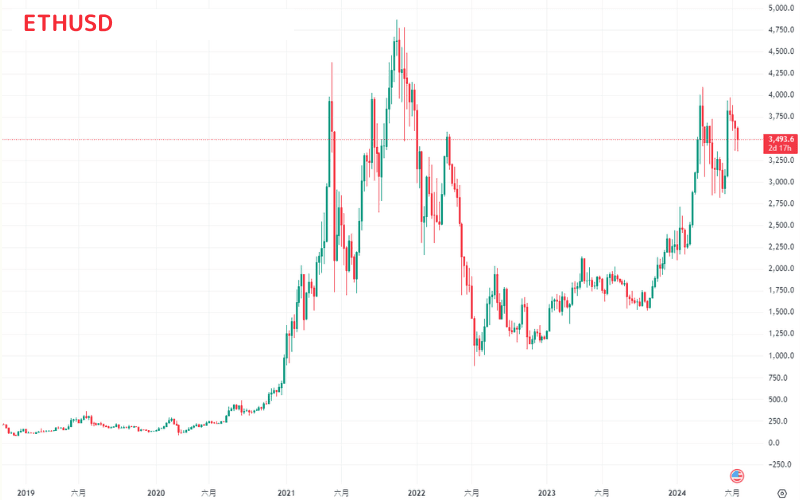
In conclusion, Ethereum’s price is influenced by various factors, including technological upgrades, market demand, macroeconomic conditions, and competition. Moving forward, as Ethereum 2.0 develops further and more applications are launched, Ether's price may continue to rise.
5. How to Start Trading Ethereum (ETH) CFDs
1. Choose a Trading Platform:
Titan FX offers cryptocurrency CFD trading with leverage up to 100x and supports trading on the MT4 and MT5 platforms, allowing investors to participate in the market efficiently.
Ethereum (ETH) Pairs Available on Titan FX
On Titan FX, you can trade ETHUSD (Ethereum/US Dollar) and ETHJPY (Ethereum/Japanese Yen).
Titan FX Cryptocurrency Trading Hours:
| Trading Day | Time |
|---|---|
| Monday | 00:01 - 23:59 |
| Tuesday | 00:01 - 23:59 |
| Wednesday | 00:01 - 23:59 |
| Thursday | 00:01 - 23:59 |
| Friday | 00:01 - 23:55 |
| Saturday | 00:01 - 23:55 |
| Sunday | 00:01 - 11:00, 13:00 - 23:55 |
Note that trading hours may change due to maintenance or upgrades. Pay attention to margin balances, stop-loss (S/L) and take-profit (T/P) levels.
What is Titan FX? Features, Leverage, Instruments, and Platforms2. Open a Trading Account:
Titan FX offers a fast and simple account opening process with no requirement for ID or address verification.
Titan FX provides Standard and Blade account types. Traders can choose their preferred type during registration.
Titan FX Account Opening Guide3. Deposit Funds:
After registration, deposit funds into your account. Titan FX supports multiple deposit methods, with credit card deposits being the fastest and most convenient, usually processed instantly.
Titan FX Credit Card Deposit Guide4. Download and Install Trading Platforms (MT4/MT5):
Titan FX offers MT4 and MT5 platforms for Windows, Mac, iOS (iPhone/iPad), and Android.
Titan FX MT5 Installation and Login
Titan FX MT4 Installation and Login
5. Place Trades:
Log into the MT4 or MT5 platform, select your trading instrument, and start buying or selling.
MT5 Interface and Order Methods
MT4 Interface and Order Methods
Titan FX Provides Free Trading Tools (Custom Indicators and EAs)
Titan FX is dedicated to providing traders with advanced trading support, including free trading tools such as custom indicators and EAs (Expert Advisors). These tools are designed to enhance traders' efficiency and strategy precision.
Custom indicators help traders analyze market trends more accurately and identify potential trading opportunities.
Meanwhile, EAs can automatically execute pre-set trading strategies, avoiding emotional interference and ensuring that each trade is executed accurately.
With these free tools, Titan FX helps you gain an edge in the competitive financial market and improve your trading performance.
All Custom Indicators EA Trading Program RankingsTrade Ethereum (ETH) CFDs with Titan FX
Titan FX offers Ethereum (ETH) CFDs with up to 100:1 leverage — go long or short with no wallet or private-key management.
6. Frequently Asked Questions
Q1. What's the difference between Ethereum and Ether (ETH)?
Ethereum is the blockchain platform that runs smart contracts and DApps, while Ether (ETH) is its native token, used to pay gas fees, stake, participate in governance, and circulate within the ecosystem.
Q2. Can you still mine ETH?
No. Since the 2022 "Merge," Ethereum has fully moved to Proof of Stake (PoS) and no longer supports PoW mining. To earn rewards, you now stake ETH or join a staking pool.
Q3. Is ETH deflationary?
It can face deflationary pressure. Since EIP-1559, part of each transaction's gas fee is automatically burned; when on-chain demand exceeds new issuance, total ETH supply gradually shrinks.
Q4. Why are ETH gas fees sometimes high?
Ethereum uses an auction model, so when DApp, NFT, or DeFi activity surges, gas fees rise sharply. Future scaling technologies such as rollups and sharding are expected to lower fees.
Q5. Is there a maximum supply of ETH?
No. Unlike Bitcoin's fixed 21 million cap, ETH supply is adjusted dynamically through reduced PoS issuance and EIP-1559 burning, which can even make ETH net-deflationary in high-demand periods.
7. Summary:
1. Features of Ethereum:
Ethereum is the second-largest cryptocurrency by market capitalization. Ether is not only the fuel for the Ethereum network but also a key foundation for the development of decentralized applications and smart contracts.
2. Factors Influencing Ethereum's Volatility:
The price volatility of Ether is influenced by factors such as market demand and supply, technological upgrades, market sentiment, competition, regulations, network security, macroeconomic conditions, and social and media influences.
3. Advantages of Opening an Account with Titan FX:
Up to 100x leverage, supports MT4 and MT5 platforms, simple and quick account opening process, multiple convenient deposit methods, and dozens of custom indicators and EAs.
Titan FX Account Opening GuideFurther Reading
The financial markets research team at Titan FX. We produce educational content across a broad range of instruments, including forex (FX), commodities (crude oil, precious metals, agricultural products), equity indices, U.S. stocks, and crypto assets.
Primary Sources (by Category)
- Official data and technical docs: Ethereum Foundation — ethereum.org (whitepaper / EIP-1559 / The Merge); Etherscan — on-chain data
- Market and research references: CoinMarketCap, CoinGecko — market-cap and price data; Titan FX — crypto CFD trading conditions and hours