

What Is a Pegged Crypto Asset? Mechanics, Targets, and Risks
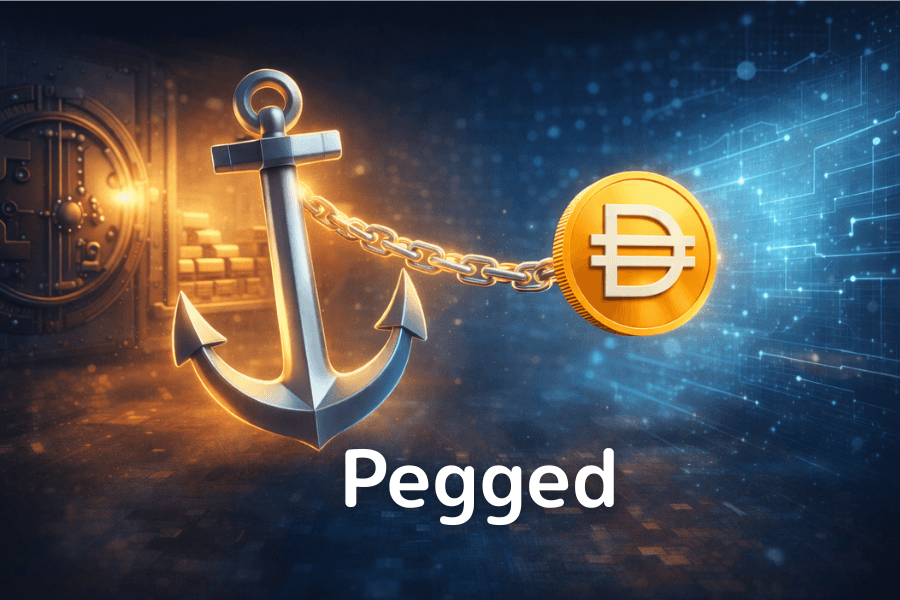
In crypto, price volatility is usually the first hurdle for newcomers. To find stability in a turbulent market, the technique known as pegging emerged. It aligns digital assets with real-world value and serves as a bridge between traditional finance and the decentralized world. This article walks you from the basic definition through the variety of pegging targets, the underlying mechanics, and how to evaluate the reliability of a pegged asset in practice.
- A pegged asset uses technology to lock its value to another asset at a fixed exchange rate — the basis for stablecoins, commodity tokens, and cross-chain wrapped assets.
- Three pegging targets: fiat (USDT/USDC pegged to USD), commodities (PAXG pegged to gold), and crypto (wBTC bringing Bitcoin onto Ethereum).
- Three support mechanisms: centralised custody (USDT/USDC/PAXG), overcollateralisation (DAI via smart contracts), and cross-chain lock-and-mint (wBTC, stETH, etc.).
- Reliability checklist: issuer transparency and audits, market liquidity, and the type of underlying support mechanism.
- Risk reminder: when the support mechanism breaks or reserves fall short, depegging can occur. A peg is a design goal, not a permanent guarantee.
- 1. What Is Pegging? The Crypto Market's Value Connector
- 2. What Can a Token Be Pegged To? More Than Just the US Dollar
- 3. The Tech Behind a Peg: How Tokens Stay "On Target"
- 4. Practical Checks: How to Tell If a Pegged Asset Is Reliable
- 5. Conclusion: Understanding Pegs Is the First Step in Asset Allocation
1. What Is Pegging? The Crypto Market's Value Connector
Pegging refers to using technical means to maintain a fixed exchange ratio between a crypto asset and another specific asset (the reference asset). In plain English, it is a "voucher" of the digital world: it gives an otherwise volatile crypto asset a stable shadow that can be used as a yardstick for value.
Definition: Anchoring the Digital and the Real
For beginners, you can think of a peg as a department-store gift card or token.
When you hold a 1,000-point gift card, it is just a piece of paper or a digital code, but because it maintains a 1:1 relationship with the official currency, its purchasing power is always equivalent to 1,000 of the local currency. On the blockchain, the same idea gives investors a value benchmark for pricing, accounting, and hedging that doesn't swing with market sentiment.
2. What Can a Token Be Pegged To? More Than Just the US Dollar
Stablecoins pegged to the US dollar are the most familiar form of pegging, but the universe of pegged assets is much broader — covering fiat, commodities, and even other crypto assets.
Target 1: Fiat-Pegged
This is the most mainstream form: pegged to USD, EUR, JPY, and other fiat currencies. These assets offer the most intuitive form of price stability and are the first stop for most investors entering the crypto market.
Target 2: Commodity-Pegged
Aligning a digital token with the value of a physical commodity. The most common is gold-pegged tokens such as PAXG: each token is backed by 1 ounce of physical gold. That lets investors hold precious metals on-chain without worrying about storing or shipping the physical metal.
Target 3: Crypto-Pegged
To move assets between blockchains, "wrapped" pegged tokens are created. For example, wBTC (Wrapped Bitcoin) pegs the value of Bitcoin and brings it onto Ethereum at 1 wBTC = 1 BTC, letting Bitcoin holders participate in DeFi lending and yield strategies.
3. The Tech Behind a Peg: How Tokens Stay "On Target"
Keeping a pegged asset's price at the target ratio requires a robust mechanism. Three approaches dominate the market, each backed by a different trust model.
Mechanism 1: Centralised Custody
The issuer commits that for every token issued, an equivalent unit of the underlying asset sits in their bank or vault as collateral.
This is the most intuitive model: real assets back the tokens, and stability depends heavily on the issuer's integrity and audit transparency.
Common examples include USDT issued by Tether and USDC issued by Circle, both claiming equivalent dollar reserves or Treasury bonds. Gold-pegged PAXG falls into this category as well — the issuer guarantees one ounce of physical gold behind every token.
Mechanism 2: Overcollateralisation
Rather than relying on a centralised custodian, smart contracts lock up crypto assets worth more than the tokens being created.
For example, generating 100 USD of a pegged token might require pledging 150 USD of ETH. That overcollateralisation buffer absorbs short-term volatility in the collateral price.
The canonical example is DAI — its logic is enforced entirely by code, and anyone can verify on-chain how much collateral backs every DAI in circulation, giving it greater transparency than centralised models.
Mechanism 3: Cross-Chain Lock-and-Mint
After locking the asset on the original chain, an equivalent pegged token is minted on a target chain. This technique is widely used for cross-chain assets, with smart contracts ensuring the total supply maintains a 1:1 correspondence with the locked source asset.
Liquid-staking tokens issued across multiple chains, such as stETH or ezETH, also rely on similar mechanisms to maintain their peg to the underlying asset across different ecosystems.
4. Practical Checks: How to Tell If a Pegged Asset Is Reliable
Not every asset advertised as "pegged" is genuinely stable. In practice, beginners should run through a quick three-point check before using one.
Check 1: Transparency
Does the issuer publish real-time on-chain data or third-party audits? The higher the transparency, the higher the probability that the reserves actually exist and the lower the chance of a financial-blackbox outcome.
Check 2: Liquidity
Is there enough trading volume across major exchanges? Without sufficient liquidity, a peg can look fine on paper while a large redemption faces big slippage or simply can't be filled.
Check 3: Peg Mechanism
Understand whether the asset is backed by physical dollars, physical gold, or another crypto asset. That determines how it behaves under extreme market conditions (a crypto-style black swan event) and where the risks sit.
Risk Reminder: A Peg Is Not a Permanent Guarantee
Investors should be aware that when the support mechanism fails or reserves fall short, the asset can drift away from the target — a phenomenon called depegging. A token meant to be worth 1 US dollar can drop to 0.9 US dollars or below.
Trade Crypto CFDs with Titan FX
Titan FX offers 20+ crypto CFDs including BTC and ETH with up to 100:1 leverage — go long or short with no wallet or private-key management.
5. Conclusion: Understanding Pegs Is the First Step in Asset Allocation
Pegging is a core technology that lets crypto serve everyday payments and complex financial products alike. It powers stablecoins, and extends into cross-chain assets and digital commodity trading. For investors, pegged assets are a practical hedging and routing tool — a safe harbour for capital in a volatile market.
The Core Idea: Mechanism Determines Stability
Always remember: a pegged asset's value depends on the safety of its underlying support and the soundness of its issuance design. Pegging is intended to provide stability, but if the underlying assets or contracts fail, the price can still drift.
Further Reading
The Titan FX financial market research team. Covering FX, commodities (oil, precious metals, agricultural products), stock indices, US equities, and crypto assets, the team produces educational content for investors across a wide range of financial instruments.
Primary Sources (by category)
- Official documentation: Tether Reserves Reports; Circle USDC Transparency page; Paxos PAXG gold-reserve disclosures; BitGo wBTC custody documentation; MakerDAO DAI collateral status page
- Technical standards: ERC-20 / ERC-721 / ERC-1155 specifications; lock-and-mint cross-chain bridge designs; Lido stETH and Renzo ezETH liquid-staking-token designs
- Market data: CoinGecko and CoinMarketCap pegged-asset price and supply data; DeFiLlama stablecoin and LST TVL statistics; Chainalysis on-chain flow analysis
- Industry and third-party references: Investopedia (Pegged Cryptocurrency entries); CoinDesk, The Block, and Bloomberg Crypto coverage of pegged assets and stablecoins; Titan FX internal crypto-asset risk-management documentation