

What Is Gold CFD Trading? XAU/USD Specs, Margin and P/L Calculation, Costs and Risks
Gold has long been seen as a safe-haven asset and an inflation hedge, and money often flows into it when uncertainty rises or the dollar weakens. Unlike buying bullion, a gold CFD involves no physical delivery: you open and close positions on a trading platform, and you can profit from falling prices by selling first.
This guide covers how gold CFDs work, how they compare with physical gold, futures and ETFs, the contract specifications and trading hours, how to calculate margin and profit or loss, what moves the price, the pros and risks, trading costs and how to get started.
- A gold CFD tracks the gold vs US dollar (XAU/USD) price; you do not own gold, you settle the difference between your entry and exit prices
- At Titan FX, 1 lot of XAU/USD is 100 ounces, the minimum trade is 0.01 lot and maximum leverage is 1,000:1
- Required margin = gold price × contract size × lots ÷ leverage; each $1 move in gold is worth $100 on 1 lot
- Holding a position overnight incurs a swap, and positions held from Wednesday to Thursday are charged three days' worth
- Gold CFDs let you go long or short with long trading hours, but leverage magnifies losses too, so control your position size and use stop losses
- 1. What is a gold CFD?
- 2. Gold CFD contract specifications and trading hours
- 3. How to calculate gold CFD margin, profit and swaps
- 4. What moves the gold CFD price
- 5. Pros and risks of gold CFDs
- 6. Gold CFD trading costs
- 7. How to start trading gold CFDs
- 8. Frequently Asked Questions (FAQ)
- 9. Summary
1. What is a gold CFD?
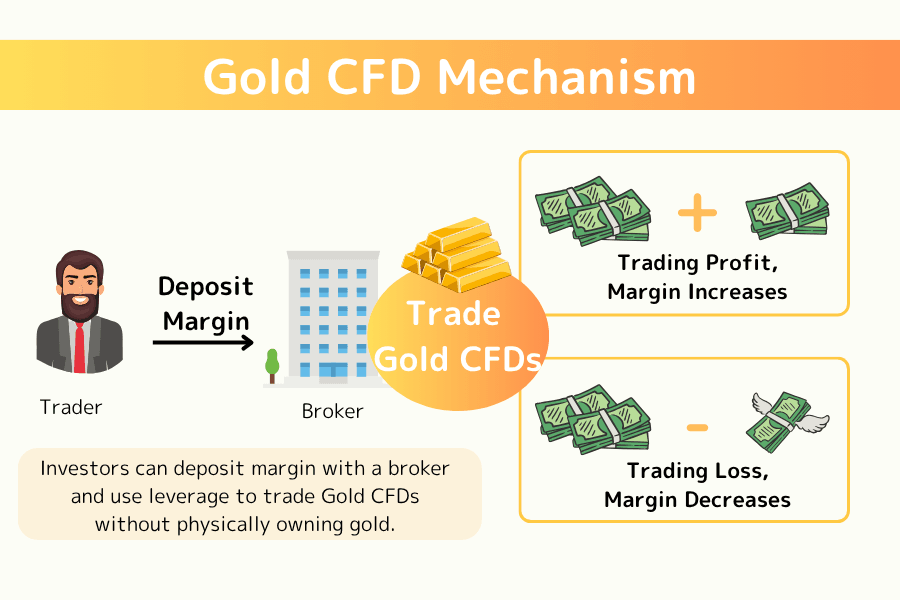
A gold CFD is a CFD (contract for difference) based on the international gold price. You do not buy physical gold; instead, you and the broker settle the difference between your entry and exit prices. If the market moves your way, the difference is your profit; if it moves against you, it is your loss.
Gold CFDs usually track the spot price of gold vs the US dollar (XAU/USD), the dollar price of one troy ounce of gold. After depositing margin, you can hold a position many times larger than that deposit.
Gold CFDs vs. physical gold, futures and ETFs
There are several ways to get exposure to gold. The main differences are what you actually own, whether you can use leverage, whether you can go short, and whether the product expires:
| Method | What you own | Leverage | Going short | Expiry |
|---|---|---|---|---|
| Physical gold (gold bars, coins) | The metal itself | No | No | None |
| Gold futures | An exchange-traded futures contract | Yes | Yes | Yes, positions must be rolled |
| Gold ETFs | Fund shares | Depends on the product | Depends on how you trade | None |
| Gold CFDs | A contract for difference with your broker | Yes | Yes | None |
Compared with futures, gold CFDs have no fixed expiry and can be traded from 0.01 lot. Compared with ETFs, which follow stock exchange hours, they can be traded for longer each day. Gold futures and ETFs are listed on gold exchanges around the world. US-regulated brokers do not offer CFDs to retail clients, so traders in the United States usually trade gold through futures or ETFs.
Comparing prices with World Gold Prices
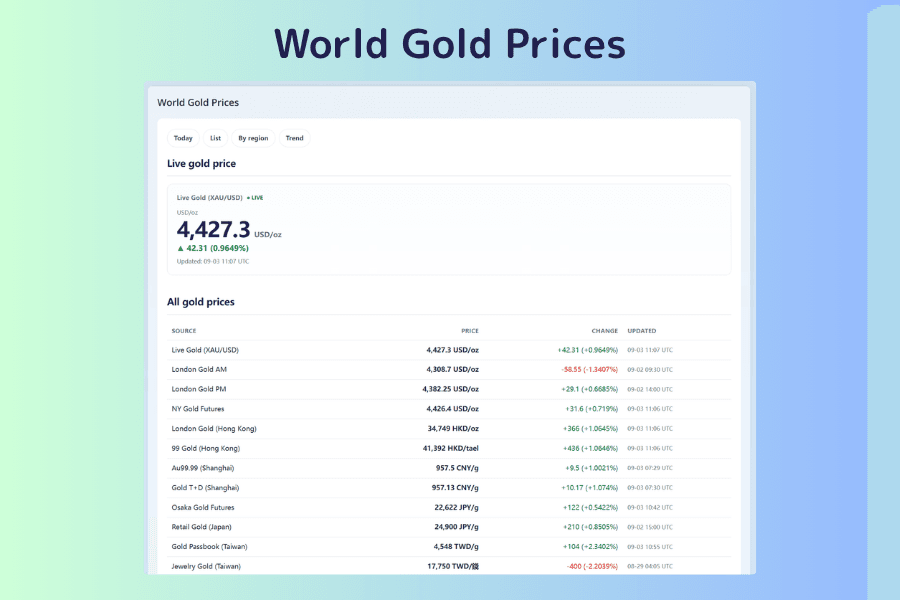
The gold CFD price is the international spot price quoted in US dollars per ounce, while local dealers and regional exchanges quote gold in their own currencies and units such as grams. Titan FX's World Gold Prices puts the spot price (XAU/USD), the London gold fixings, New York gold futures and regional prices from Hong Kong, Shanghai, Osaka and elsewhere on a single page, so you can compare them side by side.
2. Gold CFD contract specifications and trading hours
Margin and profit or loss are both calculated from the contract specifications, so check them before you trade. Titan FX's specifications for gold vs the US dollar (XAU/USD) are:
| Item | Standard and Blade accounts | Micro account |
|---|---|---|
| Instrument | XAU/USD (MT4/MT5 symbol XAUUSD) | Same |
| Quote | US dollars per ounce of gold | Same |
| Contract size | 1 lot = 100 ounces | 1 lot = 10 ounces |
| Minimum trade | 0.01 lot (1 ounce) | 0.01 lot (0.1 ounce) |
| P/L per $1 move on 1 lot | $100 | $10 |
| Maximum leverage | 1,000:1 | 1,000:1 |
| Trading hours (server time) | 01:01–23:59, closing at 23:55 on Friday | Same |
In UTC, trading runs from 22:01 to 20:59 the next day during US daylight saving time, and from 23:01 to 21:59 in winter. There is a break of about one hour each day between the close and the reopen, and the market is closed on weekends. Hours can change around holidays and daylight saving switches, so check the symbol specifications on your platform.
3. How to calculate gold CFD margin, profit and swaps
Gold CFD calculations use the following formulas:
| What you want to find | Formula | What it tells you |
|---|---|---|
| Trade value | Trade value = gold price × contract size × lots | The real size of the trade |
| Required margin | Required margin = trade value ÷ leverage | The money needed to open the trade |
| Profit or loss | Profit or loss = price change × contract size × lots | The gain or loss from a move in gold |
The contract size is the amount of gold in one lot, and it is fixed by account type: 100 ounces for Standard and Blade accounts and 10 ounces for Micro accounts. The examples below use a Standard or Blade account denominated in US dollars; for a Micro account, replace 100 with 10.
Example: trading 1 lot of gold at 1,000:1
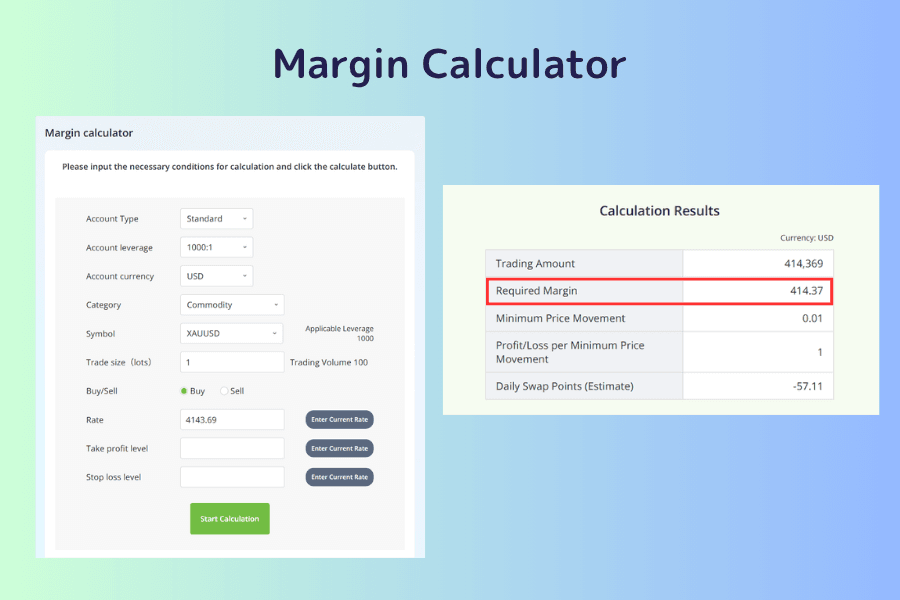
Suppose you want to buy XAU/USD under these conditions:
- Gold price: $4,143.69
- Trade size: 1 lot (100 ounces)
- Leverage: 1,000:1
Step 1: Find the trade value
Trade value = 4,143.69 × 100 × 1 = $414,369Step 2: Find the required margin
Required margin = 414,369 ÷ 1,000 ≈ $414.37In other words, about $414 of margin controls roughly $414,000 worth of gold.
How much is a $1 move in gold worth?
Take the same trade. If gold rises from $4,143.69 to $4,153.69, a gain of $10:
Profit = 10 × 100 × 1 = $1,000So every $1 move in gold is worth $100 on 1 lot. A long position losing when gold falls, or a short position losing when gold rises, is calculated the same way. Profit or loss depends only on your lot size and the price move; leverage only changes the margin needed to open the trade. These figures are before spreads, commissions and swaps, and accounts in other currencies also need to convert the result into the account currency.
Swaps
Holding a position past the daily cut-off incurs a swap (financing cost). In the example above, the Margin Calculator estimates the swap for buying 1 lot of XAU/USD at about −$57.11 a day, meaning you pay about $57 for each day you hold it. Positions held from Wednesday to Thursday are charged three days' worth to cover the weekend. Swap rates change with interest rates and differ for long and short positions; you can look up past rates in the Swap Point Calendar.
Checking the numbers with the Margin Calculator
Titan FX's Margin Calculator shows the trade value, required margin, profit or loss per minimum price movement and an estimated daily swap once you enter the account type, account leverage, account currency, symbol, trade size and rate. Choose "Commodity" as the category and "XAUUSD" as the symbol, then click "Enter Current Rate" to load the latest gold price.
4. What moves the gold CFD price
Gold CFD prices follow the international spot price, so anything that moves gold shows up in gold CFDs. Traders usually watch the first two factors most closely:
-
The US dollar: gold is priced in dollars, so a weaker dollar makes gold cheaper in other currencies and tends to support the price
-
Real interest rates: gold pays no interest, so when US real rates fall, the opportunity cost of holding gold drops and prices tend to find support
-
Central bank buying: when central banks add to their reserves, they create long-term demand, and central bank gold buying has been a major driver in recent years
-
Safe-haven demand: wars, financial crises and rising geopolitical risk tend to push money into gold
Nonfarm payrolls, CPI and Fed rate decisions move gold through the dollar and Treasury yields; you can check release times in advance on the Economic Calendar. Other factors that influence gold prices, such as inflation expectations and physical demand, shape the longer-term trend.
5. Pros and risks of gold CFDs
| Details | |
|---|---|
| Pro: No storage | No need to store bars or arrange delivery; you open and close positions on the platform |
| Pro: Go long or short | Buy if you expect gold to rise, sell if you expect it to fall |
| Pro: Low entry cost | You can trade from 0.01 lot, and the margin needed to open a position is small |
| Pro: Long trading hours | Gold trades almost 24 hours a day on weekdays, so you can react to moves during European and US hours |
| Risk: Leverage magnifies losses | If your position is too large for your account, a small adverse move can trigger a loss cut |
| Risk: Sharp volatility | Major data releases or geopolitical events can move gold sharply in a short time |
| Risk: Weekend gaps | If major news breaks over the weekend, Monday's open can be far from Friday's close |
Around the daily close and before and after the weekend, the margin rate for new precious metals positions is raised to 0.5% from Monday to Thursday and 1% on Friday, which lowers the maximum leverage to 200:1 and 100:1. If you plan to enter near the close, check that you have enough margin first. These reductions are part of Titan FX's leverage conditions and do not apply to currency pairs.
6. Gold CFD trading costs
The main costs of trading gold CFDs are:
-
Spread: the difference between the bid and ask prices, paid every time you open a trade. It varies by account type, and the Blade account has tighter spreads than the Standard account
-
Commission: charged separately on the Blade account, but not on the Standard or Micro accounts
-
Swap: charged when you hold a position overnight, and it adds up the longer you hold
For short-term traders who trade often, spreads and commissions matter most; for swing traders holding for several days or more, swaps need to be part of the cost.
Once you know how costs are made up, comparing accounts gets easier. The advantages of trading gold CFDs with Titan FX are leverage of up to 1,000:1, trade sizes as small as 0.1 ounce (Micro account) and gold priced in six currencies. For analysis, you also get free gold-specific tools such as World Gold Prices and the gold-silver ratio.
7. How to start trading gold CFDs
You can start trading gold CFDs in four steps:
- ① Open an account and fund it: complete registration and identity verification, then deposit through the client area
- ② Install MT4 or MT5: Titan FX supports both platforms on Windows, Mac, iOS and Android
- ③ Add XAUUSD: add XAUUSD to the Market Watch window; the order screens and steps are shown in How to Trade Gold CFDs on MT5 (Windows)
- ④ Size the position and place the order: check the margin and profit or loss in the Margin Calculator, then set your lot size, stop loss and take profit before placing the order
If you are new, practice on a demo account to get used to how gold moves, and start with 0.01 lot.
8. Frequently Asked Questions (FAQ)
Q1. How much money do I need to trade gold CFDs?
With gold at about $4,144, a 0.01-lot trade on a Standard or Blade account at 1,000:1 needs about $4.14 in margin. That is only the amount needed to open the trade, not a safe deposit: even on 0.01 lot, a $10 move in gold is a $10 profit or loss, so keep enough funds in your account to absorb price swings.
Q2. What is the difference between gold CFDs and gold futures?
Gold futures trade on an exchange, have expiry dates that require rolling positions, and come in larger standardized contracts. Gold CFDs are traded with your broker, have no fixed expiry and can be traded from 0.01 lot, but holding them overnight incurs swaps.
Q3. Can I hold a gold CFD long term?
Yes, but swaps build up with every day you hold the position, so the longer you hold, the higher the cost. If your goal is to own gold for the long term, compare the accumulated swaps with the cost of holding gold bars or a gold ETF.
Q4. Can I trade gold CFDs on weekends?
No. Gold CFDs trade Monday to Friday, and the market is closed on weekends. If you hold a position over the weekend, consider the risk of a gap at Monday's open, and remember that the maximum leverage for new positions is lowered before the Friday close.
9. Summary
Gold CFDs let you trade the international gold price on margin without owning physical gold, and you can go long or short. One lot of XAU/USD is 100 ounces, each $1 move in gold is worth $100 on 1 lot, and the required margin is the trade value divided by leverage.
Leverage lowers the capital needed to trade gold, but it magnifies losses as well. Before you trade, calculate the margin and profit or loss, count spreads and swaps as costs, size your position to your account and set a stop loss.
Further Reading
- What Is Silver vs US Dollar (XAGUSD)? A Trader's Guide
- What Is the Gold-Silver Ratio?
- Global Gold Demand: Jewelry, Investment, Industrial, Central Banks
- Introduction to Precious Metals Trading
The Titan FX Financial Markets Research and Analysis Team. Covering forex (FX), commodities (crude oil, precious metals, agricultural products), stock indices, US equities, and crypto assets, the team produces educational content for investors across a broad range of financial instruments.
Primary Sources (by Category)
- Trading conditions: Titan FX website precious metals and leverage pages (trading hours, minimum trade size, margin rates around the close); Titan FX Margin Calculator (XAUUSD contract size, required margin, swap estimate)
- Regulation: CFTC and SEC treatment of retail CFDs in the United States
- Education and research: Titan FX Research precious metals articles