

How Central Bank Gold Buying Drives Gold: Structural Demand, the Medium-Term Mechanism, and Trading XAU/USD
In recent years, as central banks around the world have steadily added to their gold reserves, gold's role in financial markets has shifted well beyond that of a simple safe-haven asset, gradually becoming a core commodity underpinned by structural support. Against this backdrop, the logic behind gold's price swings, the rhythm of its pullbacks, and its medium-term trends now look markedly different from the past.
For traders, understanding how central-bank buying is reshaping market structure matters, but the more decisive question is this: how do you choose the right way to trade in this kind of environment, and effectively participate in both the upside and downside of gold prices?
This article starts from the context of central-bank gold buying, explains its medium-term impact on prices, and then walks through the practical mechanics of trading gold CFDs (XAU/USD) with Titan FX, helping you turn a macro trend into executable trading decisions.
- Structural demand: Central banks have been net gold buyers for years (official reserves topped 36,000 tonnes in Q3 2025), creating long-term demand that ignores short-term price.
- Impact on prices: Central-bank buying does not drive intraday moves, but it absorbs free-floating supply and limits pullbacks, making medium-term trends more directional and durable.
- Reserve motives: Diversify away from any single currency, preserve real purchasing power, reduce geopolitical and sanctions risk, and reinforce monetary credibility.
- Reserve landscape: The US, Germany, Italy and France hold over 75%; China and Japan sit at just 7–8% but keep adding, while Turkey, Poland and India lead emerging-market growth.
- Trading application: Use Titan FX gold CFDs (XAU/USD) to trade both directions, with tight spreads, flexible leverage, the gold-silver ratio, and order/open-interest tools.
- 1. Why do central banks keep adding to their gold reserves?
- 2. The current state of global central-bank gold reserves and how they are changing
- 3. How central-bank buying reshapes gold's medium-term price structure
- 4. The core advantages of trading gold (XAU/USD) with Titan FX
- 5. How to trade gold through Titan FX
- 6. Frequently Asked Questions about central-bank gold buying and gold trading
- 7. Summary
1. Why do central banks keep adding to their gold reserves?
In recent years, gold's role in the global financial system has undergone a structural shift. Even amid rate-hike cycles, a stronger US dollar, or rapid swings in market risk appetite, the depth and duration of gold's pullbacks have remained noticeably limited, and prices have repeatedly consolidated at elevated levels before pushing higher again.
This pattern is hard to explain through short-term safe-haven demand or speculative flows alone. The more fundamental force behind it is the structural demand created by central banks steadily expanding their gold reserves.
Unlike ordinary investors, central banks do not base their decisions on price swings or short-term returns. They allocate gold for long-term reasons: the safety of the financial system, the stability of official reserves, and the management of sovereign risk.
For that very reason, central-bank buying does not drive intraday or short-term moves, yet it profoundly shapes the supply-and-demand structure of the gold market and gradually changes how prices behave over the medium to long term.
Why central banks keep increasing their gold reserves
From a reserve-management perspective, central-bank buying is not a one-off event but the cumulative result of several long-running structural factors. These motives are not short-term policy adjustments; they reflect changes in the global financial order and in how risk is perceived.
- ▸Diversifying away from reliance on any single currency or foreign-exchange asset
- ▸Preserving the long-term real purchasing power of official reserves
- ▸Reducing geopolitical and financial-sanctions risk
- ▸Reinforcing monetary credibility and the stability of the financial system
Diversifying away from reliance on any single currency or foreign-exchange asset
For a long time, the US dollar and other major foreign currencies have made up an outsized share of global official reserves, leaving reserve systems heavily concentrated in a handful of currencies. Once the policy of a core currency turns sharply, the value of the entire reserve pool tends to come under pressure at the same time.
Gold is no country's liability and has relatively low correlation with foreign exchange and bonds, so it effectively diversifies concentration risk. That makes it an important allocation tool when central banks adjust the structure of their assets.
Preserving the long-term real purchasing power of official reserves
Gold's supply growth is structurally constrained over the long run and cannot be expanded at will. Against a backdrop of recurring inflation pressure and limited fiscal and monetary-policy flexibility in major economies, gold is seen as a reserve tool that helps preserve the real purchasing power of a nation's assets.
When markets begin to doubt the long-term value of fiat currencies, central banks tend to raise their gold allocation in response.
Reducing geopolitical and financial-sanctions risk
Foreign-exchange assets depend heavily on cross-border settlement systems and financial infrastructure. When geopolitical conflict or sanctions risk rises, they can face restricted use or even outright asset freezes.
Physical gold, by contrast, relies on no single clearing system and can retain its value and remain under control even in extreme conditions. This makes it an important reserve asset for some countries seeking to strengthen financial sovereignty and reduce external risk.
Reinforcing monetary credibility and the stability of the financial system
The gold a central bank holds is not just part of its asset allocation; it also carries institutional and confidence-related symbolism.
Domestically, it helps reinforce trust in the national currency and financial system; externally, it shows that the country has verifiable physical reserves to stand behind it.
In periods of heightened financial uncertainty, the very existence of gold reserves helps improve the stability and credibility of the system as a whole.
2. The current state of global central-bank gold reserves and how they are changing
Once you understand why central banks buy gold, the next key question is: How much gold do the world's central banks actually hold right now? Which countries are these reserves concentrated in? And how fast is it changing?
The hard data shows that central-bank buying is no longer sporadic or phased; it has become a sustained structural trend.
According to the World Gold Council, as of Q3 2025, total official gold reserves held by central banks worldwide had surpassed 36,000 tonnes, with the official sector remaining a net buyer for many years running.
Looking at the timeline, since the mid-2010s, annual net central-bank gold purchases have in most years fallen within the 800–1,100 tonnes range. Even through rate-hike cycles, a stronger dollar, or sharply elevated market volatility, central banks have shown no structural retreat from allocating to gold.
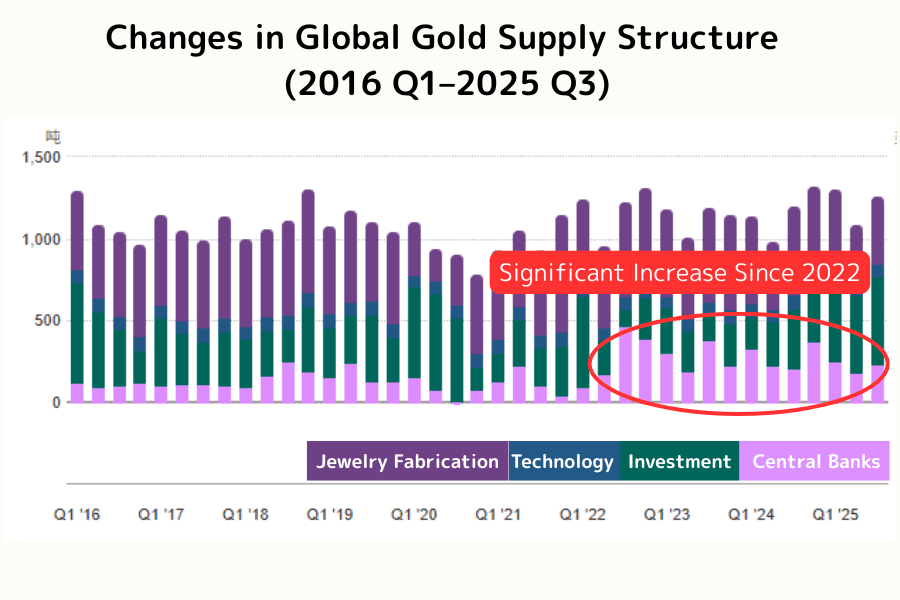
This shows that gold's role within the official reserve system has gradually shifted from a "passively held asset" of the past to a "proactively allocated position" with strategic intent.
Top central banks by gold reserves (by holdings)
By holdings, central-bank gold reserves remain heavily concentrated in a handful of countries, especially traditional financial heavyweights and certain large economies:
| Rank | Country | Gold reserves (tonnes) | Share of official reserves | Notes |
|---|---|---|---|---|
| 1 | United States | 8,133 tonnes | ~80% | The world's largest official gold holder, with a consistently high share |
| 2 | Germany | ~3,350 tonnes | ~80% | Europe's largest gold-reserve holder |
| 3 | Italy | ~2,452 tonnes | ~77% | Reserve structure highly weighted toward gold |
| 4 | France | ~2,437 tonnes | ~78% | Long-standing, very stable holdings |
| 5 | Russia | ~2,330 tonnes | — | Stopped publishing a full reserve breakdown in recent years |
| 6 | China | ~2,304 tonnes | ~8% | Large reserves overall, but gold's share is still low |
| 7 | India | ~880 tonnes | ~15% | Has kept adding in recent years |
| 8 | Japan | ~846 tonnes | ~8% | Low gold share; reserves are mostly foreign exchange |
| 9 | Turkey | ~641 tonnes | ~49% | An exceptionally high gold share among emerging markets |
| 10 | Netherlands | ~612 tonnes | ~71% | Gold makes up a high share of official reserves |
Why is gold a "high share" for some countries and low for others?
When comparing central-bank gold reserves, the share often explains more than the raw tonnage, because it reflects a structural choice about official reserves rather than simply the size of holdings.
Take the United States and Germany: gold generally makes up more than 75% of official reserves. This is directly tied to the large gold stockpiles they accumulated under the Bretton Woods system, which left gold as a core asset within their reserve structure and foreign exchange as a relatively small part. So even with limited buying in recent years, their gold share has stayed high.
By contrast, China and Japan rank among the world's largest gold holders, yet because their foreign-exchange reserves are so vast, gold still accounts for only about 7–8%. This is not a lack of regard for gold; it reflects that they are still gradually raising their allocation and adjusting their reserve structure.
For exactly this reason, markets pay closer attention to central banks with a "low but rising" gold share, because their ongoing buying tends to carry greater long-term structural weight.
The fastest-growing central banks in recent years (by additions)
Viewed through "rate of change" rather than "absolute holdings", recent central-bank buying looks different from the holdings ranking and shows a clear regional spread:
- China: Has steadily added gold in small, infrequent increments in recent years — a classic long-term accumulation strategy
- Turkey: Its gold reserves swing more widely, but the overall trend has remained upward
- Poland: Has rapidly expanded its gold allocation, lifting official reserves past 500 tonnes
- India: Has kept raising gold's share of official reserves, with sustained, consistent change
What these central banks share is this: gold is not a short-term trading vehicle but a long-term allocation asset used to adjust the risk profile of official reserves.
3. How central-bank buying reshapes gold's medium-term price structure
Central banks do not engage in short-term trading, nor do they move in and out frequently on price swings. But their long-term, steady buying has become an important structural backdrop shaping gold's medium-term trend.
When this kind of structural demand persists over time, the supply-and-demand balance of the gold market and the behaviour of its participants gradually change, giving price action a more directional character with more rhythmic pullbacks.
The real-world impact of structural demand on gold prices
| Structural change | What it looks like in the market |
|---|---|
| Free-floating gold supply is continuously absorbed | Gold bought by central banks mostly enters official reserves and rarely returns to the spot market, making prices more sensitive to changes in demand |
| The duration and depth of pullbacks are limited | Short-term declines mostly stem from sentiment or liquidity release, and selling pressure is more easily absorbed by medium- to long-term demand |
| Breakouts after consolidation are more durable | Once a move finishes consolidating, it tends to continue in the original direction rather than reverse quickly |
| Greater resilience to rate and dollar shocks | Even when short-term macro pressure appears, prices return more readily to their original medium-term path |
In this kind of market structure, gold's pullbacks gradually shift from being a "warning that the trend may be ending" to an important signal for gauging the health of the trend and the market's ability to absorb selling.
Central banks do not directly "push up" gold prices; instead, by changing the supply structure and market behaviour, they make medium-term trends smoother and more durable.
What does this mean for traders?
With central-bank buying now a long-term backdrop, gold's price action has begun to show the following features:
- ▸Pullbacks are more rhythmic and less likely to turn into trend reversals
- ▸Moves after consolidation show greater directional consistency
- ▸Volatility is concentrated, making trading opportunities clearer
This makes gold a highly tradable commodity — but one that also places higher demands on execution quality.
For that reason, trading results no longer hinge solely on "calling the direction right"; they are more directly affected by trading costs, execution efficiency, and the tools at your disposal.
In this kind of environment, choosing the right trading platform becomes a decisive factor in whether you can reliably put a strategy into practice.
4. The core advantages of trading gold (XAU/USD) with Titan FX
Against the structural backdrop created by years of central-bank buying, gold's price action features limited pullbacks, a clear rhythm, and concentrated volatility, making it a highly tradable market.
In this kind of environment, trading results depend not only on getting the direction right but heavily on trading costs, execution efficiency, and supporting tools.
The trading conditions Titan FX offers are designed precisely for these practical needs.
Advantage 1: A low-spread environment that effectively cuts the cost of frequent entries and exits
In moves such as stabilising after a sharp drop or breaking out after consolidation, traders often need to enter and exit multiple times to capture the rhythm rather than holding a single position for the long haul. In that case, the cumulative impact of spreads and trading costs directly affects overall performance.
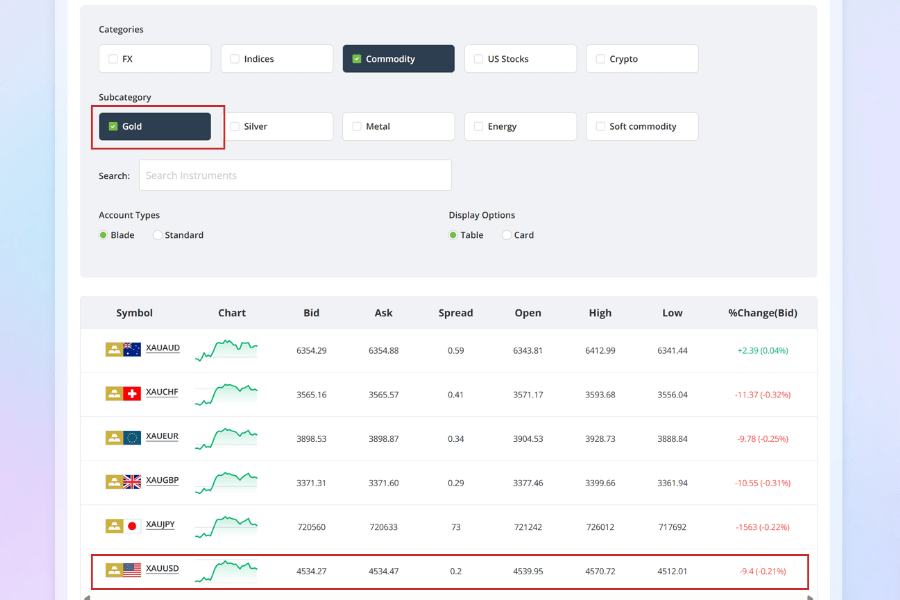
Titan FX offers spreads as low as 0.24, providing a competitive and stable low-spread environment. Especially during periods of heightened volatility, this effectively reduces the cost of entering and exiting, helping traders preserve the risk-reward ratio they should be getting when running trend-following, swing, or short-term strategies.
For live spreads, see: Titan FX live spreads
Advantage 2: Flexible high leverage that improves capital efficiency
Supported by structural demand, gold's pullbacks tend to be limited, and prices more often complete their recovery in key zones. These characteristics make traders value flexibility in capital allocation rather than simply amplifying risk.
Titan FX gold CFDs (XAU/USD) offer up to 1,000:1 leverage, letting traders size their positions flexibly according to their capital and risk tolerance.
Advantage 3: A range of market tools to help assess support and sentiment positioning
In structural price action, how prices react at key zones matters especially. Combining that with the actual positioning of market participants significantly improves the consistency of trading decisions.
Titan FX provides a number of free market tools, including order and open-interest distribution data and the gold-silver ratio, to help traders observe market sentiment and potential support and resistance levels. These tools help you judge whether a pullback is still part of normal moves within the structure, avoiding premature, mistaken conclusions during ordinary corrections.
Gold-silver ratio tool:
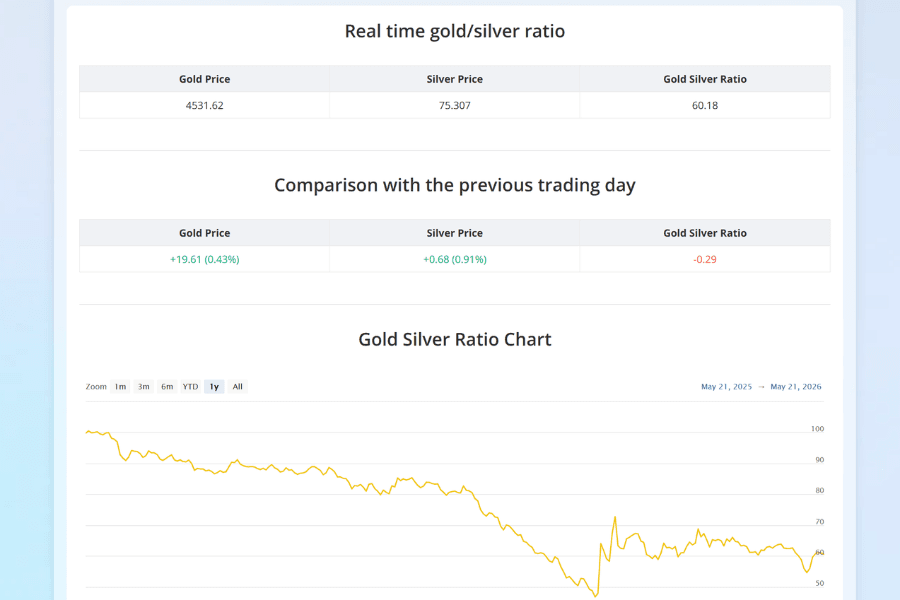
The gold-silver ratio tool lets you compare the relative value of gold and silver, spot when silver is undervalued or overvalued, and refine your trading strategy.
International gold price chart:
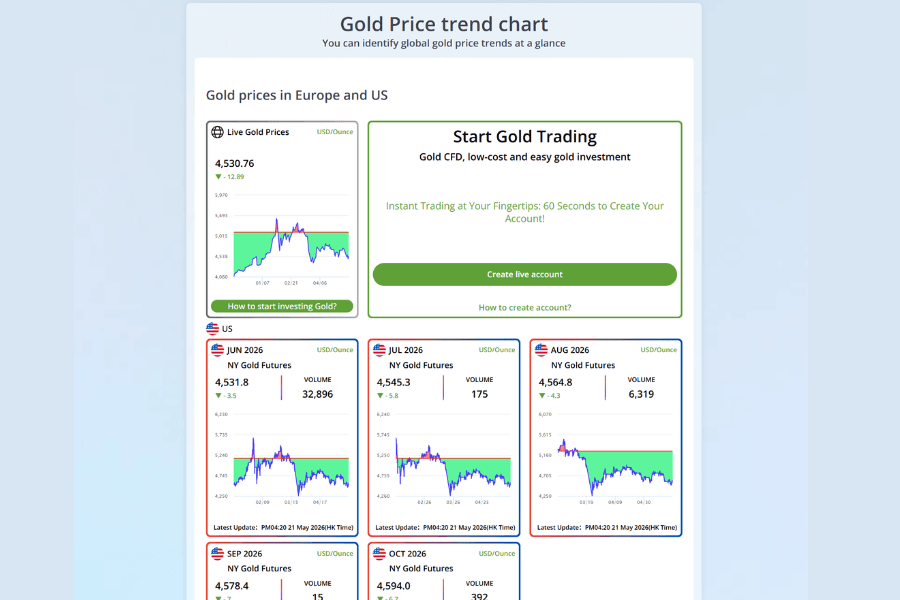
The international gold price chart provides real-time gold prices and historical trends, combined with technical indicators (such as RSI and MACD) to help analyse market trends.
Order and open-interest chart:
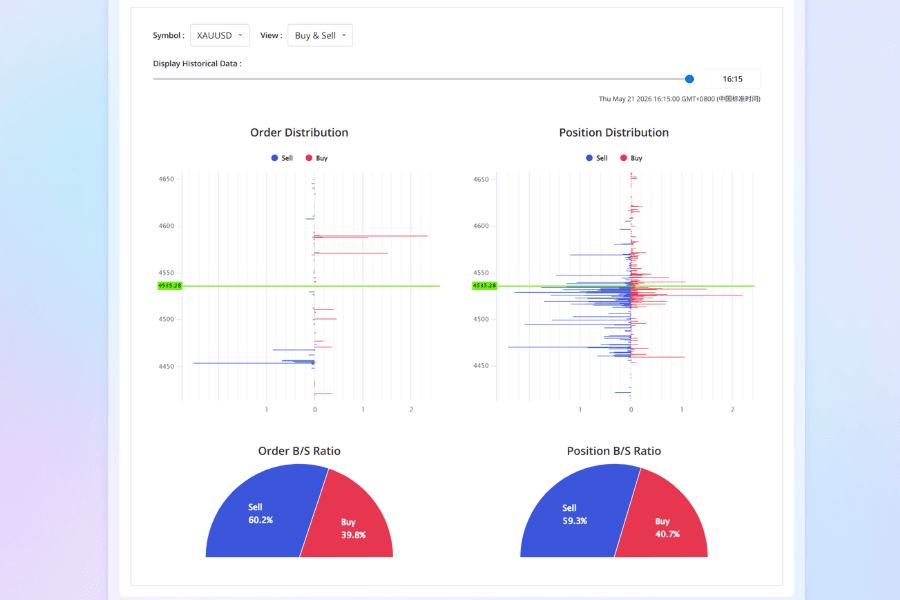
The gold (XAU/USD) order and open-interest chart is a powerful tool for observing market sentiment and potential support/resistance levels. Drawing on data from Titan FX clients, the chart is split into two parts:
Order distribution (Orders): Shows the buy and sell orders in the market that have not yet been filled. A large cluster of buy orders near a price level may act as short-term support, while a large cluster of sell orders may form a resistance zone.
Position distribution (Positions): Reflects where open positions are concentrated. If long positions are densely clustered just below a price level, a break below that zone may trigger stop-losses and intensify the decline — and vice versa.
Free gold EAs and strategy-validation resources
Titan FX offers a range of free MT4/MT5 EA (Expert Advisor) trading programs designed specifically for gold (XAU/USD), suited to traders who want to run trend or range strategies in an automated way.
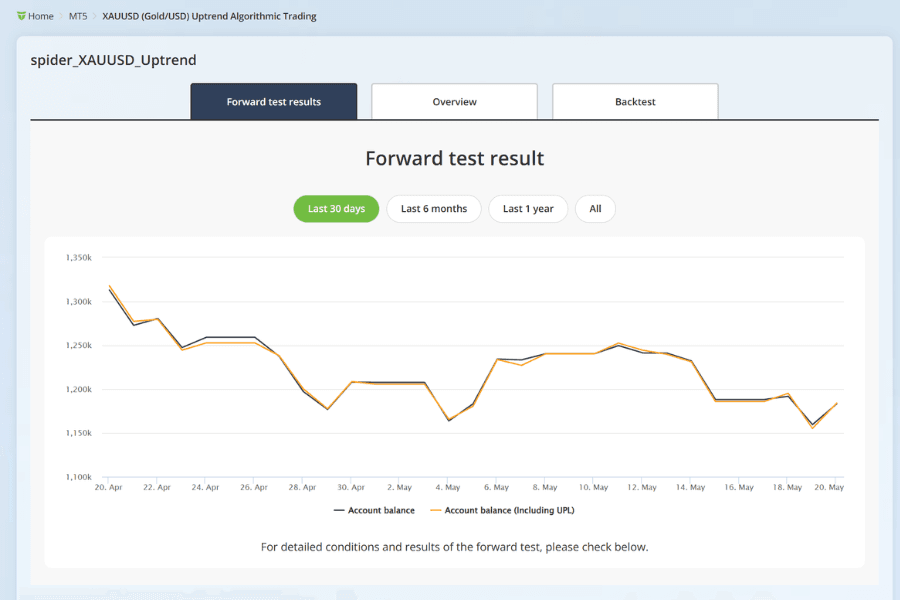
Each EA comes with complete forward-test and backtest results, helping traders understand its historical performance, risk characteristics, and the conditions it suits before putting it to use, so they can pick the strategy tool that best fits their own style and capital allocation.
For example, spider_XAUUSD_Uptrend and spider_XAUUSD_Downtrend are designed for gold's bullish and bearish trends respectively. Using a grid-style order approach, they automatically buy and sell within a defined price range, helping traders maintain strategy consistency in trending markets and reduce emotional interference.
Advantage 4: Clear educational resources and trading processes that lower the barrier to execution
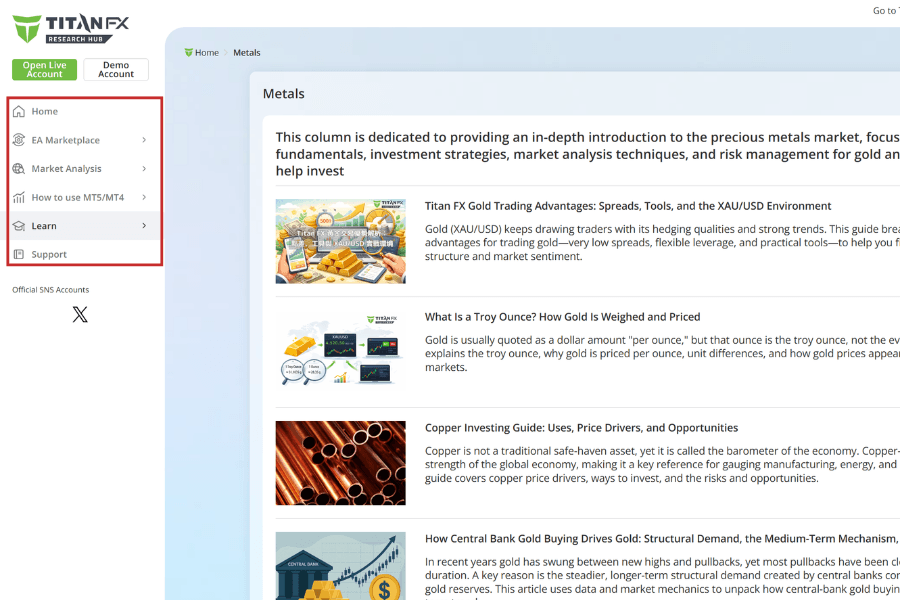
Even when you understand market structure and trading logic, real execution comes down to whether you can carry it out consistently. Titan FX provides comprehensive educational content, operational guides, and research resources to help traders get familiar with the process of trading gold CFDs, with risk management and strategy application.
Combined with a streamlined account-opening and deposit process, traders can put more energy into market analysis and strategy execution rather than into operating the platform itself.
Further reading: Titan FX review: platform overview, security, features, leverage, instruments, and platform analysis
5. How to trade gold through Titan FX
Investors can choose different routes into the gold market based on their own trading style, risk tolerance, and approach to capital allocation. Among them, CFDs (Contracts for Difference) are particularly well suited to traders focused on price swings, event-driven moves, and execution efficiency, thanks to their two-way (long/short) flexibility, adjustable leverage, and the fact that they require no physical gold.
The table below lays out common ways to invest in gold and who each suits, to help investors quickly grasp the differences:
| Way to invest | Main features | Who it suits |
|---|---|---|
| Physical gold or gold passbook | Value-preservation focused; storage and liquidity must be considered | Long-term, value-preservation investors |
| Gold ETFs | Indirect gold exposure with convenient trading | Medium-term asset allocators |
| Gold CFDs (XAU/USD) | Leverage available, can go long or short, reacts in real time, highly flexible for strategy | Traders who prioritise volatility and trading efficiency |
The trading process: how to trade gold CFDs (XAU/USD) with Titan FX
If you want to participate in gold's two-way moves with greater flexibility and a lower barrier to entry, gold CFDs are a highly efficient way to trade. Titan FX provides a trading environment suited to high-volatility instruments like gold, so traders can execute strategies precisely instead of being constrained by cost and conditions.
Building on these trading conditions, the steps below explain how to get ready to trade gold CFDs from scratch:
| Stage | What to do |
|---|---|
| Step 1: Register a trading account | Go to the Titan FX account-opening page, enter your email and basic details to register, and activate your account once you pass identity verification. |
| Step 2: Make a deposit | Log in to the Titan FX client portal and deposit via credit card, e-wallet, or bank transfer; once funds arrive, you can set up your trades. |
| Step 3: Download the MT4 or MT5 platform | Titan FX offers MT4 and MT5, available for download on Windows, Mac, iOS, and Android. |
| Step 4: Add the XAU/USD instrument | In the "Market Watch" window, right-click → Symbols → Gold → enable XAU/USD to see live quotes. |
| Step 5: Start trading gold CFDs | Open the XAU/USD chart, choose buy or sell, set your volume, stop-loss, and take-profit according to your strategy, and place the order. |
Further reading: What is a gold CFD? A complete guide to its mechanics, advantages, risks, and a Titan FX hands-on walkthrough
Trade Gold CFDs with Titan FX
Titan FX offers gold CFDs (XAU/USD) with up to 1,000:1 leverage, tight spreads, and the flexibility to go long or short without holding physical gold.
6. Frequently Asked Questions about central-bank gold buying and gold trading
Q1: Does central-bank buying directly push up gold prices?
Not directly. Central-bank buying is long-term, low-frequency structural demand that does not engage in short-term trading, so it does not drive intraday or single-day moves. Its effect is to continuously absorb free-floating gold supply and change the supply-and-demand structure, limiting the depth of pullbacks and making the medium-term trend more directional and durable. In other words, central-bank buying affects "market structure", not "the immediate price".
Q2: Where can I find official data on central-bank gold buying?
The most authoritative sources are the World Gold Council's quarterly reports, along with official reserve statistics published by national central banks and the IMF. These figures list each country's gold holdings, quarterly net buying or selling, and gold's share of official reserves — useful for tracking medium- to long-term trends rather than as a basis for short-term entries and exits.
Q3: Does central-bank buying matter for short-term gold traders?
Yes, but as a "background condition" rather than an "entry signal". Understanding that structural demand exists helps you judge whether a pullback is still a healthy correction within the trend, avoiding mistaking a normal consolidation for a trend reversal. The actual timing of entries and exits still needs technical analysis, order/open-interest distribution, and risk management.
Q4: How do gold CFDs (XAU/USD) differ from physical gold and gold ETFs?
Physical gold is mainly about value preservation and requires you to consider storage and liquidity; gold ETFs are convenient for medium-term asset allocation but still lean toward one-directional holding; gold CFDs (XAU/USD) can be traded both long and short, offer flexible leverage, react in real time, and require no physical holding, making them suited to traders who value price swings and execution efficiency. That said, CFDs are leveraged products, so good risk management is essential.
Q5: How do you use the gold-silver ratio in gold trading?
The gold-silver ratio (gold price ÷ silver price) reflects the relative value of the two precious metals. A high ratio may indicate that silver is relatively undervalued; a low ratio may indicate that silver is relatively expensive. Traders can use it to help gauge relative strength within precious metals and timing for allocation, but it should still be assessed alongside the overall trend and fundamentals.
Q6: What do you need to start trading gold with Titan FX?
The process takes only four to five steps: register and complete identity verification, deposit funds, download MT4/MT5, and add XAU/USD to your Market Watch — then you can start trading. In practice, it's wise to first use a demo account to get familiar with gold's spreads and volatility, start with small positions, and set your stop-loss and take-profit before executing your strategy.
7. Summary
In summary, the structural demand created by ongoing central-bank gold buying is changing how the gold market behaves over the medium term, making prices more directional and turning pullbacks and consolidations into part of the trading rhythm rather than mere risk signals.
In this kind of environment, trading results depend not only on getting the direction right but heavily on the flexibility of your tools, cost control, and execution efficiency.
Through gold CFDs (XAU/USD), traders can participate in two-way moves with a lower barrier to entry and respond flexibly to different market rhythms.
Whether you want to seize event-driven moves or run short- to medium-term swing trades, choosing the right platform and a clear trading process is a crucial step in turning a structural market advantage into real results.
Further Reading
- What Is a Gold CFD? Mechanism, Advantages, and Risks
- Silver Investing Basics: History, Properties, and Trading
- What Is a CFD (Contract for Difference)?
- What Is the Bretton Woods System?
- What Is Leverage?
Titan FX Research. Investor-education content covering forex (FX), commodities (oil, precious metals, agricultural products), stock indices, US equities, and crypto assets across global markets.
Primary Sources by Category
- Official data and international bodies: World Gold Council Gold Demand Trends quarterly reports; IMF official reserve statistics (COFER); national central banks' gold-reserve disclosures
- Market data: Titan FX live quotes and market tools (gold-silver ratio, order/open-interest distribution); gold-market analysis from major financial media