

Silver investment basics: history, uses, properties, and economic significance.
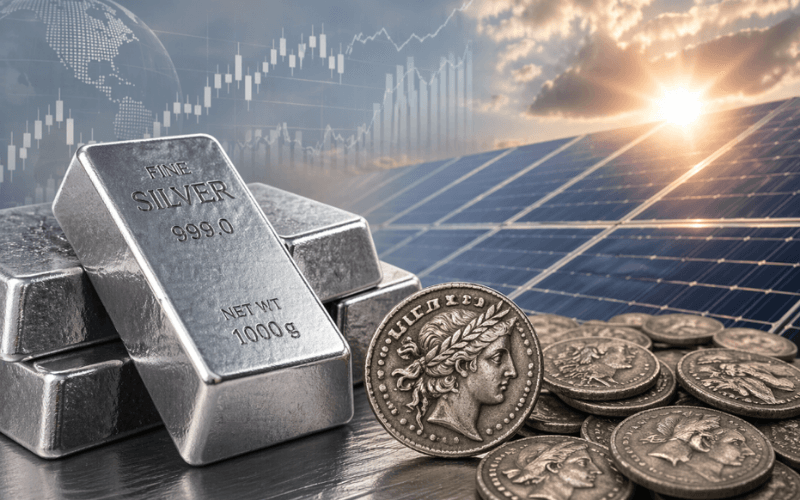
Silver is one of the oldest precious metals used by humankind, uniquely combining safe-haven appeal with heavy industrial demand (around 50% of total global demand). As solar, electronics, and EV applications expand, silver's price action and the gold-silver ratio (GSR) are both key investment signals.
What makes silver's price so hard to pin down is its half-monetary, half-industrial identity — it tracks gold in risk-off moments yet swings with solar and electronics demand when the economy expands. From ancient silver standards to modern photovoltaic panels and electronic components, silver plays a uniquely dual role in the global economy, making it a key asset for traders positioning across inflation expectations, U.S. dollar trends, and technology-sector cycles.
- Silver (XAG) carries both precious-metal safe-haven and industrial-metal properties — the second-most-important safe-haven after gold.
- Demand mix: ~50% industrial (semiconductors, solar, 5G, EVs), ~25% investment, the rest jewellery and silverware.
- Main drivers: real rates, the US dollar, gold prices, industrial demand (especially solar PV), and monetary policy.
- The historical Gold/Silver ratio averages around 60–70; readings above 80 typically signal silver is undervalued, while readings below 50 signal it is overheated.
- On Titan FX, trade XAG/USD CFD long or short with leverage, 24-hour access, and no physical-delivery requirement.
- 1. What Is Silver? Core Properties Overview
- 2. Silver's History: From Monetary Metal to Modern Commodity
- 3. Physical and Chemical Properties of Silver
- 4. Main Uses and Demand Structure
- 5. Key Factors That Move Silver Prices
- 6. Gold/Silver Ratio: In-Depth Analysis
- 7. How to Trade Silver CFDs on Titan FX
- 8. Frequently Asked Questions (FAQ)
- 9. Conclusion
1. What Is Silver? Core Properties Overview
Silver (chemical symbol Ag, from the Latin Argentum) is a naturally occurring transition metal. It is far less abundant than copper or iron in the Earth's crust but significantly more plentiful than gold. Silver has the highest electrical and thermal conductivity of any metal, along with excellent ductility and antimicrobial properties. Historically, silver has served as currency, jewelry, and religious artifacts; today it is heavily used in electronics, solar energy, medical devices, and catalysis.
| Attribute | Silver | Key Implication |
|---|---|---|
| Chemical Symbol | Ag (Argentum) | From Latin |
| Atomic Number | 47 | Transition metal, Group 11 |
| Primary Trading Symbol | XAG/USD (spot), SI (COMEX futures) | XAG/USD is the go-to for CFD traders |
| Industrial Demand Share | ~50-60% | Much higher than gold (~10%) |
| Investment Demand Share | ~20-25% | Includes bars, coins, ETFs |
| Annual Production | ~25,000-27,000 metric tons | Gold: ~3,000 metric tons/year |
| Top 3 Producing Countries | Mexico, Peru, China | ~50% of global supply |
The dual drivers (safe-haven + industrial) give silver materially higher volatility than gold, with greater sensitivity to both macro cycles and tech-industry dynamics. This makes silver a favored vehicle for traders seeking larger price swings.
2. Silver's History: From Monetary Metal to Modern Commodity
Ancient Times: Among the First Monetary Metals
Silver mining and use dates to roughly 3000 BCE. Ancient Egypt, Mesopotamia, Greece, and Rome all valued silver highly, using it for ornamentation, religious objects, and the earliest metal coinage. Silver was easier to obtain than gold and better suited to medium-denomination everyday transactions, so it served as the primary circulating currency across many regions for extended periods.
The Age of Exploration: Spanish Silver and Global Trade
From the 16th to the 19th century, Spanish colonies — particularly present-day Mexico and Bolivia (Potosí) — mined vast quantities of silver. The American silver that flowed into Europe, China, and India effectively created humanity's first truly global trade network. During China's Ming and Qing dynasties, the "Single Whip Reform" settled tax obligations in silver — testament to silver's deep influence on cross-regional finance.
19th–20th Century: The End of the Silver Standard
In the second half of the 19th century, major powers successively moved to the gold standard, and silver gradually lost its primary monetary role. After the U.S. Gold Standard Act of 1900, silver coins continued to circulate but their monetary importance steadily declined. The collapse of the Bretton Woods system in 1971 fully decoupled both gold and silver from fiat currencies, reducing them to pure commodity-plus-investment assets.
Modern Era: Industrial Demand Leads, Investment Amplifies
Since the 21st century, silver's demand structure has shifted markedly: industrial uses (electronics, solar, medical) have become the primary driver, while investment demand acts as an accelerator during episodes of inflation, dollar weakness, or rising geopolitical risk. According to The Silver Institute, photovoltaic industry silver demand has set record highs year after year — the core of silver's structural demand shift.
3. Physical and Chemical Properties of Silver
Silver's combination of physical and chemical attributes explains its irreplaceability in many industrial applications:
- Top conductivity: Silver has the highest electrical conductivity of any metal (about 7% higher than copper). For precision electronics and solar panel silver paste, this conductivity edge is hard to replace
- Excellent thermal conductivity: Heat transfer is exceptional — useful for thermal paste and semiconductor packaging in high heat-flux environments
- Extreme ductility: 1 gram of silver can be drawn into a wire about 1,800 meters long, or rolled into ultra-thin foil for architecture and art
- Natural antimicrobial activity: Silver ions disrupt bacterial cell membranes — applied in burn dressings, medical device coatings, and water purification systems
- High reflectivity: ~95% reflectivity for visible light — widely used in high-quality mirrors, telescopes, and fiber-optic reflective layers
- Moderate oxidation resistance: Silver is not as fully oxidation-resistant as gold — it reacts with sulfides to form black silver sulfide ("tarnishing"). This is why fine silverware requires periodic maintenance
These properties make silver difficult to substitute in many high-tech fields and explain why silver demand is particularly sensitive to industrial cycles.
4. Main Uses and Demand Structure
Demand Structure Overview
| Demand Category | Share (~) | Primary Uses |
|---|---|---|
| Industrial | 50-60% | Electronics, photovoltaic panels, auto electronics, 5G equipment |
| Investment | 20-25% | Bars, coins, ETFs (e.g., SLV), CFDs |
| Jewelry & Silverware | 15-20% | Sterling (925), tableware, decorative items |
| Photography & Other | 3-5% | Traditional film, catalysts, medical coatings |
Photovoltaic Industry: The Biggest Growth Driver
Rapid growth in global solar installations has driven sustained demand for photovoltaic silver paste. Industry estimates suggest every GW of solar capacity requires roughly 10-20 metric tons of silver, while global annual solar additions have exceeded 400 GW. Even as the industry pushes silver-reduction technologies (TOPCon, HJT cells still use silver paste), overall demand remains robust — the core structural support for mid-to-long-term silver prices.
Electronics and 5G/AI Infrastructure
Smartphones, servers, data centers, and 5G base stations use substantial amounts of silver conductive paste and plated contacts. As AI compute demand drives continued semiconductor expansion, silver usage in high-frequency signaling, thermal interfaces, and battery packaging is rising in parallel.
Investment Demand and Safe-Haven Properties
As a precious metal, silver has safe-haven characteristics similar to gold, but is more strongly influenced by industrial cycles — leading to greater volatility. Common investment vehicles include:
- Physical coins / bars: American Eagles, Canadian Maple Leafs, Chinese Pandas are leading circulation products
- Silver ETFs: SLV (iShares Silver Trust) is the world's largest silver ETF
- Futures contracts: COMEX Silver (SI), Shanghai Futures Exchange silver
- CFDs: Like Titan FX's XAG/USD — supports two-way trading with leverage
Jewelry, Silverware, and Beyond
Sterling silver (92.5% silver content) is the international standard for silver jewelry. Silver's antimicrobial properties continue to find new applications in medical devices (burn dressings, endoscope coatings).
5. Key Factors That Move Silver Prices
Macro Factors
- U.S. dollar trajectory: Silver is priced in dollars — a stronger dollar typically weighs on silver; vice versa. Closely watching the U.S. Dollar Index (USDX) is essential for silver traders
- U.S. 10-Year Treasury Yields: Rising real rates raise the opportunity cost of holding precious metals — generally negative for silver
- Inflation (CPI) Expectations: When inflation accelerates, precious metals' traditional inflation-hedge appeal rises
- Fed monetary policy: Hiking cycles pressure silver; rate cuts or quantitative easing (QE) typically support prices
Industry Factors
- Photovoltaic demand seasonality: China's solar installation peak season (typically Q2-Q3) drives industrial silver demand higher
- Semiconductor cycle: AI, EV, and 5G cycles affect demand for silver paste and conductive materials
- Supply side: Mine strikes, environmental policy, and energy costs in Mexico, Peru, China and other major producers shift global silver supply
Gold and Silver Correlation
Silver and gold move together directionally, but silver volatility is typically 1.5-2x that of gold. Early in a safe-haven rally, gold moves first; silver lags but then catches up with a sharper move. In corrections, silver typically falls further too.
Geopolitical Events
Wars, financial crises, and banking crises lift safe-haven demand for precious metals. Silver's benefit depends on whether industrial demand is simultaneously impacted. For example, in early 2008, silver fell with equities (industrial demand concerns overrode safe-haven demand), only rebounding sharply once QE was launched.
6. Gold/Silver Ratio: In-Depth Analysis
The Gold/Silver Ratio = Gold Price ÷ Silver Price — reflecting how many ounces of silver are needed to buy one ounce of gold. This is one of the most-used relative-strength indicators for precious-metals traders.
Historical Ranges and Meaning
| Gold/Silver Ratio | Historical Meaning | Implication for Traders |
|---|---|---|
| < 40 | Very low, typically near silver rally peaks (1980 Hunt brothers episode, 2011 silver high) | Silver may be overbought — watch for reversal risk |
| 40-70 | Relatively healthy; gold and silver moving together | Neutral zone — rely on technicals for direction |
| 70-90 | Elevated, silver relatively weak or industrial demand concerns rising | If bullish silver, wait for breakout confirmation |
| > 100 | Extreme, typically tied to crisis events (e.g. March 2020 COVID shock) | Historically followed by strong silver rebounds |
Trading Strategy Applications
- Trend continuation: When the ratio falls while both metals rise, silver typically outperforms gold
- Hedging: When long gold and worried about silver short-term chase risk, equivalent silver short can hedge ratio mean-reversion
- Extreme reversal: Historical extremes (e.g., above 125) tend to revert to the mean within months to 1-2 years — the foundation for spread trades
7. How to Trade Silver CFDs on Titan FX
Titan FX offers silver CFDs (symbol XAG/USD) with two-way trading and leverage — no physical settlement required.
Step 1: Log in to your Titan FX account
Open MT4 or MT5, enter your Titan FX credentials, and log in. If you don't yet have an account, start with a demo to get familiar with XAG/USD price behavior.
Step 2: Add XAG/USD to Market Watch
In MT5 Market Watch, right-click and select Symbols, then find XAG/USD under Metals and add to your watchlist.
Step 3: Size the position and define risk
Silver's intraday moves are typically larger than gold's — we recommend:
- Cap single-trade risk at 1-2% of account
- Widen stops 30-50% vs gold (adjusted via the ATR indicator)
- First trades in small size (e.g., 0.1 standard lot) to get familiar with spread dynamics
Step 4: Execute the trade
With XAG/USD selected, click New Order, set direction, volume, stop loss, and take profit, then submit. Use the Titan FX Economic Calendar to get ahead of CPI, FOMC decisions, and other macro events that can move silver.
Supplementary tools
- Swap Calendar: Look up XAG/USD overnight financing costs
- Precious Metals Trading Guide: Broader context across gold, silver, platinum
- Eight Factors That Move Gold: Essential companion reading for silver-gold linkage analysis
Trade Silver CFDs with Titan FX
Titan FX offers silver CFDs (XAG/USD) with up to 500:1 leverage, tight spreads, and the flexibility to go long or short without holding physical silver. Micro accounts: up to 1,000:1.
8. Frequently Asked Questions (FAQ)
Q1. Compared to gold, what type of trader is silver better suited for?
Silver's volatility is typically 1.5-2x that of gold, making it better suited for traders who can tolerate larger short-term swings in pursuit of higher potential returns. Conservative traders seeking precious-metals exposure typically do better with gold, or a 50/50 gold-silver mix. Aggressive traders can overweight silver to amplify return and risk.
Q2. Why is silver more volatile than gold?
Two main reasons: (1) Silver's market is roughly one-tenth the size of gold's, so the same capital flow produces a larger price move; (2) Industrial demand makes up over half of silver's total demand, meaning economic cycles hit silver harder than gold. The safe-haven characteristics are similar, but silver carries an extra industrial dimension.
Q3. Will photovoltaic silver-reduction technology impact long-term silver demand?
Silver-reduction technology does reduce silver content per GW of solar capacity, but the continued expansion of total solar installations typically offsets that effect. Research from The Silver Institute shows photovoltaic demand growth is still outpacing the reduction rate. Long-term investors should still monitor breakthroughs in new cell technologies.
Q4. What lessons from the silver-standard era apply to today's traders?
The silver-standard era reminds us: even though silver's monetary role has retreated, its "quasi-monetary safe-haven value" is revived whenever fiat currency systems face trust crises (hyperinflation, banking crises). The 2008, 2011, and 2020 silver rallies validate this pattern.
Q5. How do you assess whether silver is currently cheap or expensive?
Three common indicators: (1) Gold/silver ratio — historical median around 60-70, clearly high levels mean silver is relatively cheap; (2) CPI-adjusted real silver price — long-term real price ranges; (3) Growth rate of photovoltaic and electronics demand — whether structural demand supports the current price. No single indicator determines cheap vs expensive — synthesize the three.
Q6. How does trading silver CFDs differ from holding physical coins?
Physical coins carry storage costs, wide buy-sell spreads (typically 5-10%), and low liquidity — but no leverage-blowup risk. CFDs carry no physical delivery, tight spreads (Titan FX floating spreads), high liquidity, and two-way leveraged trading — but with overnight swap fees and leverage risk. For short-term trading or hedging, CFDs are more flexible; for long-term preservation of wealth, physical has its role.
Q7. Besides ETFs and CFDs, what other silver vehicles are available?
Beyond SLV ETFs and CFDs: silver miner ETFs (like SIL), individual miners (Pan American Silver, First Majestic), structured products (silver-linked notes), futures (COMEX SI), etc. Different instruments have very different risk-return profiles — consider leverage, liquidity, taxes, and holding costs when choosing.
9. Conclusion
Silver spans ancient currency, the silver standard, modern precious-metal investment, and the future of photovoltaic technology — one of the few assets that simultaneously captures macro safe-haven sentiment and technology-industry cycles. While silver's volatility is substantial, it also offers rich strategy opportunities — from gold/silver-ratio arbitrage to photovoltaic seasonality to inflation-expectation hedging to macro-cycle rotation, silver is an asset class difficult to ignore in portfolio construction.
Using Titan FX's XAG/USD CFD, you can flexibly trade both directions, deploy leverage, and enter/exit the market quickly. We recommend pairing the Economic Calendar with Gold Price Factors as companion analysis to build a robust edge in the high-volatility silver market.
Further Reading
- VIX Volatility Index — How silver behaves as risk sentiment spikes.
- US Treasury Yields — Real rates as the core driver of gold and silver valuations.
- Inflation — Silver's historical track record as an inflation hedge.
- Monetary Policy — How Fed policy transmits into silver prices.
- Raise Interest Rates — Silver's historical behaviour during tightening cycles.
- Asset Allocation — How precious metals fit into a portfolio.
The Titan FX Research team covers global macroeconomic indicators, foreign exchange (FX), commodities (oil, precious metals, agriculture), equity indices, US stocks, and crypto assets, producing educational content for investors and traders.
Primary Sources by Category
- Official data and regulators: The Silver Institute — World Silver Survey (annual); U.S. Geological Survey (USGS) — Mineral Commodity Summaries — Silver; Federal Reserve Economic Data (FRED) — silver historical price series; SEC and CFTC — precious-metal futures rules.
- Exchanges and market data: COMEX / CME Group — Silver Futures (SI), E-mini Silver (SIL); London Bullion Market Association (LBMA) — Silver Price benchmark; Bloomberg, Reuters — real-time and historical silver prices.
- Media and historical references: Bloomberg, Reuters, Financial Times, Kitco; the 1980 Hunt brothers cornering attempt (silver briefly hit ~USD 50), the 2011 USD 49 high, the 2020–2021 Reddit r/wallstreetsilver "silver squeeze," and the 2024–2025 AI/solar-driven industrial-demand surge.