

Eight Key Factors Influencing Gold Prices: Why Do Gold Prices Fluctuate?

Gold prices are driven mainly by eight forces — supply, demand, inflation, monetary policy, the US dollar, geopolitics, market sentiment, and central-bank reserves — and understanding them is key to timing gold trades.
Gold is both a safe haven and a hedge against inflation, often climbing precisely when markets turn turbulent — which makes it a cornerstone of any asset allocation. Yet its price is never dictated by a single force; only by reading the drivers behind it can you time your entries and exits through the swings.
Through Titan FX's gold CFD trading (high leverage, tight spreads) and the MT4/MT5 platforms, investors can use tools such as the gold-silver ratio and live gold charts to capture opportunities. Whether you seek long-term preservation or short-term speculation, this guide gives beginners and professionals practical strategies for growing wealth through gold.
- Why gold matters: a safe-haven, inflation-resistant asset and a core portfolio holding
- The eight drivers: supply, demand, inflation, monetary policy, the US dollar, geopolitics, sentiment, and central-bank reserves
- US dollar link: gold is priced in USD, so a weaker dollar generally lifts gold and a stronger dollar weighs on it
- Real rates: when nominal rates fall below inflation, the opportunity cost of holding gold drops and prices tend to rise
- How to trade: Titan FX gold CFDs on MT4/MT5 with high leverage, tight spreads, and analysis tools
1. Why Invest in Gold
Gold offers safe-haven and inflation-hedging qualities and has long been a core option in global investors' asset allocation.
During periods of economic instability or geopolitical turmoil, gold typically holds up well, acting as a "safe harbour" for capital and helping to stabilise an overall portfolio.
Gold also plays a key role in the jewellery market, in electronics and industrial applications, and in national central-bank reserves, all of which support real demand and provide a solid floor for prices.
Whether for long-term preservation or short-term trading, gold's scarcity and versatility make it an ideal asset for diversifying risk and adding flexibility to a portfolio.
2. The Eight Factors That Affect the Gold Price
The gold price is driven by the following eight factors, which investors should monitor closely when forming a strategy:
| Factor | Brief impact | Effect on gold |
|---|---|---|
| Supply dynamics | Higher mining costs or environmental limits constrain supply; recycled gold also shifts supply | Less supply → up |
| Demand | Stronger investment (e.g. ETF), jewellery, and industrial demand lifts buying | More demand → up |
| Inflation | Rising inflation erodes purchasing power; gold is favoured as an inflation hedge | Higher inflation → up |
| Monetary policy | Rate cuts / easing lower the cost of holding gold; hikes weigh on it | Cuts → up / hikes → down |
| US dollar | A weaker dollar boosts buying power outside the US; a stronger dollar does the reverse | Weaker USD → up |
| Geopolitics | Crises, war, or sanctions lift safe-haven buying | Rising risk → up |
| Market sentiment | Shifts in confidence and expectations amplify price swings | Optimism/pessimism → wider swings |
| Central-bank reserves | Central banks (e.g. China, Russia) adding gold supports prices | More buying → up |
Factor 1: Supply Dynamics
Gold supply comes mainly from mining and recycling. China, Australia, and Russia are the world's major mine producers, and their output is affected by geopolitics, environmental regulation, and energy prices. When mine supply is constrained, market supply falls and the gold price can be pushed higher.
Recycled gold (old jewellery, electronic scrap) helps top up supply, but it is volatile and cannot fully offset a drop in mine output. So when overall supply tightens, gold prices tend to rise.
Factor 2: Demand
Gold demand comes from three areas: investment, jewellery, and industry. In unstable markets, investors tend to buy bars, coins, and gold ETFs as a hedge. India and China are the largest jewellery consumers, together accounting for about half of global demand, and festival and wedding seasons often drive short-term spikes. Metal used in electronics (such as chip connectors) and in new-energy-vehicle batteries also underpins industrial demand, giving prices a base of support.
Factor 3: Inflation
Gold is seen as a traditional asset for fighting inflation: when prices rise and purchasing power falls, investors often turn to gold to preserve value, lifting demand. In high-inflation periods, gold's appeal is also tied to "real interest rates." When nominal rates fall below the inflation rate (i.e. real rates turn negative), the opportunity cost of holding gold drops, pushing prices higher. Inflation also tends to come with economic uncertainty, raising safe-haven demand.
Factor 4: Monetary Policy
Monetary policy affects gold through interest rates. When rates are low or in a cutting cycle, the cost of holding gold is relatively low and investors lean toward non-yielding assets like gold, supporting prices. Conversely, when rates rise, fixed-income assets become more attractive and demand for gold can weaken.
The Federal Reserve (Fed)'s rate decisions are seen as a bellwether for global markets and carry a strong influence on gold. The policies of the ECB, the Bank of Japan (BOJ), and the People's Bank of China (PBOC) also shape global capital flows and liquidity, and in turn precious-metal prices.
Further reading: A guide to major central-bank policy rates
Factor 5: The US Dollar
Because gold is priced in US dollars, the dollar and gold usually move inversely. When the dollar strengthens, gold becomes more expensive in other currencies, weakening global demand and weighing on prices; when the dollar weakens, international buying tends to pick up and supports gold.
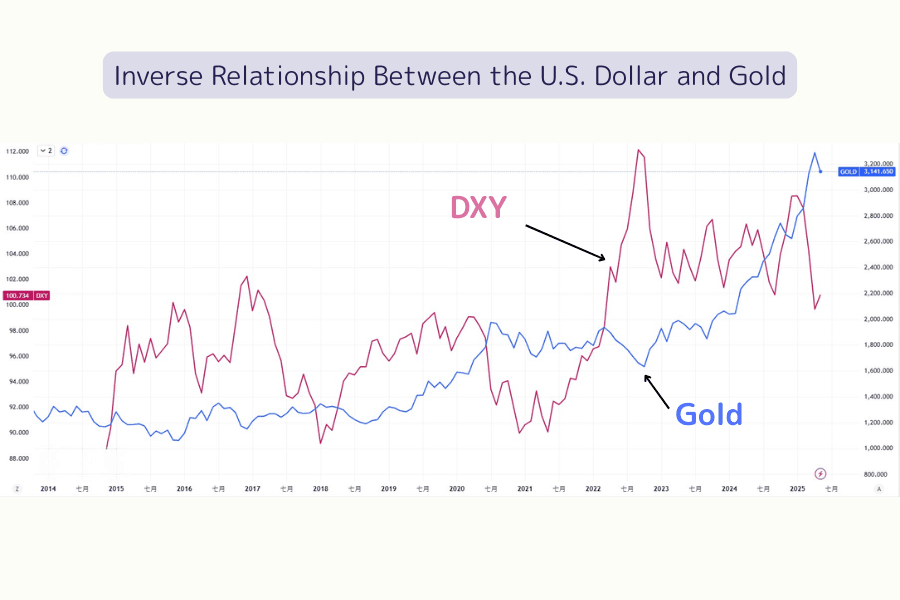
*Source: TradingView
The dollar is driven by US data (such as GDP and CPI), Fed policy, and risk appetite. Rate cuts, a widening US deficit, or rising geopolitical risk can all weaken the dollar and lift gold. Watching the US Dollar Index (DXY) and major non-dollar currencies helps you read international capital flows and shifts in gold demand.
Factor 6: Geopolitics
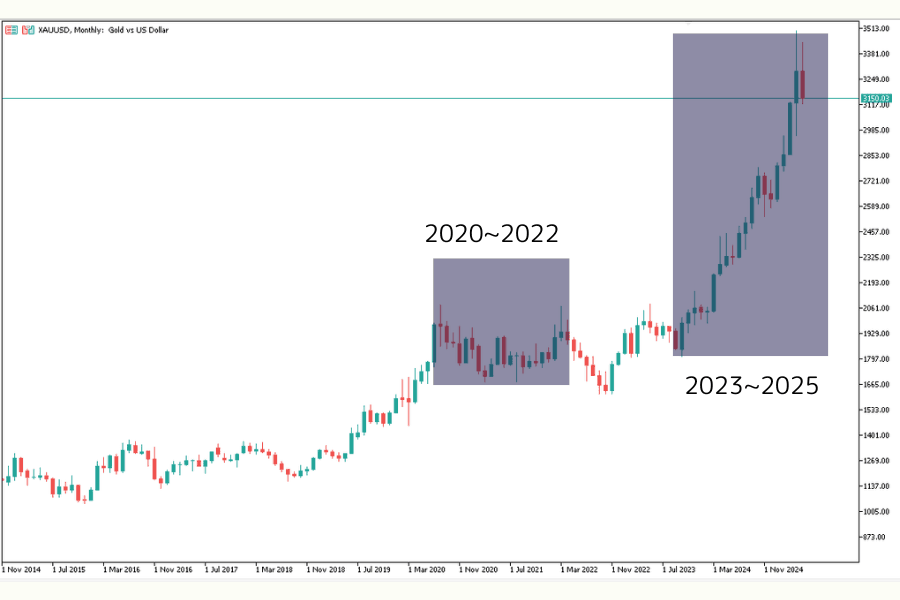
Geopolitical risk — war, trade conflict, regime change, or sanctions — often triggers market volatility and pushes capital into safe havens like gold. Because gold carries no sovereign credit risk and is not tied to any one country or system, it becomes a preferred safe harbour when crises escalate. Historically, the 2022 Russia-Ukraine war, the 2023 Israel-Hamas conflict, and rising US-China trade tension in 2025 all stoked safe-haven demand and lifted gold notably.
Factor 7: Market Sentiment
Market sentiment amplifies short-term swings in gold through speculation and expectations. When investor sentiment turns extreme — panic or over-optimism — it can trigger heavy futures buying or selling and sharp price swings, visible in surging volume and open interest. Expectations about inflation, rates, and geopolitics are also priced in ahead of time. Social-media chatter, financial headlines, and asset-allocation themes increasingly affect gold's short-term moves, and tools such as the moving average are often used to read trend and sentiment.
Factor 8: Central-Bank Reserves
Central banks' gold-reserve behaviour changes the overall supply-demand structure and is a major force on prices. In recent years, emerging-market central banks (such as China and India) have actively added gold to diversify foreign-exchange reserve risk, and according to the World Gold Council, global central-bank purchases hit record highs in 2022-2024. Conversely, coordinated European central-bank gold sales in the 1990s once weighed on prices, showing that selling can also hurt gold.
Guide to global central-bank gold reserves3. Trading Gold CFDs on Titan FX
Titan FX offers CFDs on gold, silver, and other precious metals, suited to investors who want flexibility. Account opening is fast — often within a day — at the Titan FX website.
How to register a Titan FX account| Advantage | Description |
|---|---|
| High leverage | Up to 1,000x on gold (XAU/USD), amplifying return potential. |
| Tight spreads | Competitive spreads lower trading costs. |
| Fast execution | Reduced slippage for efficient trading. |
| Advanced platforms | Supports MT4 and MT5, ideal for technical analysis. |
| Free tools | Dozens of technical-analysis tools for sharper decisions. |
| Multilingual support | Chinese, English, and Japanese customer service. |
| Education | Precious-metals tutorials and daily market analysis. |
3-1. How to Start Gold CFD Trading
Getting started with gold CFDs is simple: register a Titan FX account, complete the onboarding, deposit funds, and download MT4 or MT5 to trade gold CFDs and capture price moves.
3-2. Tools That Support Gold Trading
Titan FX offers several tools to help investors decide:
Gold-silver ratio tool:
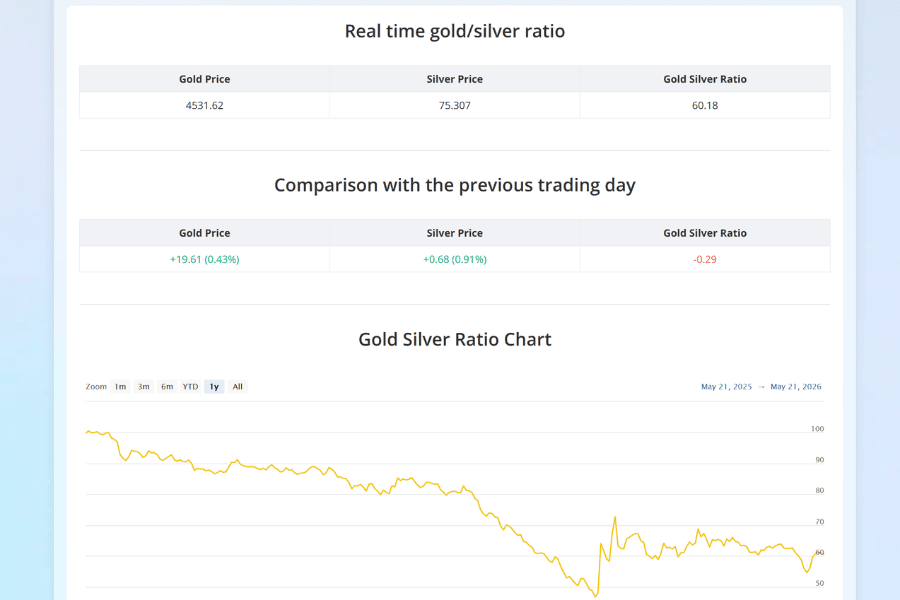
The gold-silver ratio tool compares the relative value of gold and silver, helping you spot when silver is under- or over-valued and optimise strategy.
Live international gold chart:
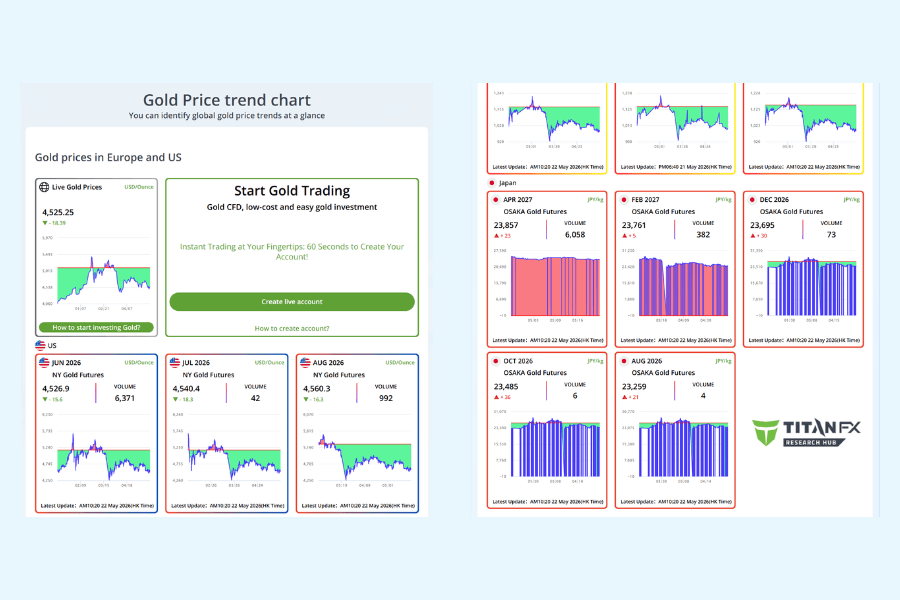
The live gold chart provides real-time prices and historical trends, which combined with indicators such as RSI and MACD help you analyse the market.
Pending orders & open-interest chart:
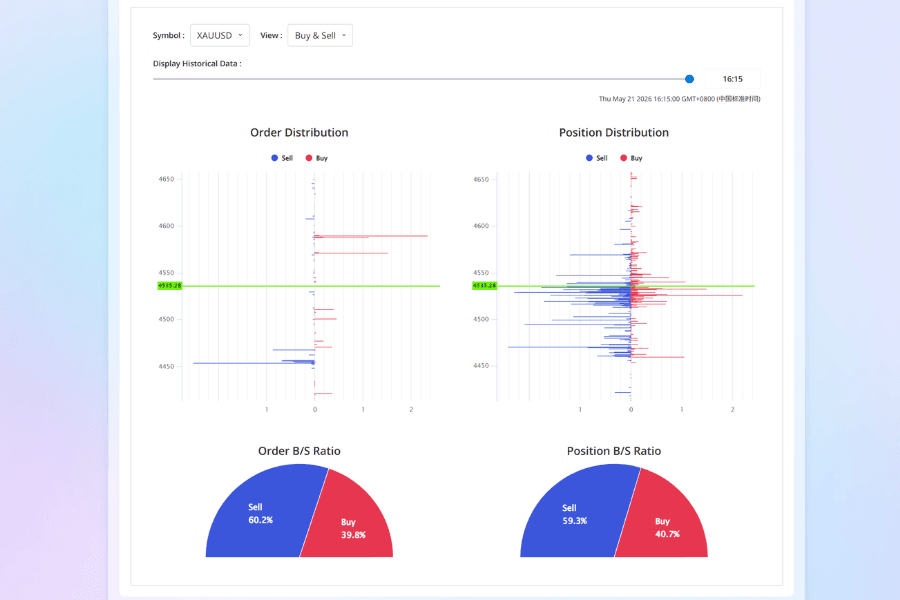
The gold (XAU/USD) orders & open-interest chart is a powerful way to read sentiment and potential support/resistance, using aggregated Titan FX client data in two parts:
Order distribution: shows resting buy and sell orders. A cluster of buy orders near a level can act as short-term support; heavy sell orders can form resistance.
Position distribution: reflects where open positions concentrate. If long positions cluster below a level, a break can trigger stops and deepen a fall — and vice versa.
These charts help traders spot potential turning points and crowd behaviour to support technical analysis and risk management.
4. Conclusion
Thanks to its safe-haven and inflation-hedging qualities, gold is an ideal portfolio holding. Its price is driven by supply, demand, inflation, monetary policy, the US dollar, geopolitics, sentiment, and central-bank reserves, so flexibility is essential.
Titan FX's gold CFDs — with high leverage, tight spreads, and professional tools such as the gold-silver ratio and live gold charts — help investors capture opportunities. With MT4/MT5 and educational resources, both beginners and professionals can build effective strategies.
Further reading: Introduction to precious-metals investing
Trade Gold CFDs with Titan FX
Titan FX offers gold CFDs (XAU/USD) with up to 1,000:1 leverage, tight spreads, and the flexibility to go long or short without holding physical gold.
5. Frequently Asked Questions (FAQ)
Q1. Why is gold considered a safe-haven asset?
Gold carries no sovereign credit risk and tends to hold value during economic or geopolitical turmoil, so capital flows to it as a safe harbour.
Q2. How does the US dollar affect the gold price?
Gold is priced in dollars, so a stronger dollar usually weighs on gold while a weaker dollar tends to lift it.
Q3. Why does inflation push gold higher?
Inflation erodes purchasing power, and when real interest rates turn negative the opportunity cost of holding gold falls, raising demand.
Q4. How can I trade gold with Titan FX?
Open a Titan FX account, deposit funds, and trade gold CFDs on MT4 or MT5 with high leverage and tight spreads.
Q5. What is the gold-silver ratio used for?
It compares the relative value of gold and silver to help spot when silver may be under- or over-valued.
Further Reading
- Gold CFD Trading
- What Drives Gold Demand
- Central-Bank Gold Reserves
- Gold-Silver Ratio
- Introduction to Precious Metals
Titan FX Trading Strategy Lab. We produce educational content for investors across forex, precious metals, energy, indices, US stocks, and crypto, covering how markets and macro forces work.
Primary Sources (by Category)
- Official & data: World Gold Council, LBMA, Investopedia
- Markets & data: TradingView, Bloomberg, and Reuters gold-market coverage