

Current Account

In global financial markets, exchange-rate moves are not random. They often reflect trade balances, income flows, policy expectations, and broader economic structure. Within that picture, the Current Account is one of the key balance-of-payments indicators for understanding a country's external position.
In simple terms, the current account compares what residents receive from the rest of the world through goods, services, income, and current transfers with what they pay out. A surplus means receipts exceed payments; a deficit means payments exceed receipts.
For FX traders, understanding the current account is more than just macro analysis — it helps identify the long-term direction of a currency and provides a grounded basis for trading decisions.
This article starts with the definition and formula, then explains the main components, the link with FX markets, and practical uses in FX and CFDs, so you can treat the data as macro context rather than a short-term signal by itself.
- What the current account records in the balance of payments
- How goods, services, primary income, and secondary income fit together
- What a current-account surplus or deficit can imply for FX
- Why traders read it alongside GDP, inflation, and rate policy
- How to use current-account data as macro context for FX and CFD trading
- 1. What Is the Current Account? Core Concept
- 2. Calculating the Current Account: Formula and Structure
- 3. Components: The Role of Goods and Services
- 4. How the Current Account Affects FX Markets
- 5. What Surplus vs Deficit Means for Investors
- 6. Summary: From Macro Data to Trading Decisions
- 7. Frequently Asked Questions (FAQ)
1. What Is the Current Account? Core Concept
The Current Account records transactions between residents and nonresidents in goods, services, primary income, and secondary income. It is one part of the balance of payments, distinct from the financial account, which records financial assets and liabilities.
A simple way to think about it is as an external income-and-payments ledger. Exports of goods and services and income received from abroad are credits; imports, income paid abroad, and current transfers are debits.
From a result standpoint:
- • Current account surplus: receipts exceed payments; the country records a net surplus.
- • Current account deficit: payments exceed receipts; the gap is usually financed elsewhere in the balance of payments.
For the FX market, this is fundamentally about the supply–demand dynamics of the currency. When export and income receipts create demand for a currency, the exchange rate can receive support. When external payments dominate, the currency can come under pressure.
So the current account is not just an economic data point — it is a key gauge for the long-term direction of a currency.
2. Calculating the Current Account: Formula and Structure
The current account is an aggregate of several flows. The most common formula is:
Current Account Formula:
Current Account = Goods Trade + Services Trade + Primary Income + Secondary Income
Broken down:
- • Goods Trade: exports minus imports (e.g., selling cars, buying oil)
- • Services Trade: cross-border services like finance, tourism, transport
- • Primary Income: investment income such as dividends and interest
- • Secondary Income: transfer payments, for example remittances
Goods and services are the most important because they directly reflect a country's trade position, service competitiveness, and external receipts or payments.
For example, a country exporting $100B and importing $80B has $20B of goods-trade inflow alone. Adding services and investment income could push the current account to a larger surplus.
Traders don't need to memorize every line item. What matters is the concept: the current account is fundamentally about whether external receipts exceed external payments, and that helps shape currency strength over time.
3. Components: The Role of Goods and Services
The current account consists of multiple flows, mainly divided into four categories:
| Item | Description |
|---|---|
| Goods Trade | Import/export of physical goods: oil, cars, electronics |
| Services Trade | Cross-border services: finance, tourism, transport |
| Primary Income | Investment-related income: dividends, interest |
| Secondary Income | Transfers without an exchange, e.g. remittances, aid |
Overall, these components shape a country's external position. For most investors, however, Goods and Services are the central drivers of FX.
Goods Trade directly affects cross-border payment demand. When a country exports, overseas buyers must exchange their currency into the exporter's, raising demand. Commodities — oil, metals, agricultural goods — often show their price changes reflected in the current account and FX rapidly.
Services Trade is typically less volatile but its share is rising in mature economies. Financial services, tech services, and tourism generate steady FX inflows that tend to offer more stable support to the currency.
Together, goods and services operate on different timescales. Commodity-price swings tend to affect short-term payment demand, while service income supports longer-term structural strength. When either changes noticeably, the current account shifts — and so does the exchange rate.
4. How the Current Account Affects FX Markets
The core logic connecting the current account to FX is currency supply and demand.
When a country runs a surplus, exports, income receipts, and current transfers received exceed imports, income payments, and transfers paid. Overseas capital must be converted into the local currency to settle, raising demand and supporting the exchange rate.
When it runs a deficit, external payments rise and the local currency is sold for foreign currency, increasing supply — which over the long term can pressure the exchange rate.
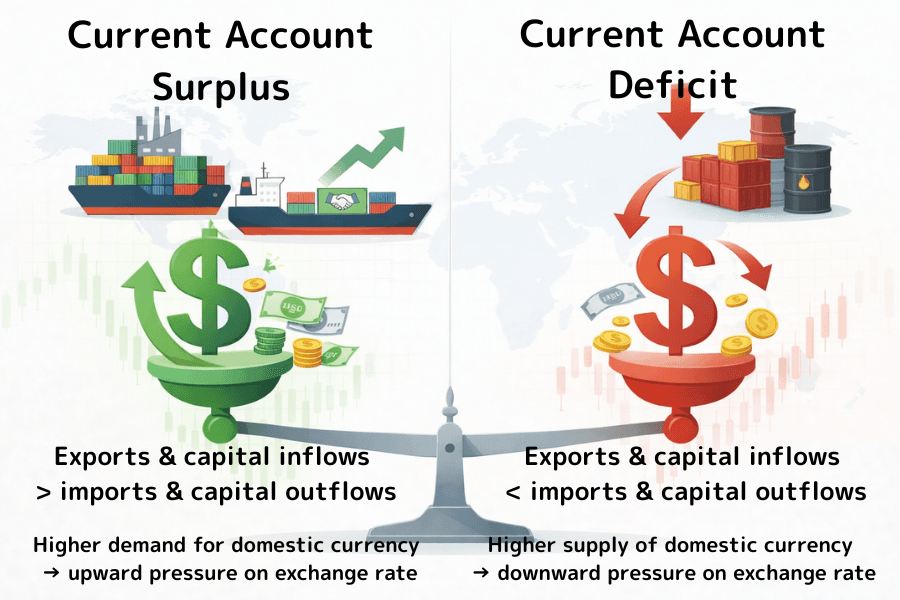
In real markets, however, the current account is not the only factor. Rate policy, capital movements, and market expectations co-influence FX. A country with a surplus can still see a weaker currency if capital keeps leaving.
For FX traders, the current account is best treated as a medium- to long-term backdrop. Sustained improvement can imply a stronger external position and more stable currency support; a widening deficit warrants caution about currency weakness.
In practice, combine the current account with rate decisions, GDP growth, and inflation to build a more complete read, rather than relying on price moves alone.
5. What Surplus vs Deficit Means for Investors
In real markets, investors care less about the absolute current account level than about its direction and trend.
A move from deficit to surplus — or a widening surplus — typically signals improving export competitiveness and stronger external receipts, supporting the currency over the medium to long term. A widening deficit often reflects deepening external dependence and raises the risk of depreciation.
Note, though, that the current account is a "slow variable," and markets tend to price expectations in advance. What often drives short-term FX is the gap between actual releases and consensus expectations.
For FX traders, use the current account as a backdrop for judging currency strength, combined with rate policy, inflation, and growth data. When a country has both a current-account surplus and rate-hike expectations, the currency typically has more room to strengthen.
Overall, the current account's value is not in the single number but in helping build a macro backdrop, which makes trading decisions more consistent.
6. Summary: From Macro Data to Trading Decisions
The current account is a core indicator linking international trade, income flows, and current transfers, reflecting a country's global competitiveness and capital position. Observing its surplus or deficit evolution tells you quickly whether external receipts exceed payments — and helps explain currency strength or weakness.
For traders, the current account's value lies in providing "trend context," not short-term signals. Sustained improvement can mean the external position is strengthening and the currency has support; a widening deficit warrants vigilance against possible depreciation pressure.
In practice, pair the current account with rate policy, inflation, and growth to form a complete macro framework. Combine that with chart structure and trading strategy to translate data into concrete entry and exit decisions.
In the long run, the single data point matters less than understanding how external receipts and payments change between economies. Once you can read capital direction through the current account, building a more consistent trading framework in FX and CFDs becomes easier.
7. Frequently Asked Questions (FAQ)
Q1: What's the difference between "current account" and "current account balance"?
They are essentially the same concept. The "current account" refers to the structure, while the "current account balance" is the actual released figure used to indicate surplus or deficit.
Q2: Does a current-account surplus always mean the currency will appreciate?
Not necessarily. A surplus implies capital inflow, but FX is also shaped by rate policy, portfolio flows, direct investment, and expectations, so it needs to be considered alongside other data.
Q3: Is the current account suitable for short-term trading?
Not really. It is a low-frequency, longer-term data series and is better used as a trend background than as a short-term trigger.
Q4: How should traders actually use the current account?
Use it as a background indicator for currency strength, combined with rates, inflation, and market expectations, to make the overall analysis more stable.
Further Reading
Titan FX Trading Strategy Research Institute
The financial market research team at Titan FX produces investor education content across a broad range of instruments, including forex (FX), commodities, stock indices, U.S. equities, and crypto assets.
Primary Sources by Category
- Balance-of-payments definitions and statistical standards: IMF Balance of Payments and International Investment Position Manual, Sixth Edition (BPM6)
- Official statistical definitions: U.S. Bureau of Economic Analysis - International Transactions and IIP Release Additional Information
- Macro data references: World Bank Data / FRED