

Equally Weighted Index
Most equity indices investors see day-to-day—the S&P 500, TOPIX, and similar—are built on capitalization weighting. There is a structurally different design that gives a very different read on the market: the equally weighted index.
This article covers the definition, calculation, characteristics, and the major equally weighted indices, plus a side-by-side comparison with capitalization weighting and price weighting for traders and investors.
- Basics: every constituent equal-weighted, reflecting the market average and small caps
- Calculation: simple average of constituent returns × base index, kept equal by rebalancing
- Strengths: avoids mega-cap dominance, surfaces small caps, can outperform in rotations
- Weaknesses: higher rebalancing cost, higher volatility, diverges from real capital flows
- Examples: S&P 500 Equal Weight Index, MSCI Equal Weighted series
1. What Is an Equally Weighted Index?
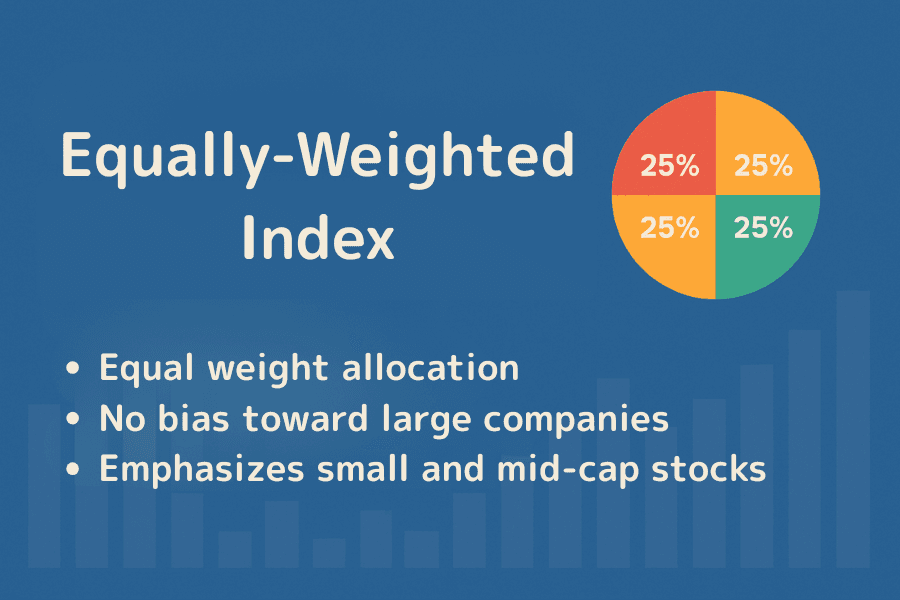
An equally weighted index is a stock index designed around a single principle: every constituent gets the same weight.
Unlike cap-weighted indices—where mega-caps dominate—equal weighting gives every name identical influence on the index. The result is an index that mirrors the average behavior of the market, with mid- and small-cap contributions visible rather than absorbed into mega-cap moves.
Key characteristics
- Uniform weighting: each company has the same influence; no single mega-cap can dominate the index path.
- Market breadth: the moves of names across the size spectrum show through, making the breadth of the rally (or selloff) visible.
- A complement to cap weighting: comparing the two reveals whether market moves are broad-based or concentrated in a few names.
The most famous example is the S&P 500 Equal Weight Index. Compared with the cap-weighted S&P 500, the equal-weighted version captures market rotation more sensitively—especially when small-caps lead or when capital spreads into a wider set of sectors.
Further reading: Stock indices explained: the basics of the headline benchmarks.
2. Calculation and Rebalancing Mechanism
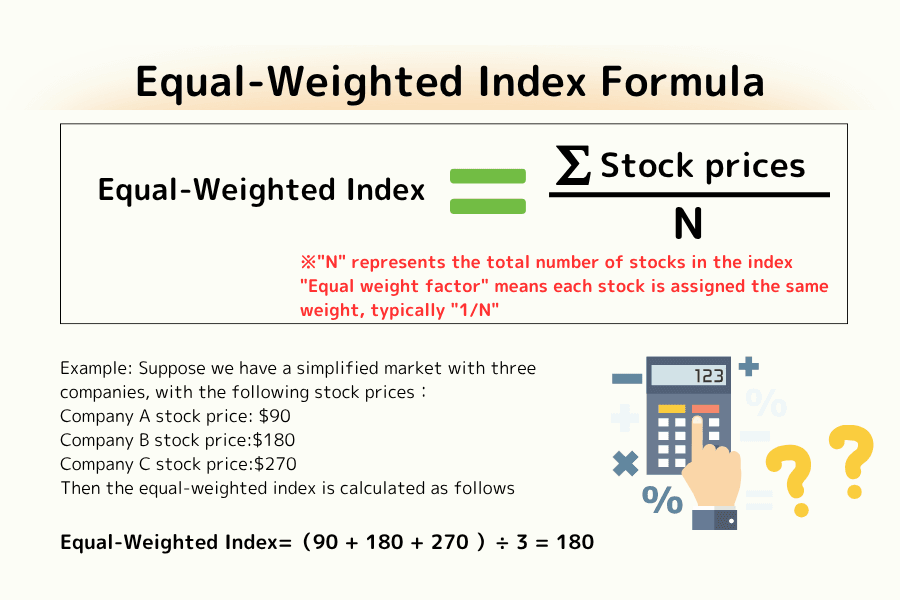
The core idea of an equally weighted index is to give every constituent the same weight. Market cap and absolute share price drop out of the calculation, and the result is a simple average of how the constituents are moving.
Base formula
Equally Weighted Index = (Average of constituent returns) × Base Index
Each small-cap constituent's price change has the same impact on the index as each mega-cap's.
Base Index
The starting reference point set when the index launches (commonly 100 or 1,000). The base index makes the index's changes easy to read without comparing the absolute share prices of different companies.
Rebalancing
As prices move, the effective weight of each constituent drifts. A stock that rallies hard becomes a larger share of the index than the others, breaking the "equal weight" principle.
To keep weights aligned, the index is rebalanced periodically (typically quarterly or semi-annually), restoring all weights back to equal.
Mechanically, rebalancing produces a natural "sell high, buy back low" effect:
- Trim the names that have run up.
- Top up the names that have lagged or fallen.
That is why equally weighted indices can outperform cap-weighted indices during clear rotation phases—especially when small caps lead a leg of the market.
Worked example
Three-stock index starting from a base of 100 points.
- Stock A: +10%
- Stock B: −5%
- Stock C: +15%
Average return = (10% − 5% + 15%) ÷ 3 = 6.67%
New index level = 100 × (1 + 6.67%) = 106.67 points
The result reflects the average performance of the three names, rather than being dragged toward whichever name has the largest capitalization.
3. Strengths and Weaknesses
Equally weighted indices are widely used as a complement to cap-weighted benchmarks. They show the "average market," highlighting mid- and small-cap contributions, with the trade-off of higher volatility and rebalancing costs.
Strengths
| Strength | Why It Matters |
|---|---|
| Avoids mega-cap dominance | Equal weighting prevents a few mega-caps from setting the index's path; the broader market shows through. |
| Surfaces mid-/small-cap contribution | Names that get drowned out under cap weighting carry equal influence here, making market breadth visible. |
| Potential excess return | The "sell high, buy back low" effect of rebalancing can outperform cap-weighting during rotation regimes. |
Weaknesses
| Weakness | Why It Matters |
|---|---|
| Higher transaction and tax costs | Periodic rebalancing means more turnover; broker fees and taxable events grow. |
| Higher volatility | Larger small-cap weighting raises sensitivity to sentiment and capital flow swings. |
| Diverges from real capital distribution | Real-world capital concentrates in mega-caps; equal weighting deliberately ignores that, so the index can diverge from where actual money is sitting. |
4. Major Equally Weighted Indices
Equally weighted indices are not the dominant investment benchmarks—cap weighting still owns that role—but they are highly useful as research and observation tools for market breadth and mid-/small-cap behavior.
S&P 500 Equal Weight Index
Maintained by S&P Dow Jones Indices. Holds the same 500 names as the S&P 500 but with equal weights—each name is roughly 0.2% of the index.
Compared with the cap-weighted S&P 500, the equal-weighted version clearly captures small-cap behavior. In early bull-market phases or periods when small caps are running, the Equal Weight version often outperforms—it has become a standard reference for tracking market rotation and structural shifts.
MSCI Equal Weighted Indexes
MSCI complements its cap-weighted global and regional indices with multiple equal-weighted variants (MSCI World Equal Weighted, and others).
By averaging out mega-cap dominance, these indices make per-country and per-sector "average contribution" easier to read, and they appear regularly in institutional research.
5. Equal Weight vs Cap Weight vs Price Weight
The weighting method shapes what an index represents and how it should be read. A side-by-side comparison of the three main approaches:
| Method | Weight basis | Strengths | Weaknesses | Representative indices |
|---|---|---|---|---|
| Equal weight | Same weight for every name | Captures average market behavior; avoids mega-cap dominance | Periodic rebalancing needed; higher trading costs; higher volatility | S&P 500 Equal Weight Index |
| Cap weight | Market cap (share price × shares outstanding) | Faithful to capital flow; the mainstream benchmark | Mega-caps dominate; small-caps drowned out | S&P 500, TOPIX, MSCI World |
| Price weight | Share price itself | Simple, historically continuous | High-priced stocks dominate; representation weakens | Dow Jones Industrial Average, Nikkei 225 |
6. Investor Perspective: How to Read It
In practice, equally weighted indices work best as a complement to cap-weighted benchmarks, giving a different angle on market structure and rotation.
Angle 1: Measure Market Breadth
The equal-weighted index reflects the average move directly, making it well-suited to tracking the overall performance of mid- and small-cap names.
If the cap-weighted index is climbing on mega-cap leadership and the equal-weighted index moves in step, the rally is broad-based—the breadth signal confirms a healthier setup.
Angle 2: Read the Gap vs Cap Weight
Cap weighting reflects mainstream capital flow; equal weighting reflects the breadth of the market. The gap between the two reveals relative small-cap vs large-cap strength and the direction of sector or capital rotation.
Angle 3: Risk-Reward Trade-Off
Equal weighting raises the small-cap allocation. Potential return is higher, but so is volatility and downside risk. Use your risk tolerance and investment horizon to decide whether equal-weight ETFs or funds belong in your diversification mix.
7. FAQ: Equally Weighted Indices
Q1. Why should I pay attention to an equally weighted index?
Cap-weighted indices can be dominated by a handful of mega-caps, which makes it easy to miss the breadth of the market. An equally weighted index reflects the average behavior, so looking at the two together makes it clear whether a rally is broad-based or concentrated. Divergence between them is itself a signal—market structure is leaning one way or the other.
Q2. Does equal weighting outperform cap weighting?
In rotations where small caps or value names lead, yes—equal weight often outperforms. But volatility and rebalancing costs are higher, so there is no guarantee equal weight wins over the long term. It works as a regime-aware tool rather than a permanent return enhancer.
Q3. What is the impact of rebalancing?
Rebalancing keeps every constituent at equal weight by selling winners and topping up laggards. Mechanically that captures market rotation, but it adds trading costs and tax events. If you're accessing equal weight via an ETF, expense ratios tend to be modestly higher than cap-weighted equivalents.
Q4. What kind of portfolio fits equal weighting?
It works best as a complement to a core-satellite portfolio. Keep a cap-weighted core (S&P 500, MSCI World, etc.) for long-term exposure, then add equal-weight ETFs in the satellite to reduce mega-cap concentration and pick up mid-/small-cap exposure. Equal weighting alone as the core is hard to defend given its volatility profile.
Q5. Are there major ETFs tracking equally weighted indices?
The canonical example is Invesco S&P 500 Equal Weight ETF (RSP)—holding S&P 500 constituents at equal weight. It's the most traditional US equal-weight vehicle. Regional and thematic equal-weight ETFs also exist for satellite allocations. Before investing, check the expense ratio, rebalancing frequency, and tax efficiency to see how the satellite slot fits with your overall portfolio.
8. Summary
Equally weighted indices rest on a simple principle: every constituent has the same impact. The result is an index that captures market breadth and mid-/small-cap momentum, avoiding the structural dominance of mega-caps—while paying a price in higher volatility and rebalancing cost.
For traders and investors, comparing equal weight with cap weight side by side gives a fuller picture of market structure and supports more balanced portfolio decisions aligned to risk tolerance.
S&P 500 Deep DiveFurther Reading
- Capitalization Weighted Index: how it works, examples, and trader use
- Stock indices explained: the basics of the headline benchmarks
- S&P 500 (US500) explained
- Rebalancing: how it works and how to use it in portfolio management
- Business cycle: the four phases and key indicators
Titan FX Research and Review Team — covering forex (FX), commodities (oil, precious metals, agricultural products), stock indices, US equities, and crypto assets, producing educational content for retail and institutional investors.
Primary Sources by Category
- Official data and regulators: S&P Dow Jones Indices Methodology (especially the Equal Weight Index Series); MSCI Equal Weighted Indexes Methodology; Tokyo Stock Exchange "TOPIX Index Series Rules".
- Market data and liquidity: Bloomberg Markets; Reuters; World Federation of Exchanges (WFE) Annual Statistics; Invesco Research (RSP ETF).
- Academic research: Plyakha, Uppal, and Vilkov, "Equal or Value Weighting? Evidence from the S&P 500"; Asness, Frazzini, and Pedersen, "Quality Minus Junk"; Burton G. Malkiel, "A Random Walk Down Wall Street".
- Industry and third-party references: Investopedia (Equal Weighted Index); Vanguard Research; Morningstar Equal Weight ETF Analysis; Titan FX Research index guides.