

VISTA

When global markets discuss emerging economies, BRICS is often the first keyword mentioned. But as some emerging markets gradually mature, attention has turned to the next group of countries with potential growth.
Against this backdrop, "VISTA" became an important concept used by financial circles and research institutions to observe emerging-market development. Unlike economies that already have scale and influence, VISTA is more of a forward-looking market observation, focused on countries with growth momentum that still face structural challenges.
For traders, the purpose of understanding VISTA is not to predict a single market's direction but to build a framework for the overall risks and opportunities of emerging markets — a reference backdrop when analysing FX and global assets.
- Definition: VISTA is the initials of Vietnam, Indonesia, South Africa, Turkey, Argentina — not a formal bloc
- Why watched: young populations, expanding domestic demand, supply-chain diversification
- Financial link: currencies sensitive to global liquidity and rates; a risk-sentiment gauge
- Vs BRICS: BRICS is established with clout; VISTA leans toward growth and transition
- Trader framing: a macro risk framework, not a short-term entry/exit basis
1. What Is VISTA? Which Countries?
VISTA is not a formal political or economic alliance but a market concept for observing the next stage of emerging-market potential. The name combines the initials of five countries seen as having medium-to-long-term growth potential: Vietnam, Indonesia, South Africa, Turkey, and Argentina.
These countries sit in different regions with differing economic structures and policy environments, but they generally share traits such as populations with room to grow, gradually expanding domestic demand, and key roles in regional supply chains.
The market groups them as VISTA not because their economies are highly mature but based on an assessment of future potential. Compared with economies like BRICS that already hold global influence, VISTA leans toward "still-developing emerging markets," where growth opportunities and structural risks coexist. So VISTA suits a reference framework for observing long-term change rather than a direct basis for judging short-term moves.
2. Why Does the Market Watch VISTA?
Attention comes mainly from a re-assessment of emerging-market growth momentum. As some large emerging economies enter a relatively mature stage, research and capital focus has begun shifting to markets that still have room and are not yet fully priced in.
A key factor is the potential change in population structure and domestic demand. VISTA countries mostly have relatively young populations, which over the long run support consumption and labour supply, giving them some growth elasticity in the global economic cycle.
Adjustments in global supply-chain layout also draw attention to some VISTA countries. As manufacturing and industrial chains diversify, some emerging markets are seen as potential regional supply-chain nodes due to location, industrial base, or labour cost.
Still, while assessing growth potential, the market broadly recognises challenges such as policy stability, inflation pressure, and reliance on external funding. So VISTA is better seen as a group of emerging markets to keep watching, not a single-direction theme.
3. VISTA and Financial Markets
From a market view, VISTA is not a single asset class but an observation set reflecting emerging-market traits as a whole. Its market impact usually shows in capital flows, risk sentiment, and volatility.
In FX, VISTA currencies are often sensitive to the global liquidity environment and rate changes. When major economies enter a policy-adjustment phase, shifts in capital flows can amplify emerging-market currency volatility.
Because these markets rely relatively heavily on external funding, price reactions tend to be more pronounced when risk appetite shifts. This makes VISTA-related markets one reference direction for observing changes in global risk sentiment.
More broadly, VISTA countries' market performance often moves with the dollar and the global rate environment. When sentiment turns conservative, funds may flow back to major currencies and safe assets; when risk appetite recovers, emerging markets may regain attention.
4. How Should Traders View VISTA?
For traders, VISTA suits a macro backdrop and risk-observation framework rather than a basis for short-term timing. This kind of emerging-market theme usually affects the market's overall attitude to risk, not a single price move.
Traders can treat VISTA as an extended gauge of emerging-market sentiment, analysed alongside the dollar's trend, global rate changes, and major economies' policy direction. This helps in understanding capital-allocation behaviour under different risk environments.
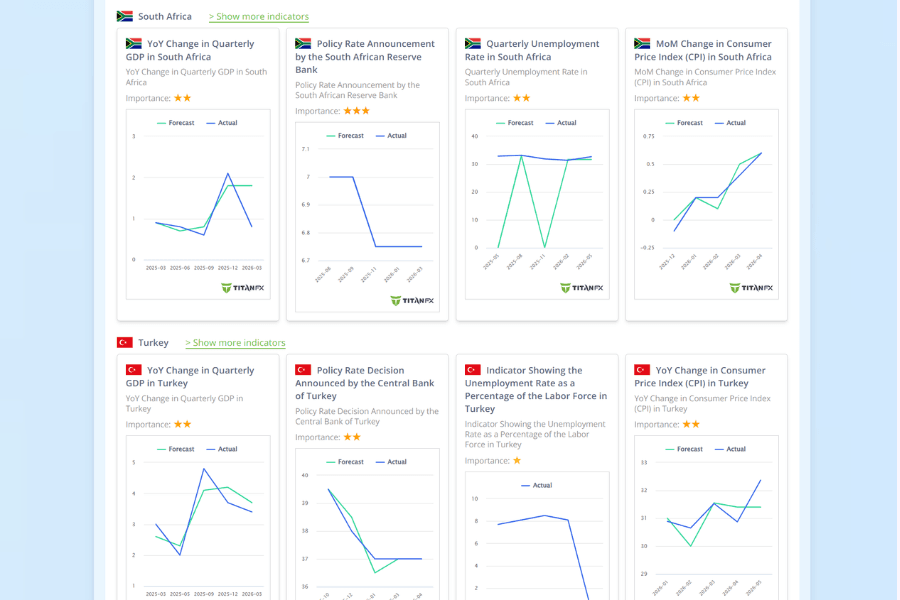
Combining emerging-market economic data in the analysis makes observation more structural. By tracking growth, inflation, and policy indicators, traders can more clearly grasp how macro changes affect sentiment and capital flows.
Related: Titan FX Research economic calendar (Emerging Indicators)
5. VISTA vs BRICS: Differences and Links
By market positioning, VISTA and BRICS are not competitive or substitutive but observation frameworks at different development stages. Most BRICS members already have scale in the global economy and financial markets, with influence in overall structure and international voice. VISTA, by contrast, focuses on economies still in growth and transition.
On maturity, BRICS members generally have larger economies and more complete financial markets, so their issues affect global markets relatively directly. VISTA countries are still developing; changes in their economic structure and policy environment affect markets more indirectly and with higher uncertainty.
Yet there are links. As the global economy moves toward multipolarity, interaction and role division among emerging markets become clearer. Some VISTA countries form complementary relationships with BRICS economies in regional supply chains, commodities, or manufacturing, so their development is not entirely independent of the existing emerging-market system.
For traders, understanding the difference helps distinguish time scales and risk layers when analysing emerging markets. BRICS reflects established structural trends; VISTA offers a lens on potential future change. Observing both together helps build a more complete framework.
6. Frequently Asked Questions (FAQ)
Q1. Which countries are in VISTA?
VISTA is the initials of Vietnam, Indonesia, South Africa, Turkey, and Argentina — a market-observation concept, not a formal political or economic alliance.
Q2. How does VISTA differ from BRICS?
Most BRICS members already have economic scale and international voice, with structural influence. VISTA focuses on economies still in growth and transition, more forward-looking and with higher uncertainty. They are frameworks at different stages, not competitors.
Q3. Can investors directly "buy VISTA"?
No. VISTA is not a single asset, index, or fund but an observation framework. To take part in related markets you must use each country's individual assets, ETFs, or related CFDs, and risk and liquidity vary widely by country.
Q4. Why are VISTA currencies more volatile?
These markets rely relatively heavily on global liquidity, rate changes, and external funding. When major economies adjust policy or risk appetite shifts, capital flows amplify their currency and asset-price volatility.
Q5. How should traders use the VISTA concept?
Treat VISTA as a macro backdrop and risk-observation framework, analysed with the dollar's trend, global rates, and major economies' policy direction — not as a direct basis for short-term entries and exits in a single market.
7. Conclusion: Could VISTA Become the Next Market Focus?
VISTA offers a forward-looking observation lens, not a concrete prediction of emerging-market moves. These countries have growth potential in economic structure and demographics but also face uncertainty from policy and external-environment changes.
For traders, the value lies in helping understand emerging markets' risk traits and the volatile behaviour they may show in different environments. Observing VISTA alongside existing emerging-market concepts like BRICS helps build a more complete analytical framework.
When following such macro themes, combining a stable trading environment with market-research resources helps in continuously tracking emerging-market change.
Further Reading
Titan FX Research Hub — investor education across foreign exchange, commodities (oil, precious metals, agriculture), stock indices, U.S. equities, and crypto assets.
Primary Sources (by category)
- Emerging-market concept: general public knowledge on emerging-market outlooks from investment banks and research institutions
- Macro and balance of payments: general public statistical concepts of GDP, inflation, and the current account
- Markets and risk: general educational material on the link between emerging-market currencies and global liquidity; Titan FX platform public information